
Random
Education for Indie Heathens
On this site, in a recent post which garnered 200+ comments, someone quoted Ezra Pound; the source, Pound’s instructional text A B C of Reading.
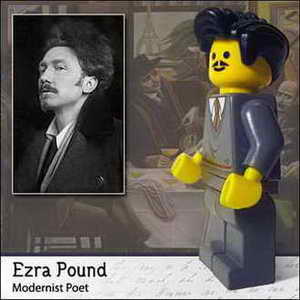
Lego my Ezra
In the book’s introduction Pound writes, “For those who might like to learn. The book is not addressed to those who have arrived at full knowledge of the subject without knowing the facts.” He goes on to describe A B C as a text-book ” ‘for pleasure as well as profit’ by those no longer in school; by those who have not been to school; or by those who in their college days suffered those things which most of my own generation suffered.”
Obviously Pound had HTML’s audience in mind.
After the jump is a passage that hasn’t aged a day since its 1934 publication.
When you start searching for ‘pure elements’ in literature you will find that literature has been created by the following classes of persons:
1. Inventors.
Men who found a new process, or whose extant work gives us the first known example of a process.2. The Masters
Men who combined a number of such processes, and who used them as well as or better than the inventors.3. The Diluters.
Men who came after the first who kinds of writer, and couldn’t do the job quite as well.4. Good Writers Without Salient Qualities.
Men who are fortunate enough to be born when the literature of any given country is in good working order, or when some particular branch of writing is ‘healthy.’For example, men who wrote sonnets in Dante’s time, men who wrote short lyrics in Shakespeare’s time or for several decades thereafter, or who wrote French and stories after Flaubert had shown them how.
5. Writers of Belles Lettres.
That is, men who didn’t really invent anything but who specialized in some particular part of writing, who couldn’t be considered as ‘great men’ or as authors who were trying to give a complete presentation of life, or of their epoch.6. The Starters of Crazes.
Until the reader knows the first two categories he will never be able ‘to see the wood for the trees.’ He may know what he ‘likes.’ He may be a ‘complete book-lover,’ with a large library of beautifully printed books, bound in the most luxurious bindings, but he will never be able to sort out what he knows or estimate the value of one book in relation to others, and he will be more confused and even less able to make up his mind about a book where a new author is ‘breaking with convention’ than to form an opinion about a book eighty or a hundred years old.
He will never understand why a specialist is annoyed with him for trotting out a second- or third-hand opinion about the merits of his favorite bad writer.
Until you have made your own survey and your own closer inspection you might at least beware and avoid accepting opinions:
1. From men who haven’t themselves produced notable work.
2. From men who have not themselves taken the risk of printing the results of their own personal inspection and survey, even if if they are seriously making one.
Tags: education, ezra pound, starters of crazes
soffi
love this sort of discussion. i’m smaashed tho.
gonna read it tomorrow.
soffi
love this sort of discussion. i’m smaashed tho.
gonna read it tomorrow.
whoops, switching computers.
whoops, switching computers.
thank you for the education. i especially liked:
Until you have made your own survey and your own closer inspection you might at least beware and avoid accepting opinions:
1. From men who haven’t themselves produced notable work.
2. From men who have not themselves taken the risk of printing the results of their own personal inspection and survey, even if if they are seriously making one.
it is my opinion that if your hair looked like ezra’s hair in that pic, that would be hott
thank you for the education. i especially liked:
Until you have made your own survey and your own closer inspection you might at least beware and avoid accepting opinions:
1. From men who haven’t themselves produced notable work.
2. From men who have not themselves taken the risk of printing the results of their own personal inspection and survey, even if if they are seriously making one.
it is my opinion that if your hair looked like ezra’s hair in that pic, that would be hott
hi barry!
i have some ideas about all this-
how are you?
hi barry!
i have some ideas about all this-
how are you?
Someone gave me a copy of this book yesterday……
READING GROUP!
Someone gave me a copy of this book yesterday……
READING GROUP!
i just pulled it off my shelf and am looking at it
ill read it now if people want to
i just pulled it off my shelf and am looking at it
ill read it now if people want to
a week late
isargentina gonnoa win?
where’s barry?
a week late
isargentina gonnoa win?
where’s barry?
pr.
whats going on baby girl.
how was the dr. good i hope.
ryan:
no need. ezra pound is a douche
pr.
whats going on baby girl.
how was the dr. good i hope.
ryan:
no need. ezra pound is a douche
are we gonna reach 200 comments on this one tonight?
are we gonna reach 200 comments on this one tonight?
bbarry!
bbarry!
i dr,pr
y
i dr,pr
y
Ezra Pound was a douche, sure, like all the rest. ABCs is still a fun read.
Ezra Pound was a douche, sure, like all the rest. ABCs is still a fun read.
nunc est bibendum, eh pr?
ryan- i think me and soffi are game if you are.
nunc est bibendum, eh pr?
ryan- i think me and soffi are game if you are.
i was just babbling. i actually like pound. i think people stopped reading the early 20th century poets and its unfortunate. william carlos williams especially. so much to learn from those guys.
i was just babbling. i actually like pound. i think people stopped reading the early 20th century poets and its unfortunate. william carlos williams especially. so much to learn from those guys.
i read this essay once, where williams and pound, both in their early 20’s, were driving around the college campuses trying to pick up college girls, they scared the shit out of them mostly. ha, that must have been a site.
i read this essay once, where williams and pound, both in their early 20’s, were driving around the college campuses trying to pick up college girls, they scared the shit out of them mostly. ha, that must have been a site.
my jury is out on pound. in fact, it’s barely started hearing the case, much less deliberating. but what attracts me to him is how he’s one of those figures everyone feels like they “know” about, without ever having read him. my knowledge of Pound is mostly derived from other stuff I’ve read about him- Barthelme’s caricature of him in The King; Elizabeth Bishop’s poem about visiting him at the mental hospital; Eliot’s dedication of the Wasteland. Time to see it for myself. So far I’m having great fun.
my jury is out on pound. in fact, it’s barely started hearing the case, much less deliberating. but what attracts me to him is how he’s one of those figures everyone feels like they “know” about, without ever having read him. my knowledge of Pound is mostly derived from other stuff I’ve read about him- Barthelme’s caricature of him in The King; Elizabeth Bishop’s poem about visiting him at the mental hospital; Eliot’s dedication of the Wasteland. Time to see it for myself. So far I’m having great fun.
ill start reading it tonight.
ill start reading it tonight.
barry, i would like to read that essay
barry, i would like to read that essay
Ha, that sounds like a great essay, Barry. Is that something from Williams’s memoir stuff? Though I like and respect Pound, I enjoy reading Williams more, definitely, prose and poetry alike. Spring and All & Kora In Hell: hella good.
Ha, that sounds like a great essay, Barry. Is that something from Williams’s memoir stuff? Though I like and respect Pound, I enjoy reading Williams more, definitely, prose and poetry alike. Spring and All & Kora In Hell: hella good.
i had the (mis)fortune of being an undergrad at a private catholic university where we were beat over the head with 1860-1960 american lit. so i got eliot and pound and williams over and over and over and over, and even more of them in grad school. i like some of what they do, images, scarcity.
i think people dont read pound because he can be dense and heavy and intimidating and no one really knows for sure what the fuck he’s saying or what the fuck he means, whether they say so or not
i had the (mis)fortune of being an undergrad at a private catholic university where we were beat over the head with 1860-1960 american lit. so i got eliot and pound and williams over and over and over and over, and even more of them in grad school. i like some of what they do, images, scarcity.
i think people dont read pound because he can be dense and heavy and intimidating and no one really knows for sure what the fuck he’s saying or what the fuck he means, whether they say so or not
i’ll email my old prof tonight and find out where it came from, but mike, i think you’re right, i think its from williams memoir
i’ll email my old prof tonight and find out where it came from, but mike, i think you’re right, i think its from williams memoir
barry-
lets talk.
this interests me as you know.
barry-
lets talk.
this interests me as you know.
pr:
how about if you just say something smart and i’ll take it in. i like your smart talk. its sexy.
pr:
how about if you just say something smart and i’ll take it in. i like your smart talk. its sexy.
In a Sation of the Metro
The apparition of these faces in the crowd;
Petals on a wet, black bough.
(not always dense and heavy!)
I dig Pound’s poetry, but his politics are insane, antisemitic, etc. Didn’t we talk about this before?
I got a steady stream of Eliot, Pound, Willams, et al. as an undergrad, and a decent dose in grad school. People (meaning grad students?) still read them.
In a Sation of the Metro
The apparition of these faces in the crowd;
Petals on a wet, black bough.
(not always dense and heavy!)
I dig Pound’s poetry, but his politics are insane, antisemitic, etc. Didn’t we talk about this before?
I got a steady stream of Eliot, Pound, Willams, et al. as an undergrad, and a decent dose in grad school. People (meaning grad students?) still read them.
of course i dont mean students and lit nerds
of course i dont mean students and lit nerds
even that poem though matt, i think 90 percent of folks outside of the lit world who read that (and even folks in it) would go…what the fuck is he talking about
even that poem though matt, i think 90 percent of folks outside of the lit world who read that (and even folks in it) would go…what the fuck is he talking about
Yeah, and if I remember correctly (it was a long time ago), to really ‘get’ the poem, or Pound, took some reading.
Yeah, and if I remember correctly (it was a long time ago), to really ‘get’ the poem, or Pound, took some reading.
yeah like the sestina alforte.. i love the language but i have no fucking idea what he means half the time.
yeah like the sestina alforte.. i love the language but i have no fucking idea what he means half the time.
where is pr. she promised commentary and then bailed. i need her wisdom.
where is pr. she promised commentary and then bailed. i need her wisdom.
I will give some one my copy of ABC’s of Reading if they want it . I haven’t touched it in a few years.
The metre stuff is good. He had some funny lines in there too. Specifically how he describes avoiding reading other authors to mitigate subconscious influence on one own’s writing except for Jane Austen. There is no worry for influence because her writing is so bland.
I chuckled at that.
I will give some one my copy of ABC’s of Reading if they want it . I haven’t touched it in a few years.
The metre stuff is good. He had some funny lines in there too. Specifically how he describes avoiding reading other authors to mitigate subconscious influence on one own’s writing except for Jane Austen. There is no worry for influence because her writing is so bland.
I chuckled at that.
barry,
i concur on WCW. Pound I’m not a fan of. He’s more interested in jerking his ego than writing anything interesting (at least to me).
bukowski idolized him. i never understood that.
barry,
i concur on WCW. Pound I’m not a fan of. He’s more interested in jerking his ego than writing anything interesting (at least to me).
bukowski idolized him. i never understood that.
Maybe Bukowski found something enviable about Pound’s ur-male qualities/ego. Or misanthropy.
Bukzie also reveres a lot of Classical stuff for that sake of having an Ideal, right? Like the world’s gone to shit versus pillars of the Classic, Non-Shitty world vision, etc.
John Gardner wrote some really true and unblinking stuff about this kind of attitude in one of his books. Maybe I will do a John Gardner post and it will garner a lot of anti-whatever shittalking.
I feel like Buk Buk is not like this as much in his later poetry, tho. I like his later poetry a lot. It reminds me of suburban gangsta rap or something. His Apple II and his lawn are his bling, his “fuck y’all, all y’all, I’m risen up” kind of stance. And it’s kind of confused, kind of frantic in its bravado. Kowski is better at this than most, I think, softer and more honest.
Pound is also really “tough.” There is a “tough guy” quality to the Modernist stance: look at my dense surfaces, my endless cross-language jumps and my infinite allusions. You won’t ever “get me,” motherfucker. You won’t ever beat me. I’m tough. My brain is made of a steel baseball bat.
It seems that is not so far from other postures of masculinity.
Or maybe the Buketter just liked that hair, yo.
Maybe Bukowski found something enviable about Pound’s ur-male qualities/ego. Or misanthropy.
Bukzie also reveres a lot of Classical stuff for that sake of having an Ideal, right? Like the world’s gone to shit versus pillars of the Classic, Non-Shitty world vision, etc.
John Gardner wrote some really true and unblinking stuff about this kind of attitude in one of his books. Maybe I will do a John Gardner post and it will garner a lot of anti-whatever shittalking.
I feel like Buk Buk is not like this as much in his later poetry, tho. I like his later poetry a lot. It reminds me of suburban gangsta rap or something. His Apple II and his lawn are his bling, his “fuck y’all, all y’all, I’m risen up” kind of stance. And it’s kind of confused, kind of frantic in its bravado. Kowski is better at this than most, I think, softer and more honest.
Pound is also really “tough.” There is a “tough guy” quality to the Modernist stance: look at my dense surfaces, my endless cross-language jumps and my infinite allusions. You won’t ever “get me,” motherfucker. You won’t ever beat me. I’m tough. My brain is made of a steel baseball bat.
It seems that is not so far from other postures of masculinity.
Or maybe the Buketter just liked that hair, yo.
do the john gardner post.
do the john gardner post.
mike:
i like this alot
“Pound is also really “tough.” There is a “tough guy” quality to the Modernist stance: look at my dense surfaces, my endless cross-language jumps and my infinite allusions. You won’t ever “get me,” motherfucker. You won’t ever beat me. I’m tough. My brain is made of a steel baseball bat.”
and the suburban gangsta rap. very cool.
i got the email back from the prof and you were right, its in the wcw memoir.
mike:
i like this alot
“Pound is also really “tough.” There is a “tough guy” quality to the Modernist stance: look at my dense surfaces, my endless cross-language jumps and my infinite allusions. You won’t ever “get me,” motherfucker. You won’t ever beat me. I’m tough. My brain is made of a steel baseball bat.”
and the suburban gangsta rap. very cool.
i got the email back from the prof and you were right, its in the wcw memoir.