
How I wrote my latest novel, part 2
Last week, I documented how I came up with the initial idea for my latest novel—“Lisa & Charlie & Mark & Suzi & Monica & Tyrell,” which I was then calling “The Porn Novel”—and how I simultaneously began exploring that idea and laying out some basic formal parameters. I also provided a general overview of my general writing process. Today I’ll cover how I finished this initial exploratory period and settled into a stronger sense of the project as whole. Again, my hope is that these posts will prove useful to other writers, and interesting to everyone on God’s green earth. Because I remember very clearly that, during the decade I spent writing my first novel, Giant Slugs, I often felt frustrated and confused. And while every writer must figure ultimately things out for her or himself, some of my strategies and methods might prove theft-worthy—or at least provide a good laugh.
So I’d gotten to the point where I’d translated the original idea (“a pornographic novel that doesn’t contain any sex”) into a more specific approach: six chapters featuring six friends meeting up for six meals. I knew that each chapter was going to be long, to make the absence of salacious material more palpable. And I’d whipped up some character names, and sketched out a list of potential meals.
I also tried estimating how long each chapter would have to be. I decided that, in order to convey the proper feel, the first five chapters should be at least 20 pages each, and that the final chapter (the group dinner) should be longer—at least 30 pages. That added up to 130 pages minimum, which felt like the shortest the project could be. I translated that into word counts, since I think better that way (for one thing, I always single-space my manuscripts, since years of teaching/grading, not to mention taking writing workshops, have led me to despise the look of double-spaced manuscripts). I had a sense that the project would be dialogue-heavy and not contain any long paragraphs, running maybe 250 words/page. Hence, the projected numbers worked out to 5000+ words apiece for chapters 1–5, and 7500+ words for chapter 6. These were just targets, of course, but having a rough idea of what I’m aiming at helps me pace myself, and estimate how long the writing will take.
I also started my writing journal. I use Excel for this and it’s nothing extravagant; I just note each time that I work, and jot down a few words as to what I did. I also track the word counts as they change (using blue for increases and red for decreases). And while this habit of mine is probably the sign of a diseased mind, it helps keep me motivated, encouraging me to “log in” every day, and stick to my routine. It’s not unlike tracking my workout routines, or the movies that I watch. Plus it yields data I can later analyze, which is the only thing that sustains me through the long cold Chicago winter. (Dear NSA, I hear you had an opening recently? Call me!)
Now before you think me entirely insane, consider this. I have a simple litmus test for what enters/exits my writing routine: is it fun? I write a lot, and want to enjoy it, and make it something I look forward to doing. As such, I’m always looking for little ways to reward myself, and to make the situation more pleasant / less stressful.
For example: when I was younger and writing only fitfully, I mostly wrote late at night, even though I never had much success doing that. Writing was something I did after stressing out about it all day, feeling guilty about not having gotten any work done. After a decade or more of that, I switched to writing in the morning—and, believe me, I did not think I was a morning person at that time. But I started living with a yoga instructor who taught early morning classes. So I started getting up at 5 AM and, amazingly, I discovered that I was much more productive and happier when I wrote then. (I also realized that predawn is my favorite time of day.) That experience taught me to examine the rest of my writing routine, and to try making it more enjoyable overall. So my Excel files are in some sense silly, yes—but they are my only friends, and I name them, and I love them.
Here’s a snapshot of the journal that I made:
The difference between a concept & a constraint, part 2: What is a constraint?
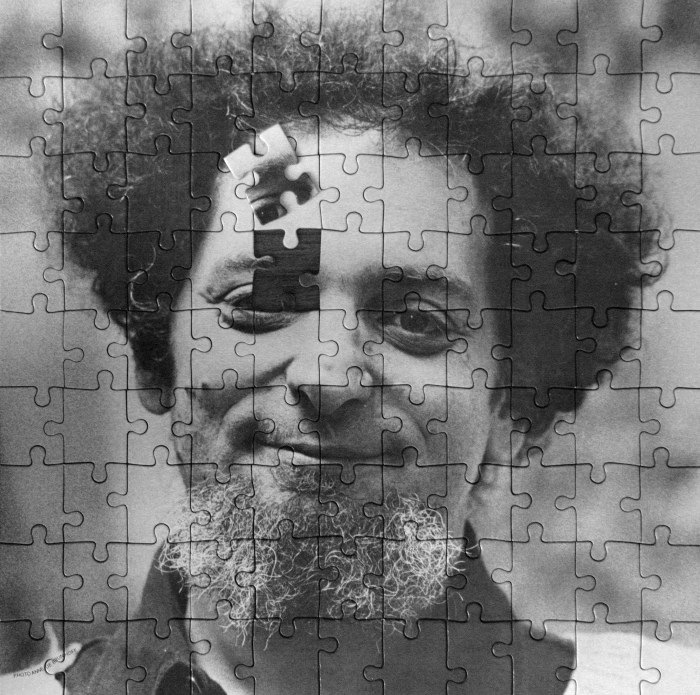
OK, back to this. In Part 1, I traced out how in conceptual art, the concept lies outside whatever artwork is produced—how, strictly speaking, the concept itself is the artwork, and whatever thingamabob the artist then uses the concept to go on to make (if anything) counts more as a record or a product of the originating concept. (This is according to the teachings of Sol LeWitt, as practiced by Kenneth Goldsmith.) Thus, we arrived at the following formulation:
- Artist > Concept > Artwork (Record)
Now, I’m not going to argue that every conceptual artist on Planet Earth works according to this model. But LeWitt’s prescription has proven influential, and continues to be revolutionary—because choosing to work with either a concept or a constraint will lead an artist down one of two very different paths. To see how this is the case, let’s try defining what a constraint is, aided by the Puzzle Master himself, Georges Perec . . .
The Higgs-Jameson Experimental Fiction Debate, part 1
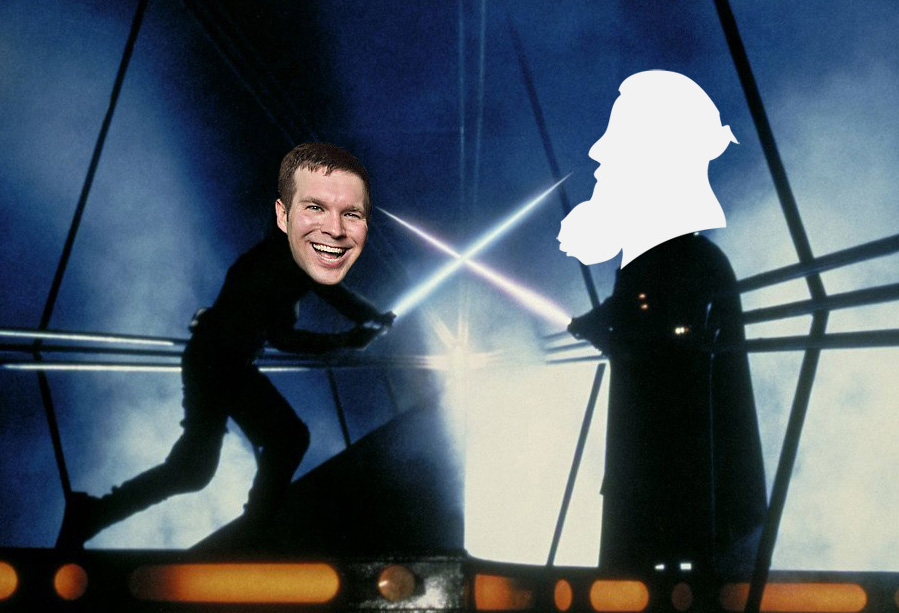
A D Skywalker vs. Darth Higgs
Adam: Last weekend, playing a stray note on my recorder summoned a cyclone that whirled me away to the swamps of Tallahassee. There I impinged on Christopher Higgs and his wife, who lodged me in their spacious Rococo flat (refurbished from a gator-packing warehouse). Over dinner, Chris and I had numerous opportunities to discuss—and to disagree about—the nature of experimental fiction…
A D JAMESON [leaning back from his seventh helping of tiramisu]: At the risk of spoiling such a fine meal, perhaps you and I can finally figure out why we’ve butted been butting heads regarding the nature of experimental fiction.
CHRISTOPHER HIGGS: OK.
ADJ: Let’s start by each defining what we think experimental fiction is!