Impossible Mike

http://topologyoftheimpossible.com
refuse reality, live forever.

http://topologyoftheimpossible.com
refuse reality, live forever.
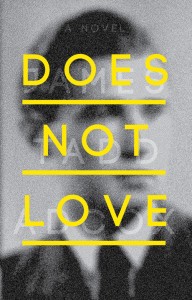 Does Not Love
by James Tadd Adcox
Curbside Splendor Press, 2014
275 Pages / $14.95 Buy from Curbside Splendor
I recently married someone. We drove to Vegas to get married. This is to say, we drove together through the desert.
We drove together through the desert to a city filled with neon signs, designed to distract from the fact that on all sides, the city’s surrounded by emptiness.
We drove together through the desert, and we got into an argument. I don’t remember what started it, but I remember driving down the strip at 1am, me squinting and crying, him slamming his fist on the wheel.
I looked at him and thought, how did this even start? He looked at me and said something that made the fight feel finished.
I felt an overwhelming warmth. I thought, this is the man that I love and the man I am going to marry. We’re staying together through strangeness, and that is what matters.
I also felt an overwhelming corresponding chill. I thought, he could have left me. I too could have left, in a burst of adrenaline.
We could have left each other standing in each other’s emptiness. Instead, we stayed together in the desert.
Every marriage is built of moments where two people stayed, but could have left. And all the moments in between. And all the emptiness between them.
*
James Tadd Adcox’s novel Does Not Love is a beautiful compendium of these moments within the fictional marriage of Robert and Viola. It is a study of ways that the couple makes meaning—and, trying and failing—attempts to make something. Appropriately, Adcox sets the novel within an alternate reality Indianapolis—a city which, to me, has always felt like something akin to a giant parking lot. Robert and Viola live in a blank space where people put new things. I feel that Does Not Love is about their unease with this space, and what they do to live with that unease.
READ MORE >
I’m very happy with my decision to maintain that silence even while working in the publishing industry. I know a lot of people say that networking is as important for writers as it is for anyone else, but I think that’s crap. Writing should stand on its own. Period. I’d hate for friendship to muddy the waters of a publisher’s decision to take on my work, even if — especially if — that muddying effect were to work in my favour.”
—Jason Hrivnak in conversation with Beth Follett, 2009
Hrivnak has written a single book, The Plight House, which came out in 2009. It’s one of my favorites. There is hardly any presence of him on the internet. The quote above pushes an idea that I think is true, and wish that everyone could realize it. It’s taken me five years, and sometimes I still doubt its veracity.
Ideally, I’d like to be invisible to my imagined audience. Yes, we live in a world where it’s important for the writer to take part in the publicity effort, but I think that The Plight House (and other books like it) work best when the author remains somewhat faceless. In terms of the work itself, I’m reasonably satisfied by the extent to which my desire to disappear has soaked down into the deepest levels of the book. Yes, much of the story is very personal, but that material is so intermixed with pure invention that even readers who know me well won’t be able to “find” me there. I’m not invisible, but I’m next-best-thing-to-invisible.
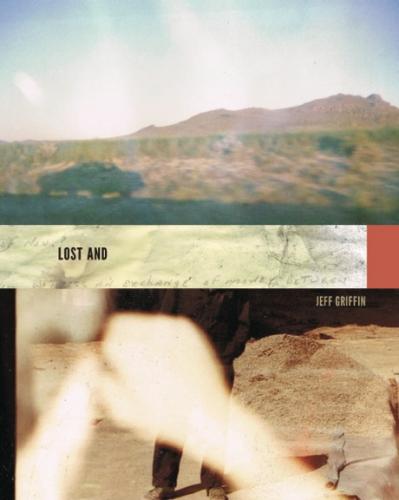 Lost And
by Jeff Griffin
University of Iowa Press, October 2013
174 pages, Buy from Amazon
I’ve been a big fan of Jeff Griffin’s work since he added me on facebook, years ago when I lived in DeKalb, IL and still had an account. I published an excerpt of Luxury Arcana, a collaborative work that Griffin produced with his compatriots Jerimee Bloemeke and Henry Fitch, in an early issue of LIES/ISLE. I became a dedicated fan of Human 500, Griffin & Bloemeke & Finch’s press, purchasing everything they put out.
One of my favorite books that Human 500 put out was There’s Never Been a Day That Didn’t Require Knives Like These (which you can hear Jeff talk about here), which is ostensibly an early version of the beautiful book LOST AND. I read it hung over after I had missed the train leaving Chicago taking me back closer to the shithole of DeKalb, IL which I called home at the time. In the state of being hung over the book carried a heavy affect that resounded through my aching bloodstream. I was astounded by the, perhaps let’s say, purity, or maybe even authenticity (though as a friend once said, “Nobody cares about authenticity other than Lorde”) that carried the tone of the assemblage. Thick for a chapbook, but totally comprehensive.
 The Weaklings XL
by Dennis Cooper
Sententia Books, 2013
84 pages / $12.95 buy from Sententia Books or Amazon
1. Dennis Cooper’s The Weaklings XL repeatedly interrogates three unknowables: the body, desire, and language.
2. Language is eternally indefinite: “You’re the / one who fired a gun at his head, so high / on whatever, and so depressed by my / lack of whatever that you were afraid you / might have otherwise not hit the target, / wherever I was at the time.”
3. We can never truly know our own bodies, the insides, the way they function. Because of this, one might assume the only way we can ever truly know the idea of a body is through exploration of the body of another. This is akin to Blanchot’s conception of death: we can never know our own death, we can only know the death of another.
4. Desire is impossible to ever know, to ever understand, to ever achieve in the sense of a totality. Cooper’s poems show how parts of desire can be hinted at in physical altercations, but desire is always immaterial and, thusly, can never be adequately incorporated into an experience.
5. In a suite titled “BOYS2BRELOCATED,” a selection of invented “personal ads” by under-age gay (or not gay, because it doesn’t really matter) men/boys soliciting sex, 666HEAVYMETAL666, 17 years old, posts the following: “DO YOU REALLY GIVE A CRAP? I’M SCARRED OK.” The suite presents a context in which misspelling echoes the reality of the quick-typing mode of the internet, where the reader can imagine these personal ads would be found. However, in a bizarre semantic twist, the context of the typo allows a double reading of the message: “SCARRED” can either be read as it is typed, as “scarred,” as in wounded, damaged or affected, or it could be taken as a misspelling of “scared,” as in frightened, terrified. This dynamic back-and-forth is all the context any of the personal ads need.
6. Before recent years Dennis Cooper was mostly known as a transgressive writer who was obsessed with writing about the sexual murders of young boys. This is his content. The success of his writing is dependent upon this obsession: it’s not literal (as in, I don’t think the claim could be made that Dennis Cooper the person is interested in murdering a young boy in a sexual context), but it’s the guiding force of the work. It’s a metonymic mode that allows a total and occasionally exhausting exploration of the indefinite nature of language, desire, and the body.
7. Somehow in recent years the content of Cooper’s work has been “white-washed” and the focus has turned onto his ability to construct sentences. Dennis Cooper is a brilliant prose stylist, and at the level of the sentence is work is amazing. This is demonstrated throughout all his work, I think; the poems here, all of the novels, his work in theater. However, I think ignoring the obsessive thematics of the work is doing the work a disservice. It strikes me as a sort of intellectualization that would position the work as some sort of purely intellectual art. Cooper is a brilliant writer who demonstrates remarkable intellect, but I think to read the sentences while ignoring the content would be a futile gesture. Language and the body, language and desire, these things are all linked.
8. Bernard Noël’s early career as a poet consisted of works that interrogated the relation of language to the body. This often resulted in the work carrying on into dark places. As a poet, I think Noël’s work is far stronger in its interrogation of the body/language divide, and much more accomplished. However, nobody reads Bernard Noël, especially not American audiences, as very little of the early poetry is available in English, and what is available is in no way easy to come by. In opposition, however, Cooper’s novels are far more accomplished than Noël’s single ‘straight-forward’ novel, The Castle of Communion.
9. Cooper’s poetry, while less formally/visually interesting or experimental than his novels, strips the words to the core of the problem that is often present in the novels: how can one mete language with desire, with the body.
10. In the annals of juvenile “trying to out-gross” one another, I remember hearing a “joke.”
“What’s the best thing about having sex with a twelve year old girl in the shower?”
“…”
“Slick her hair back and she looks like an eight year old boy.”
 The Cage
By Martin Vaughn-James
Coach House Books, November 2013
192 pages / Buy from Coach House Books
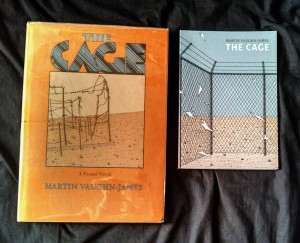
In November of this year, Coach House Books released a new edition of their seminal 1975 graphic work, Martin Vaughn-James’s The Cage. When I found this out, I was astounded. I’d been singing the praises of The Cage for years, recognizing it not only as one of the most important (and accomplished) work of graphic fiction ever created, but also insisting upon it being one of the greatest books every produced. Upon its initial publication, there were only 1500 printed copies; beautiful over-sized hardbacks with heavy brown paper inside. The book is a monolith, an object. Just the visual presence matches the title: The Cage, the book, the volume, holds something inside, much as a cage does.
I discovered the book from Richard Kostelanetz’s Dictionary of The Avant-Gardes, a resource that I read from cover to cover, taking note, over the course of the several months I spent reading it, on everything I wanted to learn more about, to discover. And then I spent several months following up on everything I had noted, often not remembering anything about why I had noted a book title or an artist’s name down. I worked in a library at the time, so I would just request anything from Inter-Library-Loan that we didn’t have on our shelves. It was through this process that Martin Vaughn-James’s book came into my life.
I took it home from work and blew through it, realizing that it was doing something heavy, something that I had long wanted the comic form to do, to work with narratives in ways similar to, say, Alain Robbe-Grillet or concrete poets had done, but to make use both of words & images, sequencing and panel development: to open up the tools available to a visual artist who also has a poetic bent. The book accomplishes so much, and I soon became obsessed. I read the book several times while I had it, and then checked it out several more times throughout the year. I desperately wanted to photocopy it (as copies available online were far too expensive) so I could always have it with me, but the book was too big to reasonably photocopy into a facsimile-ish form. I tacked down the three other primarily graphic works from Vaughn-James, again through inter-library loan, and marveled at their contents, but knew that The Cage was his masterpiece. Eventually a copy popped up on the internet for a prize I could sort of afford, so I jumped at it and the book joined my possessions.
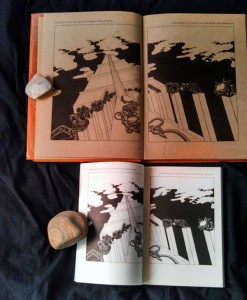
To publish this book again in 2013 strikes me as no inconsiderable feat–while comics have certainly gained a larger presence as a “true literary form” (or whatever) by now, most of the dreck that people applaud is, of course, parallel to the novel, “realistic,” though told with pictures in addition to dialog. The Cage takes the height of the 70’s delirious experimentation with form and content, and pushes it into something that, even now, speaks as something new.
As such, I’m pleased to now revisit the work, in two parts. First I will comment upon the initial 1975 release, that is virtually impossible to come by outside of the library at this point, and second, I will consider the reprint, which offers both new front-matter & back-matter, as well as a formally different content, comparing and contrasting the two.
A Note: All photos included in this post were taken on my cellphone and do not necessarily reflect either the colors or the image quality of the printed books themselves
 Villa Bunker
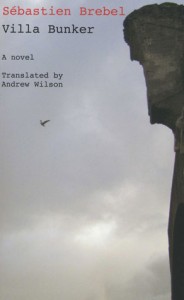
by Sébastien Brebel
Dalkey Archive, July 1st 2013
102 Pages / $14.00 Buy from Amazon
The copy of Villa Bunker, offered both on the Dalkey Archive website and the back of the book itself, presents the narrative contained within as follows:
This piqued my interest, as someone, purely on a level of narrative and story, finds himself remarkably interested in labyrinthine houses. A blurb for the book, from Fabrice Lardreau, calls the book “an unexpected cross between Danielewski’s House of Leaves and Robbe-Grillet’s geometric and obsessional universe in Jealousy.” Between the copy and this blurb, I was convinced I wanted, if not needed to read it. Besides, as someone who is perpetually interested in French fiction, I’m always curious to read more of the contemporary authors that clearly work in a lineage descended from my favorites, like the new-novelists & the post-Tel Quel novelists.
Reading the novel, I found myself more than satisfied, though perhaps not in the way I had expected. There is a shifting spatial element to the villa, recorded by the mother in her letters to her absent son, that certainly recalls the inner-narrative of “The Navidson Record” found in Danielewski’s tomb. There is, also, an almost fetishistic level of attention, at time, to minutiae, that certainly recalls Robbe-Grillet. But overall, the extent of these comparisons end at a surface level, leaving the very strange text to move like an abject music score—though not through any formal techniques, but rather through the construction of the narrative itself.
READ MORE >

 The Young Girl’s Handbook of Good Manners for Use in Educational Establishments
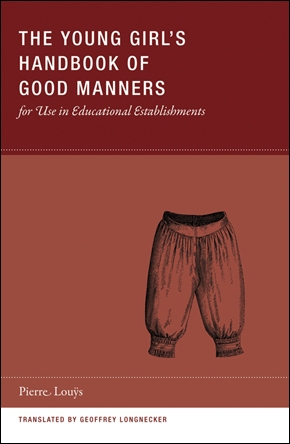
by Pierre Louÿs, translated by Geoffrey Longnecker
Wakefield Press, March 2010
80 pp. / $12.95 Buy from Wakefield Press
The first time I ever heard of Pierre Louÿs was when I read Susan Sontag’s essay, “The Pornographic Imagination.” In it, among other things, she posits five works of literature that bridge the gap between pornography & erotic, expanding into very Literary territory. Louÿs’s book was the only I hadn’t read. I tracked it down–it’s title The She-Devils–and was sorely disappointed in the translation. Despite this, I had still enjoyed the narrative, and filed the name in the back of my head to keep at bay in my never-ending path through erotic literature.
Years later, Louÿs’s name came up again–but this time as a correspondent of Mallarmé. It might strike some as strange that Mallarmé–who has probably garnered as many stuffy academic essays as God himself (though I prefer the former far more than the latter, let it be said)–chafed elbows, so to speak, with a man whose primary literary concerns were pedophilia, scatology, and whores. Louÿs was a part of the vaguely shaped Symbolist movement in France as the 19th century slipped into the 20th, immediately following the Fin de Siecle ‘movement’ that had shown artists and writers that certain ideas were now available subjects. Baudelaire was a major influence on the symbolists, as was Edgar Allen Poe.
Louÿs is most often considered a novelist, but the brilliant Young Girl’s Handbook of Good Manners instead takes the form of a satirical handbook–lampooning school guides to “good manners” and instead positing sixty pages of sexual advice, tongue planted firmly in cheek. It could perhaps be considered that this could become, shall we say, boring, or perhaps overdone, but Louÿs is a master parodist, in addition to being a damn good writer, so the laughs just keep coming.
I’m not one for humor unless it’s delivered via a sort of combination of hyperbole, absurdity, and base-ness, which the Handbook delivers in spades. The aphoristic fragments are all structured under headings, such as “Games and Recreations” (“Never masturbate a young man by the window. You never know on whom it might fall.”), “At the Ball” (“If you cum while waltzing, say so softly; don’t shout it out.”), and even a special column, “On Losing Your Virginity.”
There is no narrative thread, only a bawdy romp to be followed, with aphorism after aphorism delving into a perversely juvenile mind. There’s a total jouissance present in many of the acts which Louÿs implores ones not to do, and this set-up provides the idea that young girls are performing these acts with regularity (and who knows–perhaps they are; I was never a young girl).
– – – – – – – – – – – – –
Former WAKEFIELD PRESS reviews:
TREATISE ON ELEGANT LIVING by Honoré de Balzac
 THE STRANGE TALE OF PANORAMA ISLAND
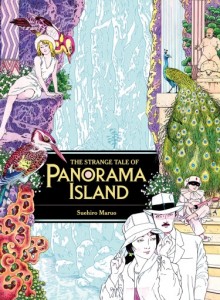
by Suehiro Maruo
Last Gasp, 2013
274 Pages / $24.95 Buy from Last Gasp
I first encountered Suehiro Maruo via the hyper-violent/erotic, aka “ero-guro” collection that Creation Books put out in 2001, ULTRA-GASH INFERNO. It’s a slim volume of short manga narratives, all focused on some sort of extremity. Despite the subject matter, Maruo carried a sense of poetry through the excess, and the resulting combination brought about similar feelings to that which I had first experienced reading the fiction that set me down my life’s trajectory, fiction such as Bataille’s Story of the Eye or Bernard Noel’s Castle of Communion. I became a dedicated fan.
Next encounter–the only other book of Maruo’s available in translation at the time–was Mr. Arashi’s Amazing Freak Show. A more developed narrative (developed in the sense that it is a book-length narrative, instead of only giving itself a few pages to breathe). It rooted itself in the earlier parts of the 20th century, which allows a certain suspension of disbelief necessary to the development of the plotting (which eventually goes off the deep end regardless).
Now, a number of years later–and after a significant waiting period between the announcement of publication and the actual publication of the book (which, I should note, should not be considered a fault)–Maruo’s most developed single-volume narrative yet has become available in English– The Strange Tale of Panorama island.
READ MORE >
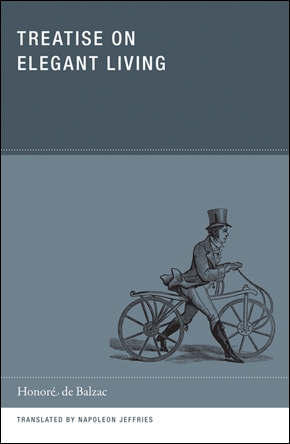 Treatise on Elegant Living
by Honoré de Balzac, Translated by Napoleon Jeffries
Wakefield Press, March 2010
112 pp. / $12.95 Buy from Wakefield Press
Wakefield Press describes themselves, on their website, as “an independent American publisher devoted to the translation of overlooked gems and literary oddities in small, affordable, yet elegant paperback editions.” The fact that they are a publisher dedicated specifically to translated “buried” texts, so to speak, has kept them on my horizon since their launch in 2010. As the press has developed, they’ve continued to release incredibly interesting (and, as is their goal, elegant) books by many authors and writers that populate the literary landscape that I prefer to frequent. Paul Scheerbart, who I learned of as a devotée to “glass architecture” in my readings on the architecture of the fantastique, has had two books released by the press, many (often absent) key players of French literature have books on the press (Marcel Schwob, Georges Perec & Rene Daumal to name a few), and even the authors I hadn’t formerly heard of seem tailored to my taste. As such, I thought it would be a brilliantly rewarding project to review every title the press has released.
Earlier in the year I reviewed their release of Rene Daumal’s Pataphysical Essays, and my enjoyment of everything about the book (from its content to its translation to the materiality of the book itself) lead me to consider the project. I had encountered the concept of reviewing an entire press’s output before, I think initially in JA Tyler’s review of Calamari Press’s output on BigOther. While I love Calamari press, their output spans, at this point, much wider than Wakefield Press, whose number of titles seemed both manageable and limited enough that I would enjoy the entire project. I had no interest in launching into the project & losing steam half-way through, as I knew that would be disappointing both on a personal level, and also probably a disappointment to the press. With these considerations in mind, I decided to dive in.
As I am a fan of chronology, I’ve decided to approach the Press’s released chronologically. This would serve to give structure to the project, and also provide me with a path through the meta-textual elements of the press itself, as they grew from a press having only published two books (their launch), into having published 10 books at this point, with more titles on the horizon. So without further adieu, I’d like to present the launch title of Wakefield Press (while I think it was released in tangent with Pierre Louys’s The Young Girl’s Handbook of Good Manners for Use in Educational Establishments, Treatise… is granted number “1” in the press’s subdivision of “Wakefield Handbooks”).
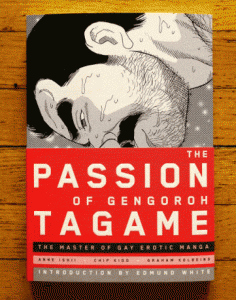 The Passion of Gengoroh Tagame
by Gengoroh Tagame, ed. Anne Ishii, Chip Kidd & Graham Kobleins
PictureBox Inc, April 2013
256 pages / $29.95 Buy from PictureBox
Passion is generally defined either as “any powerful or compelling emotion or feeling” or, within the context of personal relationships, as a “strong sexual desire; lust.” Strength & power are two words that dominate these definitions. Strength & power are two concepts that dominate the short, hypersexualized narratives of Gengoroh Tagame’s characters: strong, large & butch men dominating, fucking, & occasionally loving other strong, large & butch men.
In the world of manga, and especially in the imported consideration of such, there’s an abundance of yaoi stories that teen girls flock to, love, write fan-fic about: yaoi is a subgenre of manga that takes young, thin, often effeminate boys loving other young, thin, often effeminate boys. Clearly, there’s a contrast between this & what I’ve mentioned Tagame’s narratives hold above: thick muscles, thick cocks, heavy BDSM overtones–there is the occasional cross-generation ‘romance’ told by Tagame, but even the young boy shares a closer physic to a professional wrestler than the twinky waifs that populate yaoi.
Pierre Guyotat once remarked that he couldn’t write unless his cock was hard. Similarly, Tom of Finland once remarked that his best drawings occur while he’s erect. I have to imagine that the sexual narratives that overtake Tagame’s work drive their creator, as well, to sexual satisfaction. There’s a remarkable sense of erotic obsession that drives the work, moving from gang-bang fantasies to hyper-developed arenas of sadism. Sometimes, when there’s time for it to develop, a work develops a plot, often a somewhat complicated one considering the constraint of a number of pages. Sometimes there is less plot, but always there is a surge of powerful eroticism dominating each panel.
READ MORE >