
Random
“…by writing we lose control…”
Consider this provocative statement from a recent post over at Montevidayo entitled “The Inhuman Art of Dying vs. Poetry’s Grief Police” by Lucas de Lima, “…by writing, we lose control of our narratives, and inevitably end up thwarting not just our intentions for a poem, but also the way we conceive of ourselves and our bodies as bounded, autonomous entities shaped through free will.”
…by writing, we lose control…
Like Brownian Motion: the presumably random drift of particles, which is, of course, among the simplest of the probabilistic processes, and thus serves as a limit of both simpler and more complicated stochastic processes, writing being one we might never have thought to correlate.

Which is to say, what may begin determined becomes random. A transformation. Or, perhaps, determination and control are always an illusion anyway…?
I am currently intoxicated by the potion of Catherine Clément’s Syncope: The Philosophy of Rapture
For Kant music was “an intestinal agitation.” Clément critiques him for this prejudice. “Kant does not like [music]…because it approaches the ignoble; it is because it agitates, it is because it goes into raptures and provokes. Uncontrollable. Now, that is itself the unthinkable” (47).
The worst we can do is lose control. Without control, we are no different from the animals. Without control, we are no different from the monsters. We must believe in control. We must subscribe to control. We must worship control and demand control and fear and hate all that is out of control.
When John Cage says, “I have nothing to say and I am saying it,” he is purposefully mistaken and profoundly aware of the impossibility of his statement’s validity, because we can never say nothing. To try and say nothing is to say so many things. His statement draws our attention to our futile attempts to control that which cannot be controlled. In the opening of his book Silence: Lectures and Writings
So, it is no wonder why we are so easily mistaken when we believe we are in control of our writing. How desperately we grasp at mastery. How fearful we are of losing control, of being misinterpreted. A sneeze, a yawn, a laugh, a hiccup. Sleepwalking and snoring. All are moments of losing control that we accept or at least acknowledge.
But…somehow writing is different? Writing is not hysteria? Writing is not uncontrolled? Writing is not syncope? Egg on the face of those who believe in authorial intention. Or, no? Yes. A beautiful argument for the inability of a reader to deduce the author’s intention. Authors cannot intend. They may presume an intention, but as de Lima says, “…by writing, we lose control…”
“Do not forget,” Ludwig Wittgenstein observed, and Marjorie Perloff reminds us, “that a poem, even though it is composed in the language of information, is not used in the language-game of giving information.”
“nuffs
obbed
obbledygook
ock-cool
ockers
ockpit
ock-tease
odel-kit
ody-snatched
odzilla-plus”
–from COLDEST by Bruce Andrews
Language reminds us of our boundaries, not our borders. We are porous. The open poem. Each choice becomes another choice. Each movement meets a movement and creates a movement, becomes a movement. Brownian motion.
“A poem should be wordless
As the flight of birds.”
–“Ars Poetica” by Archibald MacLeish
The form of a poem at odds with chaos:

The form of a poem at odds with cosmos:

The form of erasure, from Martijn Hendricks’s project “Give Us Our Daily Terror”:
Or this, from Jonathan Culler‘s essay “Toward a theory of Non-Genre Literature,” “The essence of literature is not representation, not communicative transparency, but opacity, a resistance to recuperation which exercises sensibility and intelligence.”
The essence of literature is not representation.
The essence of literature is not representatio
The essence of literature is not repres
The essence of literature is no
We must ask ourselves to consider what differences exist between the function of
“Lucy Church was never there naturally naturally she was never there,” said Gertrude Stein
How could she be? Under what conditions?
“If language isn’t the most important thing for you when you author, then why not take up dance, painting, journalism, the piano?
That’s not a rhetorical question,” says Lance Olsen on page 156 of his recently published book Architectures of Possibility: After Innovative Writing
But…
language is dance and dance is language.
So, too, is painting.

Paul Klee - Fire in the Evening
The language of air and color.
The language of land.
Time and temperature.
Wordless as a flight of birds.
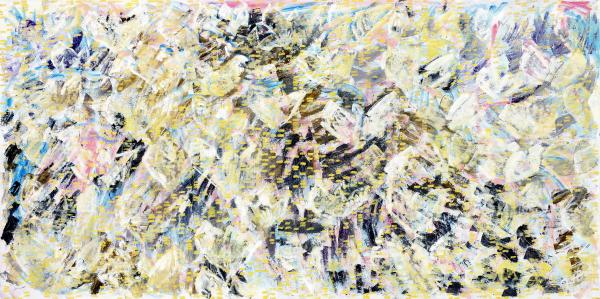
Joan De Bot – Flock of Birds
Piano, too, is language.
No..?
How could it not be language?
If we accept de Lima’s proposition that “to write we lose control,” then what can we say about the act of reading?
Writing as syncope.
Reading as syncope?
Is it fair to say that to read we recognize — or, become aware of — control’s absence? Perhaps the benefit of writing is derived from the sublime experience of losing control — succumbing to the dueling impulses: dread and desire –, while the benefit of reading is derived from the recognition of our ubiquitous daily helplessness, our futility. We are all Gregor Samsa awaking on our backs, our little legs twitching. The tension between divergent sequences (i.e. the unpredictable) and convergent sequences (i.e. the predictable). I am thinking here of the work produced by the British scientist Gregory Bateson. By writing we may consider our construction convergent, but by releasing it into the world it does not obey our command, instead it moves toward the divergent. A reader reads the construction, assuming convergence. At each end, the assumption is convergence. But between these ends a metamorphosis takes place in which the presumed convergence becomes divergent, or better yet: reveals the error of presuming convergence in the first place. The echo of this transformation thus resounds at both ends.
An automatic disconnect.
The impossibility of language abutting the desire for language.
Proof that we want what we cannot have.
I enjoyed this post immensely.
As an aside, tho, anyone else first hear that Rachmaninoff Prelude while playing Chessmaster?
Convergence and divergence of meaning are not “opposite[s]” to each other. This simplistic schematization of understanding will lead to, and in turn, reinforce, a dichotomous sense of “control”: either all, or none.
Meaning is not shared because of such an “assumption”, but rather, such an “assumption” is an interpretation of the empirical determination of shared meaning. What at least many writers and readers “assume” is that slippage and coherence co-exist between a writer and reader. This mutually implicatory co-existence — this generative equiprimordiality — is essential to participation in exchanging ambiguous or perspective-dependent symbols (that is, to natural language), which even the most dictatorial writer or reader might understand about what they’d univocally conceive and impose. Ambiguity and perspective-dependence are nothing like the counter-assumptions naively assumed naively not to have been “assum[ed]” here.
“Ontological metamorphosis” would be a uniquely non-metamorphic “metamorphosis”! Perhaps the phrase is deliberately self-contradictory — a paradox — . But even then, why imagine or posit any “metamorphosis”? The argument of the blogicle is that there is never any “convergence”, that shared meaning is “impossible” – even between one and oneself.
I think that, rather than either full “control” or no “control”, “control” itself is, in its presence, imperfect, fragmentary, neither fully effective nor absent. We don’t lose “control” completely, having had complete “control”. Rather, in language, we participate in the incommensurability of understanding with meaning.
Likewise, an author’s expression – or mere claim – of “intent” is a datum — one which need neither eliminate one’s direct understanding of a text nor be completely ignored on the grounds of irrelevance. Authorial intention is an interpretation – one which gets its authority from the author’s sensitivity, artfulness of expression, and integrity — as with any other interpretation.
lucas’s post made me want to write something about this. can’t now because i took my ambien. but i am interested in investigating/destorying the proprietary impulses that drive most writing. i think the idea that writing is about self-obliteration can be overstated to the point where self-fortifying gestures are obscured.
What is your position exactly? Need to confirm this.
Also, “The worst we can do is lose control. Without control, we are no different from the animals.” What animals? Which ones? All, including ourselves?
Meditative technique advises one to lose control, as this may be the release of the ego, and therefore allowance to truly become. It is correct, “by writing we lose control”, but to push further it is by losing control that one really transcends. Creativity tends to be a collection/gathering of energies — an allocation. But by forcing control, you are then allocating specific energies are focused by you, and not simply taking in what is already floating in the ether. This sounds more mystical than it is — your thoughts are chemical reactions, chemical reactions which hold atomic material, which means your thoughts have actual weight which can then manipulated. So instead of having this wide breadth, you are hindering the focus of creativity through your own, very limited “ego-lens” so to speak. As Jackie Wang puts it: “Self-obliteration” is needed for the creative act to have a valuable representation in the world.
really nice, ch. good words and media choices.
that might be my favorite erasure video things i’ve seen.
Love that first question, Michael! Perfect response!
In terms of your second question, I’m
less interested in being human and much more interested in being an animal, a
monster, and so on. You’ve seen this, perhaps:
http://www.youtube.com/watch?v=l-gK-CzCHug
Like Zizek, I pretend play that I am human. That act of pretend playing
is an attempt at control, for sure. I’m teaching a course right now on
monsters, and one of the more interesting things to arise from our discussions
is an idea about what distinguishes the human from the monster being that the
monster gets to say yes when the human must say no in order to maintain
control. Humans worry about self-control. Monsters, not so
much. But that’s a whole other conversation, I’m sure.
In terms of “self-obliteration”…the obvious problem with that approach is its reliance on the basic liberal humanist position: it suggests that there is a self for me to obliterate. Taking an approach grounded more in the field of posthuman studies, what if instead we explored the illusion of self, considered the concept of “self” as a construction? Under those conditions there is no self to obliterate. (Hopefully Jackie will write something to elaborate her ideas on this. I am interested in what she means by “the point where self-fortifying gestures are obscured.” That seems super interesting.)
I hope you will write something, Jackie. I’d love to hear an elaboration of your ideas on this subject. The tension between self-fortifying and self-obliterating seems really interesting to me.
It seems that you are brilliant at explaining things.
<3<3<3
Your post got a shout-out here at Wood s lot (scroll down to March 28 and then further down):
http://web.ncf.ca/ek867/2012_03_16-31_archives.html#March 28, 2012
I know I clicked ‘like’ on deadg’s harsh comment, but I also like that this post is cited at Wood s lot.
What was “harsh” about my comment? The word simplistic, or Perhaps? The comment is a level-toned, impersonal response to the gist of the blogicle–which pith is at least arguable, no?
I’m interested in how — not just by Chris, not just at HTMLG, and not just on the internet — defense against genuine philosophical, political-economic, or interpretative disagreement is made by the simple trick of categorization of it as, say, “harsh” – a slipperily sloping step towards dismissing disagreement as pointlessly disruptive, trollish.
Again, what’s “harsh” about that comment’s direct but inoffensive contradiction of Chris’s “impossibility of language” positions?
I don’t know. You’re right. It’s a direct but inoffensive, level-toned contradiction of the gist of the blog post.
Sorry.
There is a disjunction between the post’s lyrical effusions and the rigor of your examination of its underpinnings. But I suppose lyrical effusions, especially those in the register of high theory, deserve to be read as closely as anything else.
I think it’s not only on the Internet… oh, right, you’re way ahead of me. Intellectually, I see the problem with shutting down disagreement by treating it as a fault, an offense, an unfriendliness, but socially I sometimes react as trained, and see disagreement as disruptive or a put-down. Sometimes.