
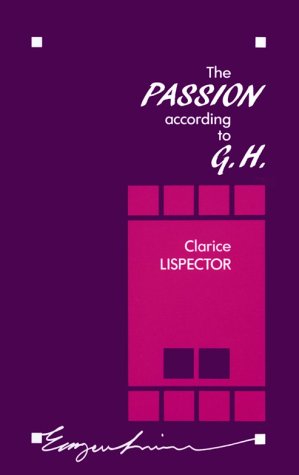
all hope abandon, ye who enter here
-The Divine Comedy
Dante, in 1321, put forth a Hell without hope. Or a Hell full of realization? of the act of abandonment?
A world wholly alive has a Hellish power.
-The Passion According to G.H.
G.H., a Brazilian dilettante–a word appearing around 1850 in Italian, Dante’s shaped language–begins her accounting with a plea and an invitation: she must share this, her story. Her passion. And she’d like to hold your hand.
G.H. lived on the top floor of a superstructure, and, even thought it was built in the air, it was a solid building, she herself too in the air, like bees weave their life in the air. And the same thing had been happening for centuries, with the neccessary or incidental variations, and it worked. It worked—at least nothing spoke, and no one spoke, no one said “no”: so, it worked.
-The Passion According to G.H.
G.H. decides to clean her house. It is a lazy day–it should be. Cleaning affords her the opportunity to organize and create. To make form. To make sense. She heads to the maid’s room.
The room was the portrait of an empty stomach.
-The Passion According to G.H.
In which she discovers a stark message.
That revolt of the flesh is the absurd.
-The Myth of Sisyphus, by Albert Camus
In which she confronts a cockroach.
That revolt of the flesh is the absurd.
-The Myth of Sisyphus
In which she becomes like Sisyphus, the absurd hero.
The world had reclaimed its own reality, and, just like after a catastrophe, my culture had ended: I was merely a historical fact.
-The Passion According to G.H.
The world evades us because it becomes itself again.
-The Myth of Sisyphus
In which she enters a desert. In which she nearly finds the edges of this desert; but she doesn’t dare go past them, for what lies beyond is the an unspoken truth and god of her story: insanity.
I already know that thought has at least entered those deserts. There it found its bread. There it realized that it had previously been feeding on phantoms. It justified some of the most urgent themes of human reflection.
-The Myth of Sisyphus
in this desert things know things.
-The Passion According to G.H.
Her journey is admittedly metaphysical, begrudgingly mystical, weirdly religious. The self of G.H. is scrutinized and washed, destroyed, reformed, figured and refigured, invisible, a present and eternal damnation.
But this is not eternity, it is condemnation.
-The Passion According to G.H.
If we take eternity to mean not infinite temporal duration but timelessness, then eternal life belongs to those who live in the present.
Tractatus Logico-Philosophicus–6.4311
I bet that Clarice Lispector read Camus’s The Myth of Sisyphus and Tractatus Logico-Philosophics; The Passion is so informed by them–it’s like catching entrenched lovers mid conversation. A review of The Passion in the New York Times asks if this story is the perfect bridge between existentialism and structuralism, and I would say yes, but, adding: it is a bridge that is ever expanding, and to be on its road is to be delirious.
From the moment absurdity is recognized, it becomes a passion, the most harrowing of all.
-The Myth of Sisyphus
G.H. finds herself awash in history and comforted by the ancients–the ancients are pieces that can be acquired in the museums and media.
And then, like after a flood, there floated a wardroe, a person, a loose window, three suitcases. And that seemed like Hell to me, that destruction of layers and layers of human archaeology.
-The Passion According to G.H.
And back near the beginning of her story:
Only later would I unerstand: what seems like a lack of meaning… is what meaning there is.
-The Passion According to G.H.
But, within this non-temporal conversation, G.H. frequently alludes to being millennia old. Is this cycle like a spinning ring that floats inside another spinning ring? Is there gravity?
People who are possessed are not possessed by something that just comes but instead by something that comes back.
-The Passion According to G.H.
Love, a seemingly tentative concern, makes and remakes G.H. into a woman.
Is love when you don’t give a name to things’ identity?
-The Passion According to G.H.
G.H. claims to be a sculptor but also a dilettante–the aesthetic plane is both a bedrock and a star behind daylight.
all people’s pictures are portraits of the Mona Lisa.
-The Passion According to G.H.
Creation isn’t imagination, it’s running the huge risk of coming face to face with reality.
-The Passion According to G.H.
The text makes a beautiful music; its rhythm is masterful.
Between two musical notes there exists another note, between two facts there exists another fact, between two grains of sand, no matter how close together they are, there exists an interval of space, there exists a sensing between sensing–in the interstices of primordial matter there is the mysterious, fiery line that is the world’s breathing, and the world’s continual breathing is what we hear and call silence.
-The Passion According to G.H.
And, Christ, there are some great sentences…
“…We are free, and this is Hell. But there are so many cockroaches that it seems like a prayer.”
-The Passion According to G.H.
G.H. experiences Hell in its true form: she experiences the world in recurrence. But, nearing the end, she drops our hand and asks us to consider paradise. She asks us to consider a now that is truly a now–one without hope, but one in passion. And, with lucidity, we then must ask ourselves: have I found the question belonging to our answer?
All in all, I think this book is a sublime, inspiring & definitive text of this and the last century. I cannot speak for its future, nor would I want to. Within the human story lies a sort of loop of conscience–we yearn to get at the middle, to discover what is hidden between ‘I’ and the hard mechanics. I fear the day we find the middle. A great bodily transformation is sure to take place. Although: what if the center truly cannot hold? What if we’re left to continually circle on ourselves and stare at the blank, passive weight behind our languages and our world?
For He knew that I wouldn’t know how to see whatever I saw: the explanation of an enigma is the mere repetition of the enigma.
-The Passion According to G.H.
Repeat: read this book. Buy The Passion According to G.H. at Amazon or at Powell’s.
Tags: Clarice Lispector, review, the passion according to g.h.
love the way you approached this beautiful book. nice collisions. thanks ken
love the way you approached this beautiful book. nice collisions. thanks ken
book ordered
book ordered
thanks, blake. thanks, lily.
thanks, blake. thanks, lily.
Damn, I had this in my hand in the library the other day and was simply too tired to check it out, guess I’ll go back.
Ken- that girl enjoyed y2k, though she’s a self-proclaimed “non-reader”
Damn, I had this in my hand in the library the other day and was simply too tired to check it out, guess I’ll go back.
Ken- that girl enjoyed y2k, though she’s a self-proclaimed “non-reader”
I didn’t buy the book after reading L. Moore’s review, but I’m buying it now. Thanks, Ken.
I didn’t buy the book after reading L. Moore’s review, but I’m buying it now. Thanks, Ken.
Excellent review, Ken! I really like the form you’ve created. Insightful connections.
If you haven’t already enjoyed Lispector’s The Hour of the Star, it’s also awesome. Here’s the opening paragraph:
“Everything in the world began with a yes. One molecule said yes to another molecule and life was born. But before prehistory there was the prehistory of prehistory and there was the never and there was the yes. It was ever so. I do not know why, but I do know that the universe never began.”
Excellent review, Ken! I really like the form you’ve created. Insightful connections.
If you haven’t already enjoyed Lispector’s The Hour of the Star, it’s also awesome. Here’s the opening paragraph:
“Everything in the world began with a yes. One molecule said yes to another molecule and life was born. But before prehistory there was the prehistory of prehistory and there was the never and there was the yes. It was ever so. I do not know why, but I do know that the universe never began.”
recently read ‘hour of the star’ and thought it was ace but this one sounds unbelievably good. Also makes me want to read wittgenstein. I reread this maybe three times. Great review.
recently read ‘hour of the star’ and thought it was ace but this one sounds unbelievably good. Also makes me want to read wittgenstein. I reread this maybe three times. Great review.
cool. thanks again for thinking to pass it to her.
great! my pleasure.
added to the top of my list. thanks.
cool. thanks again for thinking to pass it to her.
great! my pleasure.
added to the top of my list. thanks.
thanks, tomk.
yes: wittgenstein is wonderful reading, IMO. any and all.
thanks, tomk.
yes: wittgenstein is wonderful reading, IMO. any and all.
Congratulations on making it all the way through that taxing, terrifying little epic! I gave up twice, but you almost pursuade me to try it again.
Congratulations on making it all the way through that taxing, terrifying little epic! I gave up twice, but you almost pursuade me to try it again.
Where’d you give up? There was a stretch in the middle that was, yeah, taxing.
Where’d you give up? There was a stretch in the middle that was, yeah, taxing.
The Apple in the Dark is her longest novel and a complete world to itself. It should be as widely read as The Trial or Pedro Paramo – it’s that good.
Gregory Rabassa is the translator and he’s been commissioned to complete a long overdue re-translation of Joao Guimaraes Rosa’s Grande Sertao (published in English in Harriet de Onis version as The Devil to Pay in the Backlands). Grande Sertao seems – to my untutored eye – to be a setting off point for The Apple in the Dark and that’s a masterpiece too.
The Apple in the Dark is her longest novel and a complete world to itself. It should be as widely read as The Trial or Pedro Paramo – it’s that good.
Gregory Rabassa is the translator and he’s been commissioned to complete a long overdue re-translation of Joao Guimaraes Rosa’s Grande Sertao (published in English in Harriet de Onis version as The Devil to Pay in the Backlands). Grande Sertao seems – to my untutored eye – to be a setting off point for The Apple in the Dark and that’s a masterpiece too.
Wow, Ken, you certainly know how to make someone want to read this book more than anything else. Sounds like a real challenge – a very rewarding one.
Wow, Ken, you certainly know how to make someone want to read this book more than anything else. Sounds like a real challenge – a very rewarding one.
awesome. thanks for the info.
thanks, matthias.
awesome. thanks for the info.
thanks, matthias.
I loved the way you integrated the text into the review in an almost post-structuralist way. University may have piled on a stack of books for me to read, but you’ve made me put this one on top of it all.
I loved the way you integrated the text into the review in an almost post-structuralist way. University may have piled on a stack of books for me to read, but you’ve made me put this one on top of it all.
thanks, alexandra. happy to hear it.
thanks, alexandra. happy to hear it.
[…] Passion According to G.H. by Clarice Lispector : What I can say about this book I said here. One of my favorite books now, among my top three. Paths in this system dominated most of my writing […]
you might want to see amissingbookdotcom