
The Real-Time Review League reads nods by Carrie Lorig
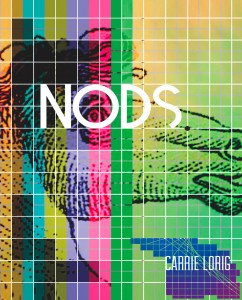 nods
nods
by Carrie Lorig
Magic Helicopter Press, 2013
48 pages / $7 Buy from Magic Helicopter Press
July 25, 2013
Kelin,
I read through the first half of nods., like we said. I’m happy to be doing it in two pieces, as the book leaves me a lot to process.
For me, what comes first here are impressions. Looking into the dark and seeing shapes, but waiting for your eyes to adjust before you can make out bodies and what they are doing.
I read the first “Scatterstate” and thought, if I had to define this term, it would be:
scatterstate: noun, immersion in repetition and variation of words; a swelling up of words, which become, in addition to their actual definitions, their sounds and the feeling of hearing/thinking them over and over; an inundation
When it is too much to think about, I am left with hearing and feeling and drawing conclusions from those sensations. And because of THE PAGE and her use of space on THE PAGE, sometimes it is too much. I think she knows this. Because it’s not like eating too much ice cream; it’s like tumbling down too much mountain, or hiding under too many houses. It surprises and excites me, too, when out of this inundation, narrative is born, which happens here.
So much here depends on unlikely pairings of words—sometimes as separate, paired words, and sometimes as compounded words. A few of my favorite compounds from p17: “mangovault,” “niagarafalafel,” “boozyoveralls,” “meatbowl.” This chapbook asks us to wonder, what happens when you push two, separate, unlike things together? How do we make sense of that? And in that way, it is a painstaking immersion in the messy business of sex and love. Preparing to leave for a long vacation without Phil tomorrow. I want to go and I don’t want to go. It feels, sometimes, like we are always orbiting the same thing, but at different rates. I’m being dramatic—everything is fine, of course, we’re very happy. But love is never easy or clean.
Last night we ate waffles filled with curried chicken from a food truck. It makes me wonder, if waffles can be a vehicle, what else can?
Last week, I sent Tyler Gobble a link to your work and he said it reminded him of Carrie’s. I hadn’t read much of Carrie’s work, but reading it now, I see what he means. I am so seriouseager to hear what you think.
xoCaro
*
July 30, 2013
Dear Caro,
I hope you are having such a wonderful trip with your sister and nephew! Minneapolis has been incredible. We have seen so many friends, and late twenties looks good on everyone. Watching them relax into themselves is making me feel more relaxed too. I now have the urge to kick anxiety once and for all. Getting an MFA in our early twenties was MISLEADING to say the least. The moment I calmed down, I noticed a LOT of people DON’T have an anxiety disorder. I don’t want one either. It is taking up my time. I’ll keep my phobias though. My life is sort of built around avoiding fish and vomit. (Walking around Lake Nokomis, I SAW A DEAD FISH THE SIZE OF MY THIGH).
Anyway, calm is what I want to work out with nods. I read myself into a frenzy, and the frenzy was, I DON’T HAVE A PLAN TO SEE CARRIE YET. One thing I forget about Carrie, and about Nick too, is that they are CALM. I called her, and even her “hello” was grounded. I’m not sure her phone recognized my number. I wonder if folks can read my anxiety-energy from my hello??. It usually either means are you a schemer?? or are you mad at me??. What I’m learning on this trip is that I don’t think people are mad at me. And what I’m trying to say here, is that Carrie is a keel. Before I called her, I chattered my way around the first “scatterstate,” loving it, getting RATTLED by “noiseflowers.” Getting hurt by “i’ll let you know if i hear anything more from you.” I underlined and circled words, sentences… There is an energy here, and there is an energy in Carrie’s calm. I get excitable talking to her, and I don’t get anxious. We made plans to see each other.
When I hung up and hit page two, I wasn’t in racket anymore, I was in flow. If a word or line rattled me, it didn’t jut out anymore, just twinkled around a rock in the river. “And my sunburnt eyes are touching each other with this beautiful delivery of flow hurt…” There is anxiety too: “you have to find a feeling / and hurt its tiny dead / glow with your hurt”. But instead of the anxiety being some illness in Carrie, it is one that she creates and controls. There is energy spinning in her—and it might be just hers, or she might be open enough to deal with my own.
On the phone she and I talked about sharing the sex we write in poems with our parents. I love your thought about the forced merging of concepts (FUELBOOGER) as being like sex and love. I need more people to talk about sex that way. I need more people to talk about sex in every way other than bikini waxes and butt jokes and have you tried….. And so yes, the lights are low in this book, and my eyes never become natural. This groping for vision and relying on sound become mebumbling with someone else’s body in the dark, trying to figure out how it works. I’m thinking about theories of touch and sound. She is building those two experiences without IMAGE. I’m not listening for the pain cattle, I just hear everything. How is this happening?? (NOT a rhetorical question!)
Have your parents read poems you’ve written about sex? (OR WORSE YOUR IN-LAWS?) Wait, do you have poems about sex? Is that what “and spark / and spark” means? (I don’t have your book in front of me—did I quote that right?)
Today is Carrie’s birthday! I’m off to practice my poem for the reading tonight (she is hosting), and to buy her flowers that look like an animal (Nick’s idea).
Love to you guys!
k
P.S. I’m reading with Abraham Smith, and I’m terrified. Not colonoscopy terrified, but on the spectrum.
P.P.S. I want to meet Tyler.
Comments Off on The Real-Time Review League reads nods by Carrie Lorig
June 13th, 2014 / 10:00 am
June 13th, 2014 / 10:00 am
A Review of Nick Sturm’s How We Light
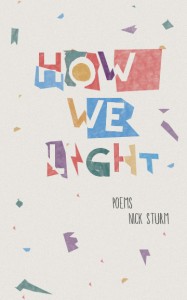 How We Light
by Nick Sturm
H_NGM_N BKS, June 2013
104 pages / $14.95 Buy from Amazon or H_NGM_N
“One traverses the same paths of thought as before. Only they seem strewn with roses.”
– Walter Benjamin
A question I’ve learned to ask my students this semester is, “What did this book of poetry make your body do?” I ask this 1) because it’s a question that has nothing to do with proving that you understood a book and everything to do with articulating an experience you had with a book 2) because it steers students away from focusing on “disliking” and “liking” and steers them more into intuitive, momentous ways of thinking that help us get unstuck / stuck into more complicated ball pits like: Did the lemonade in this book (“I drink lemonade and migrate into a system of becoming” – “I Feel Yes”) taste like it was made from concentrate or by hand? How does the repetitive presence of lemonade twist and gut the aphorism, “When Life Gives You Lemons, Make Lemonade?” Can a sour nest of pressed pulp devolving into a drink that tentacles us to words like brightness, warmth, shine be considered a kind of (un)holy transformation? Is that what your throat’s Charley Horse is telling you? 3) if students don’t learn that poems should do more than sit on a page, if students don’t learn that NOT feeling something grip or rip you is an indication that something is wrong, then I don’t know what we are using these institutions of higher yearning for.
Q: What did How We Light make your body do?
A: Bargemusic
It’s a question that’s not easy for students to answer, mostly because they are not used to incorporating their sensory organs into their thinking. They are often overwhelmed by the idea of paying attention to those reactions, by taking cell inflammation and disruption seriously, by collaging it with the logical systems of reading comprehension that are pressed and pressed into them. Lisa Robertson says a simple thing in her essay, “Time in the Codex,” from the book, Nilling, “I feel astonished that any institution could have placed [a book] in my hands, then left me alone with it. Reading misuses privileges, abuses authorities, demands interference.” Is reading and experiencing reading always volatile? I think the answer might be Yes in a way that makes me consider whether or not volatile-ness is inherently violent or violence making, whether interference is inherently violent or violence making. I forget that power is not only a thing that is stolen or improperly kept. In Robertson’s insistence and word choice, there is a leaning into the ways in which the existence of the book and our ability to digest it defies the way transformation and permission is distributed. Free Pattern Tune-Ups. Free Limb Loosening. Free Energy Glisten. A different kind of Universal Health Care. Will you open yourself up? Will you receive these things? It occurs to me that I don’t register enough how INDULGENT the act of reading is. It occurs to me that this quote is making me re-define these words, volatile, indulgent, in charged ways that I wasn’t planning on. I am beginning to associate them more thickly with pleasure and the detection of shifts. But then again, I read because reading is always interfering with the rituals I use to create expectations. It is always updating my machines. Reading is the experience of inhaling process and practice and building and force without expecting to feel recognition, nodding, without expecting to feel that what we glimpsed was completely representable. Bruce Andrews on Gertrude Stein: “Here, the meanings we construct are not compensatory. Readers don’t perform some co-invocation of a lost or ever-receding presence. This isn’t reading as containment, or rollback, but as extension.” I dream about bridges. I dream about the possessiveness reading abandons. I dream about soft gauze killing my boundary waters. Sometimes I make a sandwich and watch everything do more than I could imagine. (“Beautiful beautiful Animal / animal” -Upstairs With His Sandwich) Ben Mirov says, “Just as artists and writers have imagined sentient machines in their work, so too is it possible to imagine a poem that is imbued with qualities beyond the structure of its coherent materials.” Poor statues. They don’t move. They don’t grow kites out of a shoulder.
Q: What did How We Light make your body do?
A: “A man who doesn’t love easily, loves too much.”
– Special Agent Dale Cooper
I am not a person who comes easily to joy. Or rather, I feel joy constantly. There are dead leaves outside right now that smell like parts of the earth I’ve never seen. I walk to school everyday for the first time in years and listen to these songs that cover my organs in gold paper so hard I have lay down in the wilds. But it also hurts. It feels turbulent! The intensity of it, the impact of radical immediacy, how it seems tied also to my ability to feel immensely dented by you and everything else touching me. Can I survive it? I’m not convinced How We Light is a book that comes easily to joy, either, though it is often the first thing one can and should note about Sturm’s poetry, about where his poetical contraptions get their antifreeze. The texture of How We Light’s exuberance is pulpy, palpable, pulse-ridden.
“Why something in a word out of its body
makes me feel everywhere as air, air that lives
in mouths and birds all peach pie and dynamite”
– I Feel Yes
You know what chainsaws actually are? They are exclamation points. Boorish and toothy hounds. “My actions are excessive!” -I Feel Yes. You know what exclamation points are? Exclamation points are mouths that can’t help themselves, that can’t help interfering with the steady speed limit of a page. They are the inevitable slobber marks of awe force making you and the text slippery. They litter the fourteen pages of dawn and rumble that “I Feel Yes” is, one of two long poems that appear in How We Light. These moments of exclamation / proclamation / declaration aren’t enacting a refusal to be left out, though. They aren’t a power grab. Their presence isn’t one that feels aggressive or forceful here or in one of the titles which repeats nine times throughout the book, “What a Tremendous Time We’re Having!” They aren’t demanding attention in that way, which is exactly why I am drawn to them, why I’m whelping for them in this book’s terrarium, underlining away. They are, like lemonade, pure-ish in the mane and straightforward. “O human trying! O American bison!”- I Feel Yes
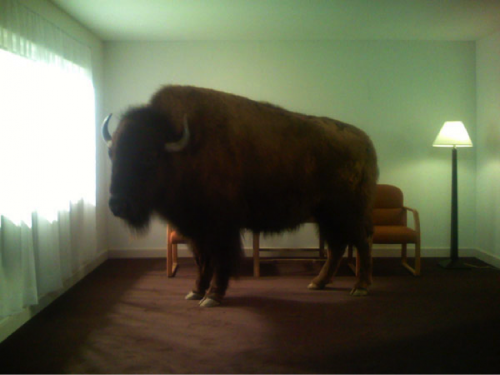
A Still From Doug Aitken’s Migration
What’s different, inside the frame of “I Feel Yes” and the book, is that these moments of joy, of piercing through, aren’t privileged. They aren’t positioned to make the reader look at and admire them for their unbridled side heaving or for their half court language shots. In the other long poem, “How We Light,” and in many of the other poems in the book, punctuation is removed, floating all seismic activity and feeling together into an enjambed collectivity (co-trembling). This is a whole body accounted for and throwing waves at and through itself.
“When I speak it is the opposite of bones
Real life bones, my name on my hands.
I understand now, the valley full of brains.
Let’s have a conversation using only our skin.”
– “I Feel Yes”
Comments Off on A Review of Nick Sturm’s How We Light
December 13th, 2013 / 11:05 am
December 13th, 2013 / 11:05 am
TWOCLOSEWORDS: HAUNTING / HUNTING
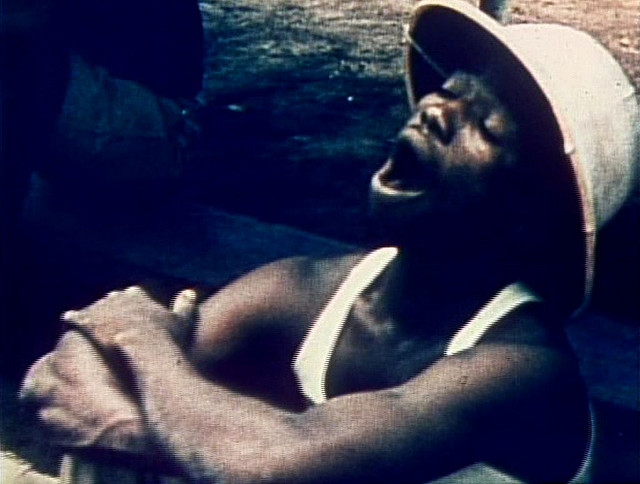
(A scene from Les Maîtres Fous (The Mad Masters), a film by Jean Rouch)
Haunting –
My left eye is fucked. It isn’t the first time. I’ve mentioned its swollen episodes everywhere: in poems, on the phone.
Because I think it’s hysterical. Because I really can’t get over it.
LOLOLOLOL. A POET. WITH A SENSITIVE. EYEBALL. FUCK ALL THAT.
Lately, there are tiny, irritated dots that have been piling up in the corner. My roommate gives me clay and DMSO, which is HORSE LINIMENT. She dabs it on for me. The eye’s anger ebbs and flows.
I like that my own body keeps haunting me from this particular room, always from this left eye, trying to get me to deal with or acknowledge some part / stress deposit of myself that I’ve neglected / buried. Your own body interrupts you. It unexpectedly cuts you off. I feel more than slightly disembodied when I look at it in the mirror, when I touch it. Ghosts are red.
A Review of Your Attraction to Sharp Machines by Matthew Mahaney
 Your Attraction to Sharp Machines
by Matthew Mahaney
BatCat Press, May 2013
53 pages / $20 Buy from BatCat Press
A woman from the audience asks: ‘Why are there so few women on this panel? Why are there so few women in this whole week’s program? Why were there so few women among the Beat writers?’ and [Gregory] Corso, suddenly utterly serious, leans forward and says: “There were women, they were there, I knew them, their families put them in institutions, they were given electric shock. In the ’50s if you were male you could be a rebel, but if you were female your families had you locked up. There were cases, I knew them, someday someone will write about them.”
—from Stephen Scobie’s account of the Naropa Institute tribute to Allen Ginsberg, July 1994
“her exhalation
tion”
—Jon Woodward, “Huge Dragonflies,” Uncanny Valley
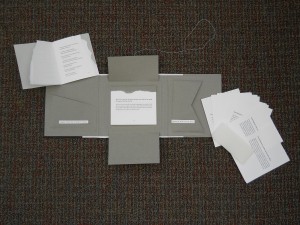
The back of Matthew Mahaney’s book, Your Attraction to Sharp Machines (AMAZINGLY assembled by hands at BatCat Press) is a silver and black Rorschach image (unique to this copy, #48 of 75) spread across a burlap-ish fabric. I stare and decide it looks like an insect head coming towards me. I think of what it means that this is the shape I chose to chisel the blob into, that this is what this mutable part emerging from the ether is to me. A PhD student is sharing the severely air conditioned portion of the TA office with me. He squints at it, moving around his glasses for a second, and says, “Isn’t it duck feet?” I look at it again and shrug.
E.T.A. Hoffman’s famous short story, “The Sandman,” is built mostly by letters sent between disoriented characters. The letters all dizzily revolve around the horror of attempting to see WHAT and WHO thrives on not being seen or perceived beyond a modestly eerie feeling that “something is off” (the Bogey-men / the Sandman / cyborgs / automatons). Nathaniel, the main character, can’t address his correspondence to the right person, he can’t understand (through his telescope) that he’s entertaining cheating on his fiancee, Clara, with a doll1 (untouchably named Olimpia), and he is haunted by either a man or a male figure of his imagination (the Sandman), who may be stealing the eyes of children at night and selling expensive / haunted Italian eyewear during the day. It is a story about the kickback / the recoil that occurs when there is an un-trusting of the senses / your instincts and their skill set. (“You’re only human,” someone says, to comfort you when you get it wrong.) It is a story that makes us wonder about what our criteria for a human being IS exactly (particularly when we’re talking about women). Most importantly, Hoffman’s disturbing tale questions the confidence we have our in our ability to recognize the difference between person and our most ancient illusions and our newest machines as they meet inside unfolding human events.2
Something I’m getting at is that “The Sandman” plays into a very important part of poetry (and Mahaney’s book): how quickly things can become de-familiarized and what can and does happen to a piece of consciousness when it experiences or expresses that (in the real world and in the more malleable and forgiving forestworld of the ‘poem”).
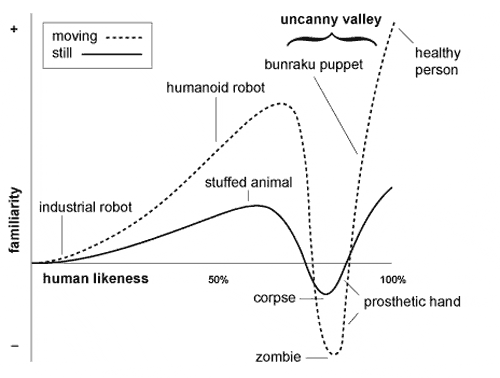
A USEFUL GRAPH // The Illustrated Uncanny Valley
Poetry knows, in deeper oceans than most forms of writing, the pain that is inevitably linked, both to seeing and to articulating what has been seen. An unnamed narrator of “The Sandman” comes out between the letters to say this on the matter:
“Your friends asked you, “What is the matter with you, my dear friend? What do you see?” And wishing to describe the inner pictures in all their vivid colours, with their lights and their shades, you struggled in vain to find words with which to express yourself. But you felt as if you must gather up all the events that had happened, wonderful, splendid, terrible, jocuse, and awful, in the very first word, so that the whole might be revealed by a single electric discharge, so to speak” (8).
When it becomes difficult or overwhelming to decipher and decode what and who is happening in front of you through bites of language, the consequences are mostly Innocuous with a capital I until they aren’t. (Poetry is always potentially toying with this line. Yes, there are birds in my throat. Sometimes I am amazed I do not find actual feathers in my toothbrush when I brush at night.) Towards the end of Hoffman’s story, when Nathaniel suddenly sees one of Olimpia’s eyes rolling around the floor like somebody’s dropped blueberry, he starts trying to kill people until he’s dragged off to an asylum.

Nathaniel’s abandoned, but his decidedly more rational fiancee, Clara, probably goes on to become one of those Women Laughing Alone With Salad.
Serious question. Do you, reader or writer or person with an imagination prone to break its bridle and every sensitive bone in your body, wonder if you would have been placed in some kind of institution (military (if you are male), mental, marriage, sanitorium) were it not that many years ago? I really do. Have you read Kate Zambreno’s Heroines? Zambreno recounts how a number of writers’ talented and vivacious wives, girlfriends, and muses are locked up in various institutions with the same thought you’d grant a rumpled dinner napkin. Christian Hawkey’s Ventrakl? Both George Trakl and his sister, Grete, were in and out of various institutions for their mental instabilities. Trakl’s difficulties were heavily exacerbated by his WWI service and substance addiction. One of the women Gregory Corso is talking about is Elise Cowen, a close friend and ex-lover of Allen Ginsberg who was most certainly writing during the Beat era. When I right click a photo of Corso to save it, the computer lets me know that the photo has simply been named, “beatgirl.png.” I make a face. No doubt any neon smile of a weatherman would predict bad things for me in a different time and place. The last part of what Corso says (In 1994!) should distress more of us. “Someday someone will write about them.”
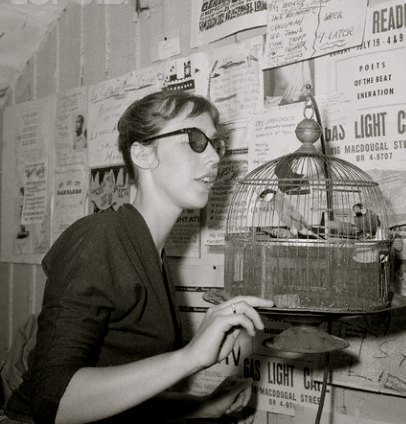
Elise Cowen
3 Comments
August 5th, 2013 / 11:00 am
August 5th, 2013 / 11:00 am
Rise in the Fall by Ana Božičević
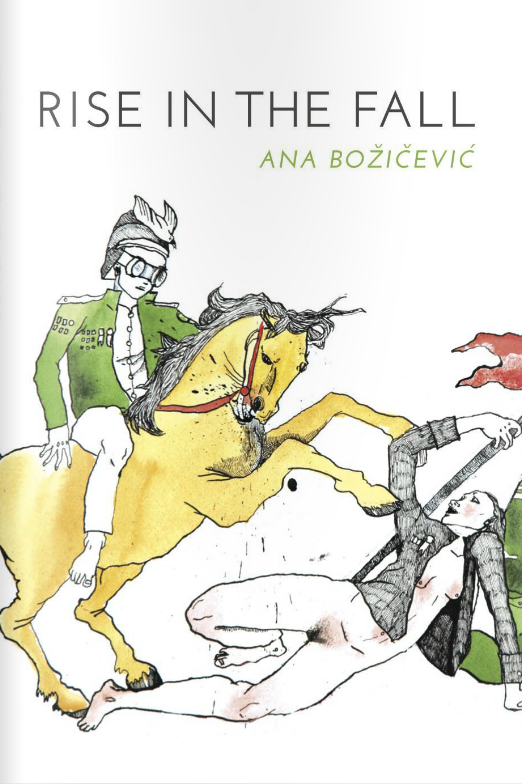 Rise in the Fall
by Ana Božičević
Images by Bianca Stone
Birds, LLC, March 2013
80 pages / $18 Buy from Birds, LLC
Mary (Feng Sun Chen) and I are sitting in a bar on Friday afternoon. We are simple about asking. We are asking: What the fuck is a sad poem? What the fuck is a joyful poem? Bettye LaVette is pushing into the air a version of “I’m Not the One” that I like better than the original by The Black Keys. Soot everywhere. “You think that I’m normal. / All these years / I’m just trying to warn you.”
I go home and look the song up and find out Lavette is quoted. “I don’t know what’s he’s [Dan Auerbach’s] saying, but I’m saying don’t fuck with me.”
Sometimes a book of poems finds you, and you type out an email to your friend describing it as, “Now I have found the Winter of my Disco Tent.” Ana Bozicevic’s book, RISE IN THE FALL, pulls at how a woman might be when she has difficult and exhausting and hard things to write about. It pulls out at how she is a speaking, loving thing who must demand from us and and rub against us, despite the fact that she knows we still might miss it, that we might not hear her. (We’re not great listeners.) Also, the book knows that can still be fun. Also, the book knows that she can die and come back and die and come back shooting out breath she made powerful herself.
The point is, it’s words, and so’s
death. Even in that silence
there’s bird calls or meteors or something hurtling
through space: there’s matter and light. I’ve seen it
through the theater of the trees and it was beautiful
death. Even in that silence
there’s bird calls or meteors or something hurtling
through space: there’s matter and light. I’ve seen it
through the theater of the trees and it was beautiful
It cut my eyes and I didn’t even care.
-Death, Is All
Comments Off on Rise in the Fall by Ana Božičević
March 25th, 2013 / 12:00 pm
March 25th, 2013 / 12:00 pm
Dreams for Kurosawa/Raul Zurita (trans. Anna Deeny)/A View
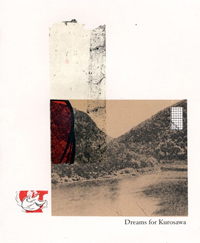 Dreams for Kurosawa
by Raúl Zurita / translated by Anna Deeny
arrow as aarow , 2012
$10 Buy from arrow as aarow
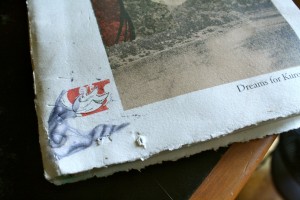
I would like you to see how I’ve scratched and bent and battered this beautiful book. I have been holding this bark relatively near to my person for almost every day of the past few months. (I don’t go to the wheezy bar or to the co-op or to any grass just outside without some kind of bike bag growing out of my back. It rains on the way. There was an angry spill in August.) Do you think it’s still in a magical shape this way? I do. I thought I might want to write something about Raul Zurita when I got Dreams for Kurosawa in the mail, and I kept waiting for the bones of the poetry to dry out. They still haven’t. They drip on me. “Once again I see the worlds,” says a line in poem simply called #2 that I repeat to myself like tattoo berries.
 Being near poetry means clanging mis-remembering and remembering together into brackish jewels. Both make the cardboard around us shine. In the case of Zurita, we have some kind of glimpse of where the lines between a real event and the logical leaps writing causes the brain to take exist. If you are familiar at all with the shapes that pus in and out of Zurita, you know he is a Chilean poet who writes primarily about surviving Augusto Pinochet’s atrocity-ridden coup d’etat in 1973. You know that his life is a circle of hinges burning around the real sadness it was pulped into. “I was seized by the Arauco brigade and before/dying I remembered the worlds” (#2). During the coup, Zurita was detained in the hold of a ship with a thousand others deemed enemies of the new military government. (He was carrying poems at the time, which were thrown into the water by a soldier. Those poems are his book, A Song for His Disappeared Love.) Over 30,000 people are estimated to have been tortured and a little over 3,000 killed during Pinochet’s time at the helm.
1 Comment
November 2nd, 2012 / 12:00 pm
November 2nd, 2012 / 12:00 pm
I Don’t Mind If You’re Feeling Alone
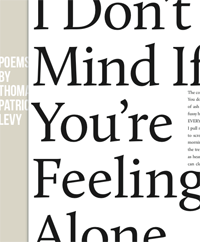 I Don’t Mind If You’re Feeling Alone
by Thomas Patrick Levy
YesYes Books, 2012
100 pages / $16 Buy from YesYes Books or SPD
I love a book about you and I. I’m not always convinced there’s anything else. One of my favorite pigeons of love, Raul Zurita, speaks in his book, Song for His Disappeared Love, of how impossibly big you and I can mean to each other, and yet, he emphasizes over and over how you and I always seem like they are on the heart twisting brink of falling apart in their own mouths. “Now the entire universe is you and I minus you and I / After the blows ended, we moved a bit and destroyed I was / only one you felt come closer” (6). What a cloth house we all are when we try to together/two gather. I’m never sure if we’re standing up or collapsing with love. I think it is going to have to be both ways if we’re actually going to climb much of anywhere. At any given point in Thomas Patrick Levy’s book, I Don’t Mind If You’re Feeling Alone, you and I are at different distances from each other, at different points of collapsing or standing with huge love. They reek of the empowered fragility that Zurita tries to illuminate for us. Levy puts you and I in cornfield after cornfield. He puts you and I next to corn-infused products and corn-infused foods and watches you and I squirm full of kernels (Why, oh why, aren’t there more glorious poems involving the most American of foods, corn?). His you and I struggle often in the house and in the bedroom of the house before they get dropped down the front of Scarlet Johansson’s dress. His you and I wake up on an island for the third time and they smell like the different kinds of cars they ride in. You and I make strange, domestic circles around each other, they sometimes touch. They sometimes speak despite all the leafy prose swaying between them.
1 Comment
May 18th, 2012 / 12:00 pm
May 18th, 2012 / 12:00 pm