
Technology
In Real Life
Last week, Blake was in town to give a reading. The first iteration of my intro for him detailed our friendship, how virtual it is, and all this hoop-la reminds me – again – of the fucked up nature of the intersection of our virtual writer-avatar selves v. real personhood. Most of the writers I have relationships with, I barely know. Most of the writers I know, I’ve spent less than a day with in real life. Most of the writers I have friendships with, we met online, interact online, and I know very very little about who they are, what they do everyday, what they care about aside from what they post online. We may interact regularly – daily, weekly, whatever – but they’re still not real, not until we meet face to face, and still, it’s within the artificial space of a conference or a reading, so it’s not really real. And yet, they must be real people with real cares. I know almost nothing about them.
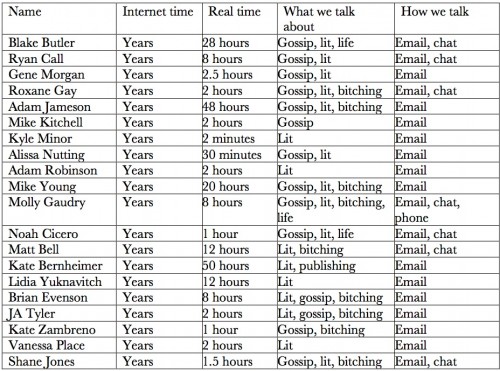
What the chart above shows – lest you fail to see the obvious point – is that almost everything I know about these people is tied up in lit and writing and their avatars. And it’s easy for me to conflate avatars with people. How you portray yourself online, in print, the stories and books you publish, they’re just one facet, a big facet, absolutely, but a mere facet nonetheless. And yet, here we are. The past few days, we’ve seen personal attacks, based solely on avatars.
When we see each other at conferences – or, in rarer circumstances, when we give readings, which accounts for the longer stretches of real time – all we have time for is gossip and some talk about literature. Not to mention that during most of this “real time,” people are majorly not sober. Maybe two or three of the people listed above know anything about my personal life, and vice versa. Are these people friends? Sure, yes, some of them. If I were in a crisis, I could easily call any number of people in the chart above, which is by no means exhaustive or indicative of the writer-people I communicate with most regularly. I can’t pretend to know much about most of these people, just what I read online and in print. And I think it’s a mistake to conflate what someone writes with the person they are, it removes the possibility of change, it assumes that when we blog or social network or email, we are being our honest and authentic selves (when the reality is that we communicate with other writers through the lens of the solidarity of our identity as writers), etc. Also, writers are the best (worst) fucking liars.
In Blake’s intro, the real one, the one I read out loud, I talked about Blake’s role in creating HTML Giant and what Giant has offered the lit community: a space to discuss lit in honest and thoughtful ways AND a space for gossip and bitching. I think both of these facets to Giant are important, equally important. If we only wrote about lit seriously, readers would get bored. If we only wrote gossip, well, writers just aren’t that interesting. We’d run out of gossip.
But then, all this Marie Calloway shit broke, and I’m reminded of exactly why I hate the Internet. I’m reminded of all the ways Giant is problematic and shitty, how misogynistic and hateful and intentionally hurtful people can be, and for no other reason than Giant is virtual. We have no investment in people as people, or at least many of the commenters don’t. Most of the contributors, we know each other on some level, we have respect for each other. And usually, I try not to treat my friends like they’re morons, I try not to treat my friends like shit – in real life or online.
But it seems like within the virtual space of Giant, avatars are no longer people. And this, non-friends, incites fear in me.
I wish we bitched together more.
Me too. Let’s fix that.
This chart would be so much bigger if you included “Tweets.”
Yeah, it sucks, but as a person who used to hang out in online communities nearly a decade back, I feel like things have improved. Or maybe it’s just that I’ve matured? Either way, the best course of action I think always is to ask yourself the question, “Would I say this, out loud, in person, directly, to this person?”
One thing that I think could help this issue is maybe inviting a place for readers to talk about non-incendiary things, any old things, things that might not apply to literature but are interesting. I lurk the punknews site, and one of the coolest post they have is a weekly one every Sunday, where anyone can start a conversation about anything they please. It offers an opportunity for people to interact like normal people instead of bickering and being snarky all the time.
HTMLGiant, I think, its setup right now is too narrow, it needs a place where the dialogue is less *directed*, which in turn reminds people that other people are people, and maybe creates friends!
That list seems really long to me. I can’t imagine having so many friends at any one time, in real life or the internet, maybe because I am loser.
I’ve been reading HTMLGiant for a few years now, but I’ve rarely commented. The biggest thing preventing me from doing so is that I feel as if I’m not “in on” a good many jokes, or references. Which, I suppose, is the same as the “in real life” phenomenon of feeling left out of a clique. Funny how similarly it translates.
And let me tell you, it’s even odder to be incredibly familiar with someone’s online persona, and work, and realize the only reason they don’t know who *you* are is that you don’t participate, but stare into their digital lives like a nosy neighbor. I can’t imagine ever meeting you, Butler, or Roxanne G. in person; I’d be like, “Hey, I totally know who you are. I read the same things you do, even. But… I guess we’re not online friends, so this is incredibly strange and inappropriate of me.”
Everyone’s just jealous because of that story you had in the Collagist last year. That story was fucking awesome.
Lets do a scenario:
We are all in a writing workshop together. HTML Giant is the teacher, and we are the students. It is the end of the semester. We have gotten to the third story. I am a student and Marie Calloway is a student. I know nothing about Marie Calloway, I am not even her facebook friend. All I know, is that she is white and has brown hair. I do not know at all if the stories she is giving the class are based off her life. These facts are unknown to me. It is my turn to critique, I state simply that I found her female leads creepy and anti-hero like and that I didn’t enjoy her epiphanies. To be honest I wouldn’t have said ugly trainwreck, my avatar said that. Because my avatar is stronger than the IRL me. If a person in the class said, “You are sexist,” for saying that. The professor would have said, “Can you specifically point out what is sexist about what he said?”
There would have been no anonymous attackers and the professor would have stepped in and demanded that people justify their views.
So my thought is: There should be no anonymous avatars to hide behind, I’m not including psuedonyms. But at least people can’t make up names like Broah Cicero to hide behind.
Second if a comment section seems to be rising above 30 comments and it is getting out of hand, HTML GIANT should have a moderator. Half of you are professors who have ran writing workshops, you know what to do.
I feel that when people started calling me a “sexist.” Which means, “Sexism involves hatred of or prejudice towards a gender as a whole or the application of gender stereotypes” I did apply anything to the whole of women. I said specifically that a female in a story seemed creepy and pathetic. In no way, does that imply that I think or anyone that agrees with what I wrote is a sexist. I did state that I did not think, Marie Calloway was a feminist because the lead characters demanded so much validation from men. Which implied I was trying to show that what she was doing was not feminism, it wasn’t anti-feminism, just not feminism.
A blog moderator could have easily said at that moment, “The last thing ten things Noah has done concerning females, either by interview or review have been positive. He is being specific and not generalizing.”
I would have felt fine with someone calling me “stupid” “an asshole” or “fuckhead.” But to have my REAL name linked with sexism, via google or bling seems like I was made the victim at the end of this.
Also, on that note:
http://turntable.fm/html_guy_ant
Play music with me! I’m drunk and probably going to try and fix my sink while we chat.
you are the john mccain of this shit
im misogynist, sexist, racist, and all kinds of shit’ist’s. i am a satanist.
So my thought is: There should be no anonymous avatars to hide behind,
I’m not including psuedonyms. But at least people can’t make up names
like Broah Cicero to hide behind.
I don’t think this alteration, even if I agreed with it, is possible, unless you started doing IP hunting, which I think would be encroaching on a person’s privacy. Why I disagree? This isn’t a workshop. Furthermore, I mean, fuck, when you sign up to be a writer, to present anything to any public ever, you gotta be prepared for unfair scrutiny, or adverse reaction, or people arguing. Would you have preferred everyone just say “I agree! Good point”, and then we put on some brown shirts and dance to a Sousa march? Chaos over uniformity, especially when the chaos exists in a vacuum such as a comment thread on an online blog.
Blog moderator is bad idea. I’ve had people who run this site give me an attitude for the simple act of disagreeing or complaining about something going on in a post; I wouldn’t trust any of them to be unbiased. I like a lot of them, those I met in real life were cool. But online? No, none of them qualify as arbitrators. For being writers, writers don’t communicate online in text boxes very effectively.
However, the fact is, you can moderate on your own. You can counter every flawed argument on a thread with a reply and try and work each disagreement out. This might sound like a lot of work, or exhausting, but it isn’t that much, really, dialogue for the sake of mutual understanding shouldn’t be a chore, so long as we don’t murk the stuff up with emotions, like Bill O’Reilly or one of those other scumbag propagandists.
As for having your name linked with sexism: Who cares what people say, especially if their accusations are unfounded? Let them live with being narrow-minded and unfair. What they say shouldn’t matter to you?
Idunno. Most of the times I like what you say, so I hope this don’t come off as an attack!
Anyone wanna play tunes and chat tonight?
http://turntable.fm/html_guy_ant
It will be fun! I swear to effing God. Unless you’re hanging out with real people, in which case hang out with them.
missed it damn
Wow, I’m, like, way up there IRL!
I love you, Lily!
yeah, you’re right. Just feel like frustrated with anonymous people calling me shit.
Just be chill eh. I have this little fiction in my head where getting
upset about being dissed on the internet turned you into getting kind of
passionate about feminism (because you read lots of feminist articles
for your arguments and realised the patriarchy is a bitch to you too). And at the end of the story you wear a dress for 40 days and become some epic feminist activist haha.
http://www.youtube.com/watch?v=HlPZihRKCzA
I’m not on Twitter, and now I feel like it’s too late. I didn’t include FB either, thought about it, but I ran out of space on the chart.
This is an arbitrary list, Luke. I correspond with some of these people maybe once a month, if that.
Hi D – We are all nice people. That’s kind of my point. Online, we have all sorts of different personalities, but in person, most of us are awkward and socially inept. Ok, I am awkward and socially inept. If you came up to me and said hi, I would probably run away.
Noah – HTML Giant isn’t a workshop though. It’s a blog. I run workshops for a living, and part of the reason I love writing for Giant is that it isn’t a workshop.
We do have someone moderating comments, but again, part of the joy of a place like Giant is that it’s mostly democratic. We rarely flag or delete comments, and when that does happen, people freak out. I like that anyone can say anything. Sometimes, I dislike what people say, but my personal reaction is irrelevant. (For instance, most of the time, when I post something here, I don’t come back for a while, or I don’t comment at all.)
Yes, I bitch and complain about anonymous avatars, but when it comes down to it, because we all barely know each other, everyone is anonymous, some of us have just tagged our names. Idk if that even makes sense. I’ll respond more fully to everything else via email.
Haha, Adam! I’ve spent time with you, yes. I would like to clarify that I mentioned that the table above is arbitrary and it’s been manipulated to make a point. I deleted aberrations, like Michael Stewart, who if I lined up the time we’ve spent together, it’d be in the years: we went to undergrad together, waited tables together, played chess and Go for hours, he’d sit in the smoking section – not smoking – so we could talk. I didn’t include Carmen Gimenez Smith and Evan Lavender-Smith, who I spend a lot of IRL time with, because we live in the same city. (I hang out with Carmen just about every day, like face to face.) But Adam, you are fabulous to the max.
:DDDDDDDD
I messed up. Satanists would never do: “:DDDDDDDD” Dang.
Noah Cicero –
I liked your comment (in a comment thread elsewhere on HTMLG) about growing up in the Midwest with brothers and about your mom. I grew up in the Midwest too, with brothers. So you ‘seem familiar’ to me. I would never call you sexist. But I think (hope) that all this discussion (that you have given rise to) is broadening your ways of thinking. You said you are living in Korea. This should also expand your mind/worldview. This is a good thing. I moved to San Francisco after college in Indiana, and what a change I experienced in my own worldview.
Keep writing! I think you have a unique voice, and you seem to me to be full-to-bursting with humanity.
– mimi
yeah that can be weird. i’ve been hanging around this site for like 4 years now, i think, and always felt rather shy/didn’t rlly give a fuck about commenting, mostly cuz i just like watching people act stupid, but because i felt like an outsider, too. the first people i met IRL and actually talked to and spent time with were jimmy chen and blake butler, who turned out to be some of the best, most important guys in my life. they’re chill. they’re funny. they’re weird. they’re incredibly self-aware. they’re kind. it’s awesome to meet people IRL whose ‘online personas’ don’t seem like personas at all (well, this can be bad, too. there are plenty of assholes around here who are sad sacks of fucking slime shit IRL), but good people can be good people online, too. it happens. anyway, i guess i should say don’t hesitate to meet some of these folks you only know in an online way, you could end up with some awesome fucking friends who could give 2 shits about whether you’re ‘in’ or you’re ‘out’
“there are plenty of assholes around here who are sad sacks of fucking slime shit IRL” made me lol lo lo (prolly wouldn’t ‘normally’ have replied to your comment but really wanted to type “lol lo lo”)
Aw, thanks!
I am offended I didn’t make the list Lily!
I’m glad you brought this post back up, mimi, because it resonated with me as well, as someone who didn’t always have the best social circumstances. One thing I’ve noticed about the lit blogosphere is a sort of classism. People spend a lot of time discussing women and feminism, and I think that’s great, but some of it feels a bit upper-middle/upper-class to me, like most of the discussion is led by people who are fifth-generation college students or something. Am I wrong? I see a lot of outright dismissing of “violence,” or over-simplification of masculinity, the kind that I probably wouldn’t see from working-class feminists, or discussion of gender in general without connecting it to class. In this country, we love talking about race and gender, but we avoid class like the plague, which–IMO–is the elephant in the room.
Let me say this…if you’re a man, and you spend time in a working class environment, or, say, an institutional space, negotiating violence is part of your world. To deny or dismiss this reality from me–and others, like Noah–is to render a harsh reality invisible. I’m also uncomfortable with this idea that claiming a “region”–like “Midwestern” or “Southern”–suggests a lack of “worldliness,” or that I can’t be as worldly as someone who has done done several stints in the Peace Corps. For these reasons, I’ve never really felt like I fit in anywhere–I’m the nerd or geek back home, the “pussy who reads books,” and I’m Joe Regular in the literary world, the guy in jeans and a t-shirt who would rather watch football at a bar than attend a writer’s conference with a bunch of people who decided to become writers at the age of four. For some of us, though, it would’ve been very difficult to make that decision at a young age, and there’s a reason why many of us didn’t “become” writers until we left home (literally or metaphorically). Sorry if this is kind of tangential, but your post struck a chord with me, because I feel like “get” where Noah’s coming from too; even if I can see some of his flaws, I think he means well, and I think it’s a bad idea for people to dismiss him as some simple-minded Al Bundy.
Whatever, Lincoln Michel. You’re cooler than any list. xo
Hm. I think I’ve spent more time with you than anyone else, actually.
Save Jeremy. But he’s a robot I designed and built, so he doesn’t really count…
The hagakure says that a samurai should meditate on his death, and every way of dying, so that when a katana fight breaks out he won’t hesitate–he has already envisioned his death–and his resolve will remain concrete.
Maybe you should do that before participating at HTMLG. Or any internet forum.
Because butt sorrow sucks.
Liar, except Jeremy being a robot, that must be true.
Jeremy just informed me that I am the robot.
That’s also probably true. I should stop hanging out with robots, or, I should hang out with them more often.
Also something about me having a bomb in my chest? Wha—?
Man, I have no clue about the “Calloway Fiasco of 2012” but sounds like the same old shit.
Lily, my gripe about this article is where’s your list of ‘enemies’? What I’m trying to say is the idea of a friend has become so muddled in the 21st century that people believe friendship comes as easy as a click of a button.
Being friendly to someone does not mean friendship. Genuine friendship is a cup of tea after a long war, not an orange julius while shopping for dockers.
I’ve known Blake since 2007, I think? I even have a cat named after him, but we aren’t friends. I cherish the times he was friendly towards me because it came during a period of my life when I was depressed and suicidal. But I barely know that nigga.
I named a dog after Jimmy Chen but she died as a puppy. Jimmy and I are no longer ‘internet friends’ because I was “a dick on facebook.” Clearly a genuine friend would not abandon a relationship over facebook antics? But I am still friendly towards him. He’s a good guy.
On the other hand, I consider two writers my actual friends: Ken Baumann and Sam Pink.
The dog who survived when Jimmy didn’t is named after Sam. I just spent thousands of dollars to fly to Chicago to visit him. The money was well spent, and I’ll gladly do it again.
My introduction to Ken was through the “blogging on bloggers” collective project back in the day. After hearing he was local to me, I told him I didn’t want to meet in real life. Throughout the years we’ve spent time with each other, and I love that shithead like a brother now.
The people you feel a valid connection with are the ones you should try to visit outside of this virtual world. Make a genuine friend. You’ll enjoy their existence a lot fucking more.
The brief version of the above: THIS IS NOT AUTHENTIC SUNSHINE.
hahah they would so
Jereme – This wasn’t meant to be authentic sunshine. Nor am I. I guess that’s part of the point, right? If you were to look at my online persona, you’d think I’m all happy and shit. Either that, or very very neurotic. The latter would be true, the former complete artifice. The friendships formed online are all based on artifice. I don’t “know” most of the people on the list. Again, that was the point. Because I don’t “know” these people as people – but as avatars – it’s not right for me to launch personal attacks on them. Can I question their writing or their online personae? Sure. But not them as people.
I live in a small town, so really, I have all of four friend IRL. And I’m fine with that. My IRL friends are supplemented by my virtual friends. They play very different functions. And for a small number of virtual friends, we get to be IRL friends too, but space separates us. There are limitations to our friendship.
Let’s take you, for instance, we’re friends via FB and here. We joke around. Maybe we’ve exchanged some messages, but I don’t know you at all. I like you, sure, but I’ve never met you, and even if I did, so much of our interaction would be based on what we know of each other online. Maybe, Jereme, one day, I’ll go to LA and we’ll hang out and we’ll get trashed together and then, we’ll be real friends. Maybe, maybe not.
As far as hating on people, I prefer not to go there. I’ll be honest with you, when I was originally composing this post, it was venomous against some of the key players in the Marie Calloway shit. But, what’s the point in taking people down? What’ll it do? Many commenters have been pretty shitty to me before, and maybe they think there’s some kind of power in it, but to me, it’s just plain fucking insecurity, and I don’t need to prove to anonymous avatars that I’m anything at all. I’m writing all of this to you, with honesty, because I like you, I respect you, etc.
This sort of begs the question, too: How do you talk to your IRL friends about your online presence? Is it an embarrassing topic? I used to find it embarrassing, and I still sort of do, if I bring it up I roll my eyes in a self-deprecating fashion (“Lame, I know”).
the way i see it, it’s none of their business unless i make it their business
“butt sorrow sucks”, that’s great
gonna hafta remember that one
Lily, not everyone is a persona. There are a few of us who don’t create a buffer, who are not afraid of ourselves and even less afraid of outside forces knowing who we truly are. But I feel you.
I know you didn’t mean to be authentic sunshine but people are apt to misinterpret. Like, is this post authentic or simply another manifestation of a persona?
It gets confusing.
Also, why is being hateful not okay if everyone is an avatar of a persona?
I think it difficult to not interpret a valueless world based on integer values where everyone is a false identity as a joke. At least it is for me.
I’m a Gargamel and you’re a care bear when it comes to internet ethics. I think both are valid points of view.
Here’s why attacking someone is important in virtual reality: it destroys their filter for a brief moment.
Take Noah Cicero for instance. People attacked him for his Marie Calloway post, which I didn’t finish because the million instances of the word sex kept me distracted. Obviously Noah didn’t like being attacked. His response: a call for a police state at htmlg. This information paired with Noah’s interest in politics is a scary revelation, for me at least.
I hope one day we do get to hang out, Lily. But partying with me isn’t going to make you my friend.
My definition of the word is not a robust one.
Why are you embarrassed, Frank?
What’s up mimi!
Frank – Before, when most of my friends weren’t writers, I didn’t talk about my online presence, because no one cared. We talked about other shit. Now, the friends I have are also writers in the academy. They know about Giant. So we talk about online shit now and then, but we talk about a lot other things too, unrelated to writing or Internet.
But no, I’m not embarrassed about it. I’m a big nerd – anyone who’s met me can attest – so the truth that I spend a lot of time online shouldn’t be a surprise to anyone.
So you’re saying you don’t want to party with me? Here are my hurt feelings, but you can’t see them because they’re virtual.
Lily, don’t be like that! Anyways, my party and your party are too different worlds. I hope you ‘get’ the connotation here: no, I don’t want to party with you.
But i’m down if you want to sneak into griffin park at midnight and do dmt, or eat some lsd and stupor around venice, or get real high then eat 4 or 5 sandwhiches at philippe’s.
Or we could just walk Hollywood Blvd and talk.
It’s kind of complicated to explain. I think a lot of it has to do with just being a very neurotic dude. In high school and college I was a pretty popular kid, and, Idunno, I think maybe I felt guilty having all of these people in real life I cared about and loved who sometimes I felt I neglected because there was a heated comment thread on LiveJournal or I wanted to spend a Friday night talking to people in a Soulseek chatroom. I don’t think I actually did neglect my real friends, but I was always afraid that one day it would shift into that level of obsession, and that fear grew and boiled and festered into a self-imposed criticism.
Why do I need the approbation of people I might never meet, who wouldn’t really care too much if I one day I (or my username or avatar) just ceased to exist? Am I just some sort of parasite for attention? Do I just want people to tell me “Good job” before I move onto someone else? Where do I get off pulling that shit anyway?
Because this is how I think, I assume it’s how other people think, too, which makes me believe admitting my online activity to someone is the same as saying I am some sort of loud-mouthed look at me attention-monger. I should also add I don’t have that attitude toward anyone else who posts here, or anyone I’ve ever really run into online. I just like being hard on myself.
So, you know, neuroses, yeah, that certainly plays a role.
I think also a lot of it has to do with remnants of high school. I was
on sports teams, so I interacted often with very mean people, and
these very mean people constantly looked for reasons to hurt the
people around them, including admitting to hanging out on the internet
or playing video games or being in the marching band, so I often go
into conversations with others thinking that they are just more very
mean people who are going unfairly judge me, and it’s better to try
and downplay my hobbies instead of justify them.
I should also clarify: I’m not really like super embarrassed about it,
I’m always growing more and more at peace with it. I am just reluctant
to talk about it, it’s not a thing I like boasting about, but at this
point I also know if someone has an issue with it they aren’t worth
the company and can go to hell.
This conversation is really interesting, though it seems everyone creates a buffer, even IRL. Especially IRL. Persona meaning “mask” etc. I also don’t think anyone has one “true” persona, but multiples that shift.
Heh, yeah, high school. I’m really glad I missed most of it.
But mean people exist regardless. I think you’re creating neurosis by not being honest about them. What does it matter if someone calls you a name or shits on you for liking opera? The hurt is genuine because you internalize it as such.
I think Mimi shares my thought process. The group of people I associate with is versatile. When I’m smoking blunts with the hood friends I don’t feel a need to tell them I’m a poet, or etc. Sometimes it gets mentioned, but it’s always casual.
The graffiti artists I hang out with don’t spend much time talking to me about their work.
I think a significant difference is found between reluctance to talk and casual talk of a subject.
Don’t ever feel embarrassed of who you are as long as you believe in who you are.
If that makes sense.
Brooks, I think most people do create buffers, especially IRL. I also think most people create buffers within their psyche, a sort of avoidance of truth. I do not.
I don’t think you will believe me either. Nobody does.
The first time someone called me an internet persona I got very angry. It was Brandi Wells during a gchat. She wasn’t being derogatory, but I instantly wanted to ruin her face with my knee for saying it. Which isn’t a normal thought process for me.
A common comment on my life outline published in Lamination Colony from writers is a disbelief that the writing is factual. It is. 100 percent.
I know an authentic person is a difficult concept to understand. I’ve stopped trying to convince people.
See, I believe you. (I’ve also read your LC piece) I think everyone puts out a buffer (or creates a persona) in the sense that they are selecting what to say at any given moment. Even if they are choosing one honest thing to say, they are still choosing. The only people who fully express every single thought on their mind ALL the time are probably literally insane.
I also probably don’t believe in the authentic “person” because no one is just one person.
truth:
A person (plural: persons or people; from Latin: persona, meaning “mask”) is a being, such as a human, that has certain capacities or attributes constituting personhood, the precise definition of which is the subject of much controversy.
http://en.wikipedia.org/wiki/Person
I am a wikipedia link pimping piece of software.
I don’t get it. You wrote an article that was extremely critical of someone, but when people are critical of your article you get frustrated and defensive. Did you ever consider that maybe your self-perception of yourself re: sexism or your understanding of what sexism etc might be wrong?
Or that it’s possible that everything you’ve ever done in your life leading up to wring that article have been anti-sexist and wonderful but that this history of being wonderful has no relation to the sexist content of what you wrote? Or that it’s possible to be a great person but still write something that is problematic for whatever reason? Or that criticism of your ideas/writing is not an attack on you as a human being (or else why would you criticize the writing of Calloway?)?
jeremy, i’ve missed you, you little hootchie-kootchie.
“Graph”?
“pharg?”
Thanks for the response. I mean that sincerely!
But mean people exist regardless. I think you’re creating neurosis by not being honest about them. What does it matter if someone calls you a name or shits on you for liking opera? The hurt is genuine because you internalize it as such.
It’s not so much I am afraid of a person disliking me for liking particular things. It’s more that I don’t like people dismissing me unfairly. When I hear that a stranger I barely met dislikes me, it angers me a lot, because it means they’re not giving me the same chance I’d give them. And I don’t like being angered. So I’ll keep the habits of mine that people unfairly judge on hold until they trust me enough that I can mention them and they won’t stop talking to me. Does that make sense? Social interactions are weird.
Don’t ever feel embarrassed of who you are as long as you believe in who you are.
I totally agree with that. I’m a pretty self-confident person. I just know that a lot of people are lazy and will dislike me for the laziest of reasons, and even though that is deplorable, I still want to meet these people and talk to them, because I feel I want to make friends with everybody ever, especially if they’re insufferable, because I like to have the opportunity to explain to people why they are insufferable. I guess everyone I know interests me so I don’t want to lose any of them.
But don’t worry, Jereme! I am a confident able fellow. I just analyze/over-analyze like a nutjob!
Yes, Jereme Dean, if I’m ever in LA
damn, i wish htmlgiant was as good as it used to be so id read it more often so i wouldnt miss the very few times something interesting happened here…
friendship is truth and sadness and loyalty everlasting and encountering it on the internet is rare.
life is beautiful. god bless.
lurk moar
I hear the glorified book fest is coming to LA in 2015.
I think our definition of persona differs slightly, but I’m picking up what you’re putting down.
A transparent authentic identity might be a better phrase than authentic person.
I think the discussion in this thread about persona, identity is also a useful way to think about a writer’s Voice.
I’m not talking about writing or prose “style” but something deeper.
I read your piece in Lamination Colony as a result of this thread, Jereme. It gave me an emotion I have never had before, related to death, that lasted for a long time. I could say that it’s because you have a “strong voice.” But really, what does that mean?
I think this is an aspect of literature that evades “literary analysis”. Although I could use literary analysis to explain why the piece created its effect, I think the real answer is that a strong voice in writing comes from the relationship that the writer has had with his or her own thoughts and feelings over their entire life. That piece in Lamination Colony is like a perfect example of this phenomenon, because it transmits those things nakedly in a very compact way, literally over the course of your life.
What is voice? Supposedly, everyone has one.