
Technology
kiddies, need 2 steal a paper on Moby Dick?? u can have mine 4 free!!!
The Multivalent God of Moby Dick
by you!!! <3
Herman Melville’s complex renderings of god convey the influence of a dichotomous religious upbringing. On Melville’s mother’s side was the Dutch Calvinist church, with its focus on man’s sins and damnation. From his father, he gleaned the more liberal values of Transcendentalism and Unitarianism: a faith in man’s essential goodness.1 “We incline to think that God cannot explain his own secrets,” he wrote to Nathaniel Hawthorne in 1854, “and that He would like a little information upon certain points himself. We mortals astonish Him as much as He us.”2 In Moby Dick (1851), Melville employs multiple symbols, including the ocean and the whale, to illustrate a god in flux. God is portrayed as an entity, which, like the whale, is not completely visible or knowable to man in its entirety. God’s existence, the shape it takes, depends on the perspective of the human who perceives it. Each character’s view of god is molded by his own innate attitude or constitution, as well as the external events of his life. In turn, a weave is created, wherein god and man are both contributors to the shape of a man’s destiny, as well as his perspective of a supreme being.
Melville prepares the reader for symbols that fluctuate in translation, when Ishmael asks that the story not be taken as a “hideous and intolerable allegory”3. Ishmael’s request is humorous, in that his tendency toward a grandiose narrative and his persistent use of metaphor lend themselves to an allegorical tone. Yet Melville’s use of this plea conveys to the reader that he does not wish for the novel to have a solitary meaning. Rather, the narrative, symbolic and thematic meanings of Moby Dick operate on many levels. Ahab, the ship’s captain, seeks vengeance on Moby Dick as he might an “evil” or “demonic” God. Alternately, Ishmael’s relationship to the white whale is more ambiguous. He says:
What the white whale was to Ahab, has been hinted; what, at times, he was to me, as yet remains unsaid. Aside from those more obvious considerations touching Moby Dick, which could not but occasionally awaken in any man’s soul some alarm, there was another thought, or rather vague, nameless horror concerning him, which at times by its intensity completely overpowered all the rest; and yet so mystical and well nigh ineffable was it, that I almost despair of putting it in a comprehensible form. It was the whiteness of the whale that above all things appalled me. But how can I hope to explain myself here; and yet, in some dim, random way, explain myself I must, else all these chapters might be naught. 4
Ishmael uses the words “mystical” and “ineffable” to convey the omnipotent and omniscient existence of Moby Dick, and his own relationship to god’s mysteriousness. He affirms that the more “obvious considerations” as to why a man might fear Moby Dick—the whale’s size, his seemingly random violence against man—are indeed justified to inspire terror. For Ishmael, it is “the whiteness” of the whale that most frightens him. This whiteness may be read as an absence of god or meaning: a blank existential canvas, upon which, man is forced to make his own meaning. The whiteness also connotes Ishmael’s resistance to the superiority of god, much like his growing resistance to the perceived superiority of whiteness in American culture.
Ishmael also paints a picture of the sperm whale as a creature that cannot be perceived by man all at once, only in parts. On land, man is able to see a whale’s carcass. Similarly, man can grasp various glimpses of god in a church or other house of religious worship. On the sea, a sailor gains a palpable experience of the whale; yet the creature is not completely visible, and the sailor’s perception depends on his own perspective. Of the whale’s tail, Ishmael says:
When Angelo paints even God the Father in human form, mark what robustness is there…
Such is the subtle elasticity of the organ I treat of, that whether wielded in sport, or in earnest, or in anger, whatever be the mood it be in, its flexions are invariably marked by exceeding grace. Therein no fairy’s arm can transcend it…
Dissect him how I may, then, I but go skin deep. I know him not, and never will. But if I know not even the tail of this whale, how understand his head? much more, how comprehend his face, when face he has none? Thou shalt see my back parts, my tail, he seems to say, but my face shall not be seen. But I cannot completely make out his back parts; and hint what he will about his face, I say again he has no face. 5
Like god, the whale possesses “grace” as a result of its mystery and size—no matter what “mood” may characterize it. What’s more, a human can only go “skin deep” when describing the whale. The whale does a have a face, and perhaps, then, God does too. But to the human who can only see the tail of the whale, a piece of god, the divine might as well be faceless. Thus, the whale is bestowed the attributes of a god who chooses consciously to say “Thou shalt see my back parts” but will never be revealed in its entirety.
Melville also utilizes the sea to convey man’s essential aloneness and the vast and unknowable nature of god. Such is depicted when the ship’s cabin boy, Pip, becomes an oarsman in second mate Stubb’s boat. When a whale bumps up against the boat’s bottom, Pip becomes frightened and jumps overboard. He is then lectured, because the crewmates have to abandon the whale in order to rescue Pip. Upon jumping a second time, the crew then leaves Pip overboard to fend for himself. Ishmael says: “Out from the centre of the sea, poor Pip turned his crisp curling, black head to the sun, another lonely castaway, though the loftiest and the brightest.”6 Ishmael’s use of the word “brightest” conveys his affection for the jolly Pip. What’s more, the word creates a contrast when juxtaposed with the color of Pip’s skin and hair, which are “black.” Along with the word “loftiest,” Pip’s brightness also depicts an ephiphanic moment with a higher power. Deserted at sea, “another lonely castaway,” Pip comes face to face with his own aloneness, as well as with the infinite mystery of god.
Once back onboard the ship, Pip is changed as a result of his encounter with the sea. The crew deems him an “idiot” for his strange behavior on the deck from that moment forth. Yet Ishmael believes that Pip’s soul experienced “wondrous depths” and gained a cosmic “Wisdom” in the sea. He has touched “God-omnipresent” and encountered “the colossal orbs.” Such experiential knowledge renders him worlds beyond “mortal reason” and so he appears “insane.” It is not possible for a man who has tasted the divine to live among his fellow humans as he once did. This man, knowing a higher plane, becomes “indifferent” to the mortal world: a mirror of god, whom Ishmael also describes as indifferent.
In the dramatic end of Moby Dick, Herman Melville creates a statuesque description of the sinking Pequod. He utilizes words like “suspended,” “wrapped,” “erect” and “hovered”7 to describe a final action taken, wherein Tashtego, a harpooner, hammers a red flag into the ship’s masthead despite its terminal end. Such language conveys a sense of fate, as though the destruction of the Pequod is frozen in time and cannot be altered. As is characteristic of Melville’s work, a multivalent subtext lies beneath the notion of destiny.
Captain Ahab, who embodies the stubborn will of man, may be read as the obvious catalyst for the ship’s fate. Surely it is Captain Ahab’s relentless quest of Moby Dick that provokes the ship’s demise; a quest inspired by his own relentless will. Yet there are unseen forces that come into play as well, the mysterious powers of god and nature. These variables are present in the ocean, the whale itself, as well as in Ahab’s accident with Moby Dick that occurred years prior.
On one level, the red flag conveys the devilish and destructive nature of man’s prideful will, especially when pitted against the will of god or nature. Such is evident when a “bird of heaven” is caught in the flag and taken down with the ship “which like Satan, would not sink to hell till she had dragged a living part of heaven with her…” But the flag may also be seen as a symbol of courage; a noble nod to the persistence of man’s will, or “forward-flowing heart,” in spite of uncontrollable elements.
The final scene of the novel, wherein Ishmael utilizes a coffin as a lifebuoy, also explores the intricacies of fate, man’s will, god and nature. The builder of the coffin, Ishmael’s friend Queequeg, possessed peace and a close relationship with god. In turn, the coffin may be perceived as a divine rescue of sorts. But it was Queequeg as a man who took it upon himself to build the coffin, not an act of divine providence. What’s more, the coffin was put in the position of a life buoy by the ship’s mates: Starbuck, Stubb and Flask. In this vein, the coffin may be read as a triumph for the bond between men: the holiness of friendship and its ability to shape human destiny.
In a modern America, where the cultural landscape is still very much imbued with religious fundamentalism, Melville’s Moby Dick is a reminder of the ambiguous, fluctuating, and ultimately personal nature of faith. In an 1851 letter to friend and fellow writer Nathaniel Hawthorne, Melville quoted Johann Wolfgang van Goethe, writing “Live in the all.”8 Readers may be quick to “live” in a single meaning of Moby Dick—narratively, symbolically, thematically—because it is more comfortable to dwell in the reductive mind. Ultimately though, Moby Dick asks to be read through multiple lenses, perhaps even all at once.
LIVE IN THE ALL!!!!!!!!!!!!!!
Footsies:
The Multivalent Race of The Adventures of Huckleberry Finn
Twain’s complex renderings of racial difference convey the influence of a dichotomous physical anthropology.
In a modern America, where the cultural landscape is still very much imbued with racial theorizing, Twain’s Huck Finn is a reminder of the ambiguous, fluctuating, and ultimately personal nature of identity.
The Multivalent Society of The Great Gatsby
Fitzgerald’s complex renderings of political economy convey the influence of a dichotomous social contract.
In a modern America, where the cultural landscape is still very much imbued with class conflict, Fitzgerald’s Great Gatsby is a reminder of the ambiguous, fluctuating, and ultimately personal nature of accumulation.
The Multivalent Ethics of The Sun Also Rises
Hemingway’s complex renderings of considered action convey the influence of a dichotomous moral intelligence.
In a modern America, where the cultural landscape is still very much imbued with guilt and shame, Hemingway’s Sun Also Rises is a reminder of the ambiguous, fluctuating, and ultimately personal nature of virtue.
The Multivalent Family of The Sound and The Fury/As I Lay Dying
Faulkner’s complex renderings of family relationships convey the influence of a dichotomous psychosexual development.
In a modern America, where the cultural landscape is still very much imbued with familial turmoil, Faulkner’s Sound and Fury/As I Lay Dying is a reminder of the ambiguous, fluctuating, and ultimately personal nature of family bonds.
Ludwig Van
Johann Von
who are you?
You know, I’ve never seen anyone just ask directly.
Maybe deadgod will just answer…
i like to imagine that blake butler has dissociative identity disorder and deadgod is one of his alters
let us know what grade you get on this
That would be amazing.
The Multivalent Offerings of the anonymous internet commenter
deadgod’s complex renderings of internet commenting, wrought with blogicle-clogging “bloggercloggers” and notorious neologisms, convey the overactivity of a well-read, generous, wandering, probing mind.
In a modern cybersphere, where the textual landscape is still very much imbued with identity turmoil, deadgod’s commenting is a reminder of the complex, ambiguous, and ultimately personal nature of identity, anonymity and self-expression on the internet.
gawd i can’t believe no one here knows who deadgod is
as a side note, this new disqus format blows. not sopa but getting there.
got an A dawg. ask me about my 10 year MFA program!
[asks you about your 10 year MFA program]
[doesn’t know if this whole post was a joke or not]
blarrrrrrrrrrrrrrrrrrrrrrrrrrrrrrrrrrrrrrrrrrrrrrrr
the grandpappy of our experimental literature is no joke.
i did get an A.
been in an mfa for 6 yrs b/c i don’t want to go into debt for poetry so i take one class a semester.
oh that’s cool, i didn’t even know they’d let you do that. seems preferable even, maybe.
it’s a good way to go. you’re consistently half-dunked in poetry for a long stretch rather than being completely immersed for 2-3 yrs and then catapulted back out into “the world.” and you can work.
this is a decent paper. good job. it should get a lit teachers dick hard. lots of words with lots of syllables. heres to 4 more years of pretty words,
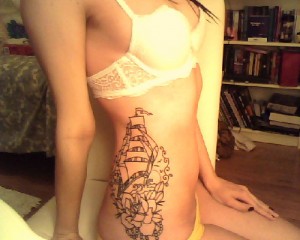
nice tat
I wish I had this paper back when I needed it. You substantiate all sorts of declarations that I was afraid to make — my paper just said that if you wanted to say anything about this novel, you have to rewrite it word for word, because as you put it. it has to be read “through multiple lenses.” Nice how you managed to say that, and other things. A+
We should all have to post our papers on Moby Dick — I mean, it is the sole criteria Blake needs to approve in order to get hired as a writer here.
yeah i’ve always wondered how i snuck in with that billy budd paper
I was like — I’d prefer wha?
my only work cited was the novel. wondering if i was the only person who just wrote papers straight from the text…happy you mentioned pip…
You get an A+ for close-reading.
luv dat pip scene–any psychic break is a friend of mine. hi worthington!
thanks. it’s not mine. wish i wuz that skinny.