Alec Niedenthal's fiction appears or is forthcoming in Smokelong Quarterly, Agriculture Reader, Sleepingfish, PANK, Corium, and other places. He currently lives in Sarasota, Florida, where mostly it is hot.
Literary critic David Winters, co-editor of 3:AM Magazine, has steadily developed a style and practice of review that can only be called materialist. Rather than “evaluate” a book, Winters qualifies its relationship to the broken and stultifying world from which it originates–not as an outright transcendence of that world, but as a moment, an effect, of its awful machinery, the gore and rancor of a history that has in many ways forgotten to bear a future. The book as such does not seek to solve the problems of the anima mundi but instead to put them on stage and in motion. So the work of literature, David argues, would not be the archangel of the everyday, but would try to give shape to its devastation, to the series of social splits and divisions whose conjunction make the novel possible, if not, David suggests, also threaten it with obsolescence. By focusing on this element of the book–its immortality and undead texture, its position as both a social given and a reflection of such givens–David has aligned materialist aims with a new form of criticism: a reading of the work as a weapon and not simply a code, and moreover, a weapon that can be trained on both itself and the present in which it is embedded. The following is an extended interview with him. Enjoy.
Not really, but close. In this new episode of Emily Gould’s “Cooking the Books,” Jon Cotner and Andy Fitch make green juice and read from their collaboration Ten Walks/Two Talks. Along the way we learn that Cotner and Fitch met as 19-year-olds in Boston. They were both crashing on someone’s roof, and started talking. They’ve kept talking. We also hear some thoughts about Basho and zits.
Timothy Donnelly, who selected Ten Walks/Two Talks as a Best Book of 2010 for The Week, included an excerpt from Cotner and Fitch’s new project Conversations over Stolen Food in Boston Review‘s National Poetry Month celebration. The short piece is called “Spiritual Laws.” It takes place in a grocery store they call “W.F.” This excerpt moves from Emerson, to a kid who soils his shorts, back to Emerson, then ends with a discussion of anxiety and bicycles.
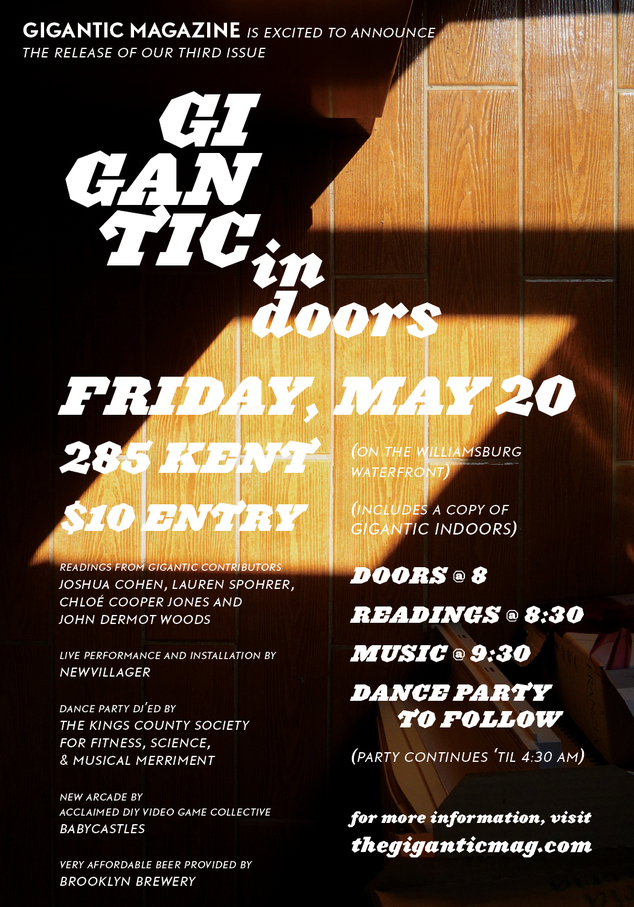
New York City’s consistently innovative print/online journal Gigantic is launching its third issue (Gigantic Indoors) in Brooklyn on Friday 8-4:30 AM. Beer’d by Brooklyn Brewery, “live performance and installation by Newvillager,” and on the Williamsburg Waterfront (!)–all the trappings of a Williamsburg soiree (what my parents used to call a “function” or “gala”) without the constant discomfort and guilt. “Our people” don’t often throw such massive events on this side of the borough, so take advantage, please. Readers include: Chloe Cooper Jones, Joshua Cohen, Lauren Spohrer and John Dermot Woods. Admission is free for subscribers, and $10 for non-subscribers. Please RSVP here, on the Facebook. Attractive people will not receive free admission simply because they are attractive, easing the resentment that their less attractive friends already feel toward them.
Elegant but problematic write-up on The Pale King in GQby John Jeremiah Sullivan. Read it for the elegance, but I’d like to unfairly isolate the review’s conclusion, which alarmed me for the reasons articulated below. Quote:
Wallace’s work will be seen as a huge failure, not in the pejorative sense, but in the special sense Faulkner used when he said about American novelists, “I rate us on the basis of our splendid failure to do the impossible.” Wallace failed beautifully. There is no mystery whatsoever about why he found this novel so hard to finish. The glimpse we get of what he wanted it to be—a vast model of something bland and crushing, inside of which a constellation of individual souls would shine in their luminosity, and the connections holding all of us together in this world would light up, too, like filaments—this was to be a novel on the highest order of accomplishment, and we see that the writer at his strongest would have been strong enough. He wasn’t always that strong.
Insightful, or regurgitation of the “humanist” DFW diet? At what point will critics realize that there is not one single sense to DFW’s work–that is, Wallace as what Kyle Beachy, ironically or not, called the “empathy machine,” the brain with a heartbeat? There is no question that this caricature of Wallace suits our time, but it nevertheless should be considered as just that: a pitiful reduction of what Wallace demands, and the ensnaring of criticism in the dangerous matrix of “human values”–as if he awoke from his postmodern slumber merely to mourn the “souls who would shine”–which is, incidentally, my answer to Blake’s recent post. Answer: a critic should be critical, a problem which will be the challenge and measure of reviewing The Pale King.
Via Adam Wilson‘s Facebook feed: a list of the “worst” analogies written by high school students, as selected by their teachers. As this blog post notes, the predicate of “worst” is an oversight, or at worst a condescending and misguided error–many of these analogies are sharp if not artful in what Adam, I think perceptively, called a “Lishian” way.
The whole scene had an eerie, surreal quality, like when you’re on vacation in another city and Jeopardy comes on at 7:00 p.m. instead of 7:30.
Luna and I have been preparing this interview for five months–or, I should say, I’ve been lazy and bad enough to (with the swerving and errant dedication that is now emerging as my style) let this one sit, short as it is, raveled and incomplete since October, asking a question every few weeks, no doubt irritating Luna in bookish, unpromising bursts. Which is all so stupid, so feckless of me because of how much of a force–a clearly, as you’ll find out, erudite and redoubtable force–Luna is in contemporary literature. Eg, here she is in Elmundo yesterday. As one might expect, Luna writes with the irreverent edge of a Rimbaud, but goes beyond mere edge, beyond what one might call the chintz of aspiration, to the “elsewhere,” not of youth, but of style, which is the earmark of youth; she might be called one of those writers who is not ahead of her time, who in fact has no toehold in anyone else’s time, but rather is planted squarely in her own time, but precisely because she has founded it–not alone, but en bloc with her comrades, who are amply referred to below (in fact, what we have there is a catalogue for the future). Hers is the time of a new world poetry. Welcome her.
This is one of about 30 “Random” posts on the front page, but here goes nothing: Chloe Cooper Jones conducts a pretty spectacular dialogue with co-stars George Saunders and Deb Olin Unferth over at The Faster Times. Inspiring considerations of the contemporary MFA program abound. George Saunders gives us the only googlable instance of “kicking entities,” which we ought to deem an idiom among idioms, even if I’m not sure what it means. Really, the hope here gets me giddy, and it’s something for sure of which this “literary culture” could use a more healthy supply. Deb Olin Unferth puts it beautifully:
You can look at any space, at any group of people, and see dreariness, self-absorption, the long trod to death. Or you can look at the same space and people and see longing, hope, heroism, and disappointment that will break your heart. If you squint just right at an MFA program, you see both. You see the lifeless side—maybe the student who isn’t finding her voice or the teacher who is just “going through the motions”—and the side that shines and beats.
Calling for a new type of submission: I’m starting this project, book or else specter, which basically consists of aphorisms on potentially any topic (sports, cars, Keynes, hunting, another aphorism). First and only aphorism so far is our own Jackie Wang, who I hung out and had a lot of fun with last week here in Florida. Aphorisms can take any form and reach any length. Either submit by emailing me (alecniedenthal@gmail.com) or through the Tumblr.
I don’t know, I think the aphorism is a form that demands new life and new flesh. (Maybe it’s like I’m asking you to donate to my charity or something.) If we’re too much measure and precision, where is the condensed flash and dissolve.
The drive for originality is also a big impediment to writing. On the one hand, we suffer from a sort of transcendental illusion. We (or I) think to ourselves that if we have an idea it can’t possibly be original precisely because the idea is familiar to us. It is not new to us. But writing is not for us, but for others, whether those others be our own future selves or the self we are becoming in the act of writing (writing has the magical power to remake you) or for the others who might read our scratchings on bit of napkins. On the other hand, originality cannot be anticipated. If originality could be anticipated it wouldn’t be originality. Rather, originality follows the logic of Lacan’s tuche or chance encounter. Originality is something that occasionally takes place, but if it does take place it can only be known as having had taken place, it can never be experienced in the moment. We only ever know that originality has taken place retroactively. As a consequence, it’s important to surrender the desire to anticipate originality so as to clear a space in which the event or chance occurrence of originality might take place.
Sartre had always seen literary works as responses to concrete situations, responses that become intelligible only when grasped within those situations. He now draws the unexpected consequences: Like tools, literary works outlive the situations for which they were intended, and they are passed down with a new material inertia. ‘The tradition of all the dead generations,’ Marx said, ‘weighs like a nightmare on the brain of the living.’ The artists of Flaubert’s generation had no way of understanding the practical purposes for which the older generation had invented their now inert themes: critical negativity, misanthropy, the ideal of classlessness, the defense of the autonomy of the intellectual (which will now be ‘mistranslated’ as art for art’s sake), and a quasi-religious conviction of the nothingness of the world and the emptiness of life. Crippled by the themes of their predecessors, the following generation became artists without inspiration. This was not a subjective matter, a lack of talent or vocation. Rather, Sartre’s idea of the practico-inert -the weight of so many dead artistic ideologies from an incomprehensible past – suggests a situation in which it was objectively impossible for them to have something to say.
This nothing-to-say–the trajectory of an incomprehensible past–will be our focus in the beginning. First there is the fact of time. There is its sense. Space becomes subordinated to time in Madame Bovary; space is now the reflection of time’s passage, its here-and-there deposit, its surplus. But there is another mistake of time: the time of Madame Bovary, in contrast with time inMadame Bovary.
Madame Bovary is first serialized in 1857. Lydia Davis’s translation–if not a watershed moment then an event, or a watershed of an event of some sort–appears in 2010. Davis wants to reproduce Flaubert’s style, which is his novel’s vocation and substance, in English: his quirks of tense, the intensities of his adverbs, the subtleties of his free indirect style. I wouldn’t go so far as to say that Davis’s task is to mirror the French, but faithfulness is indeed a primary concern of hers. How does Madame Bovary change through time? Moreover: how, and with what appurtenances, with what way of reading, do we understand Emma’s caresses, her infidelities and her ennui, in October 2010?
The author of more than 30 novels, plays and works of nonfiction, he is known for his expansive language, his alertness to the profound and the profane, and his fierce and dark disdain for tyranny. His books are not without magical touches, but he is more grounded, more a “realist” than fellow Nobel laureate and South American Gabriel Garcia Marquez.
And the fact that I’m wishing Google a happy birthday only frightens me more.
I don’t believe society understands what happens when everything is available, knowable and recorded by everyone all the time,” he says. He predicts, apparently seriously, that every young person one day will be entitled automatically to change his or her name on reaching adulthood in order to disown youthful hijinks stored on their friends’ social media sites. — Google CEO or whatever
Please welcome my dear friend Alex Henderson to the fold by reading his first published story, “Zorion,” which is up this week at Fifty-Two Stories. Alex got me started reading and writing fiction five-or-so years ago, when we met on a video game message board and began chatting, and though I am certainly indebted to him for that, this post is about his story, which is an absolute knockout by the way, and you should read it as soon as you have the chance.
This very enjoyable video that Jordan Castro just now posted on Facebook reminded me, if I needed reminding, which I didn’t, that summer is more or less over–whatever summer means in our iPhone-addled times. (This last phrase I have lifted directly from Ryan Mazer’s really hilarious piece in Monkeybicycle.) To me, summer, this summer–what the hell was it? It was Baltimore, a house of twelve anarchists, sweating while sleeping (what do you do when your fan generates hot air?), reading Faulkner. In the end it seems like all that I read this summer was Witz and Faulkner, with exceptions here or there. It feels like I was lazy, and maybe I was. After I finished “The Bear,” I walked around the house doing stuff, and every couple of minutes I would think about “The Bear” and, without mediation, whisper to myself, “What the fuck?” The gumption it must have taken to write that novella!–which is at first a linear bildungsroman or whatever (even though it’s never simply that), and then once that plot ends abruptly with the bear’s death, the narrative halts and interrupts itself to become this entirely fucked history of the bind between race and religion in the south, which is at the same time a history of… the post-Fall earth, or something? Jesus. How did someone begin to think like that? Fucking Faulkner. What did everyone read this summer? What did everyone do? I want to hear about it.
Hey. I interviewed Erin Hosier. She’s a literary agent to a couple of fiction writers (Shya Scanlon, Brad Listi) and a lot of memoirists. Okay. I have a doctor’s appointment soon. I think that there is something wrong with me. Interview.
You mostly represent non-fiction writers, but a few fiction writers too, right? What kind of fiction manuscripts catch your eye? Do you want fiction that resembles memoir?
You should ask me more glamorous questions, like what kind of shampoo I use, or who my favorite designers are. I currently represent four literary fiction writers: Paul Jaskunas, Edan Lepucki, Brad Listi, and Shya Scanlon. I represent more illustrators than fiction writers. And more rock stars. Furthermore, these four writers are very different from each other, but I expect great things from each of them. I have represented other fiction writers over the years, but fiction writers tend to switch agents when I can’t sell their work. This is why I don’t handle more of it. My strengths are in writing, editing and pitching non-fiction. That’s my comfort zone. I even prefer documentaries to other movies, and I see way more movies than read books. Also, I’m a slow reader, and fiction comes in long manuscripts. I’ve noticed too that even if a novel is brilliant in so many ways – it makes you laugh or cry or it haunts your dreams or makes you look at the world in a new way, if it entertains – but it has just ONE fatal flaw in the marketing or manuscript department, it’s not going to sell.
So, yeah, maybe it’s nothing new (wrong), and maybe there’s too much coverage to warrant another post (wrong), but I’m not apologizing for shit. Jesus. Over at The Atlantic‘s blog, Hua Hsu gives a quick, precise, and I think very insightful response to Tao Lin’s recent Gawker article. Insightful to the extent that Hsu articulates and interrogates what I find most compelling about Tao’s work. Hsu writes:
Why is Lin so polarizing? The comments that follow the Gawker “piece” are generally annoyed or sarcastically dismissive, which is expected given how long and gossip/link-free it is. But is Lin’s writing, as the detractors say, truly narcissistic or selfish? What does it mean to be narcissistic enough to be branded a narcissist, when we are all in the business of cultivating online followers and friends, issuing steady streams of news releases about our wavering moods? There’s something refreshing to me about Lin’s writing, the way it manages to be wholly about him, but deny our craving for interiority or motive.
Those are poignant, thoughtful and surprisingly novel questions about a writer who, by objectifying himself, becomes a cultural object in turn–and I think that’s a move whose significance we have yet to suss out. The question is obviously whether it’s worth our time, but I guess that’s up to you or whoever’s reading.
So, New York City, tomorrow evening is this Bastille Day Soiree, hosted by NOON and Gigantic. Reading, you’ve got Josh Cohen (Witz), Diane Williams (It Was Like My Trying to Have a Tender-Hearted Nature), and Rebecca Curtis (Twenty Grand). A dude from !!! will be DJing–those guys have such branchy legs. Custom Witz and Twenty Grand cocktails. Wednesday, 7PM, The Library Bar at Gild Hall. Holy shit! I know. I know. I’ll just see you there. Text me.
I’m baffled by the back cover of my Richard Yatesgalley. The relationship between the book’s two main characters–one, the Tao figure, 22, and the other 16–is described three times, in three separate paragraphs, as “illicit,” a heavy-handed enforcement of theme which should hold truck with the novel itself: one would expect, going in, that the scandal which supposedly holds the weight of the novel would actually sustain itself as a scandal. Which happens to be so little the case that it’s kind of funny, this negation of the back cover, and is a fascinating, if unintentional, way of diverting expectations: by Richard Yates failing totally in self-description.
“But while Lish’s work can always be likened to self-pleasure, self-pleasure—mine and yours—cannot always be likened to Lish’s work. It is in this way—in its personal, private aspect—that his inky spatter is truly seminal. The first person, the ascendant voice of the past two centuries—from Dostoyevsky’s underground origins to Beckett’s authorial endgame—is today the shrillest voice of daily expression: the online overshare, the chat-window confessional. What once was literature—revelatory direct address—has become blogorrhea: the timestamped account of what happened this morning, of what our peeves and attractions are, of what we do to ourselves and one another by night. Lish was former laureate of that plaint, of its degrees of self-knowledge, its valences of tone. If Lish’s soliloquies have any counsel for today’s solipsistic culture it’s this: Every “I” will always be a fiction; every first person is the last person you were.” — Josh Cohen, from his Bookforum review of Lish’s Collected Fictions