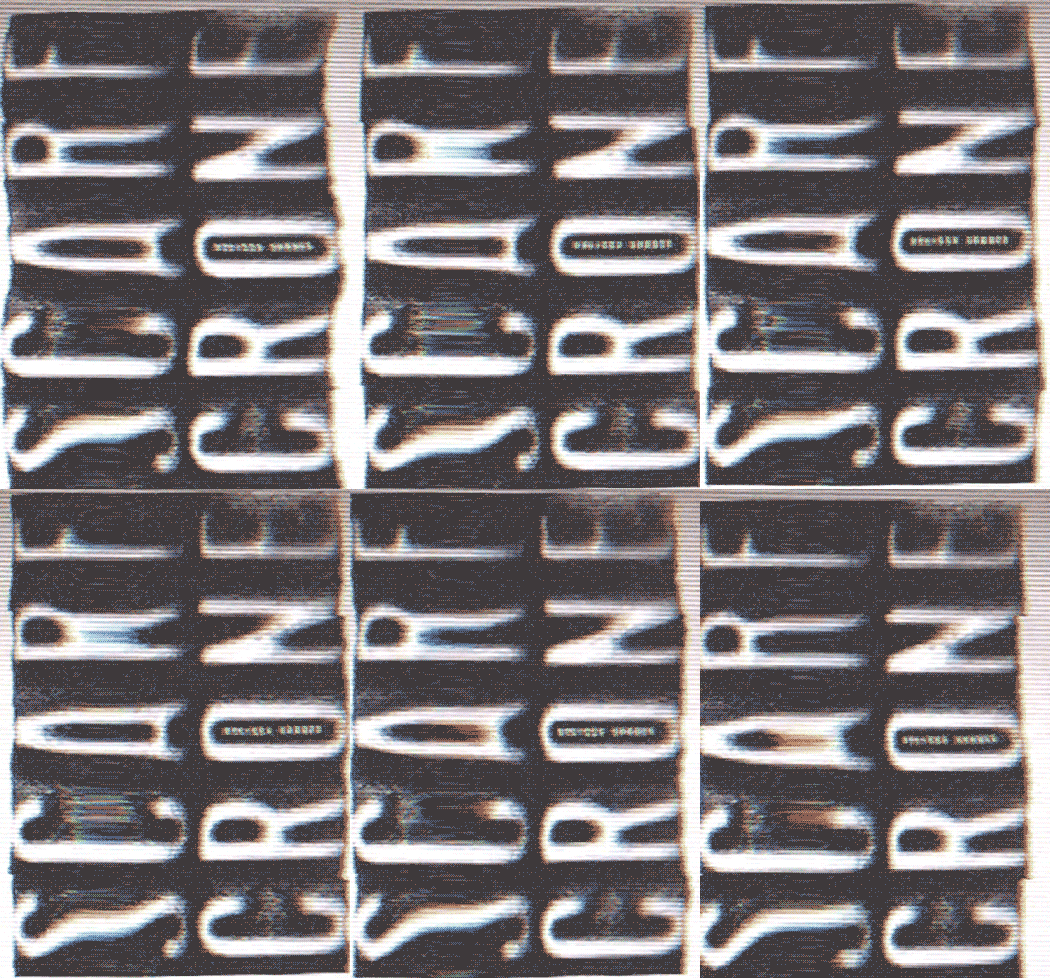
“Mystery and Mortality,” Paula Bomer’s book of essays
 Mystery and Mortality: Essays on the Sad, Short Gift of Life is, as the title says, a collection of essays. In this book, Paula Bomer (author of the powerful and unflinching books Nine Months and Inside Madeline from Soho, and Baby from Word Riot) looks at the work of writers ranging from Tolstoy to Ferrante and Kathy Acker to Brian Allen Carr. She combines her reflections about this literature with her mother’s dementia and her father’s suicide and, through this, she runs some painful thought experiments about why we are what we are and do what we do.
It’s very generous, for a writer to expose so much. It’s humbling to publish it.
Here’s the first paragraph:
Yesterday, I walked by a mirror and I stopped and looked into it and thought, or maybe said out loud, as I’m prone to talking to myself, being one of those writers who spends far too much time alone, “I am not my mother,” repeatedly. Then I walked away.
A few of the 15 essays originally appeared here at HTMLGiant before the turn of the decade, when Paula was a contributor here known as “pr.” Some readers might remember her being lauded for all that scholarship on Flannery O’Connor.
There’s an introduction by Meg Tuite where she says there’s:
no milquetoast in … anything she’s written. Straight on ferocity that doesn’t reek of the formaldehyde of sodden decorum and martyr-esque, flushed vaginas that pop out babies with a smile and a song. Bomer’s work rakes through brutality.
Plus, check out this cool spine:
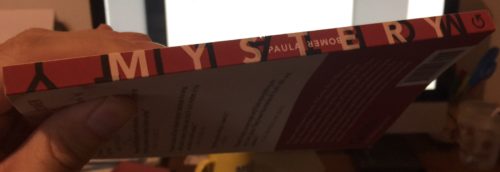
The book is available now from Publishing Genius, and right now it’s still just $10 (+ $3 shipping) through this week.
Sator Press presents… NO OTHER by Mark Gluth
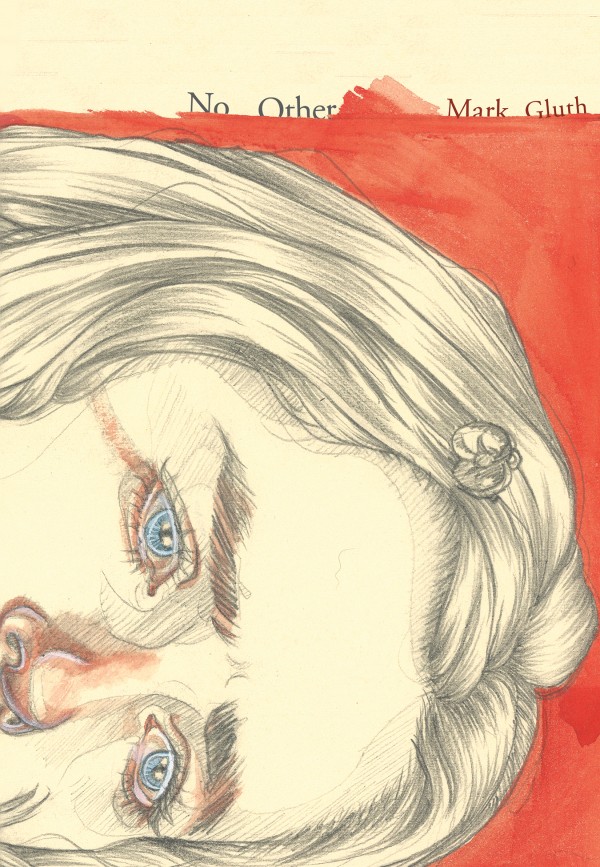
In a sequence of haunted seasons, Tuesday, Hague, and their mother Karen are pained by the aporia of love and death. With powerfully elemental prose, No Other lays bare the mysterious and emotional fate of a small family.
No Other is shipping now from Sator Press.
•
“In Mark Gluth’s beautiful family gothic No Other, the reader encounters a landscape of mood and mystery, burning with a stripped-down pain. Gluth’s sentences devastate in their raw economy, attempting to penetrate the everyday, tracing abbreviated existences struggling to survive through bare seasons.”
– Kate Zambreno, author of Green Girl & Heroines
“In clipped, incantatory verse shined from whorls somewhere between Gummo and As I Lay Dying, Mark Gluth’s No Other invents new ambient psychological terraforma of rare form, a world by turns humid and eerie, nowhere and now, like a blacklight in a locked room.”
– Blake Butler, author of 300,000,000
“It’s devastating.”
– William Basinski, composer of The Disintegration Loops
•
Four pieces from the online scrapbook documenting Mark Gluth’s influences and inspirations while writing the book:
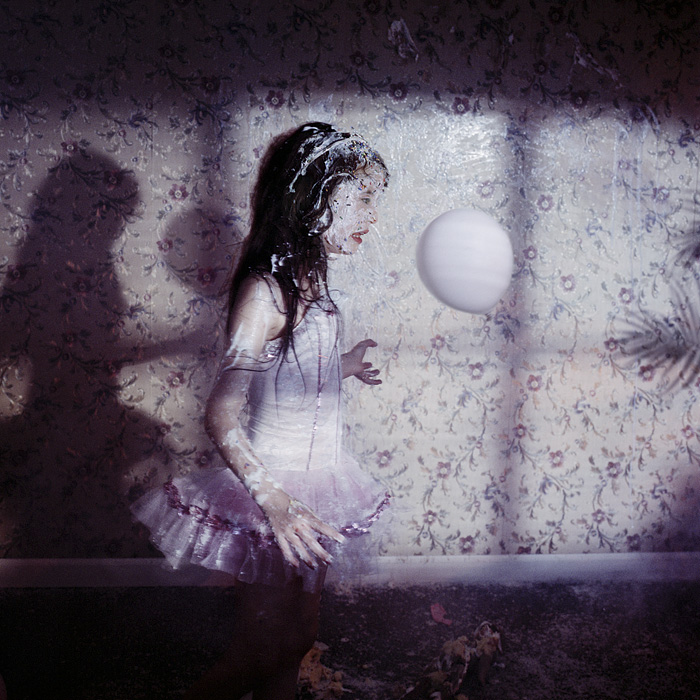
From Evidence of Things Unseen by Simen Johan.
And finally, a note about publishing No Other.
•
One last thing: This website was very important to me as a person, reader, writer, and publisher. I met many great people through writing for HTMLGiant; I bought and read many great books through reading HTMLGiant; I spoke in a lot of fervent conversations—both online and in person—through caring about HTMLGiant and its myriad ideas and moods. Safe money says that this site continues to be recognized as a weird and fecund little corner of the internet, and a place that was very important to a growing body of literature and its devotees. Thank you, HTMLGiant, and R.I.P.
Author News / Comments Off on Sator Press presents… NO OTHER by Mark Gluth
October 20th, 2014 / 9:00 am
October 20th, 2014 / 9:00 am
I’m in Mexico. There’s a tree here called “the rain of gold. ” We took the tunnel under Pablo Neruda Blvd. The columns were ancient. Blooms of lust. I finished “The Slave” on the plane. I was in tears. The young woman next to me: “It’s okay. Everything is meant to be.” I just wolfed down some cubes of jicama, watermelon and papaya. I am drifting. My dreams are filled with cows, barbed wire and a lithe warrior maiden. She is the walls of eternity burning on every side.
………………………….
Author News & Random / Comments Off on I’m in Mexico. There’s a tree here called “the rain of gold. ” We took the tunnel under Pablo Neruda Blvd. The columns were ancient. Blooms of lust. I finished “The Slave” on the plane. I was in tears. The young woman next to me: “It’s okay. Everything is meant to be.” I just wolfed down some cubes of jicama, watermelon and papaya. I am drifting. My dreams are filled with cows, barbed wire and a lithe warrior maiden. She is the walls of eternity burning on every side.
October 11th, 2014 / 1:35 pm
October 11th, 2014 / 1:35 pm
…..Birds like planets– all ripped up” (from Ringing)…..
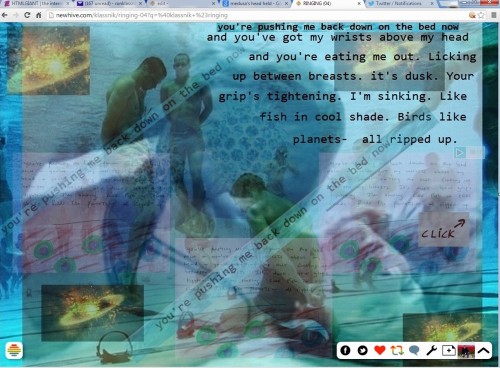
CLICK ON THE IMAGE FOR AUDIO VERSION AT NEWHIVE
********
I’ve been doing a lot on NewHive the last 6 weeks. (Art with sound, movement, etc). And with HTMGLIANT’S “last day” approaching it looks like I might be doing even more!! ………. (blah, blah) xoxoxoxo (click)
……………. p.s. you can kiss me if you want to!
Jesse Prado’s notes from the 2014 Hustle and Flow (i will always be your whore) tour

you know how alex said we were gonna do eight cities in ten days? we did seven; Brooklyn, Boston, DC, Philadelphia, Baltimore, Atlanta, and Nashville. that’s seven. i’ll bet if i said anything to alex she would say she said seven. anyway, this is a review of how i think i did in every one of those cities.
Pussy Guerilla Face Banana Fuck Nut by RC Miller
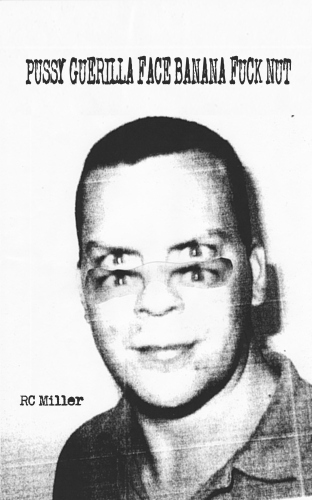
Gobbet’s dangerous and exenterating Pussy Guerilla Face Banana Fuck Nut by RC Miller is now available
Gobbet exclaims that Pussy Guerilla Face Banana Fuck Nut is all of those things. But mostly it’s a book sticky with Frederick Seidel’s wet dreams. It will burn your mouth and it will tickle the hymen you framed on your wall so it never got broke. These poems never believed in anything but the gruesomeness of the casualness of their nonbelief. These poems are shrinking pockets of mummified hope. They are what beauty becomes in the ‘Fuck You’ stare. They are the grace of dying slowly with your head in the shitter, your arse in the air, and the soul of God in your masturbator’s hand
Also, check out a beautiful and hard-prophetic poem of RC’s that’s just now gone live at Paragraphiti.
xoxoxoxoxoxoxoxooxoxoxoxoxox
Author News / Comments Off on Pussy Guerilla Face Banana Fuck Nut by RC Miller
July 15th, 2014 / 10:00 am
July 15th, 2014 / 10:00 am
I Will Always Be Your Tour: Alexandra Naughton’s notes from the road on her first book tour

I wrote a book called I Will Always Be Your Whore [love songs for Billy Corgan] and I wanted to go on a book tour, so I made a facebook post back in February earlier this year and some people invited me to read at their reading series and most of them were located on the east coast so I did some research and decided to do an east coast book tour spanning about two weeks, hitting seven cities. I told Jesse Prado who is my bff and brother and he wanted to come along and I told him we should put a book together for him to sell on the tour so I published a book by Jesse called i’ve been on tumblr on my little press, Be About It press. It’s a cute book, it feels nice.
I had no idea how to plan a tour because I never did anything like this before but I did my best and realized my mistakes while they were happening and I feel much better prepared for the next time we go on tour, which we will definitely do again. It’s already been decided.
I hope we were good guests.
Yuriy Tarnawsky visits Chicago
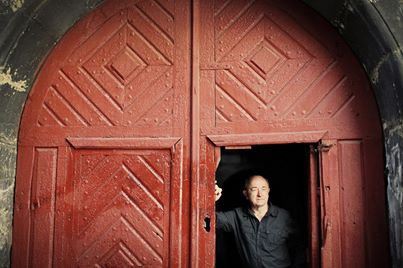
Yuriy, peering through the doorway to Chicago
This Friday and Saturday, Yuriy Tarnawsky will be reading in Chicago to celebrate the completion of his recent trilogy, The Placebo Effect.
On Friday, he will be reading at Quimby’s Bookstore (1854 W. North Ave.) with Eckhard Gerdes.
On Saturday, he will be reading at 567 Studio & Gallery (1800 N. Milwaukee Ave.) with Eckhard, Jane L. Carman, and myself.
Both readings start at 7pm, and are free and open to the public. A reception will follow the Saturday reading.
Here’s a recent interview with Yuriy regarding The Placebo Effect Trilogy, conducted by Tantra Bensko. And here’s an older interview that I conducted with Yuriy, about his life and work in general.
Since the 1950s, Yuriy Tarnawsky has published more than twenty books of fiction, poetry, drama, and criticism in English and Ukrainian. His most recent work has appeared via FC2, Jaded Ibis Press, and JEF Books. His Three Blondes and Death (FC2, 1993) remains, IMHO, one of the best English-language novels of the past thirty years—indeed, I think it the best book that FC2 has published. (You can read some of it here.)
Hope to see you there!