Matthew Simmons

Matthew Simmons lives in Seattle.

Matthew Simmons lives in Seattle.

Sometimes when we’re sitting at the dinner table, my partner looks at me and says, “Hon. Stop.”
I know what she means. She means that the table is shaking. The chairs are shaking. The room is shaking.
And it’s my fault. Because, unconsciously, I am bouncing my right leg up and down, and in doing so, I am shaking the table, the chairs, and the room.
She says, “Hon. Stop.” And I stop.
I stop for a while, anyway. Eventually, unconsciously, I start up again. And after a few minutes, she says “Hon. Stop.”
§
Magic: The Gathering is a collectable card game first introduced in 1993. It was created by a mathematician named Richard Garfield at the behest of Peter Adkinson, who was looking for a game people could play in between TTRPG convention role-playing sessions, or at home games while players waited for other players to arrive.
It’s like a combination of poker and chess, I guess? That’s how I’ve heard it described. Briefly: You have a deck full of cards (a library), you deal a hand of seven to yourself from that library, and you play them in a game that is about wizards doing battle with each other, where the cards are either a resource or a spell. You play the resource (mana) cards, and then you spend (tap) the resource in order to cast a spell that you use to try to whittle down your opponents other resource (life total). Cards interact with each other in interesting ways, and you can build your library in order to leverage all the possible synergies to win.
Poker has variants: stud, draw, Texas Hold ‘Em, etc. Chess has variants: different board sizes, random or alternate starting positions, fairy pieces, etc. Magic: The Gathering also has variants: Standard, Vintage, Pauper, Commander, etc.
Today, it is a billion dollar brand, with both its own deep and evolving lore, and relationships with existing and popular IPs in its Universes Beyond sets.
And like all things that people love, it is controversial within its fanbase, the source of strife and second-guessing, frustrating, beloved, fawned over, discussed at all different intellectual levels, copied, satired, the source of compensation-seeking content, conventioned, declared dead, declared revived, pirated…you name it.
§
“Hon. Stop.”
I’m lying on the bed, on my side, scrolling through something on my phone, and my leg is shaking.
“Sorry.”
I got it from my dad. I remember him forever bouncing his leg, sitting at the table, sitting in his easy chair watching TV. Even toward the end of his life, when he was on medication for his pain and anxiety, still bouncing.
But I don’t recall cards, whittling, knitting, juggling. He just bounced. He must’ve had something. If I could, I’d ask him.
Ah, well.
§
Lately, I’m obsessed with Magic. I play it online on both Magic: The Gathering Arena and on Magic: The Gathering Online. I play with my young son, and make decks for the two of us, I think about it, spend time online researching ways to get better at it (I’m terrible), watch strangers play it, annoy my wife with it, let it take up an ever-expanding section of my bookshelf. All that.
But mostly—and I swear I think this is really the reason—I spend my time shuffling sleeved up decks of Magic cards.
I like holding a pile of cards on the length and width, my right hand going middle finger and ring finger on top width, thumb on the bottom width, and then left hand on the bottom, thumb on one side of the length, middle and ring finger on the other. I like to split the deck in half, and then do an overhand mash shuffle sliding the pile in my right hand down into the pile on my left hand. And then I return my fingers to the previous hold and slowly, methodically tamp down the cards into a neat exact, pile.
Sometimes when I’m feeling anxious, when I’m sitting at the dinner table and the noise begins to get overwhelming, when dishes banging into glasses, or silverwear hits dishes, when the earplugs that dampen the loudest noises but still allow me to engage with others aren’t working, when I’ve moved my phone as far away from me as I can on the table so I’m not looking at it while I’m trying to eat, when all that is happening, sometimes I can feel my hands wishing for cards.
§
Repetitive movement is a well-known technique for self-regulation, and the act of shuffling cards is a successful technique because it provides predictable tactile feedback, and the cognitive demand, especially after years of engaging in the activity, is low.
There is the fingertip friction, the mirrored sensory experience of the card surface to both hands.
Shuffling offers a predictable, rhythmic sound, a quick, quiet patter of card against card, and there is a satisfaction to a competent, steady shuffle where every card in each of the two piles interweaves exactly and the rhythm is perfectly timed.
It offers: certainty instead of uncertainty. It offers: hands mirrored in space, exactly where one wants them to be. It offers: mild dopamine release. It offers: disappearance into task.
No interruptions or changes to the pattern. No goal except another shuffle.
§
My mother taught me to play solitaire in grade school, and I would play here and there. In my first semester of college (Go Fighting Phoenix!), though, I lived alone in an apartment in a city where I knew no one. I had a roommate, but he was always traveling for work—he was the son of a friend of my father—so it was just me. It was 1991, I wasn’t on the internet, and I had an electric typewriter for my assignments. I spent hours in the school library. And when I went home, I played solitaire.
Games and games of solitaire.
Which meant I shuffled my deck of red Bicycle cards over and over.
I’d listen to music and shuffle the cards, lay out the cards. Phwip, phwip, phwip. Play the black seven on the red eight. Phwip. Ace to the top row. Phwip. Sun goes down outside. Fail to complete the stacks, reshuffle. Start again. Dark outside. Desk lamp on. Sitting on my bed, laying out the cards, shuffling. Falling asleep past 2am with the stereo looping whatever is on.
Eventually, my roommate, on one of the rare days he was at home, asked if it was okay for a friend of his to move into his room, and I said yes. I didn’t really talk to this new person, but one evening, he walked by my door—shirtless…he was always shirtless at home, for some reason—and said, “Hey, how many games of solitaire do you play a day?”
I didn’t know how to answer him. I wasn’t sure. Dozens, I supposed?
“You know, you can play solitaire at casinos.”
I didn’t know that. I thanked him for telling me.
§
My phone has a number of notifications on it and I don’t really know how to turn all of them off. Or if I should keep some and get rid of others. What if I turn off notifications and something important happens?
So, I’m listening to something, and there is a notification about movement at the front door, and it’s a truck that drove by.
And then there is a notification for the rear outdoor camera, and it’s just a bunny running through the yard.
And then there is a notification for an email, and it’s just a Word-of-the-Day message that I don’t remember signing up for.
And then there is a ping about a text message, and it’s just a message from the place where we rented my kid’s trombone last year, and did I tell them I wanted to receive messages about trombones? I don’t remember doing that, either.
And then I am reminded to take my vitamins and SSRI.
I put my phone to the side, and I turn on the Focus setting to quiet the notifications, but I worry that if I don’t look at my phone every few minutes, I’ll miss a text from my partner, so I check, and I check, and I work, and I type, and I type, and then I realize I haven’t checked in a while, and I check, and there are four texts, three from my partner and the last one is “Hon?” because I missed a question that needed an answer urgently.
And then the same notifications are showing up on my laptop screen, but my eyes on the second screen I’m using to type this out. The laptop screen is in my peripheral, and a box just popped up on it. It startles me, that unexpected box popping up. I’m just here, a gentle gazelle, typing out a blog post, when out of the corner of my eye I see a carnivorous pop-up notification, warning me about an email from Wirecutter, who would like to tell me what the best rice cooker is for 2026. That email is going to eat me, my brain says. I should be on guard. I should be vigilant.
I put my earplugs in. I reach for cards and shuffle. I deal myself seven cards, as one does in Magic. I look at them. I play a land, and I pass. I draw a card, I play a land, I play a creature. I think through the lines, the proper sequencing of cards in hand to maximize efficiency.
§
In Magic’s resource management system, the resources are broken down into five colors. WUBRG–White, blUe, Black, Red, and Green. You can build a deck with cards that are all one color, or with multiple colors, and as a shorthand for combinations of colors, the designers have created two-color Guilds. Red and blUe is Izzet, named for Niv-Mizzet, the ancient dragon who founded the guild. It is blUe’s perfection-seeking study and logic with Red’s aggression and explosiveness. Green and Black is Golgari–the colors of growth (Green) and rot (Black) combined. It’s the nurse log, life growing from death, the endless cycle. It’s Herzog’s jungle, “overwhelming and collective murder,” but a murder that grows orchids from the bloody aftermath.
I like Orzhov. It’s the combination of white and black. And it feels like bureaucracy. White’s order, it’s community. Black’s sacrifice. The Orzhov Syndicate is Magic’s “Church of Deals.” Contracts are black ink on white paper. Contracts entice us. Contracts connect us. Contracts trap us.
Magic has a plane with a magical school called Strixhaven, and in Strixhaven, white and black is Silverquill, the magical rhetoricians. The writers. I used to be a writer, so I like Silverquill.
I enjoy the inevitability of death and taxes, so I like Orzhov. I love the bizarre, endless lawsuit in Bleak House. I like The Trial by Kafka. I like getting lost in a maze of words and walls. Old, empty, ruined buildings. Borges. The Marbled Swarm. Piranesi. House of Leaves. Ashbery. BLAME! de Chirico. Burial. NaissanceE. Control.
“Columnated ruins domino.”
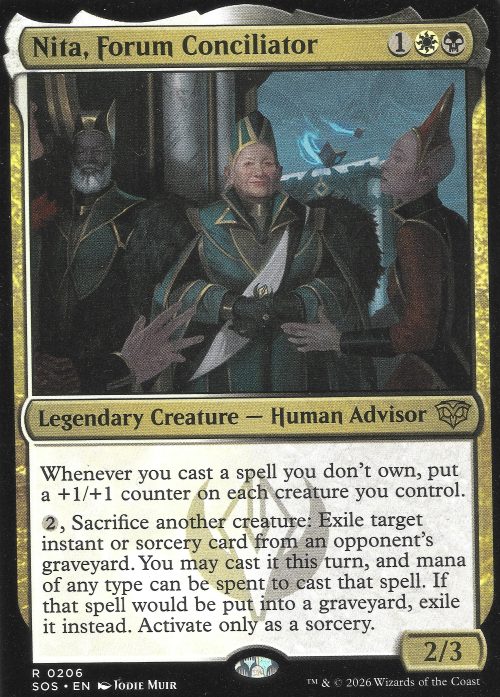
I made a Nita, Forum Conciliator deck recently, and it’s all about death and taxes. I sacrifice creatures from my board in order to take things out of my opponents’s graveyards. (Cards are permanent or impermanent. You play a permanent, like a creature, it goes to the battlefield and it stays there until it is killed and goes to the graveyard. You play a Sorcery, a spell with a limited effect, it does its thing and goes to the graveyard.). Nita digs into your history, audits your graveyard, digs up your bones and your secrets, your misplayed cards and your topdecked temporary triumphs. I make an army of weak little bureaucrats, and I sacrifice them to take the best things you’ve used away from you.
It’s my favorite. In the art on the card, Nita is an older woman, a formally dressed apparatchik. She has what appear to be the members of her forum with her, all in shadow while single light shines on her, a pleasant and passive look on her face. She appears to be ready to conciliate, to mend a conflict, to strike a bargain, to suggest a resolution, to help manage change.
And in the attire and the look in her eye, you can also see that she has a knife she will gently plunge into your back. She appears to you as a neutral party. She is from the Silverquill set, and thus, a member of school staff, one assumes. Good with words and adept at making others find compromise.
But look at that face. There’s an agenda there.
I’ve been making altered cards—versions of existing cards with art that I think also fits—and my Nita uses an Odd Nerdrum painting of a behatted woman holding what is, if the painting’s name is to be believed (and why wouldn’t I believe the painting’s name?) a door knob. But whereas Nita’s clothes are formal and crisp, this Nita’s clothes are ill-fitting and frumpy. She has a lazy eye, a dour face. She looks younger than the woman in Nita’s original art. In fact, she looks like a young person very incompetently cosplaying Nita.
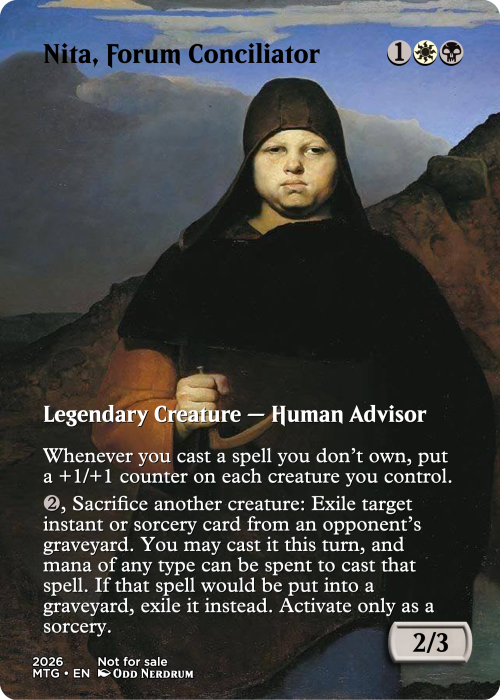
I’m a pretty terrible Magic player. It occurs to me that maybe making altered versions of cards that appear to be incompetent cosplays of the original cards is a reasonable way of illustrating that.
§
That’s the thing that makes me bad at it—I keep thinking of my deck libraries as a pile of sentences in a story instead of a set of interacting mechanics that can be mastered in order to follow lines of play that lead to game wins. I like to win but am usually surprised when it happens.
I don’t play to win. I’m sorry.
§
I volunteer in hospices these days. Not working with the clients, but making calls to the recently bereaved. I know it’s strange to say, but even though I could work from home, I prefer going in when I can. It’s quiet there. It’s all sad-eyed smiles and coping and almost no raised voices.
I like the moments when I walk from the temp office to the kitchenette to make tea or coffee. The halls are empty, the doors closed. Behind the doors, someone is quiet. People are masked. Families sit in the lounge next to the kitchenette putting together a puzzle. A counselor sits at a table with two people, talking through a pamphlet.
There’s a respect in the building. Everyone there respects everyone else’s need to exist in their thoughts. Everyone
§
Right now, my favorite deck to shuffle is a fully-proxied, 80-card Dandân deck, which I have sleeved in a set of Midnight Blue Dragon Shields.
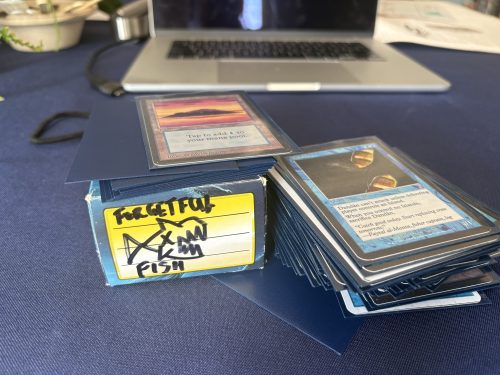
The sleeves are a little tackier on the transparent side, and slicker on the opaque side. The tackiness makes them easier to shuffle through in hand. The slicker side has a pebbled surface, given them friction.
And the proxy cards were printed not on a heavy card stock, but on a thinner photo paper, so they don’t feel like a deck of stiff Magic cards. They are more pliable. They shuffle together more easily. And even though there are 80 of them, they riffle shuffle on a tabletop easily. I like to cut the deck in two, and use the bottom corners to gather and intermingle them.
Sometimes I’ll grab a quarter of the deck, and hold the cards by the short ends with my thumbs and pointer fingers, and do a gentle, rhythmic bend. I had a Nabokov paperback that had a soft, giving cover and page quality that I would sometimes hold onto and bend back and forth, convex, concave, convex, concave, convex, concave.
Convex, concave.
I used to rub my thumb and pointed finger in small circles, feeling the smooth interaction between the pads, the whorls of the fingerprints, but then a few years ago, I cut my thumb washing a newly-sharpened kitchen knife so deeply I needed stitches, and now there is a scar across it. It doesn’t feel the same, doesn’t soothe and quiet my thoughts like it used to.
I leave the box for the Forgetful Fish deck on my desk and pull them out when I start to get too many notifications while I’m trying to type.
I wrote a lot of this in the backseat of my car while I waited for my kid to get done with their Sunday gymnastics class, typed it right into the browser, no wi-fi, no personal hotspot access. I was wearing earbuds with no music playing. No sound. No noise except for the occasional car honk from someone locking up their car with a key fob button, honking to affirm to themselves that they have locked their door. Sometimes even when I don’t have anything playing in my earbuds, I have them on. I don’t even realize that they are there.
§
        One gives pause to the other,
	Or there will be a symmetry about their movements
	Through which each is also an individual.

        It is their collective blankness, however,
	That betrays the notion of a thing not to be
        destroyed.

—From Flowering Death, John Ashbery (1979)
§
Magic: The Gathering—it’s fun. Nine out of ten. (A point deducted because it can be so darn expensive.)
I wonder sometimes about what to do with myself after I die.
Or maybe not myself. I think I mean what to do with body after I die, because maybe myself will be off somewhere else at that point. (Fingers crossed.) But there will still be this BODY just hanging out there, in the place where I was when I died. Someone will stumble upon it, or someone will already be sitting there next to it watching me leave? There will be a body. For a while, too—the body takes a while to go away. So you have to do something with it.
And you get to decide! You get to tell the people around you what to do with your body after you are gone. And they, mostly, do what you ask, I guess. You can even go to a lawyer and get a piece of paper that tells people what to do with your body, and if they don’t do it, they get in trouble. Like, legal trouble. With more lawyers. Lawyers get involved.
It sounds awesome.
There are all sorts of options! I can get put into a box and then that box gets buried under the dirt. And the box just hangs out under there, surrounded by dirt. Seems dull. Seems like a waste of dirt—dirt with which you could do other things. Why waste dirt? Why get buried and surrounded by dirt? In a box that will way too slowly fall apart, while your body way too slowly falls apart, too.
I should mention that in that case, they drain your body of all its liquids and pump a bunch of other liquids into you. Which, why? That seems like a waste of two kinds of liquids: Your liquids, which you used all through your life, and their liquids, which only get a little time to act as your liquids before they throw you into the dirt and they just settle into the bottom of your body until you fall apart and they leak out into the wasted dirt.
My dad died. (I’m sorry if I mention that a lot.) We burned his body. (Well, not “we” as in us, his family. We asked someone else to do it.) His ashes will go in a wall at a church. That’s a way you can deal with a body after the person in the body has left it. You can set it on fire and let it turn to a little, more manageable pile of ashes. It takes up less space, and if you know it’s the body of someone you loved, then it will always feel like the body to you, even if it doesn’t look like the body.
Maybe that’s what I’ll have done to me after I die, but maybe I’ll ask that my family—my wife and my son—NOT just put it in a wall. They could scatter the ashes somewhere nice. It might feel like, in my final moments knowing that my family is going to scatter me around somewhere then maybe I might be able to move around. Travel. See some places. That seems better than being stuck in a wall.
When you are stuck in a wall, other people can visit you, I suppose. My wife and my son. But I’ve read that on average, a grave is only visited twice after it is filled with a body. Give a body a resting place, stop by once, stop by a second time, and let it sit lonely for the rest of forever.
Scatter me in the air, and this is a possibility: my wife and my son can pretend that wherever they are, there I am. I mean, why not? A clump of ash is tossed up into the wind. It breaks apart and follows the eddies of air, maybe up and out and around the whole wide world on jet streams, and there I am, a little pinch of ash anywhere and everywhere you are. You can visit me always wherever. You’ll breathe me in and won’t even know it. We’ll be traveling companions. We’ll never be apart. Maybe I’ll be in all of you. And you’ll never get rid of me.
That seems like a nice fiction. One I can work with, anyway.
§
You could be dumped in the sea. You can get a permit. I spent some time considering this as an option after I learned about whale fall. “Whale fall” is a beautiful phrase, and often naming something in a beautiful way can convince me to connect myself to a thing. I would also like to fall!
Whales are resource rich, though, and I am not. As I get older, I become more resource rich, but no amount of age-related weight gain will make me truly valuable to the sea. I will never be abundant enough. Not abundant like a whale. I’d be a meager meal to crabs and fish. Hardly worth the gas it takes to sail out to a nice place to dump me.
Also, when I really start to think about being buried at sea, I become nervous about how cold it would be. This is, I am aware, totally irrational. This is an irrational argument against burying myself at sea—this idea that I might be too cold. That down deep in the water, it gets colder and colder and my body will get colder and colder. Blue and chilled from skin to marrow. But I will be dead. I will not feel the cold.
And yet.
And yet rationality is rarely a part of my calculation when it comes to the way I contend with my own mortality. My death scares me, so I allow myself some irrationality. I allow myself, in this case, to veto a burial option for an irrational reason, and not for the sake of the corpse that I will be, but for the sake of the person contemplating the corpse that I am now. It’s self care.
§
My friends Stesha says she wants to be a tree. That seems nice. Not for me, I don’t think—I think I would like the option to move. Again, irrational. But again, I allow myself the opportunity to let the living me make decisions the dead me won’t ever care about as I tell myself that the dead me would appreciate the decision the living me has made. This is what we talk about when we talk about our corpses.
§
Andrew wrote to say that I could feed mushrooms after I die. This seems like a nice idea. The site says that it would clean out all the “toxins” from my body. I’m not sure what that means. I probably have toxins, I guess. I hear a lot of people talk about all the toxins in my body. In their bodies. In all bodies. The modern world fills us with toxins, they say.
I’m betting if there are toxins, my body has its share. I’m pretty sure whatever toxins are, I enjoy having them in my coffee in the morning, or on my pancakes. I likely enjoy dipping my french fries in toxins. I bet toxins make all of those things delicious. Every food company in the world is right now running a lab that makes toxins that hit our tongues and light up all kinds of pleasure receptors in our brains.
Doing something that gets rid of the toxins sounds nice, but also sounds so vague as to mean nothing.
But being a mushroom feels like it would be remarkable. I imagine that a nice benefit to dying and becoming a mushroom is that there are all sorts of people who really enjoy going out and searching for mushrooms, finding mushrooms, identifying mushrooms, picking mushrooms—so all kinds of people would be out searching for me, finding me, identifying me, picking me. Who doesn’t want to be picked? Who among us is not, at our basest, at our more fundamentally psychological level, not just wanting to be picked?
My family could come and visit my body, but also strangers would come and find the mushrooms fed by my body. My resting place could be a place of sadness for the people closest to me, but a place of discovery and joy for the people with whom I have no relationship. I once wrote a whole story about becoming a mushroom. Sounds great. I’d like to be a mushroom.
Maybe.
Probably.
§
I received a postcard in the mail last week. I think my wife recycled it, otherwise I could take a picture of it for you.
It said that if I wanted, I could be mellified. It was from a company that offered that service. They have a hospice you can check into. They have a bed for you when you are close to death. A few weeks from the end, you can check in, get a room all to yourself, and wait there to die.
And they will feed you nothing but honey. Your body will expel all the other things you have eaten within 72 hours, and then nothing in the belly, nothing in the intestines, nothing enters or exits except honey.
And then when you die, they seal you in a honey-filled bag. They have a storage space reserved for all their clients. They will note the year and day of your death. In 100 years, they will pull you from storage, cut you to pieces, and then?
You can, and I would, opt to have your remains given to your family. Whoever is left gets a box of you, mellified, turned to candy, edible.
My son’s son’s son? My son’s son’s daughter? Someone?
I might go nicely with a soft cheese. They can enjoy me on a cracker.
People can get together and all consume me at a party. I’ll be a party guest, one last time.
That’s what I want.
We’re on the right side of things, or perhaps the wrong.
We’ve got a lot of great ways in which to be right or wrong, and we’re often able to go ahead and make those ways public to you and then also to yours.
How are yours, by the way? We feel pretty clear about you, but yours remain a mystery to us. We should maybe connect with them a little more.
Maybe a call? Maybe an email? Maybe we could go over to their houses.
Probably not that last one. Probably we shouldn’t go out to the houses of yours because we aren’t really sure if yours have been staying home and staying safe and staying away from all the places that one should stay away from at a time like this.
Hey, it’s a time like this! Have you ever felt like you were in a time like this? Feels to us like the first time there every was a time like this.
Such a time.
Such a time.
Maybe it’s not possible to be on the right side of things in times like this, though? Have you thought about that? Because we very much have not.
Hey, great, though! Great to see you! Let’s get in touch.
Hi. It’s okay. It’s just me.
Matthew. I used to write for this site.
Hey, I’ve given up on writing books in order to spend my free time focusing on table top role-playing games!
(Maybe actually I’ve given up on writing books in order to be a dad, but anyway whatever.)
So, yeah. I have the dice and everything. I have two shelves full of TTRPG books now. It’s a pretty nice-looking couple of shelves. I read interesting indie modules in my spare time and try to think about what makes them work and what makes them not work, sort of like I used to do for short stories and novels. I get together with friends online one night every week and play games with them, now that we are all stuck at home almost all of the time. And sometimes I run games, too.
Like: In February, when people could still gather together in groups, I ran a game of Tales from the Loop for my group.
Tales from the Loop is an RPG inspired by those consciously retro sci-fi paintings by Simon Stålenhag that became popular five or six years ago, which depict an alternate 1980s. In the game, the players are young adults living in those paintings—a world of dimensional rifts, AIs, big cell phones, Huffy bicycles, robots, boom boxes, Trapper Keepers, vehicles that float on massive magnetic drives, and adults who don’t listen to them.
*
My first roleplaying game was, like most people, Dungeons & Dragons. My parents bought me the Basic and Expert boxed sets when we first moved to Upper Michigan in the mid-’80s. For a while, I didn’t have anyone else to play with—my brother was older than me and not interested, and I didn’t have a lot of friends yet—so the only person who would play with me was my dad. We played once. He was pretty nice about it, but I could tell he wasn’t interested. When we had had family game nights before then, he never participated.
It wasn’t really his thing. But he tried once, anyway, with me, because he knew I was upset that I didn’t have anyone else to play with.
Eventually I found a group of others to play with in high school. And then a couple of folks to play with in college.
And then I stopped for many years, until I was given the opportunity to write a novel for the RPG company Wizards of the Coast.
That got me playing again. And I have been pretty regularly ever since.
*
In contrast to a lot of the better known tabletop roleplaying games, Tales is very simple, mechanically, involving only a few numbers and pools of six-sided dice thrown to succeed at overcoming obstacles. Like this: A character must convince someone to not beat them up, hop a fence, hack a computer, or escape an inter-dimensional monster. The player grabs a couple of six-sided dice—the number of which is determined by their natural abilities (represented by ability scores), skills (which they can spend points on during character creation), and circumstances. They role, try to get at least one six, and succeed if they do. If they fail, the story gets complicated. The game is less focused on charts and numbers and bonuses and balanced mechanics than the roleplaying games one might already be familiar with. It’s in the family of roleplaying story games, heavier on scene building and collaboration than on crunch and tactics.
None of the kids die in Tales from the Loop. The characters are the protagonists in a story that is told in scenes, everyone at the table collaborating to make a story reminiscent of a movie, so like an ’80s kid sci-fi movie, there is peril and pathos, and kids can be broken, but they don’t get killed. The rulebook is more focused on storycraft than rules, and in places reads more like a book on screenplay writing than on wargaming. Some roleplaying games drill down on rules, looking to end arguments at the table over rules by codifying everything. Tales minimizes rules to minimize disagreements.
In our group, I run Tales from the Loop. I’m the Gamemaster. Instead of playing one of the kids, I write the skeleton of a scenario, create the setting, populate it with characters for the players to interact with, and then set up the win condition. Like: Here’s the place where you live, here’s the problem, here are some people who can maybe either help or hinder you as you try to solve the problem, here’s the countdown clock and the pace at which you should go, and here’s what happens if you do or don’t solve it. And then I walk everyone through the game, play the characters that the players interact with, improvise when they go in an unexpected direction.
It’s nice, during a time when I don’t write much on my own anymore, to have a place to collaborate with others to tell stories.
*
My dad was diagnosed with Stage IV prostate cancer on December 5, 2018. He had been unwell even before then, with serious mobility issues, spinal stenosis, a tremor that we thought might have been Parkinson’s. He hated doctors and had to see them all them time over the years previous to the cancer diagnosis, and apparently had a worrying blood test in 2016—elevated Prostate-specific antigen levels—that he just didn’t follow up on. And then he slipped when my mother was trying to get him out of bed, and found that one of his legs had stopped working. My mom couldn’t lift him. An ambulance was called. He resisted a trip to the ER, but they took him anyway. They did some X-rays and some bloodwork.
A doctor talked to my mom that night and told her that my dad’s PSA levels were really high. She didn’t know what that meant and the doctor didn’t explain. The next day, a nurse mentioned my dad’s prostate cancer, and that’s when she found out what a PSA level was and why it was bad when it was elevated. Or at 4500, like my dad’s was.
*
READ MORE >A Beehive Is Not a Little City (Made Out of Honey)
Tremendous Ache in My Fingers
Are You Reasonable?
In Your Motor Car (Flash Your Lights at Satellites)
Klimt in the Country
Never Break, Day
Booze Cruise
Fellas Remind Yr Mothers
Cantankerous Oval Godhead
Green.Pleasant
Euphoric and He Looks Like a Baby
Cheeseburgers in Paradise
At Loggerheads w/Reptilians
Pants (Refrain)
Murphy and the Solar Bowler Hat
Center of the Earth (Everybody Dances in the)
This Colossal Waste of Time
Preview of a Great Massacre
O Shit I Missed the Brexit Vote
Fan Theory about the Karma Police Video Involving Edward Snowden
Casual Friday (Hazmat Suit)
Something Something Hamilton I Guess
Fodor’s Guide to Antarctica
Anvil Meets Head
Guh
I swear this is true. It starts here:
Has anyone here ever heard of a Pennsylvania tagger who went by "Little Bricks?"
— Matthew Simmons (@matthewjsimmons) September 19, 2014
I went on to speculate that said tagger was probably based in Pittsburgh.
When I was a kid, we lived in Pittsburgh and sometimes my folks would bring my brother and me to the Kennywood amusement park. READ MORE >
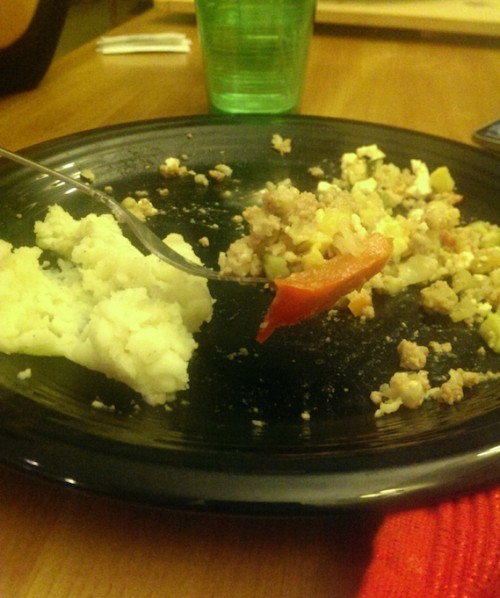
EVERYBODY, HELP! I’M AT THE GROCERY STORE AND TRYING TO DECIDE BETWEEN RED AND GREEN PEPPERS FOR STUFFED PEPPERS! WHAT SHOULD I DO?
UPDATE:
CLOSURE!

(Pictured is the author at the Bob Feller Museum in Van Meter, Iowa, back when he was younger and thinner.)
Like many of you, I still have friends in Iowa. And like many of you, I miss them very much. I’m only human. Like many of you.
My Iowa friend Eli likes to go to estate sales. He likes to buy old furniture. Most of all, he likes things that are old and made out of wood and have drawers. He often buys the things that are old and made out of wood and have drawers without first opening the drawers to see what is in them. He’s only human. Like many of you.
Recently he bought a bureau. In the bureau he found some notebooks. Eli doesn’t like notebooks.
Or, actually, Eli likes notebooks okay. But Eli likes things that are old and made out of wood and have drawers. And Eli knows that most of all, I like notebooks. And Eli likes me. So Eli sent me some notebooks.
This year, I went on a small, self-financed West Coast book tour. As a tool to market my book, it was not terribly successful. Ah, well.
As a vacation, though, it was wildly successful. There were some things on the West Coast that I had wanted to see, and I got to see them. I saw The Winchester Mystery House. I saw The Esalen Institute. I saw The Madonna Inn. I saw molting seals. I saw The Watts Towers. I saw The Museum of Jurassic Technology. And, best of all, I finally got a chance to see and use Deaver’s Great Chain of Being. READ MORE >