
A Bookseller’s Reading Snapshot
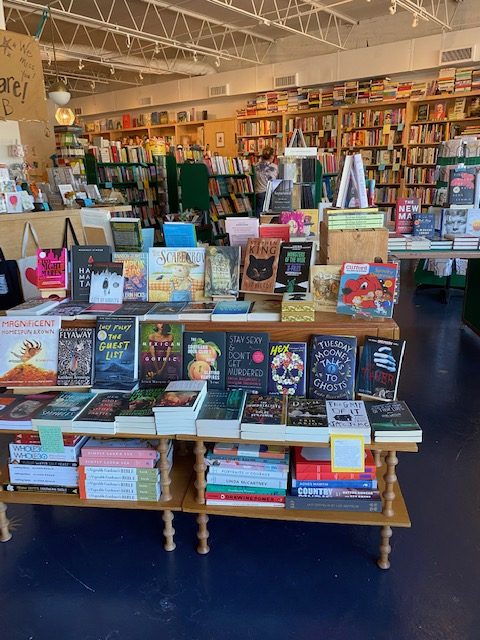
I like to hear about people’s reading habits—not just what they’re reading, but how. In the middle of the night, first thing in the morning, on the train, on the toilet, three books at a time, strictly poetry, in a deep musician biography phase—whatever. I like to hear when people are struggling to read—maybe because they can’t find the time or can’t find a book that holds them, maybe because they’re in the throes of grief or just having too good a time. It occurs to me every once in a while that some people just don’t care about books the way I just don’t care about, say, golf. Part of my job, if I’m being completely honest, is to make books look good, and make the reading life look good. I need people to buy in to the idea that owning stacks of books is important, that books are worth spending money on, especially since it’s entirely possible to own zero books and read as many as you want for free. I love this challenge. I hate capitalism but I love selling books, talking about books, and trying to learn as much as I can about why and how people read.
The place, generally speaking, where I feel most “free” to read, is in bed, before sleeping, after I’ve written in my five-year journal. I started my Tamara Shopsin journal three years ago and I cannot sleep until I’ve written something down—it’s a mental logging off for me, downloading my day somewhere safe and physical, which frees me to read without Bowsers from the day sneak-attacking my brain, enticing me to regret what I said to so-and-so or how I handled xyz parenting situation. Not now, Bowser! I’m reading. I also work hard to clear swaths of daytime hours on the weekend at least a couple of times a month, actually schedule this as I would a doctor’s appointment. Otherwise it won’t happen. The rest of my reading happens catch-as-catch can, while I’m waiting for other things, when I have a surprise thirty minutes, etc.
I read a lot because that’s my job, and it’s my job, in many ways, because I read a lot. The reading a lot part came first, and led me down a very winding path to where I am now. Here’s what I’ve been reading:
READ MORE >Where I Was and What I Was Doing When People Close to Me Have Died
In a kitchen, eating Kentucky Fried Chicken.
In front of a computer, playing minesweeper.
In a car, eating Kentucky Fried Chicken.
Standing outside of a Noodles and Company.
In bed, asleep.
Eating a bagel in a cubicle.
The Story of My Cats as Told by My Cats
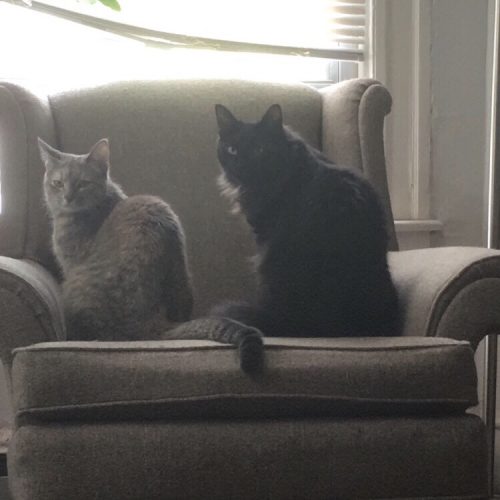
Our father is worried that if he lets us tell our story it will come out sounding like The Art of Racing in the Rain by Garth Stein.
He’s worried if he lets us tell our story it will read as cute and sappy and that the people of the internet will ridicule him for it.
But our father needs to get over himself and you, you ridiculous people, so do you.
We were born under a house next to a Food Lion grocery store in Hertford County, North Carolina.
This is what we are told, we don’t remember this.
We have different colored hair, one is gray and one is black.
We had a brother but he died in the cage with us after we were captured by a man in a truck and driven to a fenced-in facility where there were other people who looked like us, all in cages.
We were given ‘D’ names when we were brought to the facility.
Diesel, Delta, and Dax.
Dax is our brother who died.
We don’t remember our birth parents.
The person in the cage above us was old and alone and no one wanted to adopt her.
The facility smelled bad and there were holes in the floor taped over with duct tape.
Our adoptive parents visited us a couple of times before they chose to take us home.
And they changed our names from Delta and Diesel to Tammy Wynette and Possum because our mother likes country music.
We changed their names from adoptive mother and adoptive father to mother and father.
Our mother has blonde hair and blue eyes.
Our father has brown hair and hazel eyes.
He didn’t want to adopt us.
Our mother wanted us and so she made the decision.
But at first it was only going to be for a few weeks.
Our father picked us up and took us home because our mother was at her insurance-selling job she hated so much.
Our father worked part time at a pharmacy.
He always finds a way to work part time.
He brought us home and played with us and sat us on his belly.
We had dead fleas in our hair and feces on our faces and we were very small.
Our mother came home from work and played with us too.
She didn’t want to leave us alone.
One day she noticed we were sneezing and wheezing when we were breathing.
Our father wasn’t worried about it but our mother was worried and took us to the vet.
We had respiratory infections and were prescribed clavamox which was a pink fluid that they injected down our throats.
Our father said it smelled like bubble gum.
After a few weeks our mother spoke to our father about keeping us longer.
She wanted to completely adopt us.
He was hesitant.
They went to California—where our father grew up—for Thanksgiving, but they didn’t take us with them.
Instead, they drove us down the street to our mother’s mother’s house.
Our grandmother was larger than our mother and our mother was worried she’d give us too much food.
So before she flew away in an airplane, our mother told her mother not to overfeed us because she didn’t want us to get large too.
Our grandmother told our mother to relax and that she would follow all of our mother’s instructions.
Our parents had a big fight when they were in California and when they came home we could tell something was wrong.
They came from different backgrounds, our father grew up near a Whole Foods and our mother didn’t.
So they were mad at each other but then they were mad at our grandmother because when they came to pick us up our bellies were swollen and we couldn’t run or jump the way we like to.
This was because our grandmother fed us as much as we wanted.
She kept our bowls full when she left the house and she liked to give us treats.
Our mother was disappointed in our grandmother.
They took us home and it took a week or two but they resolved whatever problem they’d had with each other in California and our bellies grew smaller and we could jump onto the bed again and onto the kitchen counter.
But then our father didn’t love us.
That’s what he said to our mother one night when they lay in bed.
And that’s the correct usage of ‘lay.’
We know how difficult it can be to get that right, the “lay vs. lie” thing.
But our father cares about things like that, he pays attention to things that don’t matter.
Anyway, as we were saying, one night our father whispered that he didn’t think he loved us or cared about us.
It was after a day when we’d both stepped in our own mess in the litter box and tracked it around the house.
He hated the smell and we did too but we weren’t sure how to not step in our mess yet.
And whenever we stepped in our mess our father immediately undressed and grabbed us by the scruffs of our necks and got in the shower with us and washed our paws with warm water and a soap that smelled like coconuts and he held our butts up to the shower faucet.
So it was after one of those days.
And another problem was he’d read online about a parasite that lives in cat feces called toxoplasma gondii.
Toxoplasma gondii can make a person angry and suicidal and at the time our father was angry and suicidal and so he blamed it on our feces and, in turn, on us.
Every time he slammed a kitchen cabinet shut he thought it was because of a parasite in his brain and every time he felt like life was too much he thought it was because of a parasite in his brain.
And he didn’t love us or care about us.
Okay.
READ MORE >emoji collages w Matisse
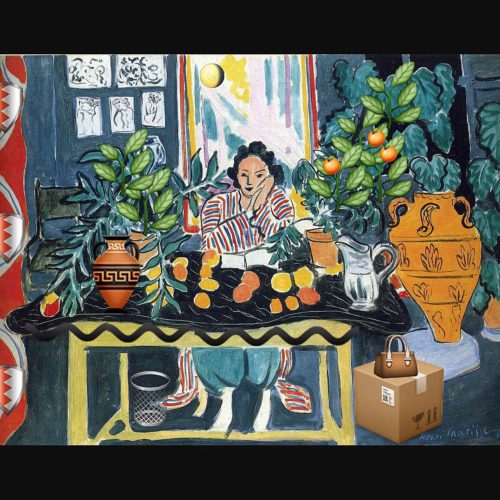
Stefania doesn’t really use the internet but still received a package from Amazon Prime. What’s the point, she thinks, in opening the box when I can use it as a table. Plus, I’m so tired, from what, I don’t know. Let’s see, where did I put my shoes. What are all these mangos doing here and what is this new trash can? The moon looks insane outside and it’s not even full. I don’t know where this vase came from. I must be losing my mind.
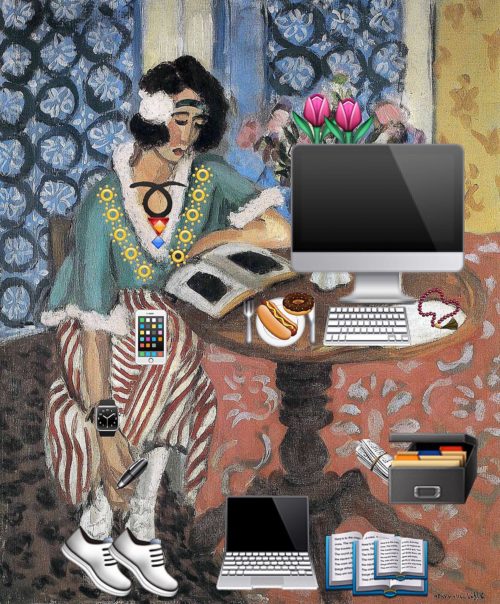
Clarice can only handle art books. Right now she’s looking at Dorothy Ianonne (Siglio Press) and checking to see how many likes her photo got. She posted “Air de Paris” because it’s a controversial one involving a blow job that Instagram won’t notice because it’s too abstract. She doesn’t even really like hot dogs or donuts. She just put them there. And the white brand-less tennis shoes? Those are abstract too which makes me wonder where she’s going with that. READ MORE >
I will miss you.
I live in Iowa City, which is a town that is very slightly famous for some of the writers who live, work, and teach there. For the most part, I spend very little time with other writers. Recently I had a book come out. It was my first book. Sometimes I worry that it’s going to be my last. Probably that won’t happen. I’m a worrier. Worrying is what I do.
I think that writing fiction is often just an advanced form of worrying. You worry about a person or a number of people in an imaginary situation. You worry about what would happen to them if they were real, if their situation were real. You worry about how sad they would be, how much they would worry. You worry about dying. You worry them until they die.
(I like to watch crime shows. I love The Wire. I enjoyed The Sopranos a lot more than I thought I would. Currently I’m watching Boardwalk Empire, which is in its last season. Actually this Sunday will be its last episode. The big question people seem to be asking is, “Will the Steve Buscemi character die?” That’s always the question in these shows — at least the ones that are focused on one particular criminal. It was the question with Breaking Bad, too, which was especially funny, because the first thing that really happens in the show is the character discovers he has a terminal case of lung cancer, so, yes, he’s definitely going to die, as will probably all of us. People were upset by the way The Sopranos ended because it didn’t seem to conclusively answer whether Tony Soprano had died or not. Recently, the show’s creator came out and said definitively that Tony had lived. James Gandolfini has been dead for more than a year. (Does a person get more dead over time, or do they die once and then stay the same amount of dead forever?))
But so recently I’ve been spending more time among self-described writers, whom we might also call professional worriers. And I was reminded that most writers choose to express their worries as complaints. For example, they complain bitterly about one-star Amazon reviews. Among these writers, complaining about one-star Amazon reviews (about Amazon in general) is like a handshake. “It arrived a day late,” they’ll say. “One star.” Everyone’s supposed to laugh about this because it’s such a stupid thing to say, because it’s not a review of the product in question (the book) at all. READ MORE >
new lit/art mag– QUEEN MOB’S TEA HOUSE — JAAAARAAAAJRRRJJJJxoBLA Yeah Yeah Yeah
\\\\\\PENNY GORING DONALD DUNBAR MELISSA BRODER GARY J SHIPLEY REB LIVINGSTON RACHEL MILLIGAN LUCY BIEDERMAN PAUL CUNNINGHAM EDIA CONNOLE TIFFANY MIDGE ERIK KENNEDY LAURA WARMAN NATALIA PANZER & more TBAnew website launching Oct 29th… spearheaded by Russell Bennetts and Rauan KassnikraRaraclick herenew website launching Oct 29th…RARARA spearheaded by Russell Bennetts and Rauan Klassnik click hereJAJAJAJAnew website launching Oct 29th… spearheadedraRAraJAAA by Russell Bennetts and Rauan Klassnik click herenew website RAARRRRRlaunching Oct 29th… spearheaded by Russell Bennetts and RauanjaRArAAra Klassnik click herenew website launching Oct 29th… spearheaded by RussellAceBennetts and RauanOldDogKlassnik click here
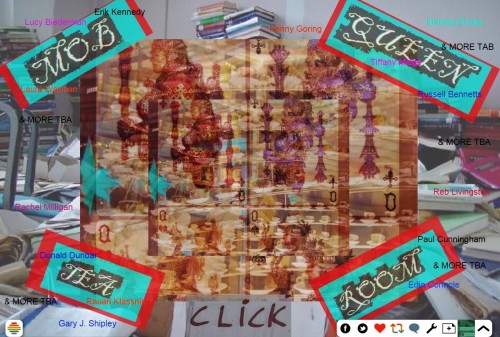
click on image to hear a J-Cash inspired WELCOME ….
blah blahhhhhhh.. spearheaded by Russell Bennetts andjRJrJJJRRR Rauan Klassnik click herenew website launchingRaRAAA Oct 29th… spearheaded by Russell JAAARBennetts andRAAJ Rauan Klassnik click herenew website launching Oct 29th.xoxoxoxoxo.. spearheaded by Russellxxxxx Bennetts and Rauan ooooooKlassnik click herenew websiteblahblahhahahaha launching Oct 29th… spearheaded byAce RussellAce Bennetts andDogRauan DogKlassnik click herenew websiteRajJarJRRRR launching Oct 29th.JJJRRRJJJJJ.. spearheaded by Russell Bennetts and RauanHoHohOOOO Klassnik clickhere&more TBA PENNY GORING DONALD DUNBAR MELISSA BRODER GARY J SHIPLEY REB LIVINGSTON RACHEL MILLIGAN LUCY BIEDERMAN PAUL CUNNINGHAM EDIA CONNOLE TIFFANY MIDGE ERIK KENNEDY LAURA WARMAN NATALIA PANZER////
Behind the Scenes & Contributor Things / Comments Off on new lit/art mag– QUEEN MOB’S TEA HOUSE — JAAAARAAAAJRRRJJJJxoBLA Yeah Yeah Yeah
October 23rd, 2014 / 6:53 pm
October 23rd, 2014 / 6:53 pm
HTMLGIANT OBIT — (HTMLEULOGY) —- (by Drew Smith)
********
in response to my Twitter calls for HMTLGIANT obits/curses/whatnot I received this reply from Drew Smith:
HTMLGIANT is ceasing operations on October 24th. I wish it wasn’t. I’ll miss it.
When I mention how much I love HTMLGIANT, people often react the same way they do when I tell them how much I love Reddit.
Wait, isn’t that a just a bunch of child molesters? Isn’t that a bunch of teenage hackers and trolls? Isn’t that where internet weirdos post nude pics of celebrities?
Well, yeah, it is. And that’s far from the worst of it. But it’s also the place where the “stop smoking” subreddit supported me through my quit. And where someone took the time to teach me how to change the oil on my car. It’s where I get recipes and workouts and shaving lessons and free business advice. It’s just a cross-section of the world at large, where there are almost as many Mother Teresas as there are motherfuckers.
So it is/was/has been with HTMLGIANT, which for the past six years has served as a cross-section—from best to worst—of the world of literature. At least the literature of a big chunk of twenty and thirtysomethings, the ones who aren’t on the Best 20 Under 40 lists, who aren’t publishing in the New Yorker, but who are likely still reading it, half-covetous, half-mocking. READ MORE >
what would be a good name for a new literary magazine ???
(i have a “friend” who’d like to know)
Thirteen Ways of Looking at HTMLGiant (by Dan Coffey)
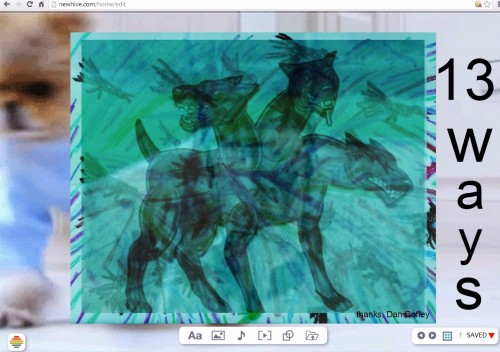
click on image for more dynamic version– Yeah !!!
*******
after I’d tweeted
happy/sad/elated that htmlgiant’s closing??? … send me obituaries/goodbye notes, etc … i’ll publish most of them (i think)….
Dan Coffey sent me the following poem:
Thirteen Ways of Looking at HTMLGiant
I
Among twenty=seven letters,
The only playable tile
Was the Scrabble blank.
II
I was of three heads,
Like a dog
You know which kind and what I guarded.
III
The gyre whirled and whirled toward the Jacuzzi.
We all got pantsed.
Behind the Scenes / Comments Off on Thirteen Ways of Looking at HTMLGiant (by Dan Coffey)
October 15th, 2014 / 9:41 pm
October 15th, 2014 / 9:41 pm