Matthew Simmons

Matthew Simmons lives in Seattle.

Matthew Simmons lives in Seattle.
 From his new book, Marbles, published by Turtle Point Press. (Second title down.)
There are sentences so triumphant we imagine we can make out the author in them, waving to us delightedly from a float within the paragraph.
A coworker found this book in our pile of galleys and reader’s copies. More of the pieces from the book here.
I’m curious about the aphorism as a form.
I recall working a temp job—test scoring, I think—where during the New Worker orientation, another contingent employee mentioned that she liked to write, and when asked what sorts of things she wrote, she said she enjoyed writing poetry, stories, and “quotes.” I assume she meant aphorisms, but you never can tell. Maybe she considered writing down things other people had said a kind of writing. Or maybe she thought she was very quotable. In fact, as I have just quoted her “quote” line, she is/was, in a way, kind of quotable.
Are there narrative possibilities in the aphorism, or just poetic ones?
Watch Merce Cunningham Beachbirds for Camera.wmv in Entertainment | View More Free Videos Online at Veoh.com
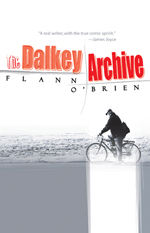 The LA Times blog, Jacket Copy, interviewed John O’Brien, founder of the amazing Dalkey Archive Press. Here’s an excerpt:
JC: How important do you think awareness of form, or a sense of play, is to telling a story in contemporary fiction?
JO’B: I think it should be, and I do emphasize “should,” at the heart of contemporary writing, but this playfulness is not always foregrounded as such. Fiction writing began with this strange consciousness of itself and the possibilities of playfulness, as though it were an inside joke with a great deal of eye-winking going on. The critic Viktor Shklovsky spent a lifetime tracing and exploring such things in relation to fiction, even as related to what would seem to be the un-playful writing of a Tolstoy or Dostoevsky. The fiction that I find unreadable is that which seems unaware of anything that has been written before, and the reader is supposed to go along with what is truly a “suspension of disbelief.” I find this fiction to be boring and condescending to the reader, though apparently many people like it.
 You may have heard that Life of Pi author Yann Martel was given a rather huge contract for his next book. And that the book is being described as an allegory about the Holocaust with animals.
Seattle writer Matt Briggs, in a post on his blog, reacted with this:
It disturbs me that the Holocaust is or has become a genre, just as there is a British tea cozy mystery. Is this an inevitable progression, that a collective trauma becomes shtick? Is the pot boiler Western the equivalent reduction of the genocide of Native Americans?…Three million dollars seems like a lot of money to pay for anything besides a bridge or highway or something.
Intrigued, I asked Briggs to elaborate.
My dear friend Brad, one of the best-read and brightest autodidacts I know, reads Burroughs’ Queer and wonders if maybe he would have developed an appreciation for it earlier if he had been introduced to it in a classroom. Bonus: Four Tet managed a Madvillian remix that is as good as the original. I know. Hard to believe. Forgive me Madlib.
httpv://www.youtube.com/watch?v=yXBckFyiMyU
+
httpv://www.youtube.com/watch?v=qAfrhmIvZ_s
=
httpv://www.youtube.com/watch?v=0hNrSya2NNs