Matthew Simmons

Matthew Simmons lives in Seattle.

Matthew Simmons lives in Seattle.
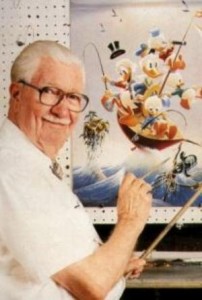
My favorite chapter from the otherwise pretty fun, but ultimately forgettable book The Science of Superheroes is this one where the author reminds readers that the man who wrote the Donald Duck comic book from 1942 – 1966 (Carl Barks) tried hard to always get the science right. Starts on page 161 of the preview on Google Books:
 Recently, Alice Hoffman had a bit of a blow-up over a bad review that gave away too many plot points. (Also, the review was not altogether positive.) So, she argues something like this:
“Critics, don’t spoil my plots. I control the release of information, and am careful about how things unfold.”
After I read Never Let Me Go by Kazuo Ishiguro, I read some of the critical reviews and author spotlights that came out with the book and they almost all gave away a significant piece of information about it—a piece of information that Ishiguro does not himself mention (though it is hinted at, of course) until page 80. At an author event, I asked Ishiguro about it, and his shrugged it off. He didn’t care. He argued something like this:
“The ‘mystery’ in the plot is not important, but instead the mystery of the characters is. The book is not about the idea that drives the plot, but the way the characters live in the world I have created for them.”
Is someone right here? I really don’t know. Is Hoffman suggesting that the pleasure of reading her book is primarily in following the plot? And that if we know what happens, we’ll be disinclined to read it? If Ishiguro doesn’t care about what the critics revealed about his book, why did he wait for 80 pages to reveal it himself? The revelation was, in my reading experience, a very powerful one. Is he wrong to be fine with a critic depriving a reader of that powerful experience?
Are these two unrelated situations that I am throwing together?

Gene and I were chatting about Shotgun Ninja last night and found out that we both had the same secret desire. We both want to meet an indie video game designer and collaborate with them to make games. But how would we ever make this happen?
Well, we have a blog. We have readers. We may as well go ahead and ask.
Are you an indie video game designer? Would you like to collaborate with willing members of the HTML Giant team? Would you like to be the HTML Giant Gamemaster? Get in touch. I’m at
giantblinditems
at
g
mail
dot
com
Imagine: EVER, The Escape
[ ]
[ ]
[ ] [ ]
Or pr’s Baked Tennis All Stars.
Or BE SAM PINK: the game.
A Jello Horse’s Giant Turtle Rampage.
The Log of the S.S. Marie Unguentine Movie Tie-in Game.
An HTML Giant text adventure.
Etcetera.
Spread the word. We’re serious.
httpv://www.youtube.com/watch?v=WokfJUK0nAk
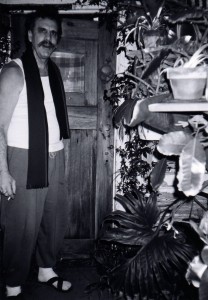
(Photo of Steve Richmond by Mike Daily, 1993)
A couple of weeks ago, Portland writer Mike Daily sent me a copy of a bound essay entitled Gagaku Meat: The Steve Richmond Story. It’s a hell of a thing, actually.
Daily discovered Richmond through the work of Charles Bukowski. They were (Richmond and Bukowski) on-again, off-again friends and fellow practioners of what some call the Meat School of poetry—masculine, direct, sometimes down on its luck. And where Richmond seems to have been influenced by Bukowski, Daily seems influenced by Richmond. Legacy. READ MORE >
 Follow this link for a series of clerihews by my friend Brad.
A clerihew is a four-line biographical poem. They are characterized by a whimsical tone, and I thought maybe today we could use some whimsy. Included is this one about Dennis Cooper:
Party-pooper,
Dennis Cooper:
First violent erections…
Then, alas, vivisections.
(For the record, Brad is a big fan of Cooper’s work. Whimsy.)
More (including Foucault) after the jump READ MORE >