
Lydia Swartz : Why Shld I Read YOUR Book ??

ok, Lydia, so why should we read YOUR book ???
Reasons to read Shufflepoems, forthcoming from Minor Arcana Press. Shuffle & read them in any order:
It’s not a book. It’s a deck of poems. Which you shuffle, so.
It’s the same temperature as your flesh, unless you’re a zombie.
If I go back to writing about pain, you will be sorry.
Can you follow a recipe? Does that necessarily mean you have to?
You’re blocked up like a constipated rooster. Pull a card. Then write/paint/dance about it.
Sometimes you read sitting down. Sometimes you read standing up or lying down. Sometimes you read walking. Or in the tub. Or in a moving vehicle.
Have you checked out the Minor Arcana Press staff? Cuu-uuuute!
I know where you live, possibly.
My ass was never my fortune, but my tits aren’t bad. READ MORE >
JUDSON HAMILTON: Why Shld I Read YOUR Book ??
ok, Judson, so why should we read YOUR book ???
Let me answer your question by way of analogy, I had a dream recently, in which I asked Ashbery to look after my two kids and when I came back they were parked in front of the TV in the living room, seemingly unharmed. I looked around and found Ashbery clad only in a pair of tidy whities rolling around laughing on the bed, deep in conversation with a woman in her 70s, an old friend apparently. They were lost in reminiscence, they’re faces lit up with the joy of nostalgia, and I didn’t have the heart to be angry with him.
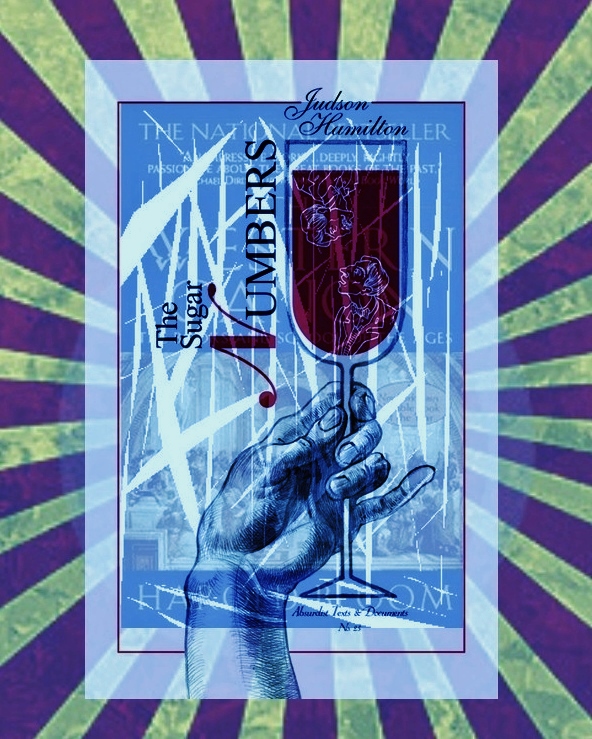
The Sugar Numbers (by Judson Hamilton)
Then he jumped up and joyfully began to pop lock, like in some shitty kid’s video,with electric cutout arms blinking blue, red, yellow and that pretty much sums up how I feel about this book. It’s surprising, delightful and absurd.
To answer your question by way of digression, about 6/7 years ago I started receiving emails that looked as though somebody had fed the better portion of the western canon through a shredder and then affixed it to emails, I assume to bypass the spam filter. I liked some of the initial juxtapositions that turned up and began playing around with the text, and while I was doing that, a narrative emerged from the depths in the form of: a Speed-hearing Judge, his brother the Duke of Marmalade and, Morel and Valentine, the two servants trying to overthrow them.
Look, I know Syria’s been forgotten and the Congo’s a mess and let’s be honest who needs another book-length absurdist narrative on their bookshelf, am I right? But we’re all doing what we can and together we can right this ship…. that and the e-book version shouldn’t cost you more than a trip to the taco truck, so what’ve you got to lose?
(Judson Hamilton 9/2014, Poland)
Judah Hardwick: Why Should I Read YOUR Book ????
ok, Judah, so why should we read YOUR book ???
Why you or anyone should read my book? What a question! …Wait, is this coy?–or cute (you know, cute in that slanted way)? Or too eager, perhaps? I don’t want to muff this.
I won’t start off by mentioning how Rise and Shine (my book) was written during one of the worst stretches of my life, in sickness and in anger, and how I worked my nerves murderously to keep patience with it and then thinned myself to barely more than a front and back cover stripping everything down to sharpness and…and…what’s the antimorph to blurtiness?–I won’t, as buckets of blood don’t much matter to the literate consumer unless they’re dumped ministerially from time to time in the plot.
That was a long sentence. Sorry. There are not many in my book. Maybe that’ll recommend it. It’s handsomely broken up. Form, as well as the content. It’s a first-person narrative. And a first-person narrative that obeys verisimilitude.
There are no words like “verisimilitude” in my book; so no one should feel hightalked. Not to say what’s inside will turn away intellectuals, real or imagined. No. It is turned away from clunkiness. Or holds it to effect when the finely patterned sensibleness of the world collapses. You’ll see what I mean. When you read my book.
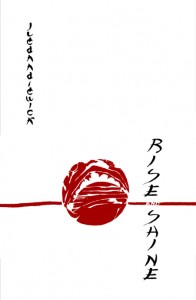
“It sure has some cover, doesn’t it?”
It is fiction. It is novella. It hews closest to the tradition of what Mark Twain called the “humorous story.” It–
It sure has some cover, doesn’t it? It tells you right off about the writing inside. The plot? You get what is depicted about a third of the way through. It resonates throughout; I’ll say that much. Although you might not know it until you come to the end. Of my book. Read it.
As it happens, there’s not much blood. It stands a chance you’ll think that funny once you’ve read my book. I’m not going to tell you here why, of course. A lot of the work I was hooting above was done so the reader would enter and wade the story as though entering and wading quicksand. While sleepwalking. It is that finicky. Sorry. But those of you who do read my book will appreciate this, and I’ll appreciate this, and we’ll all be appreciated together on some appreciable bed of daisies. Oxeye daisies. There’s oxeye daisies in my book. An invasive species in some parts of the world… (Judah Hardwick, 8/2014, Buffalo)
Author Spotlight / Comments Off on Judah Hardwick: Why Should I Read YOUR Book ????
August 26th, 2014 / 1:21 pm
August 26th, 2014 / 1:21 pm
Justin Marks: Why Should I Read YOUR Book ????

ok, Justin, so why should we read YOUR book ???
Why should you read my book? I have no fucking clue. I don’t even know why I wrote it, except that doing so was part of a compulsion I have to make things, and the only means I have for doing that, the “talent” I have, is writing. Writing in general, poetry in particular. If it were different, I would have written a novel or a memoir or a scholarly book or something YA.
My book is none of those things. There is some narrative, but it’s pretty fractured, as they say. There are characters, but not the kind you really get to know. I present them from my point of view only. It’s poetry, for Chrissakes! The lyric “I.”
The book is about me and my life, but also other lives I wish I’d had. Or think I wish I had. It is about struggle, though is decidedly not “My Struggle.”
Overall, it’s pretty adult. By which I don’t mean porn, though there is a fair amount of sex (not) happening in the book. It’s about trying to be a grown up and how much that fucking sucks. It’s about choosing a life and then having to actually live it (auto correct tried to change “live” to “love”). It’s about making decisions and having to live with them, which also fucking sucks.
It’s about broken bones. And booze.
Life, death, love and (un)happiness. Kids.
And then, by the end, it’s about realizing what a sick piece of shit you are and having to live with that. Having to figure out a way to be a better person, behave responsibly because, really, the way things are going, it’s just not going to end well.
Or maybe it’s not. Maybe it’s about something else entirely. I don’t know. You tell me. (Justin Marks, 8/2014, NYC)
A “Conversation” with Rauan Klassnik (1)– (Huh??)
Ahhhhhhh– The Magic of Poetry
******
This is the first of an occasional series in which other people ask me serious and stupid questions about my sex life, how much money I make, gender fluidity, etc, etc. And then I step up on to the stage to give the straight and skinny with as much panache, delicacy and hulking wisdom a human soul can muster post Henry Miller (Ha Ha Ha ha ha):
******
This started up when I was bored and tweeted:
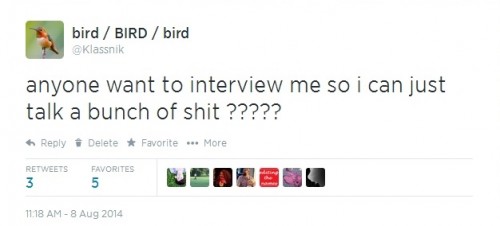
a call for help!!
******
I guess I was really bored. And I guess I was a little bewildered by some interviews I’d read online recently. (It’s better when they call themselves “conversations” and use phrases like “writing process.” . . . I wish I could get all religious here like crazy old Henry Miller. Fevered and romantic. Like a barbecue of militant, bible maniacs: teenagers at an Amy Grant concert.)
So, anyways, Timothy Volpert answered my distress call, sent me some questions, and here’s the Q and A:
Dec. 27, 1971 Letter
Hello Big John:
Here is further from the novel FACTOTUM. I feel it is picking up now and getting lively. I felt it would if I gave it a chance. Some things must begin slowly and build up their own steam. If it stays lively enough for me I will finish it. I include an excerpt I am sending out as a short story. It runs a little smoother, just a touch, which shows that minor re-writing has its value.
I am also including a poem which I don’t believe I sent you a carbon of but which is in the current issue of INVISIBLE CITY, Vangelisti’s rag.
My spirit is back up for a while. I don’t know why. But when I feel good I allow myself to.
Vangelisti who was about out on his ass at S.C. tells me he has won a Fulbright and will be teaching at univ. of Rome (?) come Sept. and that he intends to translate Bukowski to Italian. Heat up the sphagetti, pardner…
Sometimes I really enjoy writing…like the excerpt, SOMETHING LESS THAN ANGEL, I grinned all through it, glowing, flipping out the words, feeling damned near immortal like Dante or somebody, or anyhow, feeling fair enough, knowing it could probably be better written but I couldn’t write it better without that exact strain of work like changing a tire, and I don’t like the to change tires.
So, hang in, Old Black Sparrow and tell Mrs. Sparrow, Bukowski says good things are possible if you don’t fight the sun too much…which reminds me of some good told time titles—KNEEL TO THE RISING SUN (Caldwell), and better yet, BE ANGRY AT THE SUN (Jeffers)…how I warble on…more stuff, soon, I’m sure…Christmas blissfully over and only a mangey New Year’s to l eap over….
All right,
Henry
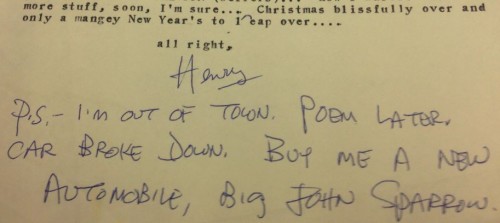
P.S. –I’M OUT OF TOWN. POEM LATER. CAR BROKE DOWN. BUY ME A NEW AUTOMOBILE, BIG JOHN SPARROW.
Noir: A Love Story – An Interview With edward j rathke
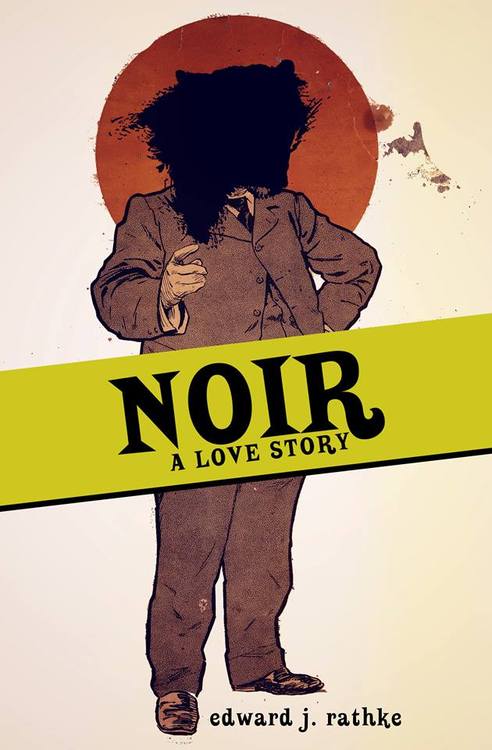
Noir: A Love Story by edward j rathke is forthcoming this summer from Civil Coping Mechanisms, and I had the opportunity to pose Edward J Rathke some questions inspired by his phenomenal book.
***
What’s your real name?
I used to hate my real name. I used to hate it so much. I hated the way it looked on paper and I hated the way it sounded, rolling round my ear, those two stupid hard consonants just a few letters apart. I’ve made a thousand names for myself over the years and most of them nothing like mine. I lived in worlds that only existed inside my head and I made me new. For a long time I hated my face too and I avoided mirrors like they were plagued and I stopped remembering properly what I look like, and this problem persists. The person I see with my name when I close my eyes isn’t the one who smiles back in the mirror. Even my dreams stopped being about this name and this body. I became other men and other women and I dreamt in their bodies, with their names.
Now I’m comfortable with the name I was given so long ago: edward j rathke. I even have a supervillain name ready for whenever I fracture apart and try to take the world apart: Wrath Key.
But is edward j rathke the best at answering these questions? Probably not. He’s a very silly human, though he sort of writes the opposite of silly books. Sometimes he wishes his novels had more silliness, way more zaniness, but we suppose writing is where those heavier parts of him go so that he can go on living silly, lightly, while we write on, Deathly.
What’s the story you always tell? What’s the story you’ll never tell?
I don’t know if there’s a story I’m always telling people. Probably there is, but the ones I feel like people are always asking me about are the ones where I almost died. Like the time I took a 60 foot freefall onto rocks or the time my appendix exploded while I was in Korea and I spent a week in a hospital where no one spoke English. Most of my stories involve me being lost and making bad decisions.
There are so many stories I’ll never tell but not because of fear or shame or regret. There are memories that are sacred to me. In many ways they’re all we have as humans. Our life is just a collection of memories, and memory is largely a creative process of stitching together misremembered moments. When you share a memory, it stops being yours. So when you speak your memory into new ears, that memory becomes theirs, and in that transference, the memory changes twice [first by making it into words and then again by the person hearing those sounds, stitching it to the fabric of their life] and becomes something new. If they share that memory, it again transforms, and so when your memory is shared with others, it stops being yours and becomes something wholly different than who you are, which is a body housing memories. And so I keep the best ones inside and I share them with no one. Not even in my fiction, and definitely not in interviews like this.
Most of them are about love. Those howling bits of time, fraying, hoping.
And maybe Noir: A Love Story is both. It’s full of the story I’m always telling—the unknowable humanity, the howling ache chasming between us, the sublime perfection of existence, the beauty of its ending—and the ones I’ll never tell. All those stories I’ll never tell, those are the ones at the center of Noir: A Love Story. I’ve given you the impressions of lives but told you nothing about what they mean to the people who lived them, and so the reader decides and discovers. In that discovery, they’ll probably find the many mes that I’ve been all these years.
What does desperation make you do?
Desperation’s made me do a lot of things. I’ve lived a strange life full of stranger existential crises. Desperation sent me to Ireland and South Korea. It’s sent me wailing into the night. It’s sent me down roads of destruction, but I’ve also poured it over thousands of written pages. When I was younger I didn’t sleep really at all—still don’t, I guess, though mostly out of habit—and that was something deep and dark gnawing at me all my life. Then while still too young I spent those sleepless nights drinking, causing chaos, writing terrible poetry and screaming it into the sunless sky, breathing smoke on rooftops.
“Time eats you. Dead or dreaming” What else?
I have strung wires from steeples to stars and tightroped across the sky. READ MORE >
A Conversation with Philip Graham
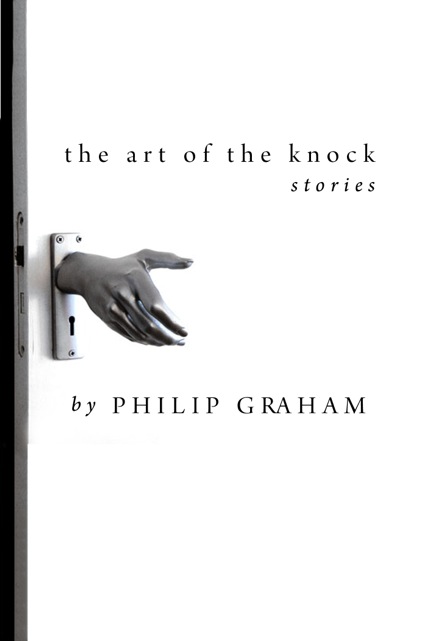
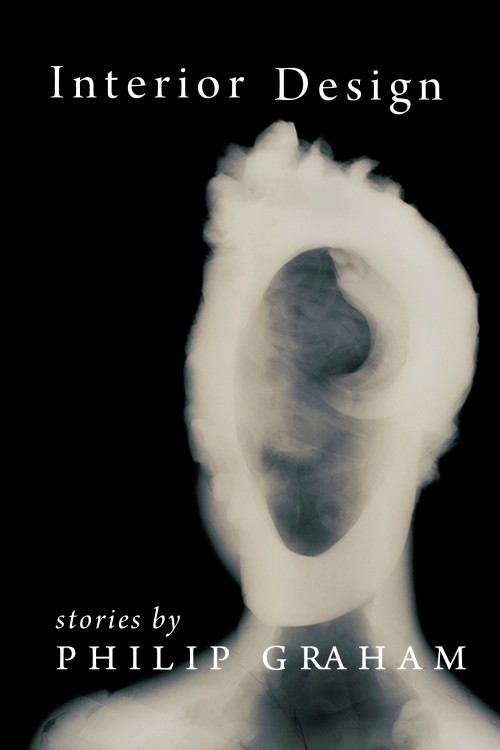
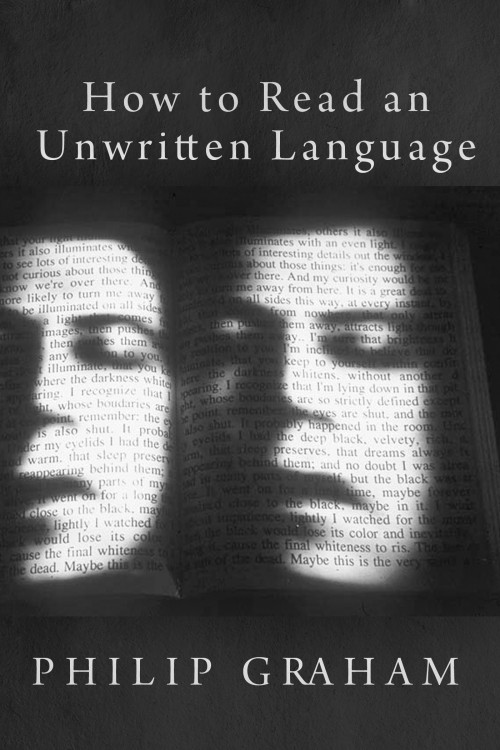 Three of Philip Graham’s early books are newly available in Dzanc/Open Road ebook editions. Graham asked me to write the introduction for one of them, The Art of the Knock, and while I was working on it, I asked him a few questions to satisfy my curiosity about his years working with Donald Barthelme and Grace Paley, his time in Africa, and his thoughts on symmetry and design, which are influenced in part by the poetry of Charles Simic and the plays of William Shakespeare.
Kyle Minor: I’ve just finished re-reading The Art of the Knock, the book that first brought you to the attention of many readers. I was struck by its symmetries of design, a thing that seems to have been a preoccupation of yours. So many story collections are simply a grab bag, a greatest-hits-lately. But The Art of the Knock is, first and foremost, a book. The parts are in conversation, and they are arranged like a series of Chinese boxes, or Russian matroyshka dolls, on the one hand, and on the other, they are directional. We begin with digging through toward China, and we land in China. We go through three iterations of the “Art of the Knock” series. And the rest of the stories are nested in two in-between sections that seem mirror images one of the other, or at least they are in conversation. How did you find the form of that book? Did you write your way into it, or did the design arrive first?
Philip Graham: Actually, The Art of the Knock grew out of a combination of the two approaches. I’d just published a first book of prose poems, The Vanishings, and my new work was tending toward the short story form. I’d written the first China piece, the first Art of the Knock story (though at the time I didn’t consider them part of a series, they just were what they were), and a few of the family stories—“Silence,” “Shadows,” and “The Distance.” I was simply working my way into a new book, and didn’t have a definite sense of what it might become. READ MORE >
Virtual Book Tour: Bonnie ZoBell
Follow Along With Bonnie’s Virtual Book Tour Using the Link on the Banner!
Bonnie ZoBell rants about sex and the elderly:
Who is it that thinks old people shouldn’t have sex? Miguel in my story “Lucinda’s Song,” that’s who. Miguel—and he’s not alone—thinks his eighty-year-old mother, Lucinda, has no business romancing at her age, especially not with someone who isn’t his father, even if his father has been dead for years. For her part, Lucinda’s having a great time with her new beau, Ramón Fernández. In fact, they’re having such a torrid affair, she can’t get around to watering her lawn and keeps getting citations from her gated community for having brown grass. She’s never had so much fun.
And why shouldn’t she, or any other elderly people? There’s no threat of pregnancy anymore. In older generations, when birth control wasn’t as widely available, extramarital as well as marital lovemaking always came with the risk of pregnancy if women were just looking for a little pleasure. Additionally, their adult lives have been spent working themselves practically to death, at least until they retired. They’ve raised children, paid their taxes, lived in wedded bliss—or not so much bliss—and many are now living alone. Don’t they deserve having as much of the old in and out as they please?
We’re too plugged in to the airbrushed beautiful people advertisers keep throwing at us. The older we get, the more we discover that looks aren’t what it’s all about anyway. Maybe both people in an elderly couple enjoy European history, watching Glee, and naps in the afternoon. For Lucinda and Ramón, weekly bingo really turns them on. He likes her ‘tude. She’s always liked Indian-looking men. Why shouldn’t they get it on?
Miguel isn’t a bad guy. I try to understand him, because I invented him after all, and I care about all my characters. I try to understand that with his dad gone, he might feel a certain protectiveness about his ma, doesn’t like to think of her that way. But come on, guys, her parts are all working and she got along just fine before you came along. Miguel particularly doesn’t appreciate finding a bottle of personal lubricant on his mother’s kitchen counter—or that she’s threw her back out when she and Ramón were going at it against the dishwasher. Get a life, Miguel! If the sex is good enough for her not to mind a small injury, you need to move on!
Remember, if our mothers didn’t have at least a small interest in sex, we may never have been born. If you have to say something, tell her you care about her and want to be sure she’s using protection. Did you know that STDs have doubled in 50 to 90 year olds in the last decade? They’re living longer. With so many medical breakthroughs over the last century, bodies are staying healthier longer, or at least healthy enough to enjoy physical pleasure. Retirement communities are like rave parties these days. It’s no longer all about shuffleboard, looking at scrapbooks of grandchildren, or dusting cat figurines.
Lucinda and Ramón have their own particular way of making love, slow and how they like it:
“Come with me, mamacita,” Ramón said when they’d finally said what they needed to say and decided to make love. That night he helped remove her shift, she his trousers. The dim light from the bathroom bathed their wise, desirous bodies. Ramón smoothed the skin on her neck for such a long time it felt like a shiny sea stone. She ran her nails over his back until he drooled.
“Don’t fall asleep yet, papacito,” she murmured.
Love that night wasn’t about getting it over and pushing [her past, abusive husband’s] dead weight aside before he dozed off. This wasn’t to say that Lucinda and Ramón didn’t fall asleep right in the middle of everything. But it was a pleasant sleep. A siesta. And when they awoke early the next morning, they picked up where they’d left off. Ramón actually cared where those folds between her legs led, what they could do, that Lucinda felt something too, that the episode wasn’t over until she had produced a certain song in her chest.
“Mi amor,” Ramón said afterward.
A man of Ramón’s age didn’t have to finish any sooner than his woman wanted him to.
So, give your mom some condoms if you must, but remember: you weren’t found under a cabbage patch!
***
Check out Bonnie’s new collection, What Happened Here, available for purchase!
***
Bonnie ZoBell’s chapbook, The Whack-Job Girls was released by Monkey Puzzle Press in March 2013. She has received an NEA fellowship in fiction, the Capricorn Novel Award, A PEN Syndicated Fiction Award, the Los Angeles Review nominated one of her stories for a Pushcart Award, a place on Wigleaf’s Top 50, and a story published by Storyglossia was named as a notable story in story South’s Million Writers Award. After receiving an MFA from Columbia on fellowship, she has been teaching at San Diego Mesa College where she is a Creative Writing Coordinator.
Virtual Book Tour: Heather Fowler

Heather Fowler’s fourth collection of fiction speaks the language of need. Desperate, obsessive, even demented need—both emotional and erotic—is voiced by characters ill or ill-advised. From cyber to stalker, illicit, explicit, tender and tedious, the relationships in Elegantly Naked In My Sexy Mental Illness translate love and lust into disorder. How we hear our own need and the way it sounds to others proves in these enthralling stories an imperfect but utterly captivating conversation, a destructive yet dynamic discourse between well-being and disease, images and words.
Heather drops by HTMLGIANT to discuss the theme of mental illness in her new collection!
***
 Why I Wrote About Mental Illness:
I was inspired to write about mental illness due to many factors. Each story has a different question that caused its creation in my body of work. In hindsight, I think I meant this collection as a whole, due to its thematic connections, as an exploration of the psyche—a way to open up discussions about degrees of mental illness, as well as broadening readers’ minds with sympathy for those affected. As a sensitive person who has witnessed a lot of painful circumstances, I think I’ve always been curious about what causes unusual behaviors, erotic and otherwise.
When Sex and Love and Mental Illness Meet:
Elegantly Naked in My Sexy Mental Illness addresses human interaction more so than strictly defined mental illness. For example, in the real world, lovers are often perceived to be insane. It’s no wonder we have household terms like “crime of passion” and “temporary insanity,” but love’s insanity is one Elegantly Naked approaches from many angles but few labels. In one story called “Ever,” a character named Caroline Light is relentlessly pursued by a romantic stalker, and, due to the long duration of the stalking, she receives little to no continuous support from friends and family. What happens next? Her guard drops and she’s killed. Is her stalker a psychopath with malignant narcissism? A sociopath with a borderline personality? Perhaps, but I’m more interested in the effect on characters’ lives than specific diagnoses.
Disorders often have diagnostic overlap. Sometimes people carry a world of trauma in their heads, multiple issues. In the book as well, I have a piece called “The Gray Fairy” in which a young mentally ill character must be watched constantly. She hears voices—but also suffers the will to self-harm, anxiety attacks, dissociative disorder, depression, PTSD, and more. She’s a hard character to love with any security of reciprocity, but I explore the idea of her caretaker platonically attempting to get closer—until the dysfunctional home family dynamic forces the outsider out. There’s something fascinating and horrifying in that idea for me, the idea that those who harm can care more about protecting their reputations than exploring what ails their damaged daughter.
In another story, “His Other Women,” I explore a female narrator in love with a womanizer, whose inability to know whether she reads him correctly becomes an emotionally traumatizing spiral of self-induced doubt, abnormal thoughts, and paranoia: “But your cheating bastard has his claws in Clarissa, you know, you think…Sometimes, you imagine yourself and these women as a herd of sick sheep that oddly want to comfort one another. Sometimes, you want to make love to his women, every single one of them, so that you can enjoy the pleasure of taking what he has enjoyed.” She desires erotic transference, a shared state of reduced pain.
In each of these pieces, in different ways, I’m interested in causes of fracture in relationships and deviations from “normal.” I’m interested in the idea of psychotic breaks—the shifting balance of how perception impacts a construction of “sanity” that can change by the action or hour. READ MORE >