
Observations

Fire may be the only cure for a deformed protein zombifying deer all over the country. Liquid crystal film charged by ultraviolet light can wave without wind. Apparently, Uranus opens and closes every day to bathe in hot particle beams. Alpha male mountain gorillas care deeply for young gorillas in their group, regardless of kinship. Somewhere in Washington, DC, thirteen white men tried to cut healthcare to millions of working class and poor Americans that voted them into office. It is becoming more and more plausible that someone could fabricate an event. “It could be there is a there there after all,” said a woman to her son in their hallway — as pale mid-morning light crept into the picture frames, a haze cast over their eyes like gauze and neither knew what to do with her hands.
Harassment from males reduced fecundity in one of three morphs of female polymorphic damselfly. It turns out there are three kinds of snow leopard and some may be less endangered than others. Unfrozen bioregions of Antarctica are expected to increase by 25% over the next 80 years. A retired woman watching MSNBC on her smartphone at an Amazon processing facility in Arizona spent three unauthorized hours producing a thousand greeting cards to accompany her day’s shipments. The cards said, “It’s always spring somewhere…” and they were covered in crude drawings of flowers she thought she remembered. It was 118 degrees outside and the facility gleamed like the sun.
As many as 17 million Americans think chocolate milk comes from brown cows. Urban ecologists want to spend a lot of money studying rats, which cost the world’s economy billions of dollars, and are apparently not well understood. A philosopher in Tennessee concluded that since it is difficult to establish how much of a person people in vegetative states are “we should go ahead and treat these patients as if they are persons.” The New York Times devoted some of its Arts Section to explain the origin of the Milkshake Duck. A child in Nebraska noticed water drops in a row of corn sprouts — when she realized they did that on purpose, everything seemed to get a little wider, like there were eyes all over and she could see out the corners of them. And when she asked her daddy where the rain comes from he said, “I don’t know.”
Observations
Female paleontologists contributed to the community of inclusion by donning beards for field selfies. Donald Trump’s odds of winning slouched to zero as diehards threatened revolt and the Times reported his assessment of Arsenio Hall in the 00s: “Dead as dog meat.” A middle-aged man realized marijuana does not contain inspiration. Two hours later he forgot. The American hacker Jester told CNN he posted a message on the homepage of Russia’s Ministry of Foreign Affairs telling the country to go to its room. Former FBI agents call him Batman.
Scientists flooded a population of E. coli with a compound derived from cypress trees to see if it would shed its antibacterial-resistant transposons. It did. A woman in Coeur d’Alene, Idaho drove through a carwash five times in a row because she is in love with the feeling of detached time and the simple beauty of blue soap. “It’s cheaper than therapy,” she said, “and my car is so clean.” A sociologist in North Carolina argued that censorship today is not defined by withholding information, but by giving it directly to the public. In 20,000 pages of email WikiLeaks told us that John Podesta thinks former New Mexico governor Bill Richardson “can be a dick.” Richardson tweeted that he didn’t care.
A brown maple leaf slowly fell, draping the body of a dead squirrel like a blanket. A PhD candidate at Cambridge attributed the creation of Frankenstein, as well as the bicycle, to the distinct lack of summer in 1816. Astrophysicists lost a round of hide and seek with dark matter. No one knows why capuchins crack stones together just to lick the dust. This may be the last election dominated by baby boomers. People began to worry about a weaponized internet of things. All over the world people walked around dressed as creepy clowns. An elderly man in Fresno, California said, “That’s enough.” Then he sat exactly where he was, watching Jeopardy as steam rose from a humidifier in front a house plant. The light of the TV reflected the windows around him. Night fell and he was alone.
Collision
“Just because you don’t know where you’re going is no excuse for not going on. That doesn’t matter at all to me.”
(Marguerite Duras, 1969)
I.
Inside the mania it moves around. It’s an upswing, but “some sharks must swim constantly in order to keep oxygen-rich water flowing over their gills” or else something, inevitably bad, will happen. The B-side of the record finishes and I flip it over to start again. It’s working exactly how I want it to. I’m in the bed. I take the headphones off and go into the office. I remember a note I had scribbled in a notebook and immediately forgotten: re-read Craig Watson books. In the office I climb on the rolling chair to grab the books off the high shelf. I’m not afraid of falling because to lose control is to find pleasure. This thought invokes another and I go to the living room to try to find the pamphlet I made of an essay about Jean Daive. The books are everywhere, things move around. Paul Buck says it’s best to reorganize the library every few years, to accept that certain books can and should find themselves comfortable in different places. Forgetting where a book is can be a necessary part of finding it. In the hallway between the office and the living room I throw a handstand to revitalize. Beyond, on the shelf with the zines and pamphlets, I find what I’m looking for. Flipping through, I also grab the Guyotat pamphlet I forgot I already had, find V Manuscript‘s ARGOT OF INSCRIPTION still wrapped in plastic, blood stamped. Why did I never finish reading this? I want to read it now so it goes in the stack under the Craig Watson books. The running around is corporeal, an exercise for the body that needs the grabbing and the shifting and the stacking and the touch. This is how I can feel it, connect to it. Thought forms out of these connections. The interest in study has no end point other than in the construction of my own personhood. Endless research; an embedding.
II.
I stand on my head when I need to figure out what’s happening to my body. I’ve learned it’s the easiest way to immediately tell if something is off: digestion, congestion, exhaustion. Condition also ends with -tion. The inversion tells me I am fine. When I’m inside the text it’s like this too: I can tell with my body. By 1:30 I regret having gone to yoga at 9am because I’m ready to go again. Where are we at? Disappearing Curtains is pushed away but I stop it from falling to the floor. INSIDE: The juxtaposition of the translation of a text by Bernard Noël that circulates around an absent photograph next to a translation of Mathieu Bénézet’s Us These Photographs, No keeps vibrating lately. When you want to continually experience something you find yourself embedded infinitely, matryoshka dolls, labyrinthine tangents. In William Cameron Menzie’s The Maze a frog pond is kept at the center of the meander. Why? Because this way getting to where you’re going is an act in its own capacity. The dynamicism makes it worth it. Gemini’s have to keep busy. “Don’t you ever come down?” “Not if I can help it.”
III.
Wandering through multiple texts is just another form of movement. I can’t slow down or else I crash. Distanced from this wander I’m absent & detached, perhaps even depressed. It’s not writer’s block because I’m not necessarily trying to write anything. I’m more interested in meeting an all-encompassing void. Sometimes people ask me why I’ve started doing so much yoga & I realize that the honest answer would sit somewhere between that all-encompassing void & a refusal to give up on the float. Sometimes I don’t want to say anything because anything would require too much explanation. If it were possible I’d just shut my eyes and transfer the aura of the feeling–the one that carries across: corpse pose after a good practice, the vertiginous space of literature, the echo of space coming across in the depth of the cassette, the flicker of light in the projected 16mm that opens up to another world, meditation. This is it. What if I told you I was only ever interested in writing to get closer to what can’t be expressed in words?
Venus & Jupiter: The Conjunction of Brown & Powell
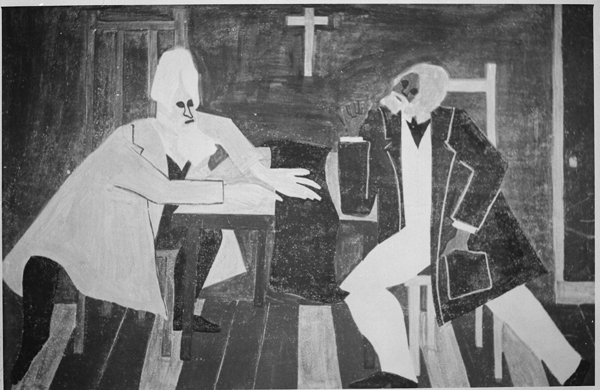
Frederick Douglass argued against John Brown’s plan to attack the arsenal at Harpers Ferry, Jacob Lawrence
One hundred and fifty years ago, a man named John Brown was put to death by the state. He was not gunned down in the street, nor was he unarmed. He was arrested by Robert E. Lee for leading a raid on the national armory at Harpers Ferry, Virginia. He had planned to arm America’s slaves with a hundred thousand guns. He was a white man, a preacher. Newspapers called him “a madman.” In most pictures he had “crazy eyes.” Abe Lincoln declared him “insane.” One thing’s for sure, he was mad. His rage boiled over.
American poets compared Brown’s life to a meteor that tore across the sky as he sat in jail, very nearly bisecting the interim of his conviction and execution. Emerson called him a saint, “whose martyrdom, if it shall be perfected, will make the gallows as glorious as the cross.” Thoreau said, “When a man stands up serenely against the condemnation and vengeance of mankind, rising above them by a whole body . . . the spectacle is a sublime one.” Both had attended his speeches and probably knew about the raid before it happened. Years later, Melville wrote, “the streaming beard is shown / (Weird John Brown), / The meteor of the war.” Whitman, who was there, put him in Leaves of Grass: “YEAR of meteors! brooding year! / I would sing how an old man, tall, with white hair, mounted the scaffold in Virginia; / (I was at hand—silent I stood, with teeth shut close—I watch’d; / I stood very near you, old man, when cool and indifferent, but trembling with age and your unheal’d wounds, you mounted the scaffold;)” The actor John Wilkes Booth was there, too. He wrote his piece in Lincoln’s blood.
Even Victor Hugo, in exile, called for Brown’s pardon. “There is something more frightening than Cain killing Abel,” he said, “and that is Washington killing Spartacus.” READ MORE >
Poem by my friends Bela and Katya
Standing Poem
I take my job really seriously.
My job is standing:
Your job is being. Your job is not being naked.
My job is not standing for something but rather simply standing.
Standing for nothing? I don’t stand for anything…I won’t stand for just anything. I’ll stand for $8.75 an hour.
I don’t stand for that much else otherwise, but I can stand $8.75 an hour. I can’t stand for any less, but I could stand for more.
Oh, this is stand up.
I am standing up for my right to get paid a minimum hourly wage for standing up.
I stand for at least the minimum — at most, I stand for 8 hours. I can stand on my own two feet, but only if I am paid to be standing. Otherwise, I will sit.
I don’t stand for freedom; I can stand for minimum wage.
I don’t stand for free dumbdumb. I stand for: a living.
A high standard of living?
I’m pretty short so not that high a standard, but some take me as their standard.
My standing is standard.
I will take $8.75 sitting down, but I will take it standing up also. When I can’t stand anymore they won’t pay me for standing any more. I will keep standing as long as I can stand to keep standing.
Get up, Stand up. That’s a standard workday. You can think on your feet, but you don’t have to. Understanding standing plays a big part in the job of standing: you must understand that your job is standing to stand for a job.
It’s taken a long time to get over sitting, but I’m finally beginning to understand.
by Bela Shayevich and Katya Tepper
*Bela also wanted to make sure I let you know about her upcoming book tour with Ainsley Morse. They translated Vsevolod Nekrasov’s collected poems together. Go.
Concurrent Events: There is no money
I hate when people announce a series. Usually when I announce a series, it just doesn’t happen. Like talking about something you’re writing, it makes it hard to finish, because talking about it makes it exist a little and that means you can move on. I prefer to move on. But I see no way around it: this is the first in a series of Concurrent Events. Hold on to yr butts.
At the crash of a Bank, vague, mediocre, gray.
Currency, that terrible precision instrument, clean to the conscience, loses any meaning.
OPEN LETTER TO HTMLGIANT: THE SEXISM STOPS HERE

I think everyone has an Internet feud they will never forget. Here’s mine: in January 2010, Jimmy Chen wrote a post for your site (that has since been removed) in which he showed a photograph of Zelda Fitzgerald and “complimented” her cute rolls of back fat. In the comments section, I called out the sexist move of reducing a female writer to the shape of her body, and was immediately dismissed with a “fuck you” and someone asking why I had a sexy picture of myself on my own blog.
And on my blog, Chen told me my life would be easier because my face looks like this.
In an open letter apology (that has also since been taken down), he wrote, in his defense:
“Leah [sic] Stein has a ‘right’ to post a sexy picture of her, and I have a ‘right’ to think her life will be easier because of her beauty than an ugly woman’s which is why she [sub]consciously posted it.”
There is nothing easy about the life of a writer with the face of a woman, especially when men get to tell you what you’re allowed to do with your face. Which brings me to yesterday’s post by Garett Strickland, about how Kate Zambreno humiliated him when she unfriended him on Facebook, taking away his ability “to participate in a conversation I’ve got as much right to as any other human being, regardless of the seemingness of my being white or male.”
Note that both Chen and Strickland are eager to point out their “right” to write whatever hateful, sexist, ignorant thoughts cross their minds, even in the personal spheres that female writers are often forced to create out of necessity for their own safety (Chen was commenting on my blog; Strickland was writing on Kate’s own Facebook page).
In retaliation for his hurt feelings, Strickland goes on to unleash what I can most accurately call a sloppy prose poem about sexual inadequacy, which ultimately turns Zambreno into a doll, “Made by Men,” who arrives in a box. When he pulls the string, she delivers “reactionary polemic” that Strickland can’t understand due to “personal deficiencies.”
Here’s the most significant thing Strickland doesn’t understand, the worst of his personal deficiencies: he doesn’t realize that by objectifying Zambreno and turning her into a doll, he is being aggressively chauvinist. He isn’t participating in a conversation he has a “right” to. Notably, in order to have a conversation, he has had to create a doll who can only spew pre-recorded messages, who can’t actually talk back.
To Chen and Strickland, I would ask: have you ever been reduced to a body and a face? Have you ever felt afraid for your safety because of your body? Has anyone ever trivialized your work because of your gender?
In the summer of 2011, I met with a team of Random House sales reps who would be responsible for bringing my novel and poetry collection to bookstores and libraries around the country. One asked me what kind of cover image I wanted for my novel.
“I only know I don’t want a headless woman on the cover,” I said. “I don’t want my book cover to exclude men from picking it up.”
“Do you really think a man would read your work?”
“Well, a lot of men like my poetry,” I said.
“Only because you’re cute,” I was told. By my editor.
I didn’t know what to say. I like to think that out of the 37 people in the world who read poetry, the men who read mine are finding some merit there, and not just jacking off to my author photo.
Chen has described Zambreno as “a feminist who hosts an irrational hatred of me due to not being able to perceive my misogyny ironically,” but what’s truly ironic in all this is that Zambreno has written an entire book about women who were written off, robbed, and institutionalized for/because of their creative talent, while their husbands and lovers were celebrated. I read Heroines with my jaw hanging open in recognition, especially when I got to page 140. She describes Chen’s Zelda post and the feuding in the comments section:
The snarky dismissal. I answer back with vitriol. It becomes heated, ugly. Personal. Slurs of a sexual nature slung in the comments section, mostly by a chauvinistic supporter of Chen’s. A way to bully, which is to humiliate, to silence, to make a woman smaller whose behavior is seen as outsized. (Won’t she fucking shut up?)
As writers, we know words carry power. I challenge HTMLGIANT contributors to use their power to make this site the weird-ass literary carnival it is at its best, without using discriminatory, sexist, hate speech that objectifies, humiliates, and infuriates their female readership. To quote the Urban Dictionary, please check yourself before you wreck yourself:
Take a step back and examine your actions, because you are in a potentially dangerous or sticky situation that could get bad very easily.
Sincerely,
Leigh Stein
Speaking Through
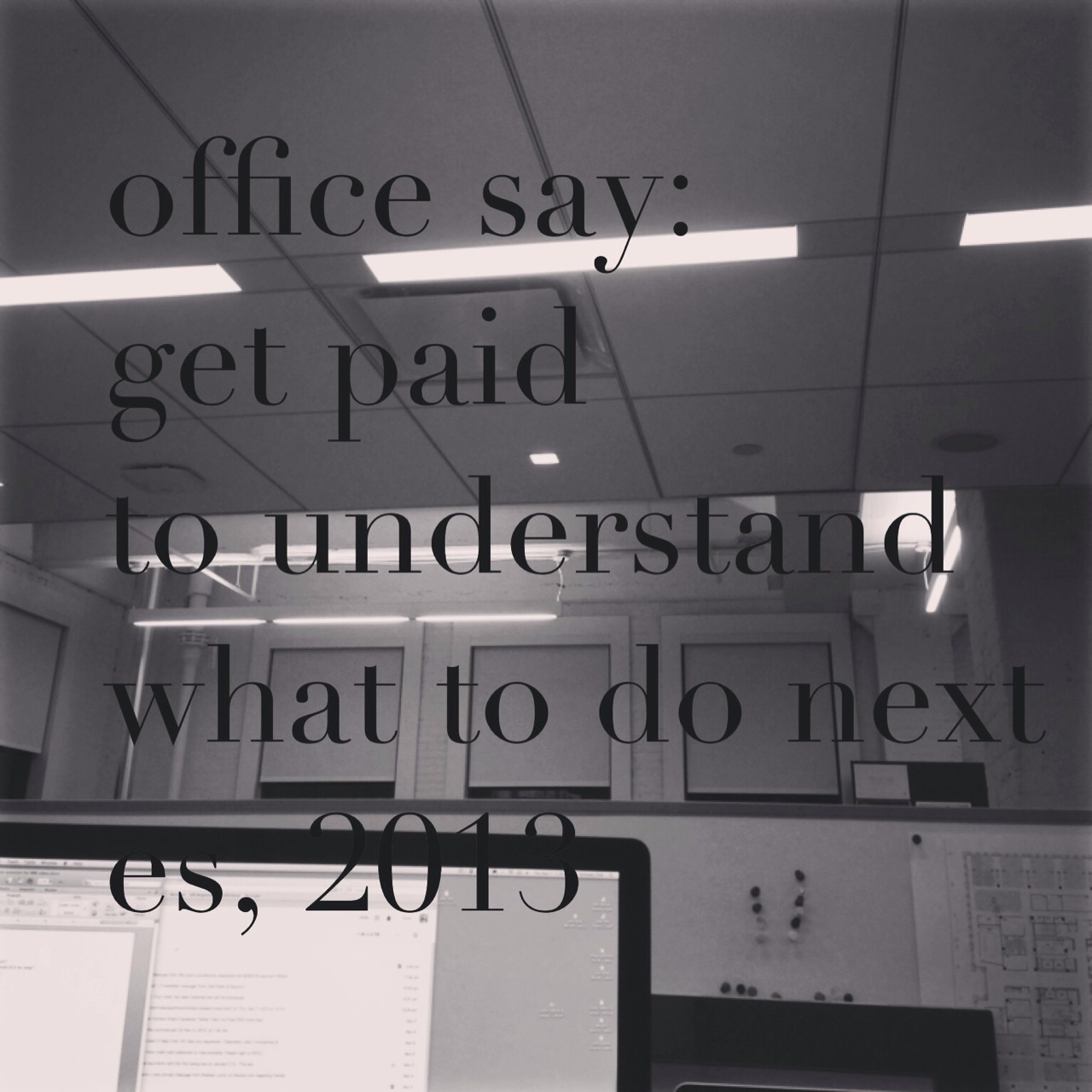
Late 2013
This tribute to anti-office poet-burnout Slash Lovering–who died on this day in 2004–continues indefinitely.
Thoughts — May 9th to May 31st
On May 9th, 2013 I started doing this thing where I’d force myself to write one thought for every hour that I was awake. I did this regularly for 22 days. The end came not from a lack of thoughts but, conversely, because I found myself totally overstimulated during a trip to New Orleans (referenced in the final entries) and it didn’t make sense to pick it up again after that.
I wasn’t sure what I could or would do with this project while I was doing it, but reading back over it now, I’m intrigued by the weird, oblique narrative it creates. You get NBA playoff scores, observations from an 8-part Beatles documentary I was watching at the time, a legal “brouhaha” my roommate involved me in, and updates on the dogs I walk and cats I sit (my job). It’s sort of feels like a liveblog/livetweet but different because the constraints and medium are different. It was really fun to do, I hope it’s fun to read.
Need a finer knowledge of building materials. Clapboard, vinyl, sheetrock – what are these things?
Fishkind’s party. Am I gonna go? Feel fat and stupid, but also like drinking.
George Harrison was from an Irish family with the last name “French.”
I can’t tell if it’s foggy or if I’m just tired.
A PRIMARY INTEREST IN EVERYTHING THAT SURROUNDS THE SUBJECT
and how to eclipse the object
retake
like the spatial configuration of what it means to be in love
do you want to learn how to float
Such–such fiasco that folly takes a hand. Such bits and scraps. Seen no matter how and said as seen. Dread of black. Of white. Of void. Let her vanish. And the rest. For good. And the sun. Last rays. And the moon. And Venus. Nothing left by black sky. White earth. Or inversely. No more sky or earth. Finished high and low. Nothing but black and white. Everywhere no matter where. But black. Void. Nothing else. contemplate that. Not another word. Home at last. Gently gently.
[Samuel Beckett // Ill Seen Ill Said // Nohow On]