
Dress in Words: The Self Unstable by Elisa Gabbert
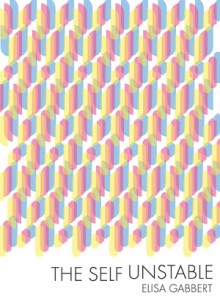 The Self Unstable
by Elisa Gabbert
Black Ocean, Nov 2013
96 pages / $14.95 Buy from Amazon or Black Ocean
Already, I have the problem of memory. Memories act precariously when they are the palate of thought. Example: I can’t remember when I first read Elisa Gabbert, but I remember the rough poetics of The French Exit. Bodies and minds took beatings. The words violenced through the poems. I was especially captivated by the sexual aggression. A voice attempted to transcend the self through bodily destruction, like autoerotic asphyxiation. Like a lack of could force the mind out of the body.
The Self Unstable exemplifies a bodiless self. Gabbert explores how thought dictates action, then action dictates belief. Memories lead the way because they create an illusion of understanding. “It can almost ruin you, the belief that you can choose,” (3). Language shreds the roles of identity. Her Twitter-brain essays/poems fragment connections. Art, games, leisure, love, sex – everything that fills our time – seem like activities to enjoy. Instead, they [dis]assemble the violent act of creation.
Animals, news, dreams pollute the mind. Where is placement? Ego feels displaced. Ego never had a place. Like grandparents coming through Ellis Island, body and mind attempt to locate a self. Look, my Dad found the papers. The family’s entrance was legitimate. At least on my Mom’s side. Names were misspelled, but sound has barely changed. The art of phonetics assert an idea of WHO. Some sort of declaration of I AM.
Generations exist as fragments collaged through shared behaviors. Family is why I’m here, but is family ME? Who has a choice in creation? Forget ideals, love and sex are “enjoyment of adversity,” (67). We ruin others. Relationships start based on these fallacies. Gabbert explains that a shared a taste in music creates the idea sameness. My mixtape to you means SOMETHING.
4 Comments
May 5th, 2014 / 10:00 am
May 5th, 2014 / 10:00 am
STARK WEEK EPISODE #7: “Reveling in the evocative power … of personalized Jabberwocky” — Elisa Gabbert on THE WATERS
For Episode Lucky Seven of STARVING WEEK IT’S STARK STARVED OUT THERE WEAKLINGS, we feature poet mover and shaker Elisa Gabbert on The Waters, book three of The First Four Books of Sampson Starkweather. Read on as EG takes a delightful comb to Starkweather’s transcontemporatory faithfulness.
 If you don’t speak Spanish, here’s what you need to know about Cesar Vallejo’s Trilce: Clayton Eshleman does the best translations, and Sampson Starkweather does the best transcomtemporations. That’s what he calls them in “The Waters,” Book III of The First 4 Books of Sampson Starkweather – English-to-English translations that update the vocab and bric-a-brac of Vallejo’s originals for the life of an American man straddling the 20th and 21st centuries. In other words, “A transcontemporation is to a poem what RoboCop is to a normal police officer.”
You don’t have to read “The Waters” side by side with Trilce to enjoy it, but doing so makes Starkweather’s tricky, allusive, funny-sad poems extra-magical. Let’s take a look at “XIII” from Trilce, first in Vallejo’s original Spanish:
XIII
Pienso en tu sexo.
Simplificado el Corazon, pienso en tu sexo,
ante el hijar maduro del dia.
Palpo el boton de dicha, esta en sazon.
Y muere un sentimiento antiguo
degenerado en seso.
Pienso en tu sexo, surco mas prolific
y armonioso que el vientre de la Sombra,
aunque la Muerte concibe y pare
de Dios mismo.
Oh Conciencia,
pienso, si, en el broto libre
que goza donde quierre, donde puede.
Oh, escandalo de miel de los crepusculos.
Oh estruendo mudo.
Odumodneurtse!
Now here’s Eshleman’s translation:
XIII
I think about your sex.
My heart simplified, I think about your sex,
before the ripe daughterloin of day.
I touch the bud of joy, it is in season.
And an ancient sentiment dies
degenerated into brains.
I think about your sex, furrow more prolific
and harmonious than the belly of the Shadow,
though Death conceives and bears
from God himself.
Oh Conscience,
I am thinking, yes, about the free beast
who takes pleasure where he wants, where he can.
Oh, scandal of the honey of twilights.
Oh mute thunder.
Rednuhtetum!
 Every translation makes choices, but you can probably see, if you know even a little Spanish, that this is a faithful translation. The final line is the weirdest part of the poem—at first it looks like a nonsense word, then you realize “Odumodneurtse” contains the last two words of the penultimate line, backwards and jammed together to form a new word. Unfortunately, something is lost in Eshleman’s translation—his own nonsense word, “Rednuhtetum,” is “mute thunder” backwards, so the move comes across on a literal level. But in Spanish, the final “o” at the end of “mudo,” for “mute,” echoes the vocative/exclamatory “Oh” at the beginning of the previous two lines. Eshleman’s translated nonsense doesn’t have quite the same effect.
Starkweather’s version isn’t so faithful, especially when it comes to the last line:
XIII
I think of your sex.
With dumbed-down heart I think of your sex
as ants hijack the day’s blonde daughter.
Even the Pope gets the hiccups.
The cardinal fluttering against the glass:
phoenix, arrested.
I think of your sex, wave which knocks
out the breath, holds a body under, no way to say
which way is up. Death keeps feeding coins
into the meter of your mouth.
O, Consequence,
I am thinking too, about you, free animal
who takes pleasure where she wants, because she can.
O, honey of daughterless dusk.
O, hoarse voice of lightning.
Rudderowstarkweathersampson!
You’ll notice that the “transcontemporation” is derived from both the sound of the original lines as well as the meaning, so line three (“ante el hijar maduro del dia”) is a combination of straight translation (“before the ripe daughterloin of day”) and soundplay: ante becomes ants and hijar becomes hijack, but the day’s daughter comes from the “underpoem,” such as that exists, not the surface sounds. And yet, also, some of the poem is entirely new—“phoenix, arrested” seems to come from nowhere, or rather from Sampson’s degenerate brain entirely.
The last line is where you really see the exuberant beauty of Starkweather’s riffs. “Rudderowstarkweathersampson” isn’t anything spelled backwards – it’s his name rearranged. Rudderow (the poet’s middle name) seems to have been triggered by alliterative association with “Rednuhtetum,” Eshleman’s rendition of “mute thunder.” Though the literal meaning of “Odumodneurtse,” such as there is one, is lost in the Starkweather version, it retains that feeling of reveling in the evocative power of nonsense, of personalized Jabberwocky. (Later, in LXV, we learn that Rudderow is “a nonsense word made up by [his] mom.”) And – the really lovely part – Rudderow contains a syllabic “O.”
Then, of course, there are the metaphors both more subtle (I love “wave which knocks / out the breath, holds a body under, no way to say / which way is up” – though a wave of love is less strange than a prolific furrow) and more absurd (“Death keeps feeding coins / into the meter of your mouth”) than the original. Every poem in “The Waters” is like this, not a puzzle to figure out, but a little game full of meanings, as many as you want: “at the edge / of beauty, it quivers, it sings, it holds / no water.”
Elisa Gabbert is the author of The Self Unstable (forthcoming from Black Ocean in Fall 2013) and The French Exit (Birds LLC, 2010). Her poetry, prose, and collaborations have appeared widely in publications such as Boston Review, Colorado Review, Conduit, Denver Quarterly, Pleaides, and elsewhere. She is a founding member of the Denver Poets’ Theatre and blogs at http://thefrenchexit.blogspot.com/.
STARK WEEK EPISODE 1: “The redonkulous and the sublime” — An interview with Sampson Starkweather
 WEEKS: A lot can kill you in a week. Even more can eat you at your weakness. A whole week of hair growth depends on, uh, genetics? Weeks contain a finite series of burritos and an infinite burrito of choices. Hoopla, regrets, collapses, dancing so hard you have to pour a cup of ice water on your dome, other times that feeling like you have to drag yourself so hard by your own collar your shirt might tear. Huge trucks at night carrying turned-off, unblinking versions of those normally blinking signs that say CONSTRUCTION AHEAD or SLOW LANE ENDS, except the signs are big so the trucks themselves say OVERSIZED LOAD and are blinking, themselves, even though their cargo’s dark. What I would like to do is nominate Sampson Starkweather to rewrite the entirety of America’s highway marginalia, to be the official roadside spokespoet for all of America’s restless feelings. I don’t have shit to do with those decisions, so what is happening instead is that this week will be Sampson Starkweather week here at HTMLGIANT, aka STARK WEEK.
 THE BOOK: Sampson’s debut book of poems, The First Four Books of Sampson Starkweather, is out now from Birds LLC. It’s really big. Like almost 400 pages. Who does that? It’s what it says it is. 4 books. All the feelings enacted in the opening paragraph happen inside of its four books, which are categorized as “poetry/life.” Sure, yes, yeah.
WHAT’S IN IT: It’s a book I’d give to someone just coming to poetry and to someone who feels totally burnt out on poetry. Those are kind of the same readers, I think. That’s why the whole week. Starkweather’s poetry is the existence of a nonexistent photograph of Andre the Giant jumping off the top rope. In his introduction, Jared White mentions “bass-voiced sexy soul-singer slow jams” and “punch-drunk Harlequin-robocop masculinity.” The poems have angry leaked dreams and love before roads and a pistol-whipped desire and the world’s saddest TV and offensive hurricane names and corpses wrapped in huge tropical leaves on islands named after them and that’s just in the poems you can read on the excerpt page.
WTF IS GOING ON: Over the course of this week, we’re going to feature a series of guests talking about Sam’s work in each of the books within T4B—1) King of the Forest, 2) La La La, 3) The Waters, 4) Self Help Poems—and also we’re going to hear from the awesome artists who made the covers for each of these four books. There will be criticism, talk of process, grand sweeping theories, tiny insightful scalpels. You’ll get to read some of Sam’s poetry. There will be some talk of what goes into, in 2013, putting out a 400 page book of your poems that is actually 4 books. Maybe there will be some interaction, multimedia, surprise. Buy a copy of the book if you want to follow along closely. I promise it won’t feel like being stuck on a brokedown bus at a rest stop in Connecticut. There are poems that feel like that, but not in this book. Here’s a list of who’s coming at you: Matt Bollinger, Ed Park, Bianca Stone, John Cotter, Melissa Broder, Eric Amling, Elisa Gabbert, Jonathan Marshall, Amy Lawless, Sommer Browning, and Jared White.
WHO IS SAMPSON STARKWEATHER ANYWAY, IS HE THAT GUY WHO DID THAT THING GUYS DO: The reason a lot of people want to share and talk about Sam’s huge ass tree-killer is because he and his work (which are impossible to unspoon from each other, which is how it should be) is like getting the best high five of your life from Teen Wolf. He is loved and easy to love and easy to mistake in rural supermarkets for Javier Bardem. He’s a longhaired poet surfer with a heart of messy pizza and manic kindness. Thank the exhausted fucking stars he is with us and with poetry. Enjoy STARK WEEK.
HOW DOES STARK WEEK BEGIN: To begin STARK WEEK, I talked to Starkweather:
1) Hi Sam. Welcome to Stark Week. This is how it starts, with an interview of you. Our interview starts with the “who is Sampson Starkweather and what’s going on, what is this stuff all over my arms, is this sap” portion of the interview. So let’s start at the start. Four books? Why? Why buck the prevailing model of slim little precious supermodel books? More importantly, why buck it in this beautifully thunking doorstop fashion?
Sorry about the sap “this forest / is unusually horny.”
 In the end it came down to precisely the opposite of your question: “Why not?” Why not 4 books in 1? Why not a 328 page monster poetry collection that sounds like a seminal lifetime work by some famous, award-winning, about-to-die poet who now tends a garden, published by some big-ass conglomerate press like Penguin, but is actually by some dude with a ridiculous name that no one has heard of (and sounds like a character from Game of Thrones) and has yet to publish a full-length book, on a small indie poetry press that, oh yeah, he just happens to be a publisher/founding-editor of? It seemed ridiculous, audacious, absurd, unheard of, taboo, laughable—in other words, perfect.
5 Comments
July 15th, 2013 / 1:28 pm
July 15th, 2013 / 1:28 pm
Live-tweeting “2001: A Space Odyssey”
This Sunday evening, I’ll be live-tweeting while watching 2001: A Space Odyssey with Elisa Gabbert, Sommer Browning, Dan Boehl, and Dan Magers. The details:
For reasons I find difficult to articulate, even to myself, Sommer Browning (fellow Denverite, Birds LLC poet, and comrade in comedy) and I are planning to “live-tweet” Stanley Kubrick’s 2001: A Space Odyssey this Sunday night at 7 p.m. Mountain Time (9 p.m. Eastern). It’s not going to be on TV or anything; we’re just going to rent it and watch it and tweet about it. (It’s no coincidence that “MST” stands for both Mountain Standard Time and Mystery Science Theater! Unfortunately, we’re currently on Daylight Saving Time.) If you have this movie in your arsenal or can get access to it, you should join us! We’ll be using the hashtag
#2001#2k1. My Twitter handle is @egabbert and Sommer’s is (wait for it) @vagtalk. Also joining us will be Dan Boehl, Dan Magers and ________?
My Twitter handle is @adjameson. I’ll also be happy to chat about the film (and movies in general) on Facebook then. Hope you can join us!
23 brief replies to Blake Butler & Elisa Gabbert & Johannes Göransson & Chris Higgs re: (dear god, what else?) the fucking New Fucking Sincerity

ToBS R∞: Arguing in blog posts and on Facebook about aesthetics vs. Going out for a pleasant dinner together, then taking a nice walk at sunset in a park
I’ve decided that, from now on, all I’m going to write about at this goddamned site is this goddamned thing.
… No, seriously, I’m delighted that so many have chimed in. Thanks to everyone! I thought one massive reply would be easiest. If you read this whole thing, may your god shower blessings upon you. And if I missed any pertinent responses, kindly direct me to them in the comments. (I was traveling last weekend, and as such had trouble keeping up with all the discussion.)
1.
I’ve claimed (here, here, here) that one thing at stake in the New Sincerity is the discovery of what maneuvers currently count as “feeling sincere.” That such maneuvers exist I consider more an observation than a topic for debate. E.g., Blake, in his recent post about Marie Calloway’s Google doc pieces, wrote that Calloway’s recent work:
What we talk about when we talk about the New Sincerity, part 2

"Hi, How Are You?" cover art by Daniel Johnston (1983); "financially desperate tree doing a 'quadruple kickflip' off a cliff into a 5000+ foot gorge to retain its nike, fritos, and redbull sponsorships " by Tao Lin (2010)
It made me very happy to read the various responses to Part 1, posted last Monday. Today I want to continue this brief digression into asking what, if anything, the New Sincerity was, as well as what, if anything, it currently is. (Next Monday I’ll return to reading Viktor Shklovsky’s Theory of Prose and applying it to contemporary writing.)
Last time I talked about 2005–8, but what was the New Sincerity before Massey/Robinson/Mister? (And does that matter?) Others have pointed out that something much like the movement can be traced back to David Foster Wallace’s 1993 Review of Contemporary Fiction essay “E Unibus Pluram: Television and U.S. Fiction” (here’s a PDF copy). I can recall conversations, 2000–3, with classmates at ISU (where DFW taught and a number of us worked for RCF/Dalkey) about “the death of irony” and “the death of Postmodernism” and a possible “return to sincerity.” Today, even the Wikipedia article on the NS also makes that connection:
I am drinking gin & wrote about 18 long titles i randomly chose using wikipedia
 If the New Sincerity is anything real or coherent (and I wrote that post last Monday because I, like others, am trying to figure out whether that’s so, or will be so), then we should be able to identify the devices or moves that define it—that arguably make a piece read as being “New Sincere.” The “New” implies they produce that sincere effect right now, in the current literary landscape; whether the techniques or devices are entirely new doesn’t matter (they could be older techniques, fallen out of prominence, now returned). Similarly, it’s irrelevant whether the author using them is “really” being sincere. What matters instead is that
- Those devices exist;
- People think they “feel sincere” (as opposed to other devices, which don’t);
- “Being sincere” has some value at the present moment.
Why sincerity? What is its present value? My broad and still developing belief is that “sincere” writing is one means of breaking with the aesthetics of postmodernism and self-referentiality: invocation of Continental Theory, metatextuality, excessive cleverness, hyper-allusion, &c. What makes writing “sincerely” even more delicious when perceived against postmodernism 1960–2000 is that it proposes to offer precisely what pomo said didn’t matter or couldn’t exist: direct communion with another coherent, expressive self, even truth by means of language. (Don’t tell Chris Higgs!)
One of my first impressions of the NS came when I started noticing artists and authors using longer titles—in particular, long rambly ones with strong emotional resonances. My thought then and I think now was that both the length and the ramble, as well as the emotive quality, signaled non-mediation: a desire to appear uncensored, unrevised. Those titles stood out (defamiliarized the title) because they failed to comply with what a “proper,” “edited,” “thoughtful” title should be.
Is this a sensible thing to argue? Have I had too many G&Ts? Let’s pursue …
What we talk about when we talk about the New Sincerity, part 1
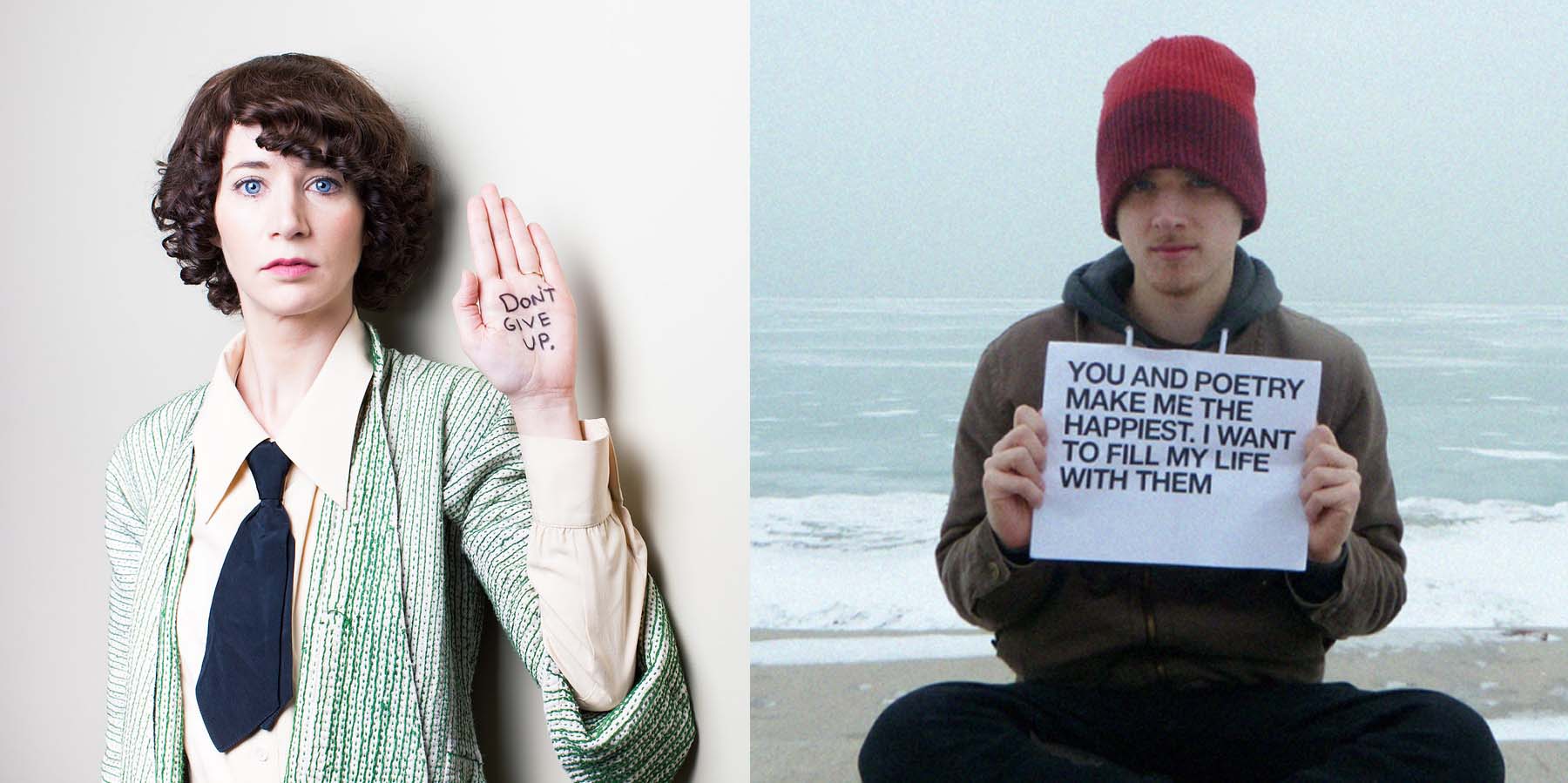
Miranda July; Steve Roggenbuck (photo dates unknown)
I wasn’t surprised that my Monday post, which was ultimately about reading & applying some ideas from Viktor Shklovsky’s Theory of Prose, mostly generated conversation about Tao Lin and the New Sincerity. I knew that would happen even as I wrote it. So I thought I should take a post to clarify my thoughts on “the whole NS thing.” What follows will be a mix of fact and personal reflection.
Theory of Prose & better writing (ctd): The New Sincerity, Tao Lin, & “differential perceptions”
In the first post in this series, I outlined Viktor Shklovsky’s fundamental concepts of device (priem) and defamiliarization (ostranenie) as presented in the first chapter of Theory of Prose, “Art as Device.” This time around, I’d like to look at the start of Chapter 2 and try applying it to contemporary writing (specifically to the New Sincerity). As before, I’m proposing that one can actually use the principles of Russian Formalism to become a better writer and a better critic.
Viktor Shklovsky wants to make you a better writer, part 1: device & defamiliarization
When I was finishing up my Master’s degree at ISU, I worried that I still didn’t know much about writing—like, how to actually do it. My mentor Curtis White told me, “Just read Viktor Shklovsky; it’s all in there.” So I moved to Thailand and spent the next two years poring over Theory of Prose. When I returned to the US in the summer of 2005, I sat down and started really writing.
I’ve already put up one post about what, specifically I learned from Theory of Prose, but it occurs to me now that I can be even more specific. So this will be the first in a series of posts in which I try to boil ToP down into a kind of “notes on craft,” as well as reiterate some of the more theoretical arguments that I’ve been making both here and at Big Other over the past 2+ years. Of course if this interests you, then I most fervently recommend that you actually read the Shklovsky—and not just ToP but his other critical texts as well as his fiction, which is marvelous. (Indeed, Curt has since told me that he didn’t mean for me to focus so much on ToP! But I still find it extraordinarily useful.)
Let’s talk first about where Viktor Shklovsky himself started: the concepts of device and defamiliarization.