
Ha-ha

Before the advent of mechanical lawnmowers a commonly-used way to keep grass trimmed was to allow livestock, usually sheep, to graze; a ha-ha allowed them to trim the grass of large estates while keeping them out of view from the house.
The ha-ha is a feature in the landscape gardens laid out by Charles Bridgeman, the originator of the ha-ha, according to Horace Walpole (Walpole 1780), and by William Kent and was an essential component of the “swept” views of Capability Brown.
The contiguous ground of the park without the sunk fence was to be harmonized with the lawn within; and the garden in its turn was to be set free from its prim regularity, that it might assort with the wilder country without.
Walpole surmised that the name is derived from the response of ordinary folk on encountering them and that they were, “…then deemed so astonishing, that the common people called them Ha! Has! to express their surprise at finding a sudden and unperceived check to their walk.”
An unusually long example is the ha-ha separating the Royal Artillery Barrack Field from Woolwich Common in southeast London. This deep ha-ha was installed around 1774 to prevent sheep and cattle, grazing on Woolwich Common as a stopover on their journey to the London meat markets, from wandering onto the Royal Artillery gunnery range.
Ha-has were also used at Victorian-Era lunatic asylums such as Yarra Bend Asylum and Kew Lunatic Asylum in Australia. From the inside, the walls presented a tall face to patients, preventing them from escaping, while from outside the walls looked low so as not to suggest imprisonment.
Another Random List of Things

1. UVA issues its audit of VQR: No bullying on record. Conversely there’s also this piece of reporting. Hopefully VQR will resume publishing soon.
2. Elaine Castillo at Everyday Genius.
3. Luke Perry is willing to take a picture.

Comment: Easy there Bernhard, it’s as easy as ‘Enter’ then ‘Tab’…
Thus far, Justin RM has garnered 2 “people liked” for his quick response to Kyle Minor’s admittingly Bernhard-esque sans ¶ break post. Minor has an MFA in Literature, and obviously knows how to indent; he was simply employing a denseness in aid of the compulsive quality of the post, a rhetorical compulsion that operates as sentiment/endearment towards the book under review. Justin’s comment is witty, but does things which bother me: 1) he name drops a non-mainstream esteemed author to establish himself as one of the initiated, 2) he uses “easy there,” a phrase commonly used at/with/for a horse, dog, or some unconstrained wild animal, 3) he ends with the ever ominous ellipses, as if he could go on, but won’t, because, well, he’s not an impulsive uncontrollable hog, unlike Minor; and finally, 4) he uses “easy” twice, splitting the effect of that word in half, with no ear for alliteration.
Justin’s comment pairs well with gorgonzola on wonder bread, for one wonders if it’s the cheese, or if Justin just removed his shoes.
Geography Thursdays #5: Gypsies, Romanies, and Travelers

Gypsy/Romany/Traveler Photographs by Lyn Smith, from the DX Collection
How do you study a people who don’t have a fixed national home, about whom there is no scholarly consensus about how to define the object of study, and who largely don’t want to be studied in the first place? That’s the difficult task faced by David J. Nemeth, ethnographer, “radical geographer,” and curator of the DX collection at the Carlson Library of the University of Toledo, where you can peruse photographs, video and audio recordings, blogs, and bibliographies related to the study of Gypsies, Romanies, and Travelers.
For Esmé–with love and squatter
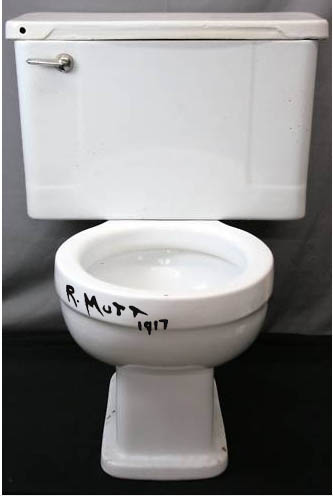
J.D. Salinger's toilet à la Duchamp
Duchamp’s Fountain is signed “R. Mutt,” arguably an alter-ego, though others consider it code for “Ready Made utt [eut été in French],” which would read “Readymade once was.” His work, and titles, were never forthcoming, so the interpretations and word games will go on. J.D. Salinger’s toilet, auctioned on eBay for a million dollars, is no longer available, meaning someone may have bought it. The former dadaist ceramic conceit may have been lost on Rick Kohl (a collectibles dealer who bought the toilet from a couple who now own Salinger’s old home), who placed the auction. Oh Esmé, how I wish it were you.
You take a dead man, Esmé, and he always stands a chance of again becoming a man with all his plu– with all his p-l-u-m-b-i-n-g intact.
A Random List of Things
1. A review of Ben Greenman’s Celebrity Chekhov.
2. An Ultimate Flash Fiction Package Giveaway (deadline 10/31).
3. Knee Jerk Magazine is going offline. They need help raising money for their first print issue. Consider contributing to their Kickstarter campaign.
4. There’s a new issue of absent magazine. It’s one of the only magazines I’ve read in its entirety, in recent memory.
5. Willow Smith, the 9 year old daughter of Will Smith and Jada Pinkett-Smith has a music video and I find it so damn charming and the song is catchy and I am now very confused.
6. Super Arrow is looking for good writing. The theme is collaboration. There are also submission guidelines.
7. Eco-Libris is holding a Green Books campaign.
8. There is a great story by Susan McCarty at Wigleaf. It seems so real, doesn’t it?
9. If you were curious about what the Rock of Love girls were up to, and why wouldn’t you be, there are some answers.
10. Of course there’s no 10.
Random Live Broadcast of Recent Books I Liked #3
You missed the live reading but you can watch it archived.
Featuring excerpts read from:
Museum of the Weird by Amelia Gray
Flowing in the Gossamer Fold by Ben Spivey
The Book of Frank by CAConrad
Unclean Jobs for Women and Girls by Alissa Nutting
Selected Poems by Mary Ruefle
Event Factory by Renee Gladman
Sean Kilpatrick’s “The All Encompassed Drowned” in New York Tyrant Issue 8
In wheel life
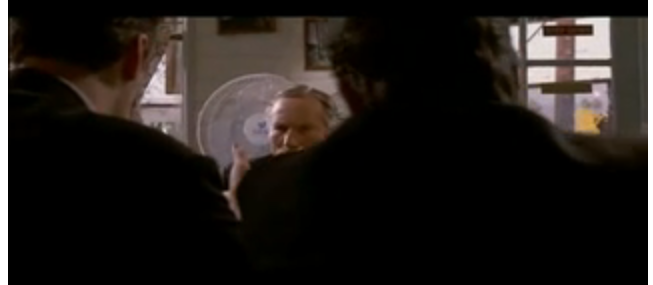
The first scene of Reservoir Dogs follows a group of men around a table having a discussion about Madonna’s “Like a Virgin,” my favorite moments being when the camera’s view is completely obliterated by someone’s back — and a black occurs like said movie’s premature end. Tarantino (both writer and actor here) proposes that the song is about a woman in coitus with a man of such large girth, that the pain is that of a virgin’s incipient intrusion. In 1917 an unidentified photographer took multiple pictures of Marcel Duchamp and patched the images together.
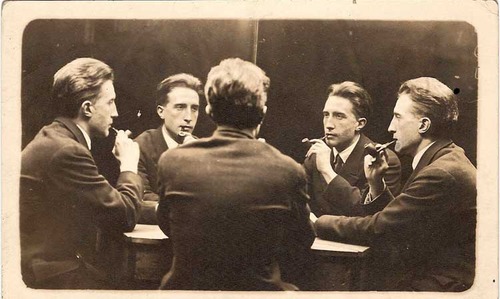
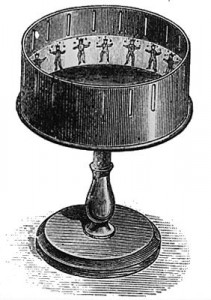
The zoetrope — or (from Greek) “wheel of life” — is a device we owe our first moving images to, a kind of cyclical Sisyphus, like our tethered earth moving in circles and never going anywhere, just forcing seasons into chapters, as if a grand story were being told. Should Duchamp look a little like Andy Garcia, and should Zoetrope be Ford Coppola’s production Co., then we’ll have to block Godfather III out of our minds.
Madison Smartt Bell in Haiti

Madison Smartt Bell, badass
I’ve spent every minute, day, week, fortnight I can beg, borrow, or steal in Haiti for the last three years. I went the first time because a film director had enticed me to go in preparation for a proposed project for which I was to write the screenplay, but then pulled out at the last minute when the book he wanted to option fell through (the author unfortunately was booked on the Oprah show and had dollar signs in his eyes). By then I had been studying my Pimsleur language tapes (woefully inadequate), my Edwidge Danticat stories (magic on paper), and my C.L.R. James (men in chains, severed heads on posts, quills dipped in skulls filled with the blood of white men), and it was love from afar. I had to go, so I started going, and I’ve been going ever since.
Most the time I’m in Ouest Province — Port-au-Prince, Petionville, Fermathe, Callebasse, Artiste, Barette. But this summer I traveled north for the first time, to Cap Haitien, near where King Henri Christophe hired an Italian architect to build him the most beautiful royal complex in the Western Hemisphere, bid him adieu, then sank the architect’s boat in the harbor with his cannons, so he would never be able to build anyone else anything like what he had built for Henri Christophe.
I’ve tried my best to experience Haiti as the Haiti I am experiencing, through the filter of my own experience and through the eyes of the friends I have made in Haiti, rather than on the terms set by books. But it was difficult to visit Cap Haitien and not be constantly in mind of its foremost American interpreter, Madison Smartt Bell, whose trilogy of the revolution set a standard for precision and exhaustiveness that the rest of our practitioners of historical fiction have yet to match, and whose uncollected essays on Haiti reflect a degree of insightfulness I doubt I’ll be able to achieve twenty or thirty or a hundred years from now unless I finally give in to an impulse my family considers dangerous and move to Haiti for good.
An excerpt from Bell’s “Miroir Danjere,” an essay about vaudou, a religious expression to which Bell has become an acolyte:
According to the vaudou beliefs in which the country has been saturated since the time of slavery, the ocean surrounding Haiti is a mirror, whose surface divides the world of the living from the world of the dead. The division is not absolute, however, for in vaudou as in the African religions from which it springs the dead do not depart, but remain present and available for communion with the living. It’s fortunate that no one really dies in Haiti, since it has always been a bloody place. READ MORE >