
Someone has touched me; I need to lie down
“Someone just now has touched me! A human hand
has touched me! — I am ill and I need to lie down.”
…
“We know that only through observation or by
the sense of touch are we able to recognize and identify
the handiwork of our brothers, in this way
distinguishing it from prodigies of natural force.”
…
“I know that the toad which lives in prison
is moist to our touch, and flabby
because it does not ever give the steady warmth of love,
but is thus from hidden desire. I no longer deny
cruelties are sweet; there are vines whose tendrils
split cathedral walls.”
…
“I am ill. Someone has touched me;
I need to lie down.
I would scatter dots on a sheet of paper, or practice
the art of geomancy,
if that would be enough.”
…
“In a window across the street the curtains
have moved.
A withered hand appears,
and the features of an old woman
near the glass. She allows the curtains to fall;
I awake to the beneficent touch
of my mother’s hand.
Is this a portent of things to come?”
…
“I must set down, before it is too late, the pink murex
my daughter this morning brought to me, naming
for my benefit each part. I scarcely listened;
not that this shell might be less lovely
than she presumes—but that her touch and voice,
the confident gestures of an infant hand,
proved almost more than I could endure.
Have we not lived deep-buried in the pages of
children’s books, in a world of high moral fable
and fantastic adventure, in times to make our blood
run cold? Is it not incumbent upon each of us
to keep safe from the holocaust all that matters?”
…
“We feel there is within each one of us
something which will not ever die. Our experience
and every dream conspires to counter revelation,
making us hold this fondly, as leaves touch
to their only tree, our one presumptuous hope.”
From Notes from a Bottle Found on the Beach at Carmel (1962) by Evan S. Connell
Excerpts / Comments Off on Someone has touched me; I need to lie down
September 11th, 2020 / 9:45 am
September 11th, 2020 / 9:45 am
at school people say things
at school people say things
i can feel myself turn inward
the escalation from ‘politely responding with terse expressions of acknowledgment’
to
‘feeling my face morph into something soft and wet while seconds turn to minutes turn to hours
turn to years and i am staring and nodding and smiling strangely and maybe saying “yeah” or
“uh huh” while internally moving at a speed of one hundred miles per hour and experiencing
feelings in a linear manner that go from anxiety to self-hatred to self- aware self-hatred to
sarcastic self-aware self-hatred to “what is going on” to “what…” to thoughts about myself in
terms of the current social situation to thoughts about myself in terms of some insanely large
context like forever to thoughts about myself in terms of myself to extreme feelings of
detachment to nothing while having already started to feel even more anxiety about the prospect
of tweeting said feeling, which is really many feelings, a poly-feeling, which may or may not be
explicable in 140 characters or less in a manner that is clear, enjoyable, and relatable’
happens quickly
my face feels numb and my mouth, i think, is open
someone smiles at me
i fall further into myself, screaming
from If I Really Wanted to Feel Happy I’d Feel Happy Already
5 Points: The Narrow Circle (by Nathan Hoks)
***
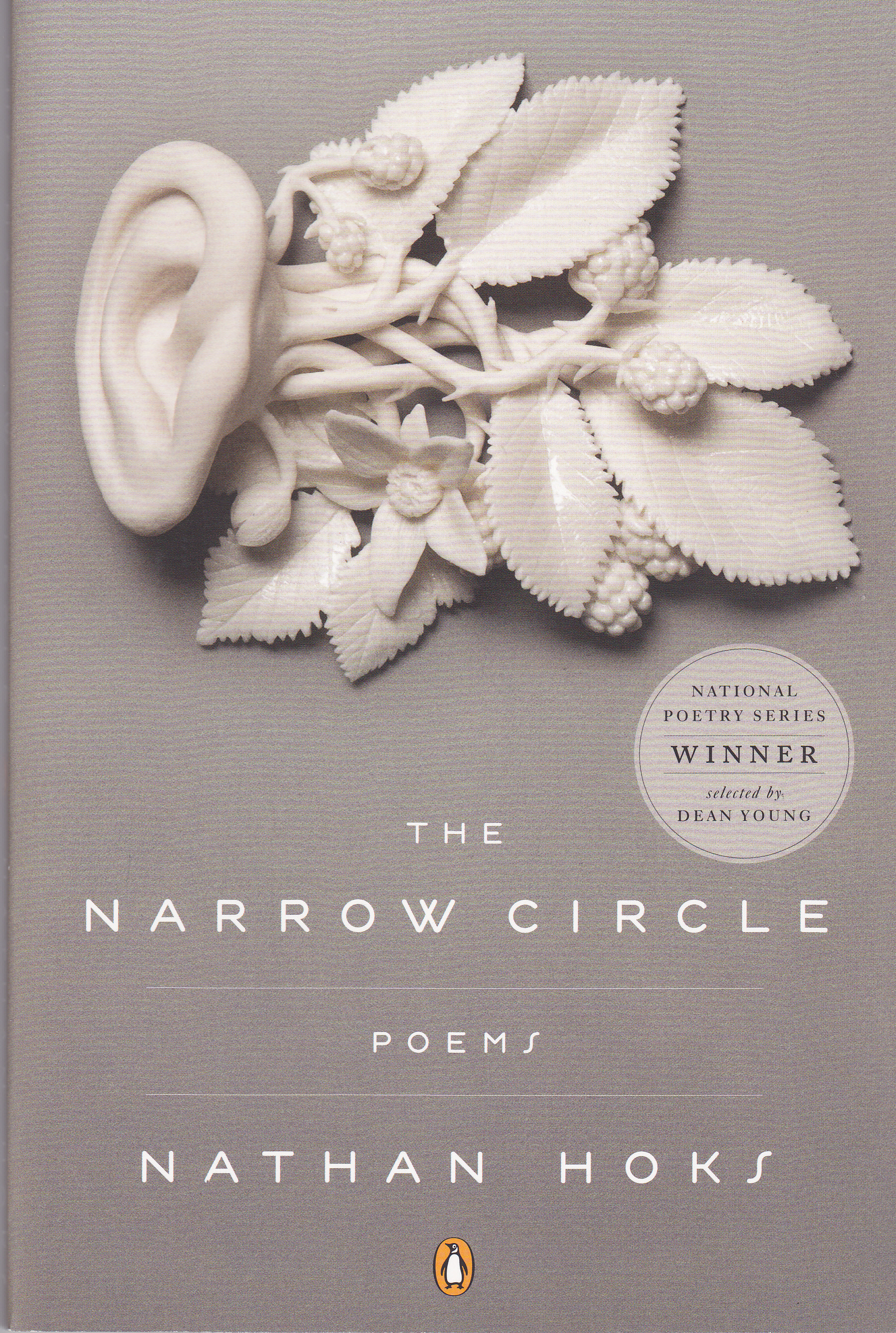
Nathan Hoks is one of my favorite writers. And this is a 5 point review of “The Narrow Circle,” a National Poetry Series winner selected by Dean Young (Penguin Books, 2013).
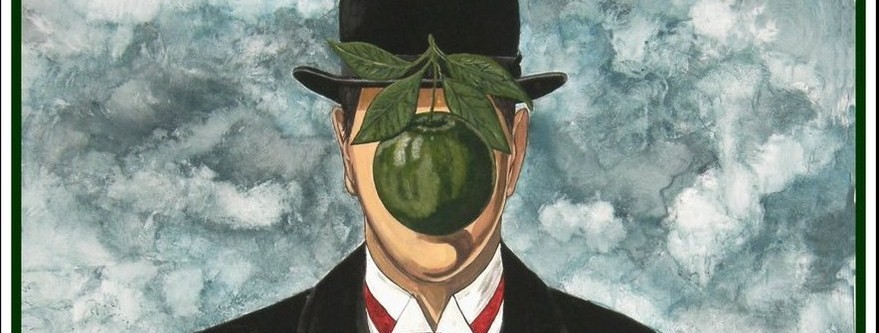
1) At times the careful and elegant lines and images of The Narrow Circle, a book moving and blurring between “Interior” and “Exterior,” feel like the work of a classic Surrealist. A Magritte, let’s say. And, here I’ll quote a poem in its entirety:
***
LILY OF THE INTERIOR
First I love it, then I want it dead.
A lily is sprouting from my head.
First I love it, then I want it dead.
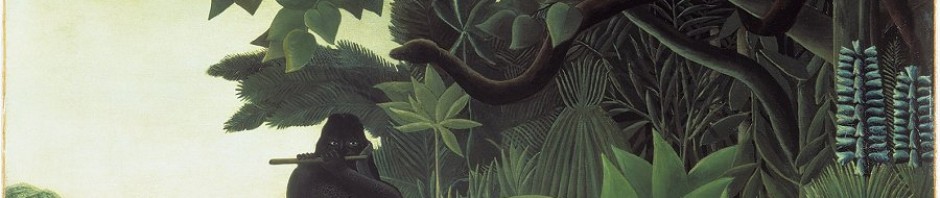
And now I’ll quote the beginning of the poem that follows LILY OF THE INTERIOR because it spiked in me the Primitive and Eden-Like scenes work of Henri Rousseau, who came to mind, also, from time to time, as I read through this collection:
When my wife comes home from work
The invisible bird is still hissing near
Her head.
The invisible bird is still hissing near
Her head.
2) Inside and out through much of these poems there is a thriller-horror movie feel. The feel of something morphing. Of an evil or strangeness (an alien sort of thing) building. Impending. Within and out.
“…………and the lake
Of soluble phosphates will fill with
Algal blooms and kill the fish and plants
The same green spot is growing inside me.”
Of soluble phosphates will fill with
Algal blooms and kill the fish and plants
The same green spot is growing inside me.”
And
“…my wife and I stand in the middle and call it
The inside. A leaf is growing out of our face.”
3) Quentin Tarantino’s movie-making came to mind, also, as I read through The Narrow Circle. I mean careful and exact tension building (think of the farmhouse scene in Inglourious Basterds, the terrified family hidden beneath the floorboards) and culminating from time to time, in waves, like a lily, exploding, facially:
Nathan Hoks is a vague hunger.
Nathan Hoks is a 50/50 blend
Gunpowder and guts. Film comes
Whirring out of his mouth.
Rusted screws hold his fingers to hands.
Flies hang around his buttocks.
Shoots and pods are sprouting from his intestines.
Nathan Hoks is a fork in the egg yolk.
Nathan Hoks is a penitentiary.
Nathan Hoks lives inside himself
Where he is choking on the curtains, READ MORE >
Nathan Hoks is a 50/50 blend
Gunpowder and guts. Film comes
Whirring out of his mouth.
Rusted screws hold his fingers to hands.
Flies hang around his buttocks.
Shoots and pods are sprouting from his intestines.
Nathan Hoks is a fork in the egg yolk.
Nathan Hoks is a penitentiary.
Nathan Hoks lives inside himself
Where he is choking on the curtains, READ MORE >
2 Comments
February 19th, 2014 / 4:00 pm
February 19th, 2014 / 4:00 pm
an excerption of an excerption in the breakdown of the bicameral mind
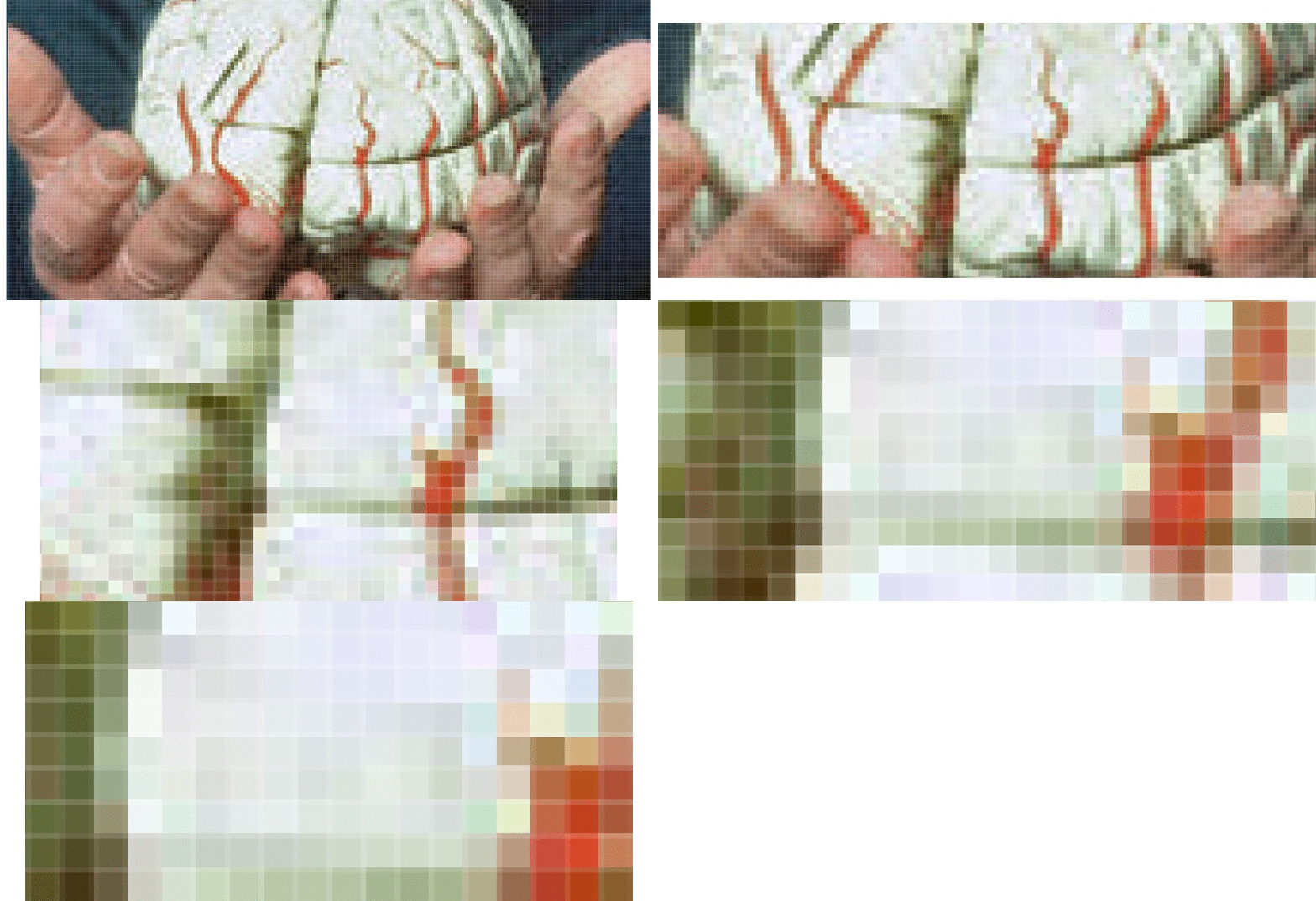
2. Excerption. In consciousness, we are never ‘seeing’ anything in its entirety. This is because such ‘seeing’ is an analog of actual behavior; and in actual behavior we can only see or pay attention to a part of a thing at any one moment. And so in consciousness. We excerpt from the collection of possible attentions to a thing which comprises our knowledge of it. And this is all that it is possible to do since consciousness is a metaphor of our actual behavior.
Thus, if I ask you to think of a circus, for example, you will first have a fleeting moment of slight fuzziness, followed perhaps by a picturing of trapeze artists or possibly a clown in the center ring. Or, if you think of the city which you are now in, you will excerpt some feature, such as a particular building or tower or crossroads. Or if I ask you to think of yourself, you will make some kind of excerpts from your recent past, believing you are then thinking of yourself. In all these instances, we find no difficulty or particular paradox in the fact that these excerpts are not the things themselves, although we talk as if they were. Actually we are never conscious of things in their true nature, only of the excerpts we make of them.
READ MORE >
2013 PO’ IN REVIEW–85 (or so) Lines & Quotes That Effed Me Up, in chronological(-ish) order of when i reddit

Right about now is the time of the year when everyone with a goddamn login gets all hyperboled about whatever dumb book they read way back in March, just so they can save a .jpeg and write a bunch of convoluted bullshit about that dumb book and some other dumb books for some dumb literary blog. Those things (blogs, books, hyperboles, et al, et al) are cool. But books are books, and books cost money, and I’m sure that you’re probably broke because you bought me a bunch of Yolo Polos for God’s birthday. Oh, you good little sigh, you.
So instead of giving you a list of books you’re never going to read, I figured I’d go through my pockets and pull out the best lines and quotes I came across in 2013, because (and I know I might be alone here) 2013 felt like a winning fucking lotto ticket to me. Happy holidays. Now give me a hug.
<3 <3 <3 <3 <3 <3 <3 <3 <3 <3 <3 <3 <3 <3 <3 <3
I.
Out there, in the Between, it’s kiss or be kist
R.M. O’Brien, “Poem For Chris Toll In The Between” (Sink Review, Jan. 1)
II.
He could have laid me back
in the middle of the Atlantic; we could have been on a raft
loaded with exotic cargo, parrot eggs and pigeon blood rubies
rather than egg sandwiches and a bottle of wine
thick and pungent enough to be blood. It was hard to imagine
anyone here, not him shucking his shirt onto the deck,
nor ancient sailors or drug dealers in their bullet-boats.
Bridget Menasche, “Claudine Goes Sailing With A Man Who Hates The Hamptons” (PANK, Jan. 15)
III.
It takes
a huge amount of fire to see much.
Daniel D’Angelo, “The End of the Sound of Waves (Alice Blue Review, Jan. 29)
IV/YES.

(Feb. 15)
V.
My heart is a sleeping deer
about to be awakened.
I think that’s what I mean,
wake up. Don’t reason
with a plane crash,
clean up the fucking bodies.
Layne Ransom, “Mercy” (H_NGM_N chapbook, Feb. 26)
STARK WEEK EPISODE #5: “the world can’t / hold / what is / the world / built for / exactly” — Melissa Broder on Starkweather’s LA LA LA
For Episode Five of STARK ATTACK A WEEK OF STARK ATTACKS, we move onto the second book of T4B with the firm and jubilant columns and poemreview joy of our own Melissa Broder talking about Sam’s LA LA LA. As an added bonus, we also get the last LA LA LA itself to accompany Melissa’s text!
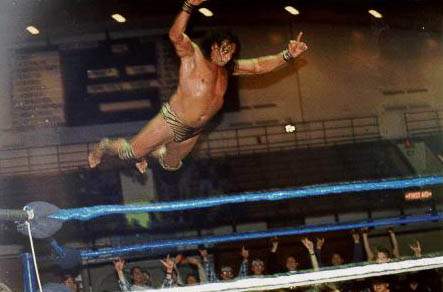 Joyce Carol Oates
or someone
said don’t
put yourself
in the review
fuck that
even if
I wanted to
disappear
WHICH I DO
there is no
omniscient god
of reviewership
only the white goddess
and the poet
and a pair of eyes
trying to jump
‘if you love me
unlock your phone
see those two lights
on the sea
that’s me
that’s me
that’s me’
some people
you just know
will be ok
Sampson
Starkweather
the poet
is one
he says
his desire map
is running
out of room
mine is more
an ash mouth
either way
the world can’t
hold
what is
the world
built for
exactly
‘the more animal
the less pain…
stagger to the edge
of the woods
suck the poison out’
I have had
to rescue
myself
from the earth
and rescue
myself
from the ways
I rescued
myself
1000000 times
nobody gets
what they want
why not?
green paper
or something
something
‘blood on the keyboard
spiritual pop ups
dizzy by
bright lipstick’
I want to
disappear
but really
I want to stay
‘past black fields
that feel more
like memory
than memory can…
this life is super
fucking hard’
when you get
to the sky
there’s a sky
let me float
twice
once so
that I know
once so
I remember
Melissa Broder is the author of two collections of poems, most recently MEAT HEART (Publishing Genius, 2012). Poems appear or are forthcoming in The Iowa Review, FENCE, Guernica, The Missouri Review, et al.
LA LA LA EXCERPT BELOW THE JUMP!
6 Comments
July 17th, 2013 / 3:02 pm
July 17th, 2013 / 3:02 pm
Three Quotes from Literature about Saint Simeon Stylites
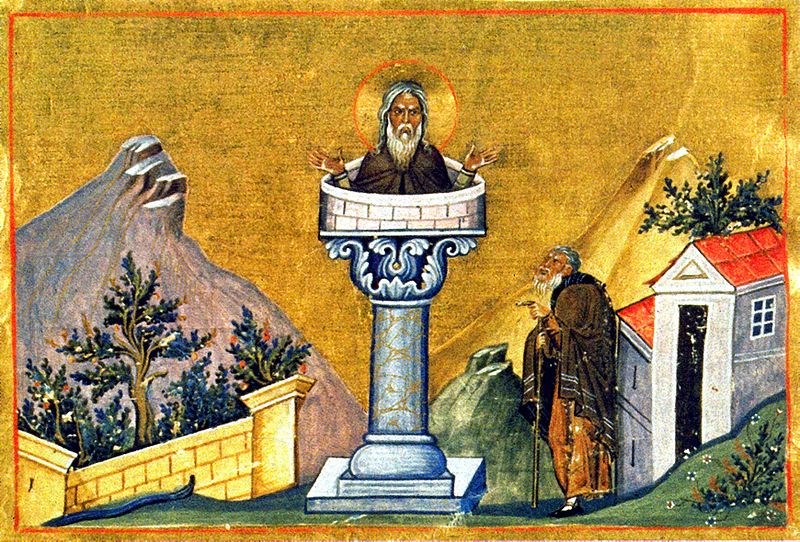
Simeon Stylites, who spent thirty-six year on top of a sixty-foot pillar in the Syrian desert. For most of that time his body a mass of maggot-infested sores.
The maggots no more than eating what God had intended for them, he said.
– David Markson, Reader’s Block
– – –
And her eagerness to learn the preparations he had set himself to teach her was sometimes pathetically touching, and sometimes it frightened him: touching, delicately absurd for there was no mockery in her when, for instance, she affirmed the dogma of the Assumption of the Virgin with that of Little Eva in Uncle Tom’s Cabin, as the only historical parallel she knew; frightening, when she brought from nowhere the image of Saint Simeon Stylites standing a year on one foot and addressing the worms which an assistant replaced in his putrefying flesh, —Eat what God has given you . . .
– William Gaddis, The Recognitions
– – –
These considerations, which occur to me frequently, prompt an admiration in me for a kind of person that by nature I abhor. I mean the mystics and ascetics—the recluses of all Tibets, the Simeon Stylites of all columns. These men, albeit by absurd means, do indeed try to escape the animal law. These men, although they act madly, do indeed reject the law of life by which others wallow in the sun and for death without thinking about it. They really seek, even if on top of a column; they yearn, even if in an unlit cell; they long for what they don’t know, even if in the suffering and martyrdom they’re condemned to.
“HIS LAST DAYS AS AN ARTIST”
“HIS LAST DAYS
AS AN ARTIST”
Slash Lovering
60 min
[2011, partial, unpublished bootleg – Erik Stinson, 2013]
Characters
CARL – male, 29
LINDA – female, 24
ROMAN – male, 29, work friend of Carl
SOPHIE – female, 22, a reveler
1 EXT Bushwick, Monday night, in the quiet of the early
work week, walking from the train, then INT at CARL’s
apartment.
Mike Young—
now I am famished for peace
now I watch a 90 year old movie to
witness dead people talking singing
riding horses samsara
SAMSARA SAMSARA
I’ve been walking the border of sleep to find you
dreaming around the circumference of
a hole in the ground
the bravest thing sometimes is
how the morning is greeted
fight for the money or
fight for the soul the saying goes
but another goal is to
fight for neither
from CAConrad’s “I Loved Earth Years Ago”
Comments Off on I Loved Earth Years Ago — CAConrad
Picture a Cowboy.
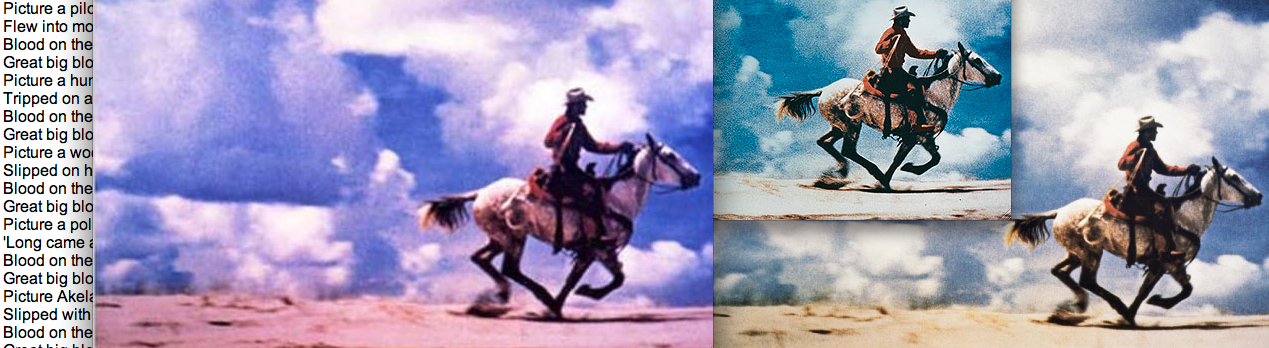
Picture a cowboy all dressed in red
Slipped on a boulder, bashed in his head
Blood on the saddle, blood on the sand
Great big blobs of blood all around.
Picture a pilot flying his plane
Flew into mountain, bashed in his brain
Blood on the fuselage, blood on the ground
Great big blobs of blood all around,
Picture a hunter so big and brave
Tripped on a lion and there was nothing to save
Blood on the bushes, blood on the ground
Great big blobs of blood all around.
Picture a woodcutter cutting a tree
Slipped on his saw and mangled his knee
Blood on the timber, blood on the ground
Great big blobs of blood all around.
Picture a policeman all dressed in blue
‘Long came a semi and ran over his shoe
Blood on the roadway, blood on the ground
Great big blobs of blood all around.
Picture Akela shaving in bed
Slipped with the razor, cut off his head
Blood on the pillow, blood on the floor
Great big blobs of blood all around.
Slipped on a boulder, bashed in his head
Blood on the saddle, blood on the sand
Great big blobs of blood all around.
Picture a pilot flying his plane
Flew into mountain, bashed in his brain
Blood on the fuselage, blood on the ground
Great big blobs of blood all around,
Picture a hunter so big and brave
Tripped on a lion and there was nothing to save
Blood on the bushes, blood on the ground
Great big blobs of blood all around.
Picture a woodcutter cutting a tree
Slipped on his saw and mangled his knee
Blood on the timber, blood on the ground
Great big blobs of blood all around.
Picture a policeman all dressed in blue
‘Long came a semi and ran over his shoe
Blood on the roadway, blood on the ground
Great big blobs of blood all around.
Picture Akela shaving in bed
Slipped with the razor, cut off his head
Blood on the pillow, blood on the floor
Great big blobs of blood all around.
— “Scout Songs”