
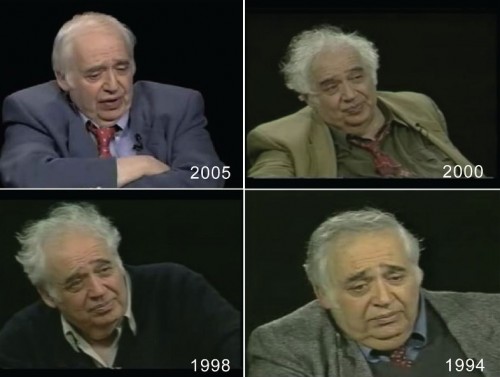
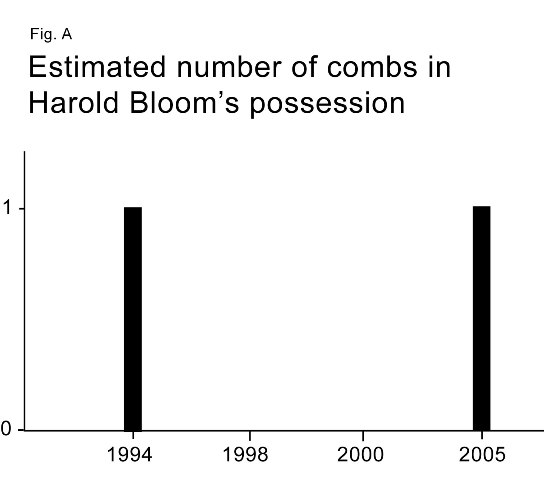
Harold Bloom recites “Tea at the Palace of Hoon” by Wallace Stevens
with a hearty hat-tip to Adam Fitzgerald. Happy Sunday!
Justin Taylor—
As regular readers of this blog know, over the past year or so I’ve been reading a lot of Harold Bloom. I’ve blogged my favorite quotes from his books as I’ve come across them, read several books on the strength of his recommendation (Bleak House, Kafka’s Blue Octavo Notebooks, Tolstoy’s Hadji Murad). But I don’t think I’ve said much about his body of work as a body of work, or articulated what it is about him that compels my sustained interest. And I’m still not going to do that–at least not today; first, because I’m not yet prepared to articulate that thought or those thoughts (blogs happen basically in real time, and my own work here is a present-tense record of my own ongoing education and expanding horizons, rather than any kind of attempted statement of intractable positions or beliefs); and second, even if I was prepared to attempt such an undertaking, I’ve got other things to do this afternoon. But, since the Viceland interview I linked to the other day seems to have been received well, I thought I would share another bit of Webvailable Bloomiana: this New York Times Review of Bloom’s Where Shall Wisdom Be Found?. The review is from October 2004, and is written by the great Melville scholar Andrew Delbanco. It offers a concise and articulate an introduction to Bloom’s virtues and talents–as well as a clear-eyed but vitriol-free acknowledgment of his limitations. I don’t know–or care, quite frankly–whether it will sell you on Bloom, but I think it will help make clear why I have become such a regular customer.
33
Harold Bloom Viceland Interview
Read a report today in the Yale Daily News that Harold Bloom has had to cancel his classes this semester due to illness. He’s had a brutal last several years, but had seemed to be doing well lately–up until today’s announcement, anyhow. Here’s hoping that this is just a blip on the screen for him. Anyway, the above is from a great, and weirdly sweet, interview that I just uncovered that he gave to Vice Magazine last year. It’s worth reading in full.
Lastly, since HB tends to be a lightning-rod for controversy and/or ignorant invective, you are hereby reminded that a man is ill, perhaps gravely so, and you are forewarned to say something kind/useful, or else keep your bullshit to yourself for once.

I do not count my borrowings, I weigh them. And if I had wanted to have them valued by their number, I should have loaded myself with twice as many.
– Montaigne, “Of Books”
quoted in Where Shall Wisdom be Found? by Harold Bloom
Still More Harold Bloom… Hooded Negro’s YouTube Posts
I just discovered this, and it’s awesome. Part 1 is a general discussion of Bloom and his work; Part 2 focuses specifically on The Anxiety of Influence.
httpv://www.youtube.com/watch?v=y_WtTx2x5sg
httpv://www.youtube.com/watch?v=cj7p_brtNA8
Talkin’ Blood Meridian: The Harold Bloom Onion A/V Club Interview
 Wonder and delight!!!! (Also: Terror and violence!!!!)
Recently The Onion chose Blood Meridian for their Wrapped Up in Books feature, and then they decided to kick things to the next level by calling up Harold Bloom to talk about it with them in an Onion A/V Club interview not to be missed. And what are the first words out of Professor Bloom’s mouth? “I read it on the recommendation of a friend, Gordon Lish, a New York book editor and a specialist in fiction”
It’s Monday morning and I love life, not just because of the above, but the above sure as damn doesn’t hurt. One more money quote (they’re all money quotes) then you need to go click through and read the whole thing.
Something Baffling, Something Bloom: In which I follow H.B.’s advice and start reading Kafka’s Blue Octavo Notebooks
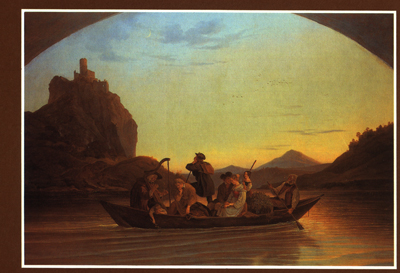
February 19, 1917.
Today read Hermann und Dorothea, passages from Richter’s Memoirs, looked at pictures by him, and finally read a scene from Hauptmann’s Griselda. For the brief span of the next hour am a different person. True, all prospects as misty as ever, but pictures in the mist now different. The man in heavy boots I have put on today for the first time (they were originally intended for military service) is a different person.
–The First Notebook
Uncategorized / 14 Comments
May 14th, 2009 / 4:12 pm
May 14th, 2009 / 4:12 pm
Power Quote: Harold Bloom Brings it All Back Home

The motives for reading, as for writing, are very diverse and frequently not clear even to the most self-conscious readers or writers. Perhaps the ultimate motive for metaphor, or the writing and reading of figurative language, is the desire to be different, to be elsewhere. In this assertion I follow Nietzsche, who wanred us that what we can find words for is already dead in our hearts, so that there is always a kind of contempt in the act of speaking. Hamlet agrees with Nietzsche, and both might have extended the contempt to the act of writing. But we do not read to unpack our hearts, and so there is no contempt in the act of reading. Traditions tell us that the free and solitary self writes in order to overcome mortality. I think that the self, in its quest to be free and solitary, ultimately reads with one aim only: to confront greatness. That confrontation scarcely masks the desire to join greatness, which is the basis of the aesthetic experience once called the Sublime: the quest for a transcendence of limits. Our common fate is age, sickness, death, oblivion. Our common hope, tenuous but persistent, is for some version of survival.
–Harold Bloom, The Western Canon, “Elegiac Conclusion”
Power Quote: Harold Bloom, Virginia Woolf Double Down
Yet who reads to bring about an end however desirable? Are there not some pursuits that we practice because they are good in themselves, and some pleasures that are final? And is not this among them? I have sometimes dreamt, at least, that when the Day of Judgment dawns and the great conquerors and lawyers and statesmen come to receive their rewards–their crowns, their laurels, their names carved indelibly upon imperishable marble–the Almighty will turn to Peter and will say, not without a certain envy when He sees us coming with our books under our arms, “Look, these need no reward. We have nothing to give them here. They have loved reading.”
— Virginia Woolf, from The Second Common Reader (quoted by Bloom in The Western Canon)
Those first three sentences have been my credo ever since I read them in my childhood, and I urge them now upon myself, and all who still can rally to them. They do not preclude reading to obtain power, over oneself or over others, but only through a pleasure that is final, a difficult and authentic pleasure.
— Harold Bloom, The Western Canon, “Woolf’s Orlando: Feminism as The Love of Reading”