
250 Points: The Hobbit pt 2: The Desolation of the Hobbit
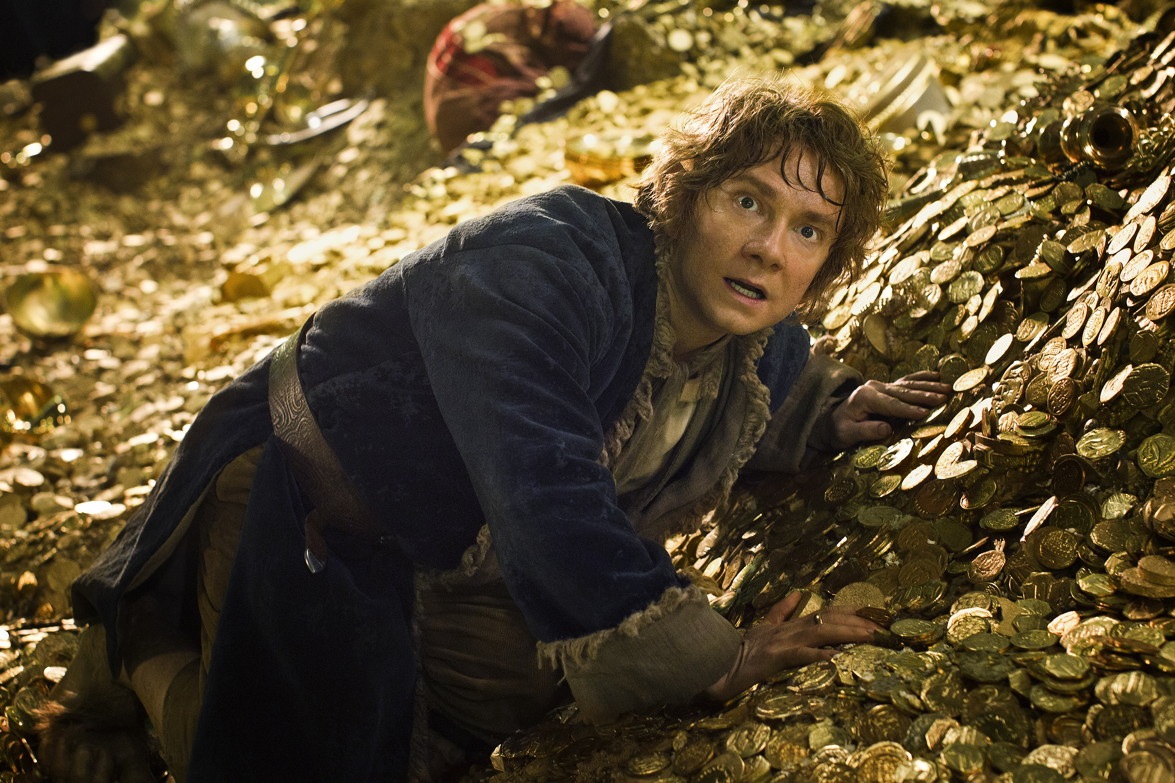
Bilbo Baggins, guarding the film’s box office receipts
- I missed The Hobbit: The Desolation of Smaug in theaters. Obviously since I wrote so much about the last one, I considered seeing its follow-up on more than one occasion, but just couldn’t summon the energy, even though a good friend invited me to join her, promising she’d bring snacks from Trader Joe’s.
- And then a few days after that, while I was out strolling the boulevard, I passed another friend who was en route to see the thing, on a lazy, chilly Sunday afternoon. But instead of joining him, I went home and took a bath.
- So you can see how excited I was to watch this movie. Please keep that in mind as you read this.
- Then the film left theaters, and I realized I’d missed my one and only chance for all time. I rushed to my local multiplex and pleaded with its employees to give me a private screening, but they refused, and threatened to call the police. Again.
- I despaired, and spent a week wondering what had happened to Bilbo, and Gandalf, and Thorin, and Whorin, and Hewy, and Dewy, and Chewy, and Killy, and Thrilly, and Culty, and the ninety-seven other little dwarves, and everyone else in Middle-earth.
- Suddenly, just when I could no longer bear the suspense, a CGI moth flew through my window, gripping an AVI copy of the film in its fuzzy mandible. It landed on my shoulder and mumbled something about how Gandalf was in trouble and “needed me.”
- Well, I need you, too, Gandalf! So I decided to watch the movie, after all, and take a lot of notes.
- These are my notes.
- It’s been fifteen long months since I watched An Unexpected Journey, and I barely remember anything that happened in it.
- It occupied a tremendous number of minutes? And presented a great many wolves and goblins that were born in a super-computer’s digital bowels?
- I do recall that the movie featured at least one terrific scene: the riddle game between Bilbo and the creature known as Gollum.
- Gollum won’t be in this new film, I have heard, which is a minus going in.
- Even still, I have no doubt that this movie will do its best to amuse and delight us, because that is how capitalism works. So let’s get right to it! READ MORE >
25 More Pints: Revisiting The World’s End
[Note: This review discusses the entire film, and as such contains many spoilers.]
1. The World’s End is a challenging film that’s already well on its way to being misunderstood. I myself got it entirely wrong on my first viewing, after which I concluded that it was the simplest and weakest of Edgar Wright’s movies to date. After a second viewing, I can see more of the film’s intricate design, and now think it might be Wright’s most complex work, and possibly also his best.
Part of the problem is that I went in with wrong expectations. The World’s End is a very different movie than Hot Fuzz or Shaun of the Dead. It’s funny, but it’s not as funny as its predecessors, and I thought that a problem. I wasn’t alone—Anthony Lane, for instance, wrote of it in the New Yorker:
“the patter of laughs […] is less breakneck than it was before, and the result is strangely sour and charmless by comparison. […] I cannot imagine returning to it the way one does to ‘Shaun of the Dead’ and ‘Hot Fuzz,’ hungry for fresh minutiae.”
But this is a film all about returning, and the minutiae are there. They’re just invisible on a first viewing.
2. The World’s End is indeed a soberer film than its predecessors. This isn’t a problem, though, because the film, while comedic, isn’t ultimately a comedy.
Wright & co. do try to alter our expectations. Consider the opening narration, in which Gary King triumphantly recounts a twelve-tavern pub crawl that he and his mates attempted in 1990. Although they conked out nine pubs in, King proudly pronounces the night the greatest of his life.
From there we cut to an unflattering shot of him seated in sweats in a rehabilitation center, decrepit, gaunt, and totally spent. It’s a funny transition, to be sure, but it’s uncomfortably funny, and more than a little bleak—our hero’s a drug addict, something the film doesn’t want us to forget. As others continue speaking, King zones out, lost in his memories . . . only to be replaced by an image of what he’s doubtlessly thinking about: a beautiful shot of a beautiful pint of golden beer, over which Wright applies the title: “The World’s End.”
And for King, that’s true: beer is the world’s end.
3. King begins the film a tragic character, his many flaws all apparent. Only he recalls the past as glorious. Everyone else is glad to have left it behind, and now thinks him mad—a loser unable to function in the world of 2013. King’s biggest mistake, his error, is that he never moved on, never shaped up, never got with the program—he never grew up. As such, he’s treated like a child—as he later cries, complaining about the rehab center, “They told me when to go to bed!”
The message would appear simple: This is going to be a film about learning to mature. “You can’t live in the past, Gary King!”
But what if it turns that out one can? What happens if we take Gary King seriously?
25 Pints: The World’s End
[Update 1 September: Since posting this, I’ve seen The World’s End a second time, which radically changed my opinion of it. I now think it an extremely complex film and a masterpiece, perhaps even Wright’s best work to date—see my second attempt at a review/analysis.]
1. I love everything that Edgar Wright has made.
2. Spaced is one of the cleverest sitcoms I’ve ever seen, demonstrating repeatedly how innovation can be wrested from the most hackneyed cliches of a given form.
3. Shaun of the Dead I rank among the greatest zombie films made, the full equal of Night of the Living Dead and (the original) Dawn of the Dead.
4. Hot Fuzz is probably Wright’s best film to date; three viewings in, I’m still grasping its subtleties.
5. Scott Pilgrim vs. the World is my probably favorite film of the past three years—when I am honest with myself, I’m forced to admit that I love it even more than Drive or The Ghost Writer.
6. Edgar Wright is the only celebrity that I follow on Twitter.
7. I now go into everything that he makes expecting nothing short of sheer brilliance and genius.
8. I went to see The World’s End opening day.
9. It pains me greatly to say that the movie is, to date, my least favorite work of his.
Experimental fiction as genre and as principle
A few years ago at Big Other I wrote a post entitled “Experimental Art as Genre and as Principle.” That distinction has been on my mind as of late, so I thought I’d revisit the argument. My basic argument then and now was that I see two different ways in which experimental art is commonly defined.
By principle I mean that the artist is committed to making art that’s different from what other artists are making—so much so that others often don’t even believe that it is art. As contemporary examples I’m fond of citing Tao Lin and Kenneth Goldsmith because I still hear people complaining that those two men aren’t real artists—that they’re somehow pulling a fast one on all their fans. (Someday I’ll explore this idea. How exactly does one perform a con via art? Perhaps it really is possible. Until then, I’ll propose that one indication of experimental art is that others disregard it as a hoax.) Tao visited my school one month ago, and after his presentation some folks there expressed concern, their brows deeply furrowed, that he was a Legitimate Artist—so this does still happen. (For evidence of Goldsmith’s supposed fakery, keep reading.)
Eventually, I bet, the doubts regarding Lin and Goldsmith will fall by the wayside. Things change. And it’s precisely because things change that the principle of experimentation must keep moving. The avant-garde, if there is one, must stay avant.
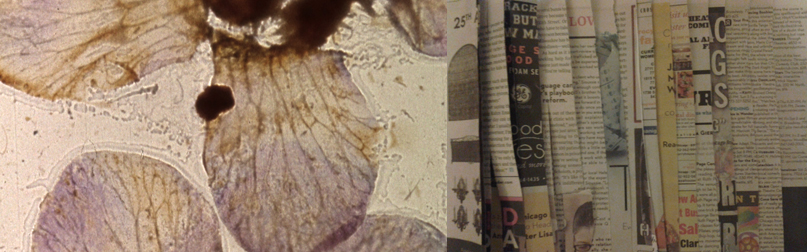
That’s only one way of looking at it, however. Experimental art becomes genre when particular experimental techniques become canonical and widely disseminated and practiced. The experimental filmmaker Stan Brakhage, during the 1960s, affixed blades of grass and moth wings to film emulsion, and scratched the emulsion, and painted on it, then printed and projected the results. Here is one example and here is another example. And here is a third; his films are beautiful and I love them. (The image atop left hails from Mothlight.) Today, countless film students also love Brakhage’s work, and use the methods he popularized to make projects that they send off to experimental film festivals. (Or at least they did this during the 90s, when I attended such festivals; I may be out of touch.)
Those films, I’d argue, while potentially beautiful and interesting, are not necessarily experimental films. As far as the principle of experimentation goes, those students had might as well be imitating Hitchcock.
My Favorite New Movies of 2012
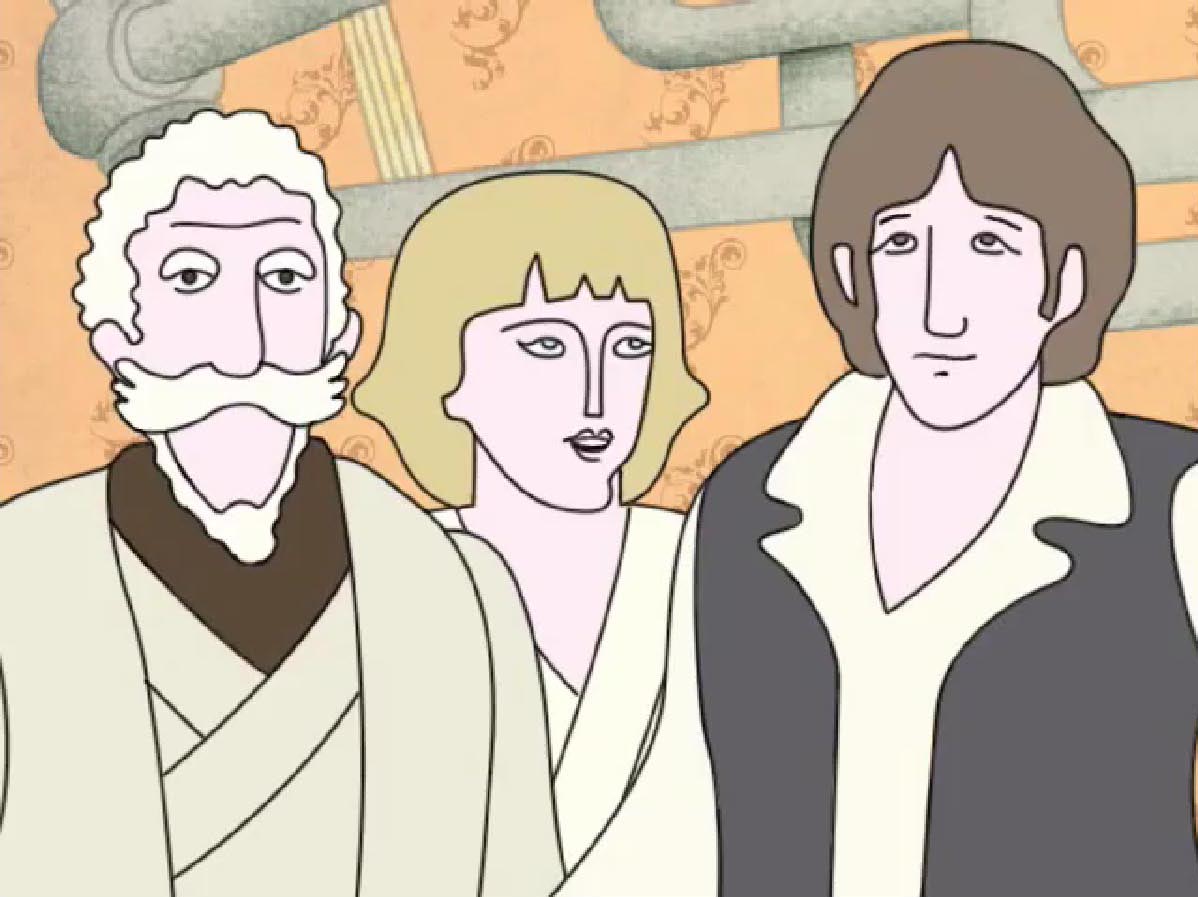
“Star War’s Uncut: Director’s Cut” (2012)
Here’s a roundup of my favorite newish movies, with some thoughts on each one. If you appreciate and/or doubt my taste in motion pictures, here are my lists from 2009 & 2010 & 2011. And here are some overall notes:
- Films marked with an * can be watched for free online; just click on the title.
- Roughly half of the films are from 2012; the rest hail from 2008–11. As I argued in my posts “How Many Movies Are There?” and “How Many Movies Have You Seen?“, no one can watch every new release when it comes out (especially when they’ve recently started a PhD program). I prefer to think of my lists 2009–present more as an ongoing project than as definitive statements on any given year. (I also feel free to revise my opinions over time.)
- You may find relevant two older posts—“How Many Cinemas Are There?” & “Why Do You Need So Many Cinemas?“—where I decry the habit of so many film critics to consider only feature-length theatrically-released films when making these kinds of lists. (All other cinema somehow disappears at the end of the year! Which is particularly odd at the present moment, when broadband has been revitalizing the short movie form.)
- If you want straight lists of the titles without any commentary, just skip to the end.
And now, without further to do, here are 30+ relatively-new movie-things that I saw and have thoughts on, starting with—
I. MY 10 FAVORITE NEWISH FILMS THAT I SAW THIS YEAR AND FEEL COMFORTABLE RECOMMENDING THAT OTHERS CHECK OUT
On the inevitability of more Star Wars films
| film | year | production budget | worldwide gross |
| Star Wars | 1977 | $11 million | $775,398,007 |
| The Empire Strikes Back | 1980 | $18 million | $538,375,067 |
| Return of the Jedi | 1983 | $32.5 million | $475,106,177 |
| The Phantom Menace | 1999 | $115 million | $1,027,044,677 |
| Attack of the Clones | 2002 | $115 million | $649,398,328 |
| Revenge of the Sith | 2005 | #113 million | $848,754,768 |
| $404.5 million | $4,314,077,024 |
Net profit: 3.9 billion dollars.
And that’s just ticket sales.
I made a video that critiques the opening three scenes of “Inception”
I’m trying out different ways of doing film criticism. In addition to writing articles, I think it makes sense to record commentaries (like the one I just did for Drive) and make critical videos. (My inspirations here are Mike Stoklasa and Jim Emerson.)
So here’s my own foray into the latter:
The Higgs-Jameson Experimental Fiction Debate, part 1
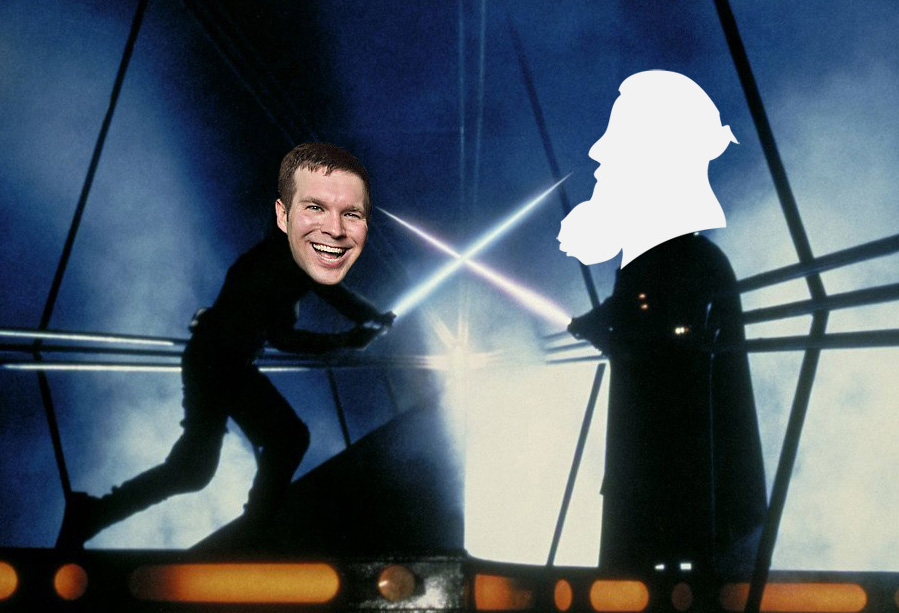
A D Skywalker vs. Darth Higgs
Adam: Last weekend, playing a stray note on my recorder summoned a cyclone that whirled me away to the swamps of Tallahassee. There I impinged on Christopher Higgs and his wife, who lodged me in their spacious Rococo flat (refurbished from a gator-packing warehouse). Over dinner, Chris and I had numerous opportunities to discuss—and to disagree about—the nature of experimental fiction…
A D JAMESON [leaning back from his seventh helping of tiramisu]: At the risk of spoiling such a fine meal, perhaps you and I can finally figure out why we’ve butted been butting heads regarding the nature of experimental fiction.
CHRISTOPHER HIGGS: OK.
ADJ: Let’s start by each defining what we think experimental fiction is!
How Many Movies Are There?
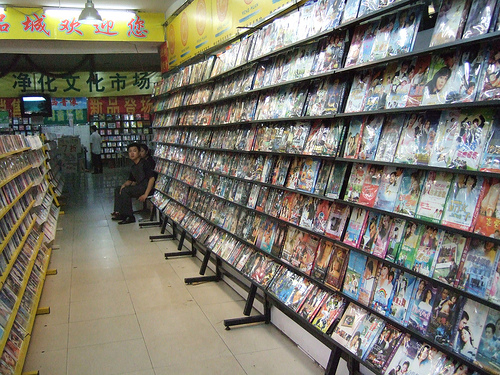
A Shanghai DVD shop.
First, it depends on what you consider a movie. If you define “cinema” as broadly as I do, then the answer is probably “countless.” So let’s pick something more discrete: feature films (which is what most people mean, anyway, when they say “movie”).
There’s no hard and fast rule as to what constitutes a feature. The term itself is a relic of theater-going: the feature film was the featured film—it was what the theater advertised outside, and presumably what compelled you to purchase a ticket and enter—as opposed to the various newsreels, cartoons, and serial installments that also ran (and then, eventually, stopped running). Theater-going in 2012 seems an increasingly old-fashioned hobby (see Roger Ebert’s recent article on declining ticket sales), but we still use the word to mean “a long film.”
But how long? The Wikipedia informs us:
The Academy of Motion Picture Arts and Sciences,[1] the American Film Institute,[2] and the British Film Institute[3] all define a feature as a film with a running time of 40 minutes or longer. The Centre National de la Cinématographie in France defines it as a 35 mm film longer than 1,600 metres, which is exactly 58 minutes and 29 seconds for sound films, and the Screen Actors Guild gives a minimum running time of at least 80 minutes.[4] Today, a feature film is usually between 80 and 210 minutes[citation needed]; a children’s film is usually between 60 and 120 minutes[citation needed]. An anthology film is a fixed sequence of short subjects with a common theme, combined into a feature film.
Let’s go with that 40-minute cutoff. Are we ready to start counting?
May the Force Be With You When You’re Burning in Hell

You’ve just got to check out this gallery of Star Wars religious art, over at io9.