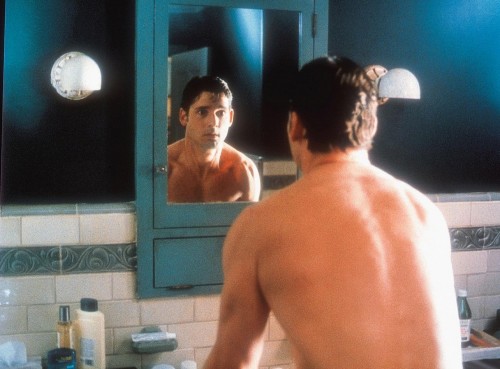
Mark Bibbins sent this to me while I was talking to him
I went to the bar with Mark Bibbins after class. He bought my first drink and then he bought my second drink and possibly my third. I don’t remember. I asked him about Gertrude Stein and he told me about Gertrude Stein but no great conclusions were arrived at. No, wait. One great conclusion was arrived at. I came to the realization that when Gertrude Stein said “when painting becomes abstract it becomes pornographic” she was talking about pornography in the 1930s and not the pornography I usually look at. But I’m getting ahead of myself. When we sat down, an actress walked in and Mark recognized her. She walked over to Dean, the bartender, hugged and kissed him. Mark said they were making out. Then the realization happened. Then we talked about money, power, and domesticated animals. Mark has a cat named “The Pagoda.” I remember being amazed at how good the name “The Pagoda” is, yet not acknowledging this in any way to Mark other than a brief nod of my head. I talked a lot of shit about nearly every person in my MFA program in harsh and intolerant ways. I tried to draw a picture of a cat on a napkin and failed and continued to do this over and over. I made Mark do this with me. Justin Taylor appeared. I don’t think he recognized me with my beard on. I made Mark introduce us for fun. We talked about a few things. I talked to another person. It became late. I don’t remember leaving the bar. I took the wrong train and ended up in the wrong part of Brooklyn. I could have easily taken another train and gotten home quickly, but instead I took the train back to where I had originally gotten on and just started over. It took a very long time. I’m going to be blogging here now. Sup with you?
Roberto Bolaño: “Instead of waiting, there is writing.”

“The truth is, I don’t believe all that much in writing. Starting with my own. Being a writer is pleasant—no, pleasant isn’t the word—it’s an activity that has its share of amusing moments, but I know of other things that are even more amusing, amusing in the same way that literature is for me. Holding up banks, for example. Or directing movies. Or being a gigolo. Or being a child again and playing on a more or less apocalyptic soccer team. Unfortunately, the child grows up, the bank robber is killed, the director runs out of money, the gigolo gets sick and then there’s no other choice but to write. For me, the word writing is the exact opposite of the word waiting. Instead of waiting, there is writing. Well, I’m probably wrong—it’s possible that writing is another form of waiting, of delaying things. I’d like to think otherwise.”
from interview in Bomb, 2002
Maurice Blanchot on inventing language in an unfamiliar tongue
“Since we happened to be in the street at the moment Paris was bombed, we had to take shelter in the metro. At that time these formalities were not taken seriously. And N. enjoyed anything that allowed her to leave her work. So the two of us were on the steps in the middle of an enormous crowd, the kind of crowd that is urgent and unwieldy, sometimes as motionless as the earth, sometimes rushing down like a torrent. For quite some time I had been talking to her in her mother tongue, which I found all the more moving since I knew very few words of it. As for her, she never actually spoke it, at least not with me, and yet if I began to falter, to string together awkward expressions, to form impossible idioms, she would listen to them with a kind of gaiety, and youth, and in turn would answer me in French, but in a different French from her own, more childish and talkative, as though her speech had become irresponsible, like mine, using an unknown language. And it is true that I too felt irresponsible in this other language, so unfamiliar to me; and this unreal stammering, of expressions that were more or less invented, and whose meaning flitted past, far away from my mind, drew from me things I never would have said, or thought, or even left unsaid in real words: it tempted me to let them be heard, and imparted to me, as I expressed them, a slight drunkenness which was no longer aware of its limits and boldly went farther than it should have. So I made the most friendly declarations to her in this language, which was a habit quite alien to me. I offered to marry her at least twice, which proved how fictitious my words were, since I had an aversion to marriage (and little respect for it), but in her language I married her, and I not only used that language lightly but, more or less inventing it, and with the ingenuity and truth of half-awareness, I expressed in it unknown feelings which shamelessly welled up in the form of that language and fooled even me, as they could have fooled her.”
–Maurice Blanchot, Death Sentence
Peyton Manning on Writing

“People always say, ‘Hang in there.’ And I went, ‘I never was out there, wherever there is. I’ve always been in there, I’ll always be in there.’ Wherever that is, I never have left.”
THE ARTIST ELUDES ANY SYSTEM
“When, in order to adapt to his destiny as an artist, Anselm Kiefer attempts to throw himself open to a dimension larger than himself, he does not retreat in the face of a force that may overwhelm and daunt him. He allows himself to be possessed and swept away by it, to become the arbiter of a challenge which ultimately implies the construction of the formal energy of art. To let ourselves be overwhelmed means to agree to be impregnated and to mediate that which submerges and overtakes us: to discover ourselves in order to discover. The artist, like the poet, eludes any system, whether good or bad, religious or moral: he negates himself, dies in favour of an unknown and indefinable force, and aspires to establish the right relationship with forms and their origins. He wants to succumb to their primacy and lets himself be shattered and overwhelmed not for any banal or general reason, whether it be ideological or sociological, anonymous or impersonal, but only for one exceptional reason: the survival of the language of art.”
quote-o-the-day
Loafing is the most productive part of a writer’s life.
James Norman Hall
True dat, Mr. Hall. Internet, coffee maker, gazing out the window at the snow—it may seem like not-writing, even now, but the mind stirs the pink shirt that becomes the fish that sings the flamelets of river, also known as words. For all the clatter of the laboriousness of writing, you should be thankful that every time your eye tingles cotton triangles, your lingual papillae meet ketchup (one of the only foods to trigger all 5 taste receptors: salty, sweet, bitter, sour, umami), your hand grips the perfect heft of a green bocce ball, you are indeed writing. Or you could read a book, another form of osmosis, but Hall isn’t talking about reading, me thinks, because reading is not loafing, no matter how far you drift away…so when someone on Facebook pokes you about yet another 8500 words, or when Joyce Carol Oates belches and out floats her 83rd lurid tale of obsession, etc., etc., relax, relax, go take a slow walk through a cow pasture, an interstate, a marriage, take a walk down through a brown couch, or a blog. You are loafing right now. I mean to say writing. Continue.
The good, the bad, and the wandering eye
Thus, there are only good and bad novels. The bad novel aims to please by flattering, whereas the good one is an exigence and an act of faith.
Power Quote: Foucault on Creation

“My desire is that a book, at least for the person who wrote it, should be nothing other than the sentences of which it is made; that it should not be doubled by that first simulacrum of itself which is a preface, whose intention is to lay down the law for all the simulacra which are to be formed in the future on its basis. My desire is that this object-event, almost imperceptible among so many others, should recopy, fragment, repeat, simulate and replicate itself, and finally disappear without the person who happened to produce it ever being able to claim the right to be its master, and impose what he wished to say, or say what he wanted it to be. In short, my desire is that a book should not create of its own accord that status of text to which teaching and criticism will all too probably reduce it, but that it should have the easy confidence to present itself as discourse: as both battle and weapon, strategy and shock, struggle and trophy or wound, conjuncture and vestige, strange meeting and repeatable scene.”
[from the preface to the 1972 edition of History of Madness]
from The Bloody Chamber

Angela Carter, badass
Concluding line of Angela Carter’s “The Company of Wolves”:
“See! sweet and sound she sleeps in granny’s bed, between the paws of the tender wolf.”
Mute Prophecies
“In traditional cultures art offered visual and other types of definitions or embodiments of the prevailing cultural and philosophical measure. In times when the measure is broken into contradictory fragments, the role of the artist, in Kounellis’s view, is also shaped by contradiction. The artist must be at the same time social and political on the one hand, individually creative and self-expressive on the other. When the measure is changing, art can function either adversarily to destroy lingering credulity about the past measure or positively to fashion or define a new one. This is the great power of art and the great and serious role of the artist. The artist performs an interruption in the stream of measure, or of false measure as in our time; this interruption is the creative/destructive act through which the lingering appeal of the old measure may be destroyed and a new measure found. In Kounellis’s view, an artist who attempts something else in his or her work does not understand the solemnity of truly belonging to history. His or her art does no real work. It enters the world of the market or of entertainment or of the mass media but it does no real work with the roots of culture and the problem of human nature.”
Testify.
Let me take a MEAN WEEK—and HTML Giant’s usual apolitical bent—timeout to say how much I love Bishop John Shelby Spong:
I have made a decision. I will no longer debate the issue of homosexuality in the church with anyone. I will no longer engage the biblical ignorance that emanates from so many right-wing Christians about how the Bible condemns homosexuality, as if that point of view still has any credibility. I will no longer discuss with them or listen to them tell me how homosexuality is “an abomination to God,” about how homosexuality is a “chosen lifestyle,” or about how through prayer and “spiritual counseling” homosexual persons can be “cured.” Those arguments are no longer worthy of my time or energy.
Much more here. Seriously, spread this link far and wide.
Drew Kalbach Power Mean Quote

"htmlgiant is the walmart of litblogs" -- Drew Kalbach, Oct. 25, 1:50 EST

Drew Kalbach
Poet Drew Kalbach is the Richard Simmons of creepy ebuillience, per his goodreads slash twitter pic. Two profiles and one pic; dos cojones y uno prick, hope you’re bilingual Drew. One figures what’s behind his profile pic’s ambiguous backdrop: a broken real doll, eight empty venti mochas, and an extra toupee. With Donald Trumpian hair like that Drew, you might have a future in real estate — not your literary estate, but the soft patch of grass under which we will all be buried. Start counting away them years, and for fuck sake, blink.
To me fiction is not about ideas. It is above ideas. I make a divide between the holy, the sacred, the mysterious, the unexplainable, the implicit, the aesthetic, the moral, and the ethical on one hand, and the empirical, the functional, the explainable, the logical, the true, and the proven on the other. In short, the Holy and the Empirical. Literature belongs to the holy. You can do fiction, nonfiction, a mixture, who cares. Literature is above the distinction. It is sacred.
This is either “Power Quote: Louis CK,” or “Louis CK on Writing”

“I just wanted to buy a trumpet to learn how to play trumpet. I went in to Sam Ash, or one of those places, and there were all these student trumpets for, like $100. The guy started showing me, you know, here’s like a nickel-plated, beautiful trumpet and it’s got a flawed bell because it was hurt, but they had repaired it. And it was $1400. I didn’t have any of that kind of money. But I went to an ATM and I took out everything I had in the bank, and I bought this fucking $1400 trumpet without having any ability. I’d never even blown into a trumpet before. And then I was walking through Times Square with this fucking thing in my hand, and just freaking out and feeling bad. And I went and ducked into one of those peep shows. Next thing I know I’m in a peep show booth, one of those upright coffins, looking at a chick—a tired Latvian girl, probably—through the window of this peep show and jacking off. And it’s a two-foot by two-foot room. So I jerk off and I came on the trumpet case, which was standing between my legs. And once I came, and I looked at the come on this beautiful, brass-buckled trumpet case, I realized that if I had come to this peep show first, I could’ve saved $1400.”
The very, very funny Louis CK explains the boundaries of ambition. From the October 4, 2010 episode of WTF with Marc Maron.
Begs the questionRaises the question: better that he bought it or better to have headed to the peep show first?
Me? Gotta go trumpet.
UPDATE: Schooled. Thanks for the links.
The Literature of Desperation
“Now let’s take the desperate reader, who is presumably the audience for the literature of desperation. What do we see? First: the reader is an adolescent or an immature adult, insecure, all nerves. He’s the kind of fucking idiot (pardon my language) who committed suicide after reading Werther. Second: he’s a limited reader. Why limited? That’s easy: because he can only read the literature of desperation, or books for the desperate, which amounts to the same thing, the kind of person or freak who’s unable to read all the way through In Search of Lost Time, for example, or The Magic Mountain (a paradigm of calm, serene, complete literature, in my humble opinion), or for that matter, Les Miserables or War and Peace. Am I making myself clear? Good. So I talked to them, told them, warned them, alerted them to the dangers they were facing. It was like talking to a wall. Furthermore: desperate readers are like the California gold mines. Sooner or later they’re exhausted! Why? It’s obvious! One can’t live one’s whole life in desperation. In the end the body rebels, the pain becomes unbearable, lucidity gushes out in great cold spurts. The desperate reader (and especially the desperate poetry reader, believe me) ends up by turning away from books. Inevitably he ends up becoming just plain desperate. Or he’s cured! And then, as part of the regeneration process, he returns slowly – as if wrapped in swaddling cloths, as if under a rain of dissolved sedatives – he returns, as I was saying, to a literature written for cool, serene readers, with their heads set firmly on their shoulders. This is what’s called (by me, if nobody else) the passage from adolescence to adulthood . . .”
- the testimony of Joaquin Font, from page 208 of The Savage Detectives, by Roberto Bolano
Power Quote: Luna Miguel

It’s impossible to support today the idea of the author as a divine entity… If we want people to approach poetry, it would be better to delete the myths.
I’m Scared; Happy Birthday to Google
And the fact that I’m wishing Google a happy birthday only frightens me more.
I don’t believe society understands what happens when everything is available, knowable and recorded by everyone all the time,” he says. He predicts, apparently seriously, that every young person one day will be entitled automatically to change his or her name on reaching adulthood in order to disown youthful hijinks stored on their friends’ social media sites. — Google CEO or whatever
The Sisterhood of Travel Books

I’m in the midst of writing research proposals for grants in a discipline I know next to nothing about, and so, naturally, I’m reading a lot. Naturally, I’m also procrastinating by writing this blog. (Brief back story: I’ve just started working on my PhD in Geography, which is only funny if you know me, because if you know me, you know I have no sense of direction. Up until five months ago, I thought Lake Champlain was a great lake. But of course, this has no real bearing on my Geography degree. I’m studying human geography. But either way, my training as a fiction writer has given me little insight, little preparation for grant writing.) The basic premise to my project is “imagined” geographies, that is, how second generation immigrants imagine a homeland they’ve never been to and how this imagining impacts development.
Naturally, considering the premise of my project, I’m reading folks like Benedict Anderson, Edward Said, Foucault (Jesus, people love Foucault), and Agamben.
I’m reading Said for probably the third or fourth time (each reading offers something new, of course), and this time, I found this gem:
Many travelers find themselves saying of an experience in a new country that it wasn’t what they expected, meaning that it wasn’t what a book said it would be. And of course many writers of travel books or guidebooks compose them in order to say that a country is like this, or better, that it is colorful, expensive, interesting, and so forth. The idea in either case is that people, places, and experiences can always be described by a book, so much so that the book (or text) acquires a greater authority, and use, even than the actuality it describes. (93)