
An open letter to Kevin Smith (aka Silent Bob) about silence and writing-as-shitting
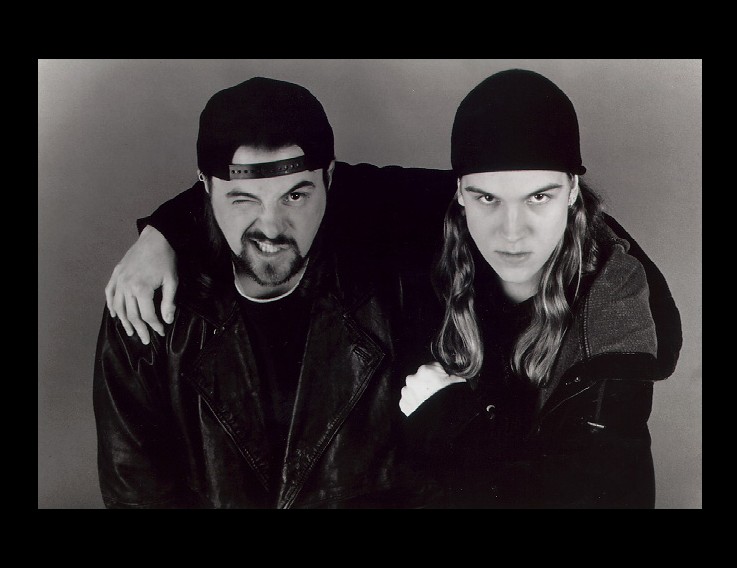
Dear Kevin Smith,
You have a fucking radio show? That’s kind of hilarious because you were always the silent one. You were Silent Bob. You went from being pure body to pure voice. Why’d you do it, man? There was something philosophical about your silence, they way you were so expressive without saying anything. We all liked to imagine what you were thinking, how you were perceiving everything that was going on around you. There was a profound quality to your sparse interjections (because you never spoke, because of the scarcity of your words). The law of economics says that when demand exceeds supply, value increases. Maybe I should shut up. Maybe I should retreat into silence like you once did. Maybe then—only then—will people give a shit about any of this. Any of these words.
When you did speak, we felt lucky to be graced by your wise words. Because you never spoke, we felt like you were enlightened, like you were beyond language, like language was something the petty people did, and you did not need it. You were above all that, the way spiritual gurus are above food, the way they no longer need to satiate those earthly desires. You didn’t need to feed the part of the body that longs for recognition. You were a watcher, an observer. Everyone around you was always blabbering on and on, but you didn’t feel the need to fill up space in the same way. You know, most people feel anxious about silence. It’s the hardest thing, to live in silence. You can’t just “be” next to someone. It makes you totally nuts to feel like you don’t know what they’re thinking. Maybe their silence means hatred. Maybe I’m fucking boring. So we talk on and on because we are afraid, because we need to know where the other person is at, because silence can mean anything and we need our interactions to be anchored in certainty.
Koreanish & Some Notes About Reading a Blog As Though It Were A Book Whose Ending Hasn’t Yet Been Written

Koreanish is a blog operated by the novelist Alexander Chee, author of Edinburgh and the forthcoming The Queen of the Night. Chee recently offered a four-part series titled “100 Things About a Novel.” It begins like this:
1. Sometimes music is needed.
2. Sometimes silence.
3. This is probably because a novel is a piece of music, like all written things, the language demanding you make a sound as you read it.
Interview Roundup, Part Ten: Eugenides, Jelinek, Adichie, Solzhenitsyn, Carson
 “That’s what gave me such trouble and why it took me so long to write the damn book at first. It took me two years to get this first-person omniscient narrator. I was sure I needed a first-person narrator for many reasons. I wanted the story of Calliope’s transformation to be intimate. I also wanted to avoid — and this is a very practical writerly point — to avoid the pronominal problem with he/she that we’re having in this interview. I wanted it to be ‘I.’ And the point is also that we’re all an I before we’re a he or a she. So it seemed important to have this ‘I,’ but in order to tell the story of the grandparents and the parents, if I remain in a first-person narrative voice, I can’t go into their minds and tell you what they’re feeling. It becomes very dry and voyeuristic. It took me a long time to figure out how to have a first-person that could also switch into the third-person. I had to basically give myself permission to do that, and I had a lot of scruples against doing it for the first couple of years. So I wrote the story many different ways — sometimes all third-person, sometimes all first-person. I knocked my head until I finally realized I could have the narrator do both things and give the sense to the reader that Cal, telling the story years later, is possibly inventing things and maybe knows things that he can’t but that’s all right. I worried that the reader would resist certain things that Cal knows, but I’ve found that actually readers don’t bother themselves with the details as much as I do. In general, readers don’t worry about things like, how would he know this about his grandmother?” – Jeffrey Eugenides, in Salon
 “The novel is the opposite of pornography. Pornography suggests desire everywhere and at every moment. The novel proves that this does not exist, that it is a construct meant to keep women willing, because they are usually pornographic objects anyway, while men look at them, and can almost penetrate their bodies with their gaze. But I am used to being misunderstood. I am even blamed for what I attempt to analyze in my writing. As so often happens, the messenger is attacked, and not what she expresses. No one is interested in that.” – Elfriede Jelinek at Serpent’s Tale
 “I’m not sure my writing in English is a choice. If a Nigerian Igbo like myself is educated exclusively in English, discouraged from speaking Igbo in a school in which Igbo was just one more subject of study (and one that was considered ‘uncool’ by students and did not receive much support from the administration), then perhaps writing in English is not a choice, because the idea of choice assumes other equal alternatives.” – Chimimanda Ngozi Adichie in WOCALA
 “Periods of rapid and fundamental change were never favourable for literature. Significant works, have nearly always and everywhere been created in periods of stability, be it good or bad. Modern Russian literature is no exception. The educated reader today is much more interested in non-fiction. However, I believe that justice and conscience will not be cast to the four winds, but will remain in the foundations of Russian literature, so that it may be of service in brightening our spirit and enhancing our comprehension.” – Aleksandr Solzhenitsyn in The Independent
 “In surfaces, perfection is less interesting. For instance, a page with a poem on it is less attractive than a page with a poem on it and some tea stains. Because the tea stains add a bit of history. It’s a historical attitude. After all, texts of ancient Greeks come to us in wreckage and I admire that, the combination of layers of time that you have when looking at a papyrus that was produced in the third century BC and then copied and then wrapped around a mummy for a couple hundred years and then discovered and put in a museum and pieced together by nine different gentlemen and put back in the museum and brought out again and photographed and put in a book. All those layers add up to more and more life. You can approximate that in your own life. Stains on clothing.” – Anne Carson, in the Paris Review
Interview Roundup Part Nine: Markson, Hoang, Zhuoxiang, Gudmundsson, Shozo
 “I thought The Recognitions was—Lowry being English—the great American novel of that period. That’s the only other letter I wrote to a writer, but it was different from the Lowry one. When The Recognitions came out, it was shat on by every reviewer. They said, ‘How dare he write so long a book? How dare he deliberately try to create a masterpiece?’ I wrote this casual letter, saying, ‘Screw them. Some of us out here know what you did.’ When my wife and I went to Mexico for three years, an editor came down there, and Aiken had given him my name. We had him to dinner, and all I did was talk about The Recognitions. And this guy said, ‘Shut up already. Tell me about Mexico. I’ll read it when I get home.’ And he did. The Recognitions came out in 1955, and this would have been about 1961. One day I get a letter there: ‘Dear David Markson, If I may presume to answer yours of”—whatever it was—’May 16, 1955.’ It turned out that this editor, Aaron Asher, had come home, read the book, and decided to resurrect it. There had never been a paperback, and he put it in print, and it brought Gaddis back to life.” – David Markson, in Conjunctions
.jpg) “I first conceived of this novel as one that would explore the occult & religion as mythologies, but as I started researching, I found a lot about numerology and mathematics. Since I was little, I wanted to be a scientist or a mathematician (I’m not quite sure why I’m not, to be completely honest!) so I decided to use the superficial constraint of the form of a parabola to shape this text. Again, while researching, I came to understand that there were so many more mythologies out there than just the occult & religion. As such, I expanded the scope of my novel. I wanted to create a work that dialogued within itself. As for the shape of the text, I wanted to mimic the traditional triangular structure of a novel, but I wanted to invert it. A parabola was a perfect fit! I love interactive novels. I think the various tests that appear throughout the text add a new level of interactivity. Ideally, readers would actually take some of the tests. Additionally, I know many people (myself included) who put a great deal of weight on personality tests, IQ, and psychology. I see these as modern-day myths, a new form of “religion” and a method of categorization. To me, IQ seems to be especially troubling, particularly because of the mass sterilization in the early to mid 20th century based on the Army Beta IQ test. I based some of the questions on my test on that original test.” – Lily Hoang at Experimental Fiction / Poetry
“I first conceived of this novel as one that would explore the occult & religion as mythologies, but as I started researching, I found a lot about numerology and mathematics. Since I was little, I wanted to be a scientist or a mathematician (I’m not quite sure why I’m not, to be completely honest!) so I decided to use the superficial constraint of the form of a parabola to shape this text. Again, while researching, I came to understand that there were so many more mythologies out there than just the occult & religion. As such, I expanded the scope of my novel. I wanted to create a work that dialogued within itself. As for the shape of the text, I wanted to mimic the traditional triangular structure of a novel, but I wanted to invert it. A parabola was a perfect fit! I love interactive novels. I think the various tests that appear throughout the text add a new level of interactivity. Ideally, readers would actually take some of the tests. Additionally, I know many people (myself included) who put a great deal of weight on personality tests, IQ, and psychology. I see these as modern-day myths, a new form of “religion” and a method of categorization. To me, IQ seems to be especially troubling, particularly because of the mass sterilization in the early to mid 20th century based on the Army Beta IQ test. I based some of the questions on my test on that original test.” – Lily Hoang at Experimental Fiction / Poetry
 “If Literature is to be defined by that which bears and even demands repeated readings, then certainly, of all the genres, lyrics are the most dominant form of Literature in the Mandarin-speaking world at the moment—due to the ubiquity of the Internet, the traditional ‘being quoted’ has taken on the technologized form of ‘being forwarded’, or ‘being cut and pasted’.” – Li Zhuoxiang at Asymptote
 ” As a publisher, I once edited the Icelandic translation of another ‘untranslatable’ work; ULYSSES by James Joyce. I went with the translator to Dublin, we met some relatives of Joyce, saw the sites of the book, and I think the translation is very well done and gives a lot to the Icelandic reader. One just has to accept that it is another work, the connotations are different, and there is another audience. Once you have accepted this, translations are a wonderful add-on to literature. And for writers who write in a language like Icelandic, which only 300 thousand people can understand, they are an absolute necessity.” – Halldor Gudmundsson in IceNews
 “Japanese people today are becoming more and more interested in Taiwanese literature, primarily because of Taiwanese movies, which are very popular in Japan. Flicks like March of Happiness and Lament of the Sand River ran for a month or two at theaters. Movies directed by Hou Hsiao-hsien are very popular in Japan. It’s easier to get hooked on a movie than a novel, so a lot of people will see a movie first and then go out and start buying novels.” – Fujii Shozo in Taiwan Panorama
Interview Roundup Part Eight: Lasky, Coetzee, Butler, Arasanayagam, Saramago
 “I think poetry should do what it was meant to do—exist. And then the big things that need to be done—like saving the world, for instance—needs to be up to us as humans. We need poetry, but we need it like we need a tool. Poetry is our poetry hammer. And likewise, poetry is human, even as it is dead. And so I think poetry can connect us to our humanity if we bring the human back into it. I am interested in this Armantrout statement, as I think I know what she means (or at least can interpret what she means to support my own views). I think she is saying that poetry should bring in the superhuman—the everyhuman—and be the summation of all the voices that it can summate. Because in every person there is some power that can be brought—whether it be coaxed or triggered depending on the specific personality—into every poem. And when we only seek out “voyeuristic identification” in our poems, we only expect the smallest parts of humanity (its meaningless specifics) from them. And in that way, humanity becomes even more and more entrenched in meaninglessness when we identify with poems in these empty ways. To make meaning we need to value meaning and vice versa. It is a feedback loop.” – Dorothea Lasky in Octopus
 “It is difficult to be a so-called successful writer and to occupy a marginal position at the same time, even in our day and age.” – J. M. Coetzee in Ohio Swallow
 “Devil Girl From Mars is the movie that got me writing science fiction, when I was 12 years old. I had already been writing for two years. I began with horse stories, because I was crazy over horses, even though I never got near one. At 11, I was writing romances, and I’m happy to say I didn’t know any more about romance than I did about horses. When I was 12, I had this big brown three-ring binder notebook that somebody had thrown away, and I was watching this godawful movie on television. (I wasn’t allowed to go to the movies, because movies were wicked and sinful, but somehow when they came to the television they were OK.) It was one of those where the beautiful Martian arrives on Earth and announces that all the men on Mars have died and they need more men. None of the Earthmen want to go! And I thought, ‘Geez, I can write a better story than that.’ I got busy writing what I thought of as science fiction.” – Octavia Butler in Locus
 “I wonder if my kind of work will appeal to the West. Writers like Michael Ondaatje are wonderful, I admire them, but they are based in Britain or Canada, in the land of the expatriates, and very consciously write with an eye and ear to another kind of readership.” – Jean Arasanayagam in The Hindu
“An idea had been with me since about 1972: the idea of a siege, as in a besieged city, but it was not clear who was besieging it. Then it evolved into a real siege, which I first thought of as the siege of Lisbon by the Castilians that occurred in 1384. I joined to this idea another siege, which occurred in the twelfth century. In the end, the siege was a combination of those two historical ones—I imagined a siege that lasted some time, with generations of besieged as well as generations of besiegers. A siege of the absurd. That is to say, the city was surrounded, there were people surrounding it, and none of this had a point. In the end all of this came together to form a book that was, or that I wanted to be, a meditation on the notion of the truth of history. Is history truth? Does what we call history retell the whole story? History, really, is a fiction—not because it is made up of invented facts, for the facts are real, but because in the organization of those facts there is much fiction. History is pieced together with certain selected facts that give a coherence, a line, to the story. In order to create that line, many things must be left out. There are always those facts that did not enter history, which if they had might give a different sense to history. History must not be presented as a definitive lesson. No one can say, This is so because I say it happened this way.” – Jose Saramago in the Paris Review
“somber silence, broken by periodic weeping.”
“This B-movie fare is widely mocked, often for good reason. But the early “Godzilla” films were earnest and hard-hitting. They were stridently anti-nuclear: the monster emerged after an atomic explosion. They were also anti-war in a country coming to grips with the consequences of World War II. As the great saurian beast emerges from Tokyo Bay to lay waste to the capital in 1954’s “Gojira” (“Godzilla”), the resulting explosions, dead bodies and flood of refugees evoked dire scenes from the final days of the war, images still seared in the memories of Japanese viewers. Far from the heavily edited and jingoistic, shoot’em-up, stomp’em-down flick that moviegoers saw in the United States, Japanese audiences reportedly watched “Gojira” in somber silence, broken by periodic weeping.” – Peter Wynn Kirby (read the rest here)
(what is experimental ______ )
“The only way to atone for the sin of writing is to annihilate what is written. But the author can only do that; destruction leaves that which is essential intact. I can, however, tie negation so closely to affirmation that my pen gradually effaces what it has written. In doing so it accomplishes, in a word, what is generally accomplished by ‘time’ — which, from among its multifarious edifices, allows only the traces of death to subsist. I believe that the secret of literature is there, and a book is not a thing of beauty unless it is skillfully adorned with the indifference of ruins.” (Georges Bataille, Abbe C)

2].
            The nothing [the void] names that undecidable of presentation which is its
unpresentable, distributed between the pure inertia of the domain of the multiple, and
the pure transparency of the operation thanks to which there is oneness [d’où procède
qu’il y ait de l’un]. The nothing is as much that of structure, thus of consistency, as
that of the pure multiple, thus of inconsistency. (BE 55; emphasis added)
disappear
most clouds are simply mayonnaise
9. New Tony Kushner podcast.
8. Riveting: the day Reagan was shot.
9. When I was in grad school the elderly would oft phone the English department and ask if a grad student “would write my life story.” Anyway, none of us did that I know of, though one student did write porn under a pen-name to make some beer money. Anyway, fascinating article on ghost writing here.
People just seem to be really surprised that the name on the book is not always the name of the person who wrote it.
9. Children e-books? Orwellian. Blue phosphorescence on the face. Worst at bedtime. The smell of blankets and ozone and despair.
What is Experimental Literature? {Five Questions: Kate Zambreno}
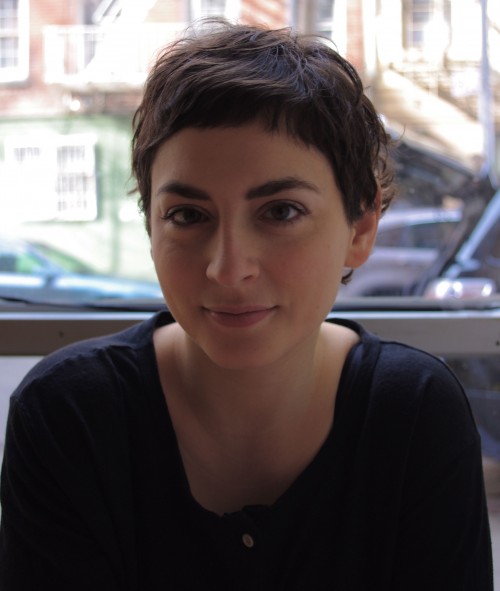
Kate Zambreno is the author of O Fallen Angel, which won Chiasmus Press’ “Undoing the Novel—First Book Contest.” Another novel, Green Girl, will be published by Emergency Press in Fall 2011. A nonfiction book revolving around the women of modernism, Heroines, will be published by Semiotext(e)’s Active Agents series in Fall 2012. She writes the blog Frances Farmer is My Sister. She is also an editor at Nightboat Books. Currently she is curating a series called Prose Event for the Belladonna* Collaborative, which examines the intersection of fiction and the essay. The next Prose Event will be on May 17 at Dixon Place in NYC and will feature Amina Cain, Danielle Dutton, and Renee Gladman.
Interview Roundup Part Seven: Whitehead, Klima, Krilanovich, Touré, Roy
 “My whole life I’ve seen those elevator inspection certificates. I’d go to school, when I was a kid, and come back and the person had been there, the exact same guy for 10 years. The elevator seemed perfectly fine, so what’d he do? I was thinking about what would make a funny detective story. Well, why not put this person in a situation where he actually has to apply his esoteric skills to a straightforward mystery? But then I had to actually make up what kinds of skills he had, and it became all about elevators and not so much this chase-the-McGuffin sort of story.” – Colson Whitehead, in Salon
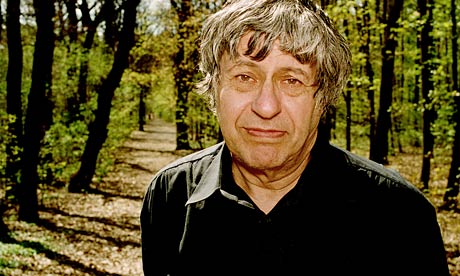 “I said something simple about the situation and there was tremendous applause. The strange thing was that afterwards many people came up and said that they had not known I was living in Prague all these years. Blacklisted writers had been made non-existing persons by the regime. People thought we lived in exile; in a way we did.” – Ivan Klima, in The Guardian
 “Oh yes, I explicitly used cutups for this novel. Lots and lots, especially during the big push, the heavy lifting that took place in ’06. And I’m talking cutups in the classic Burroughs/Gysin sense, two texts sliced down lengthwise and reattached with their opposites: AA and BB become AB and BA. Then you strike out the word fragments caught in between so it looks like a crooked seam. They’re great aesthetic objects, just on their own. You may notice a few words and scenarios in the OEC crop up again and again—I think some of the sections involving day laborers—and that’s the residue of the cutups. Eventually I rewrote things so much that the effect was mostly obliterated, but it did help generate content, which was my reason for doing them. I wanted to come up with ideas that I couldn’t simply conjure up through ordinary means—out of thin air, the old fashioned way.” – Grace Krilanovich in Hobart
 “Early on there was an assumption from editors that I could write about hip-hop and black music but not about white music. Once an editor suggested I’d be lost writing about Eric Clapton, which is strange because he’s steeped in black music. I just kept fighting and I found white subjects who others didn’t want to cover and did them well. In time my editors realized I could write about anything.” – Touré in No Strings Attached News
 “I don’t see a great difference between The God of Small Things and my works of nonfiction. As I keep saying, fiction is truth. I think fiction is the truest thing there ever was. My whole effort now is to remove that distinction. The writer is the midwife of understanding. It’s very important for me to tell politics like a story, to make it real, to draw a link between a man with his child and what fruit he had in the village he lived in before he was kicked out, and how that relates to Mr. Wolfensohn at the World Bank. That’s what I want to do. The God of Small Things is a book where you connect the very smallest things to the very biggest: whether it’s the dent that a baby spider makes on the surface of water or the quality of the moonlight on a river or how history and politics intrude into your life, your house, your bedroom.” – Arundhati Roy in The Progressive