RIP Sweetie Niedenthal (1999-2010)

This is my favorite dog-death poem. It is tearing me up right now. What are your favorite pet-death works, or pet-death moments in works?

SKEIN is Calling

Today is the day to make it your business to submit to the print journal of your dreams. To that end, the great Seth Parker, editor of SKEIN, has this to say to you today:

With an ear to the strange womb of 21st Century letters, SKEIN Magazine, a small, mostly hand-made journal of poetry and very short fiction (under 750 words), founded in 2003 in Athens, GA and now nestled in Marietta, seeks submissions for what will be its 7th issue.

Queries, comments or submissions (.doc or .rtf) can be sent to the editor at skeinmagazine@gmail.com.

Uncategorized / 4 Comments
February 2nd, 2010 / 12:12 pm

[Via Christopher Newgent] Here’s a call for submissions from Booth, a handsome looking journal made by the MFA program at Butler University. (more…)

Bob Dylan Kids Book Forthcoming in September

PR Newswire - BOB DYLAN picture book Man Gave Names to All the Animals        ...

Read the full story here, though I’ve already told you everything you need to know. Here’s the worst cover of the book-inspiring song that I could find.

httpv://www.youtube.com/watch?v=wBzQnJXnIEw

Random / 3 Comments
February 1st, 2010 / 5:33 pm

Ice Sun Wind

…a cold, blue light enters the window I feel enveloped in sap, or as if a clot of sap but also down the throat, into the lungs, sludging along tributaries, cold sap, and I was going to write–jacked on Coffee3–but now I will write little.

How does the weather affect your work?

An anecdote: One year Norman Mailer decided to winter in Provincetown. While this locale is famous for authors and their doings (and undoings), most everyone agrees you do not purposely winter in the region. Mailer knew this, but wanted to be alone, to focus on a novel. He got no writing done. Why? As he put it, in a bit of word-play: “You must watch your drinking.” He then explained that he found himself miserable, unproductive, and eventually reduced to sitting in front of a tall mirror, pouring bourbon into a glass, and staring into his face–In a phrase: watching his drinking.

READ MORE >

Craft Notes & Random / 10 Comments
February 1st, 2010 / 5:04 pm

Animal Instincts: Destroying the Cult of Reason

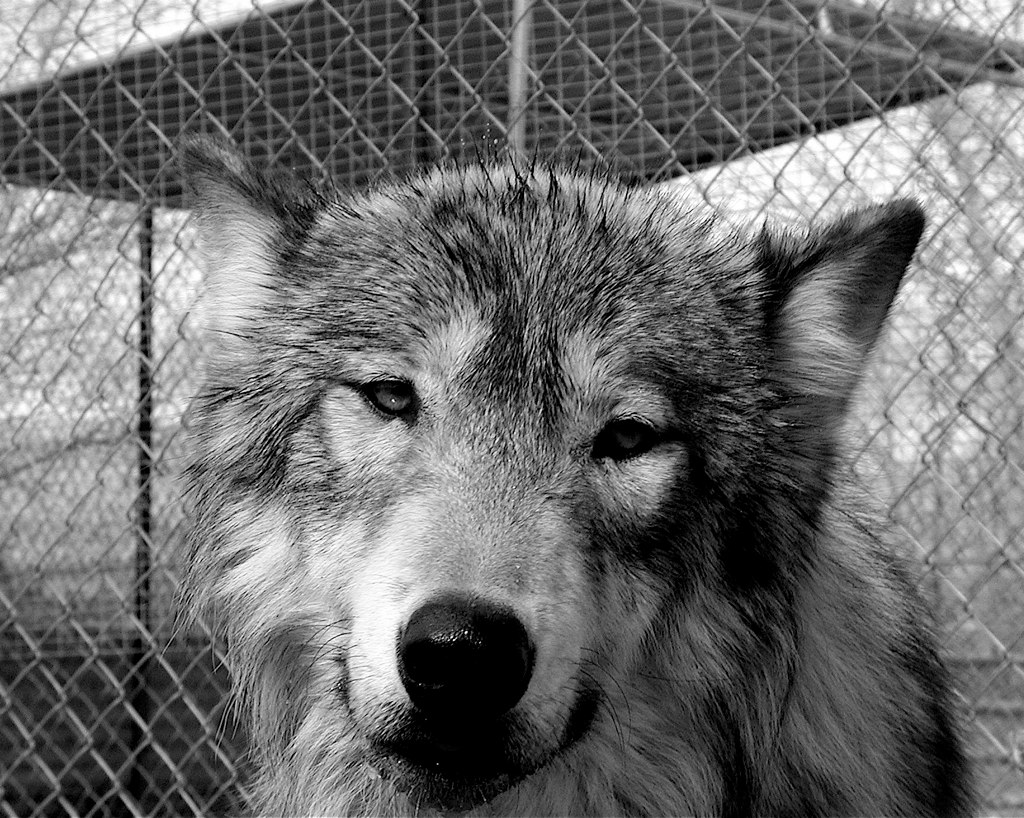
Wolf in a Cage by Josh Grigsby

“One major lesson I had to learn was to become empty and dumb and trusting enough to write every day. For this I needed, at times, blind patience, no theories about art.” –Larry Levis

Thinking about the intangibles of writing is like walking around, drunk, in a pitch-black room the size of an airplane hangar, with ghosts, with disembodied voices, with naked doppelgangers, choking on the fear of bumping into something much larger, much hairier than yourself.

I believe that’s why we talk about craft, the building blocks of a piece of art—light, shadow, line break, sentence. These are necessary to the physical architecture of the thing, certainly, and they’re quantifiable. Humans, we, desire formula and quantitative resources, names and registers. These are easier than dark, open spaces.

But what about the intangibles, the anti-craft, anti-move, anti-self-consciousness of making? What about the inexplicable creates lasting art, something more than pop culture referentiality, more than tricks-of-a-trade? What a friend of mine calls irreducibility?

Many poets and artists have tried to define the “it” factor. Many, to my eye, have succeeded in some way but never in a flesh-and-blood way. Never in a follow-these-eight-easy-steps way. For that, I’m glad.

Garcia Lorca had his duende, hovering at the lip of the wound; Ginsberg said, “the only poetic tradition is the voice out of the burning bush.” Keats sought the capability “of being in uncertainties, Mysteries, doubts without any irritable reaching after fact & reason.” I could go on forever, maybe.

There’s an interview with Aline Kominsky-Crumb in the Nov/Dec 2009 issue of The Believer. In it, Kominsky-Crumb describes a similar abstract quality to her comic-making:

“I’m so emotionally charged when I’m doing that, I can’t really control what comes out. It just comes out in a very direct form. In a way, I’m lucky that I can access that. In another way it’s horrible because I can’t refine it or improve it and make it look more, like, acceptable.”

Craft is a given, right? You love an art form so you study it; you dissect its structure. You practice, you imitate. You count syllables, maybe. You look at possible moves, maybe. Sometimes you go to school to understand and synthesize the great traditions in the company of other humans so you don’t have to read poems to your dog all the time. Sometimes you benefit from school. Sometimes you are ruined and reborn [see the Kominsky-Crumb interview for more on that].

But then what? Inevitably, you ask yourself, why does this poem make my heart sing? Why do I feel like I could jump off a building after I read this book? Or, like Dickinson, why does this thing make me feel physically like the top of my head has been taken off?

READ MORE >

Craft Notes / 43 Comments
February 1st, 2010 / 4:35 pm

(1) I read Maggie Nelson’s Bluets yesterday afternoon. That book is a serious bruiser, and beautiful. “That each blue object could be a kind of burning bush, a secret code meant for a single agent, an X on a map too diffuse ever to be unfolded in entirety but that contains the knowable universe. How could all the shreds of blue garbage bags stuck in brambles, or the bright blue tarps flapping over every shanty and fish stand in the world, be, in essence, the fingerprints of God? I will try to explain this.”

(2) SPD has a few copies of Maldoror and The Complete Works of Comte de Lautremont from Exact Change for almost 50% off. You should really own this book.

Kitty Snacks Guest Post: A conversation between Mary Miller and John Brandon

[Guest post from contest winner David Swider of Kitty Snacks.]

Kitty Snacks contributors Mary Miller and John Brandon sat down (at their computers) and emailed each other back and forth for about a week discussing different topics from writing to hanging out in their respective towns in Mississippi. John Brandon, the author of Arkansas (McSweeney’s), lives in Oxford, Mississippi (the home of Kitty Snacks magazine) where he is the John Grisham writer in residence, which means he gets a sweet house to live in, a few classes at the University of Mississippi to teach, and time to write. He has a new book coming out on McSweeney’s this summer. Mary Miller is the author of Big World (Hobart) and lives in Hattiesburg, Mississippi where she studies under Frederick Barthelme at the University of Southern Mississippi. Both writers were featured in Kitty Snacks #2 and they both have stories forthcoming in Kitty Snacks #3, which is out in a few weeks. — DS

Mary Miller asks John Brandon 7 questions

1. I was particularly interested in your story “Naples. Not Italy.” (which was published in Subtropics) because it’s excellent, but also because I’m currently writing a story in first person plural.  I thought this POV was obscure but it seems like I’m finding it all over the place lately, particularly in flashes by contemporary writers.  Do you write in this point of view often?  What do you think you’re able to achieve using this perspective as opposed to first person singular, or third person?

John Brandon

I went on a first person plural kick.  I wrote three stories in it, if that’s a kick.  I think there’s something mysterious about that POV because the reader can’t pinpoint the origin of the information they’re receiving.  And there’s an authority to it.  Somebody may argue with you, but will they argue with you and a bunch of your friends?  I read a Tom McGuane story where he uses first person plural to characterize a town’s sensibilities.  I think that’s when I became interested in it.  Yeah, mystery and authority.

READ MORE >

Author Spotlight / 23 Comments
February 1st, 2010 / 1:36 pm

An enterprising individual has come up with a list of ten reasons why poetry is bullshit and folks have added to the list which is now a whopping 93 items long. It’s worth reading, chuckling over, agreeing with or railing against.