Adam Robinson

http://www.publishinggenius.com
Adam Robinson lives in Baltimore, where he operates Publishing Genius Press. His book of poems, Adam Robison and other poems, will be published by Narrow House Books this year.

http://www.publishinggenius.com
Adam Robinson lives in Baltimore, where he operates Publishing Genius Press. His book of poems, Adam Robison and other poems, will be published by Narrow House Books this year.
 Mystery and Mortality: Essays on the Sad, Short Gift of Life is, as the title says, a collection of essays. In this book, Paula Bomer (author of the powerful and unflinching books Nine Months and Inside Madeline from Soho, and Baby from Word Riot) looks at the work of writers ranging from Tolstoy to Ferrante and Kathy Acker to Brian Allen Carr. She combines her reflections about this literature with her mother’s dementia and her father’s suicide and, through this, she runs some painful thought experiments about why we are what we are and do what we do.
It’s very generous, for a writer to expose so much. It’s humbling to publish it.
Here’s the first paragraph:
Yesterday, I walked by a mirror and I stopped and looked into it and thought, or maybe said out loud, as I’m prone to talking to myself, being one of those writers who spends far too much time alone, “I am not my mother,” repeatedly. Then I walked away.
A few of the 15 essays originally appeared here at HTMLGiant before the turn of the decade, when Paula was a contributor here known as “pr.” Some readers might remember her being lauded for all that scholarship on Flannery O’Connor.
There’s an introduction by Meg Tuite where she says there’s:
no milquetoast in … anything she’s written. Straight on ferocity that doesn’t reek of the formaldehyde of sodden decorum and martyr-esque, flushed vaginas that pop out babies with a smile and a song. Bomer’s work rakes through brutality.
Plus, check out this cool spine:
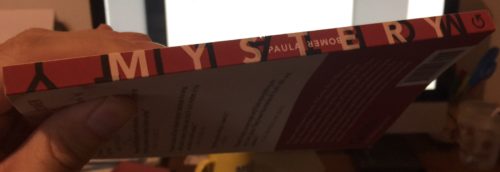
The book is available now from Publishing Genius, and right now it’s still just $10 (+ $3 shipping) through this week.
Blake sent me a password so I could write for HTMLGiant. It was “peeshirt.” I asked Amy what hers was, and it is equally funny. Anyone else get a funny PW from Blake? He is the best at that stuff.
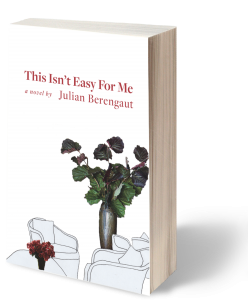 Julian Berengaut’s new novel, This Isn’t Easy for Me, a story told entirely in dialogue, is available today. Jen Michalski had some nice words for it:
“In Julian Berengaut’s This Isn’t Easy for Me, two strangers—Sabine, a German physicist, and Renata, an economist and philanthropist—meet for tea, one with a confession, the other a proposition. What follows is not a novel, but a conversation—a conversation that becomes more than a novel. It is a sweeping look at history, love and relationships, science, mathematics, and most importantly, women. Berengaut has written Sabine and Renata with as much tenderness, respect, and understanding as any woman writer.”
—Jen Michalski, The Tide King and Could You Be With Her Now
So did Linda Franklin:
“… here’s a book for people who love language. Language of literature, but also of physics, history, and the tangles you make with the daily news and private memories. Inside here is sex and sin and religion and dietary restrictions. This Isn’t Easy for Me is also for people who wish they could let their minds go wild—because by the end of the book, they will. From Conan Doyle to Pushkin, from Diderot to Godel, from Jewish jokes to Dumas to the Bible to Babel, bring some sticky notes for this lively marathon conversation between two learned women, so you can jot all the words, books, and your own ideas that you’ll want to follow up on later. The only problem here is that, as much as wish you could be, you aren’t there to join in.”
—Linda Franklin, Barkinglips
The internet since the early 2000s has made it possible to achieve a much higher profile, though the requirements are the same; you have to work hard, have reasonable expectations, and be cool in the world in order to be successful. But the potential for success in terms of readership is greater.

I used to do occasional “inside baseball” posts about running a small press, like this one from four (!) years ago. I guess it’s been a while. I find them clarifying, and usually after I write one I change something about how I “do business.” With that in mind, here are some numbers and thoughts related to Publishing Genius’s book submissions currently and throughout history. This year’s open submission period ends at 11:59pm on Monday.
Last year Publishing Genius didn’t even have an open period, but that doesn’t mean that I didn’t accept books from submissions. It’s just that I was still working through 2012’s manuscripts. There were about 400 that year, and it took me too long to figure out my responsibility to each one. It’s really hard to honor every book, and I think I was intimidated by the force of dreams coming at me like a big, wet wave. I know the excitement of finishing a writing project—big or small—and the intense hope that comes with sending it off. READ MORE >
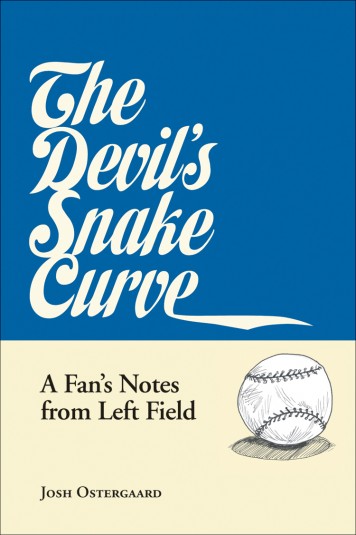 Last night the Kansas City Royals won their tenth game in a row, which should make my friend Josh Ostergaard pretty happy. He’s a Royals fan from way back, and that comes out in his new book from Coffee House Press, The Devil’s Snake Curve. The 256-page alternative history book is made of five chapters with titles you might not expect to find in a baseball book, such as “War” and “Nationalism.” These chapters are broken up into short sections, which also have titles. The first is “Kansas” and the last is “On the Beach” and along the way there are hundreds more, like “Cud,” “The Value of a Soldiers Life,” and “Another Take on Hair.”
These nonlinear sections weave through numerous subjects, sometimes about the roots of baseball and baseball traditions, sometimes about the strange cast of players and owners. Josh also writes funny anecdotes about his own experiences playing the sport, and the socio-political incidences that have occurred related to the game both in the US and around the world. War comes up a lot, and not just in reference to Abner Doubleday playing rounders in 1861 (or whatever). This is a serious book, heavily researched, and complicated. In fact, referencing the Royals’ current success is misleading, given how little attention Josh pays to the scoreboard compared to the game as cultural soporific or propaganda machine.
It’s interesting how many ways the book is characterized. Publishers Weekly listed it in its Top 10 for sports books while Shelf Awareness called it “a backdrop for American political history.” Epoch Times said it’s “a kind of Fargo of baseball books” (?). I like Eula Biss’s comment, who said it’s “like a box of eclectic baseball cards about our country and our culture—curious, compelling, and disturbing in turn.”
You worked on this for years and years, right?
I started writing in late 2004. I remember flying to Amsterdam that Christmas to visit my sister and taking on the plane a pile of old newspaper clippings about Lew Burdette, the Braves pitcher who was good at beating the Yankees. But I think the genesis of The Devil’s Snake Curve was the year before, during the months leading to the Iraq war. Like millions of other people I was against what was clearly a war of choice in Iraq, and even in the New York Times there was enough doubt about WMD and about the lack of connection between Iraq and 9/11 that it was obvious our country was about to go off the rails. During those very same months, The Field Museum, where I worked, hosted an exhibition called “Baseball as America.” I went through the exhibit many times, and enjoyed it, but the more I thought about it, the less I was able to reconcile the mythology of the sport and of our nation with the incessant warmongering. Then we started bombing Baghdad. The Devil’s Snake Curve is my attempt to reconcile the darker aspects of American history with the ways professional baseball has been represented. That old cliché about the Black Sox—“say it ain’t so”—well, that’s how I feel, but with regard to the ways the sport has been used as a public relations vehicle for war during the past decade.
Melissa Broder would like to offer you these new poems, handwritten, made with love and gifs. Read them online, analyze not just the words but the penmanship.
“I had a thing of words, and now they’re gone”
Poetry and eBooks have never played well together because, for instance, fixed line lengths don’t jive with the reader’s ability to adjust type size (poetry is too rigid). There are, of course, some clunky workarounds, like including a note for users to match their settings so that the longest line in the book is unbroken. Certainly this doesn’t have to be an issue; it’s something an HTML5 developer could solve quickly, I think—but why should they?
Limitations drive ingenuity. I’ve often wondered if, say, no one figured out how to make cars, would something else have been invented? Antimatter transportation!
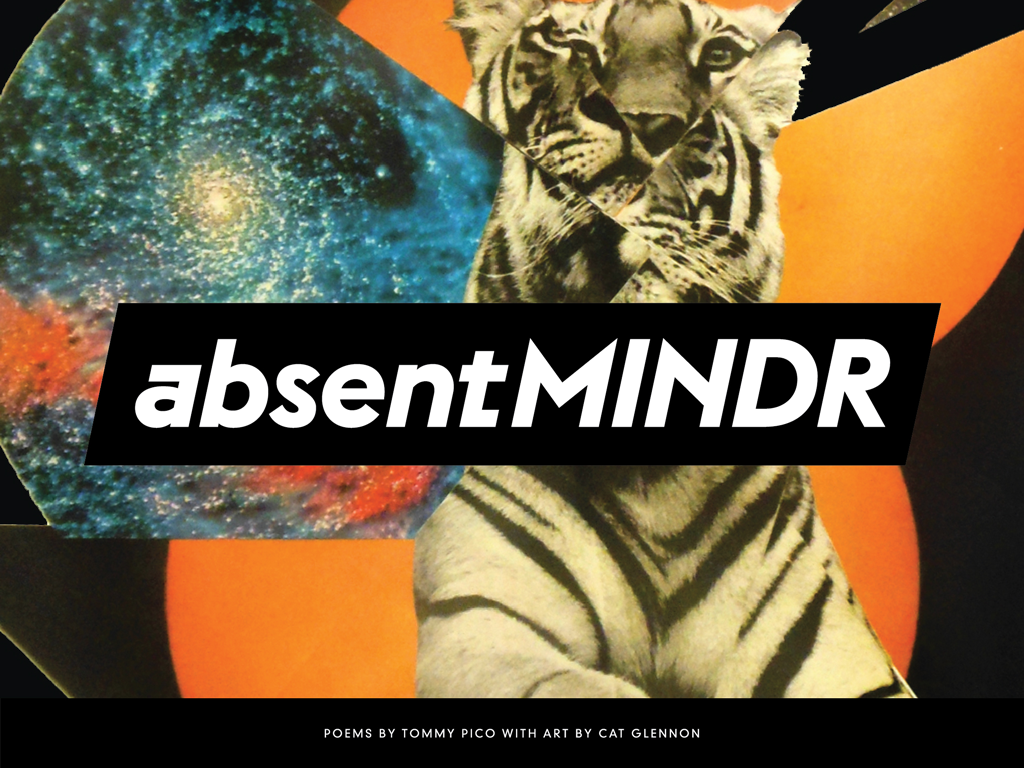
Tommy Pico, who does Birdsong, released what he calls the first poetry App (for iOS and tablets) yesterday. Called Absent Mindr, it’s a “ch-app” he says—of course it is!—with 24 poems in four sections, situated alongside audio playback of him reading the poems, and bright collages by Cat Glennon.
The poetry is cool. That’s first. I really appreciate that the literature isn’t secondary to techcrunches, and the press release for this app is all about the poetry. Certainly it’s good stuff (read “Inheritance” at Best American Poetry), and Tommy “Teebs” Pico’s voice is pitch perfect on the audio (which can be listened to when you’re not connected, like on the subway, because all the content is a download), but what I’m really impressed by and excited about is the presentation, which is slick and gorgeous. It’s antimatter transportation to cars. The app considers the poetry, the art matches the tone. Books rarely match content with UX this well.
I think apps are expensive to create, whereas eBooks are free—but Absent Mindr suggests there’s a good future for presenting poetry this way. As startups like Atavist, Byliner, Oyster, Zola, Wattpad, Readmill (RIP) and Medium etc explore how to monetize this new frontier, it will be interesting to see what DIY pioneers like Tommy Pico create in the margins.
Anecdotally, I got my hands on the app just a day before I went to NYC for the Chapbook Festival. He did a good job spreading the word, because the room was abuzz about it (ie. three or four people mentioned the app to me while I was there). Chapbooks are a space traditionally reserved for handmade, crafty, papery books that fold, but they are open to sweet new fields like—may I suggest—chappbooks.