As regular readers of this blog know, over the past year or so I’ve been reading a lot of Harold Bloom. I’ve blogged my favorite quotes from his books as I’ve come across them, read several books on the strength of his recommendation (Bleak House, Kafka’s Blue Octavo Notebooks, Tolstoy’s Hadji Murad). But I don’t think I’ve said much about his body of work as a body of work, or articulated what it is about him that compels my sustained interest. And I’m still not going to do that–at least not today; first, because I’m not yet prepared to articulate that thought or those thoughts (blogs happen basically in real time, and my own work here is a present-tense record of my own ongoing education and expanding horizons, rather than any kind of attempted statement of intractable positions or beliefs); and second, even if I was prepared to attempt such an undertaking, I’ve got other things to do this afternoon. But, since the Viceland interview I linked to the other day seems to have been received well, I thought I would share another bit of Webvailable Bloomiana: this New York Times Review of Bloom’s Where Shall Wisdom Be Found?. The review is from October 2004, and is written by the great Melville scholar Andrew Delbanco. It offers a concise and articulate an introduction to Bloom’s virtues and talents–as well as a clear-eyed but vitriol-free acknowledgment of his limitations. I don’t know–or care, quite frankly–whether it will sell you on Bloom, but I think it will help make clear why I have become such a regular customer.

Theater of Cruelty to Myself

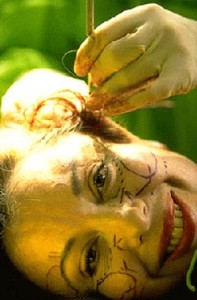
The French artist Orlan works in various mediums and has been prolific and provocative for years. Her most notorious work uses her body and surgery as an expression of art.

“I am the first,” Orlan claims, “to divert plastic surgery from its aim of improvement and rejuvenation.”

These are called “operation-performances.”

She took a digitized version of the “idealized feminine” face (her source material: Leonardo’s Mona Lisa, Botticelli’s Venus, Francois Pascal Simon Gerard’s Psyche, Gustav Moreau’s Europa) and then surgically altered her own face to create this image.

Nine plastic surgeries. She considers her works “sacrificial.” These performances were painful and potentially fatal.

Orlan’s website.

A new essay from Unzipping of Images…Orlan’s Operative: Provocation, Performance, Personhood

Random & Technology / 4 Comments
January 14th, 2010 / 9:50 am

The Increasingly Poor Decisions of Todd Margaret

New UK TV show pilot starring Will Arnett and David Cross [pt 1 of 3]

Web Hype / 10 Comments
January 14th, 2010 / 1:12 am

Just a friendly reminder to backup your stuff; the computer is okay now, but it was frozen and making the weirdest clicking sounds just a few minutes ago.

Today at Vice, The Tyrant, Ken, and myself present a list of literary no-nos, THE NY TYRANT GUIDE TO NOT BEING A HORRIBLE WRITER IN THE YEAR 2010.

Q & A 3

If you have questions about writing or publishing or whatever, leave them in the comments or e-mail them to roxane at roxanegay dot com and we will find you some answers.

Q1: How do you get a poetry manuscript published?

Sam Pink

write a poetry manuscript that you like and show it to people.

Sean Lovelace

That’s a tough one. I would say contests and then send it out to presses who you admire, or who have a sensibility somewhat like your own work. Also, publish the individual poems, build a presence, voice, and you might just get a publisher contacting you, saying, “Do you have a collection?” Like all writng, if it is a strong collection and you believe in it, it will eventually find its place.

Alexis Orgera

So far editors have asked for the chapbooks I’ve published. I’m told you just have to send out relentlessly, particularly to places where the editors’ aesthetic is similar to your own. For instance, I wouldn’t send a manuscript with lots of shit-fuck-goddamns…well, that’s not true. I send everything everywhere.

READ MORE >

Behind the Scenes / 24 Comments
January 13th, 2010 / 2:58 pm

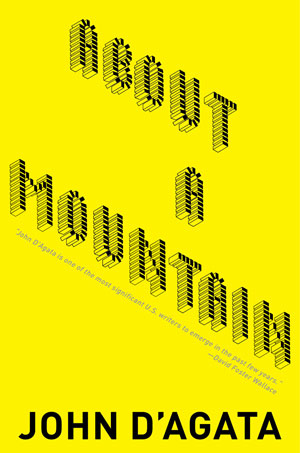
About John D’Agata’s About A Mountain

Inestimable are those writers who we look forward to like children in want of being told, the arrival of whose books come in great anxiousness and sublime waiting, in the way one might for a magical movie or arrival of a friend. I can remember obsessively visiting Barnes and Noble in the weeks and months before Wallace’s Everything and More came out, how I must have been back there a couple dozen times, in each checking the Wa- partitions of the fiction, science, and philosophy sections to see if it’d been stocked (I for some reason didn’t want to buy it online, I wanted it the very day it was in stores). All of this over a book of theoretical science! Math! Who else could render such desire in my mind? In his future absence, the dome of delightful patience in expectation over future books seemed greatly dimmed.

And yet, when I heard of the upcoming release of John D’Agata’s About a Mountain from W.W. Norton, I found myself again beginning to obsess over its event. Reading his Halls of Fame several years ago I become absorbed by it, some certain modes and designs therein feeling in my fingers a certain way, a manner of speaking that combines fact and vision, architecture and heart, packed in a style that looms and moves from page to page. As well, the two anthologies of innovative essays, The Next American Essay and the brand new The Lost Origins of the Essay (which I’ve also already torn through, all 700 pages, which is a whole other sets of posts herein forthcoming), each from Graywolf, have acted as buoys or maze-mirrors in the way of thinking about interpreting and approaching language as objects and objects as language in the world, tomes that anytime I’ve felt blank or stifled for new ways of writing I’ve opened them again and felt lit up.

Even in his anthologizing and therein collaging of others’ texts, D’Agata’s poise and manner has proved for me something magical to look after, and all of this at age 36: a blink of future by present day. Say what you want about the pursuit of ‘creative nonfiction’ (for which D’Agata, by hook or crook, is in some ways a young figurehead, with degrees in both nonfiction and poetry, his style a magic wedding of the two, and more), but in what can often be an over-stylized or navel-gazing (in a bad way) or simply a very difficult thing to make seem new, D’Agata not only wields that poetic essayist branch in a way that transcends any decoration, any term, but makes it something worthy of compulsion. Where for me great writing is great writing, some great writing is a true event, on par with any sort of aesthetic experience, and that is the most needed thing, what keeps the art of it in the body, and alive. It is what we need.

READ MORE >

Uncategorized / 31 Comments
January 13th, 2010 / 2:25 pm

The five stages of publishing

Hey, writers! Where are you in the publishing process?

Denial: I think maybe I’ll write a novel. I have a really great idea for one. My friends think I’m a pretty good writer. I once got a rejection from The New Yorker that referred to the “obvious merit” of my fiction. Sure. I’ll write a novel and then send it to an agent!

Anger: No one is publishing me because they don’t understand how amazing my work is. They just don’t get it. Philistines. Agents won’t even look at my manuscript. The whole system is corrupt. You have to be one of those New York elites to get a book published. You have to be from money. You have to know people. You have to get an MFA. Publishing is a racket.

Bargaining: What the heck. I’ll go ahead and get an MFA. It might be fun to hang out with a bunch of writers like myself—people just trying to figure out how to get their work out for the world to see. It’ll be fun. I’ll learn some stuff about my craft. Maybe I’ll get into a huge argument in a workshop!

Depression: Even though I have an MFA, Knopf has not yet given me the big, Jonathan Safran Foer-esque, two-book deal. This sucks. Why have I been wasting my time? Publishers are only interested in turning people’s mildly funny conceptual blogs into books. Why the hell didn’t I just take a photo of my cat wearing a monocle, and then ask other people to submit photos of their cats wearing monocles to me? I’d have a book contract right now.

Acceptance: You know, it’s actually surprisingly easy for me to just do this myself. Maybe I’ll just start my own small press.

Behind the Scenes & Craft Notes / 49 Comments
January 13th, 2010 / 2:00 pm

Do You Research?

I’m working on another ‘weather story’ and found this video of a wind turbine self-destructing. I believe, based on what little I’ve read, this can happen in storm conditions if the brakes in the turbine fail.

httpv://www.youtube.com/watch?v=c3FZtmlHwcA

I can’t remember if we’ve talked about ‘research’ here (so sorry if this is an old topic), but I just wanted to type out a few notes on research and my research habits.

READ MORE >

Craft Notes / 7 Comments
January 13th, 2010 / 1:15 pm

Schadenfreude Freakout Party!

Considering that I don’t have cable or broadcast television in my home, and that the entirety of my TV-watching consists of hulu’d Simpsons, South Park and Daily Show episodes (plus of course the biannual celebration of Let’s Netflix A Whole Series of Something, Probably West Wing Again), I’ve been surprised and delighted at my own sustained interest in the NBC-inspired Late Night Free For All. I have been watching the YouTube’d clips with enormous enthusiasm and rapt attention. Here, David Letterman–who seems to be the true winner in Leno V. O’Brien, and in any case is the horse I’d back over any and all of the rest of them–sort of takes us through the “controversy”‘s major movements. But don’t just take his word for it. Bother yourself to get over to this Gawker post that catalogues all the major snarking and bitchery from all of the Late Night shows, including the weird episode of Jimmy Kimmel Live! in which JK impersonates Leno for the entire duration of the episode.

httpv://www.youtube.com/watch?v=A98_-EeXS_I&

Mean & Random / 26 Comments
January 13th, 2010 / 12:55 pm