Eric Oberauf On The New Publishing Model: Not Boutique But Better

Eric Oberauf, captain of the publishing house Two Dollar Radio, has a great article in the new Brooklyn Rail arguing that we should be sober but optimistic about the printed book object and its success as a method of literary distribution. In “The Revenge of Print,” Oberauf explains the relevance of independent presses very well, summarizes the identity crisis that passes for a business model at most big and butterchurning book houses, and argues with a thoughtful and historically aware perspective that adapting a “realistic scale” isn’t downsizing expectations but getting back to mattering. What his argument reminds us is that people pay for books not because they’re addicted to mulch, but to read words and like words and carry words around so they can read them some more, which makes the whole thing more communication than commodity. Maybe you’re going to make more friends than money, it’s true. So if corporate book publishers want to continue tricking any cash into falling toward them, they might want to remember that books are closer to party invitations than to coat hangers.

Here’s a pull quote:

The goal for book publishers, most simply put, should not be to undertake a virtual arms race of developing technology with both the Internet and media, or to try to compete on a bloated scale with music and film, or even to translate a work to conform to an undetermined potential future model. The mission for book publishers and print media at large should be to create a product that is irreplaceable and indispensable.
Behind the Scenes & Presses / 2 Comments
July 18th, 2009 / 12:27 pm

Codex Followup: Dr. Harpold’s Syllabus

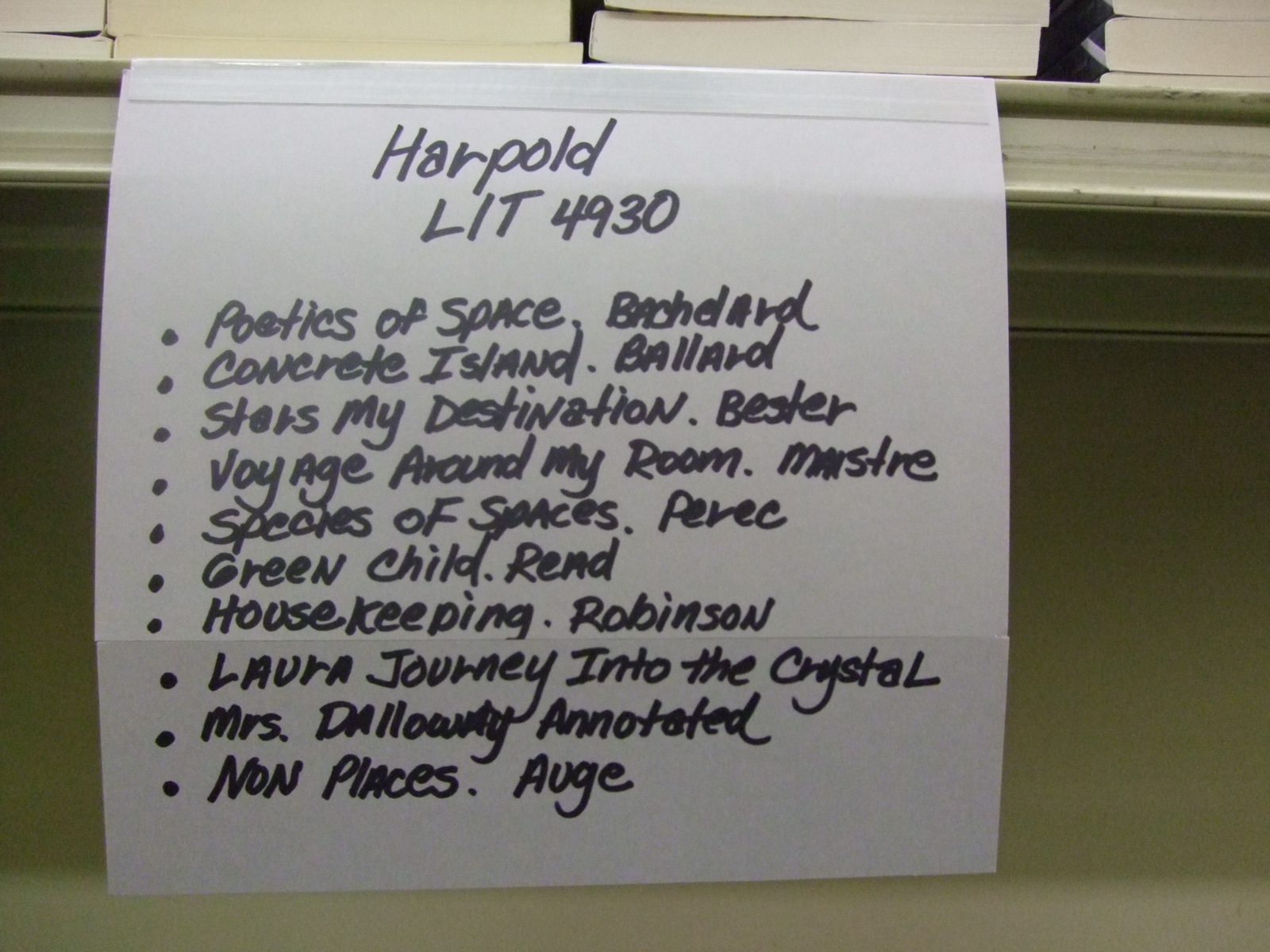
DSCF2571

It’s a love-fest! A couple of days ago I posted about an old essay of mine on an art book called the Codex Seraphinianus, and about all the responses I’ve gotten to that essay over the years. To my enormous pleasure, that post generated a whole new round of reader response, which came in via the comments section here, via email, and via Facebook. A few people who wrote in mentioned Dr. Terry Harpold, the professor at UF who first introduced me to the Codex in a course called Eccentric Spaces and Spacialities. Dr. Harpold, it seems, has the makings of a cult web-following, and that’s a fire I feel is well worth stoking. As it happens, I was down in Gainesville over July 4th weekend, visiting my little sister. I hadn’t been there since 2005, and I was only in town for a few days, so I didn’t even attempt to touch base with Dr. Harpold (or any of my other former profs) but when I visited Goerings Bookstore–which gets the book orders for the sweeping majority of UF’s English department course offerings–I saw the reading list for the most recent iteration of Harpold’s LIT 4930, and snapped the photo you see just above. It seems that the latest version of the course is called “The Literary Representation of Space,” and is being offered Summer B, 2009, ie right now. I’m straight-up jealous of anyone who gets to study Mrs. Dalloway with Dr. Harpold, a book that wasn’t on the syllabus when I took the course. Housekeeping, however, is a Space/s mainstay. It’s one of my all-time favorite pieces of literature. I don’t even know how many times I’ve read it, but I do know that I read it for the first time because Dr. Harpold assigned it to me. One more thing I’ll always be grateful for.

LIT 4930 Summer B – The Literary Representation of Space

Ex-foliations: Reading Machines and the Upgrade Path (Univeristy of Minnesota Press, 2008) by Terry Harpold

Author Spotlight & I Like __ A Lot / 2 Comments
July 18th, 2009 / 9:56 am

A Prehistory of the Posthuman

New book out from the ever estimable University of Minnesota Press called The Dada Cyborg: Visions of the New Human in Weimar Berlin by Matthew Biro.

“In an era when technology, biology, and culture are becoming ever more closely connected, The Dada Cyborg explains how the cyborg as we know it today actually developed between 1918 and 1933 when German artists gave visual form to their utopian hopes and fantasies in a fearful response to World War I.”

Uncategorized / 16 Comments
July 18th, 2009 / 8:58 am

The Eraser[head]

401877792_c19986cc15.jpg

Thom Yorke, Radiohead at The Garage, London (c. 1992)

63998221_03a49330b2.jpg

Teresa Banks, Twin Peaks: Fire Walk With Me (1992)

Uncategorized / 4 Comments
July 18th, 2009 / 3:43 am

This is Why Everyone Hates You, Asshole: Starbucks Edition

Let’s be honest. In the scheme of things, Starbucks is a fairly benign corporate citizen.  Sure, their union record sucks, and they run local businesses under, but on a variety of other issues–wages, environment, fair trade coffee–they’re somewhere between middling and decent, and they produce a variety of quality products that people actually want. So why does everyone hate them so much? Well in NYC, there’s almost no single Starbucks from which you cannot see another Starbucks. It’s sickening. They run local businesses out, and then all you’re left with is their Borg-like monoculture with its idiotic patois and 2k calorie frozen drinks. Now, however, Starbucks is trying to go back the other way, by testing out new Baudrillardian nightmare stores that will simulate all aspects of local indie coffee shops, from faux-hip furniture and art, to the branding on their in-store products. The Rumpus got the story from the Seattle Times, and I got it from them. The shift, essentially, is from Borg to Cylon.

The ubiquitous coffee-shop giant is dropping the household name from its 15th Avenue East store on Capitol Hill, a shop that was slated to close at one point last year but is being remodeled in Starbucks’ new rustic, eco-friendly style. It will open next week, the first of at least three remodeled Seattle-area stores that will bear the names of their neighborhoods rather than the 16,000-store chain to which they belong. … If the pilot goes well in Seattle, it could move to other markets. … Those who can capture a sense of community and offer consumers a compelling experience will win in the long run, said Michelle Barry, senior vice president of the market-research firm Hartman Group in Bellevue.

(Boldface is mine.) The article then goes on to detail how a bunch of Starbucks suits spent several months sitting in local coffee shops, not buying anything, but taking notes on decor and operations. How fucking evil is that? Seriously. Their policy is literally to target the market of people who are making a concerted effort to buy local, and then trick those people into sending their money out of said community, back to Starbucks. I don’t think you need to be a ski-masked anti-globalization activist to read this article and instantly think brick.

Dear Starbucks, When you do shit like this, all the other good(ish) stuff you do stops mattering. You’re like a child-rapist who donates a lot of money to the fight against cancer. It’s like, yeah, thanks for that, but still–this thing with the child-raping. Anyway, this is why everyone hates you. Asshole.

Mean / 63 Comments
July 18th, 2009 / 12:11 am

Derek White is entering the new-text-yard pleasingly: || | || CASTing A HEXaGRAM : NEXT ∃XIsT ∀mPIRE ARK N j∩NY || | ||. My man inventing his own languageses n whatnot, blogstyle. Loved. “…left the SKY cracked open like a confetti-egg bleeding pyres, running along the new “highline,” then south along the Hudson UNtil I could see elliIS ISland & the staTUE of LIBerty through the fog…”

Friday “Fuck Books, Let’s Dance”

httpv://www.youtube.com/watch?v=yXBckFyiMyU

+

httpv://www.youtube.com/watch?v=qAfrhmIvZ_s

=

httpv://www.youtube.com/watch?v=0hNrSya2NNs

Uncategorized / 3 Comments
July 17th, 2009 / 7:05 pm

I’ve been thinking for a while now about getting a tattoo of this line from this book. Are text tattoos stupid? Do they blur badly over time? Where would one get a 60 word quote tattooed on their body? I’ve been thinking around my wrist but seems rash, and maybe bad. Text tattoo thoughts? Suggestions? Heeding? Help me figure this out. I’m probably just running my yap.