
Stuck in the Middle: Second Person and You
Ask ten people what they think about second person, and a good seven or eight of them will say that McInerney did it once, sure, and did it well, but outside of Bright Lights, Big City, second-person’s just a gimmick, is best left trapped in all the choose-your-own-adventure series from the eighties.
I can kind of understand this, too.
With stories, we have default settings: first- and third-person, with third really being the deviance from the norm, the deviance from first-person. First-person is our natural delivery method, isn’t it? If you’re telling somebody about the amusement park last week, you do it like: I was standing in line for like ten hours, and then this clown laughed at me and it had to be eight thousand degrees and on and on, I’ing your way into some perfect punchline of a conclusion. But you, if your name’s Jimmy, say, never go Jimmy was standing in line for ten hours, and then this clown laughed at him and it had to be like eight thousand degrees.
Note too with those examples that part of our natural mode for fiction, it’s past tense. This is because fiction is narrative, and narrative is selection, and selection is from pre-existing events, and events only pre-exist if they, you know, happened before.
It’s complicated.
FRESH OFF THE NEUE GALERIE: “THE ATTACK ON MODERN ART IN NAZI GERMANY, 1937”
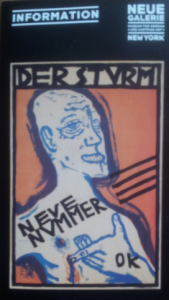
Last Saturday I went all the way uptown to Neue Galerie to see the first American exhibition on the topic of “Degenerate Art,” which will be available through June 30, 2014. One of my favorite subjects during my ultra-brief academic career (aka “undergrad”) was the exploration of the factors that made the transition from the Weimar Republic to the Third Reich possible. Above all other realms, that of culture was the one that appealed to me the most in my studying of how the German people were capable of gradually dehumanizing “non-Germans,” and to what extent this process was a political construct smoothly created by the Nazis. Reactively responding to German people’s despair and economic insecurity, Nazis built an ideology that made it possible for Germans to replace fear with hate for anything different. I am still fascinated by the institutional curating of art performed by the government, and what it translated to in political terms to have government authorities declare the validity of certain art, while condemning the existence of other art.
Maybe you should go see it if you feel like it and happen to be in New York, even if the security staff is unnecessarily rude. Especially if you are not familiar with what was presented as “Degenerate Art” and how it became a key tool in spreading Nazi propaganda.
My favorite thing about the Neue Galerie exhibit was the curatorial decision to dedicate the lower level part of the exhibition to a mourning ritual. Specifically, the curatorial team conveyed a sense of cultural loss by presenting empty frames in the place of artwork that was intentionally destroyed by Joseph Goebbels’ Commission for Disposal of Products of Degenerate Art, the government body responsible to preserve the German identity. An inventory which chronicles the status of what was labeled “Degenerate” can be also found downstairs, listing more than 16,000 artworks the Goebbel Commission would destroy, exchange or sell.
On Coke Poetry

The well-respected, finically solvent and totally fun-to-chill-with advertising agency Droga 5 created these outdoor ads for the Coca-Cola Company, which recently appeared on the streets of New York City. They have a poetic quality, seeming to evoke certain characters and a unique Manhattan headspace. Longer than most written ads, and with an obvious, weighted subtext, they speak in a slippery psedo-literary voice.
Tunnel: Fourteen Thoughts On Writing
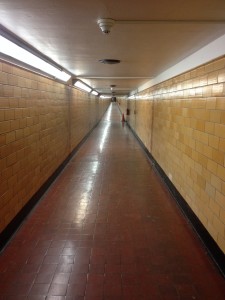
Tunnel
1) This is a tunnel I walk nearly every day. It connects via underground one office building (where I work) with another office building (where I bring things). I’m not sure how long the tunnel is, but I imagine about a football field or Walmart parking lot in length. There’s a narrowness and low ceiling height that’s suffocating. I’ve imagined the tunnel dug by a giant beaver consisting mostly of gnashing yellow teeth, the beaver’s body large enough to eat its way through the space I walk daily. Someone you probably know and want to slap would call the tunnel, “Lynchian.”
2) When I walk the tunnel I think about writing and submitting writing because there’s something about the tunnel that leads to a metaphor I don’t want to talk about directly.
A few other things about the tunnel:
ALL THE TEXTS I’D SEND YOU IF YOU WANTED TO GO TO A SERGIO DE LA PAVA TALK WITH ME ON DEAD RUSSIANS
…but then got ran over by a bus and died. No im totally kidding! but you really did get the flu and couldn’t join me.
The talk was at Housing Works, and it included two other speakers: David Gordon and Michael Kunichika.Your expectations were unclear: talk about Russian writers who, though they left us long ago, remain potent presences for readers and writers today. From Dostoevsky and Tolstoy to Vasily Grossman and Sigizmund Krzhizhanovsky, we’ll learn about obsession, madness, realism, fables, and more, in an event with all the drama and pathos (well, at least some of the drama and pathos) of the great Russian novels themselves.
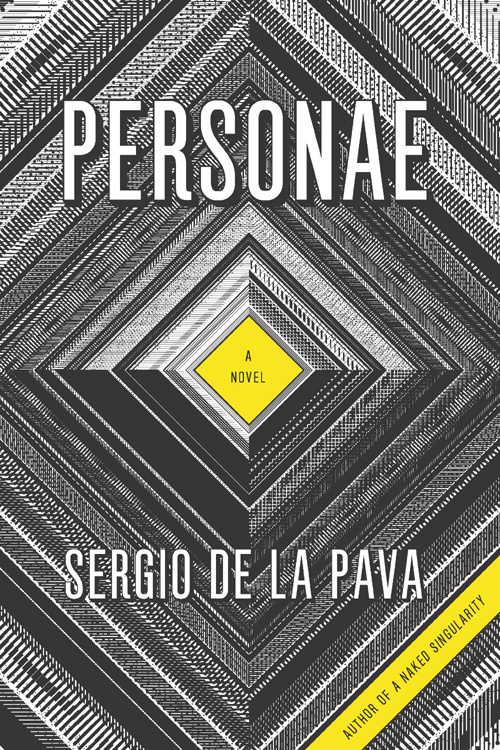
Here are all the texts I would have sent you, in chronological order and without clarifying who said what, because color-coordinating via SMS goes a step too far:
truth-seeking urgency intrinsic in russian lit
antithesis to beckett & writers who focused extensively on beauty of language
falling in love w/ english language, less plot driven urgency
dostoevsky similar to conrad in terms of truth-seeking urgency
multivocality of dostoevsky
there is no right, just different truths
dostoevsky threw the best literary parties (metaphorically speaking, as a creator)
proust s parties were too long, and maybe the guests were wearing better clothes
abstract psychological curiosity in motives, including abnormalities–>russian approach
going in depth for big questions, characters not being introverted
serialization of lengthy works, such as ‘war & peace,’ adds towards creating a broader debate. they become part of the broader debates occurring during their time
some compare the creation of microcosms of russian lit to ‘the wire’
comparing to british office, where they look at the camera at moments of despair but the viewer cannot do anything to help // to embarrasing dostoevsky characters
nabokov disliked dostoevsky for his “bad writing”
dostoevsky had a v diff approach to writing from nabokov: almost got executed literally, then was told he had another five years
that is also why dostoevsky did not pursue inanimate writing, unlike tolstoy (?)
nabokov didn t like music!
neither did dostoevsky !! (probably diff reasons)
saul bellow s ‘dean of december’–>similar urgency in truth-seeking (someone from the audience)
can reading a book be so vivid it appears like a different life?
if yes, it depends on willingness of writers to go to great lengths in creating characters who go too far, embarrass themselves/ are visceral
perhaps a key element that helps bring about the urgent truth-seeking: religion s role for the writers
religion, like their fiction, was trying to explain what goes on beyond the physical
nabokov s direct ancestor was dostoevsky s jailor. weird how he was not willing to cut him any slack, considering
dostoevsky was crowd-pleasing oriented bc he lived off writing
MONEY!!!
Behind the Scenes & Craft Notes & Events & Haut or not & Random / 2 Comments
February 11th, 2014 / 5:20 pm
February 11th, 2014 / 5:20 pm
oops!…i did it again: i cant remember to forget you (FKA MEANINGFUL)
I. Two Days After Whateverdaythegrammystookplacethisyear
I was taking about sex with a new person when I said I was annoyed choking is not on the table as an option. Then I said my ex’s name and remembered how she loved it.
“Oh, I know,” came his Freudian drip. I then punched him pretty hard on his arm, but without being violent. I was kind of upset, but I also knew he didn’t mean to hurt me, his tongue just worked faster than his brain in that moment.
The weird thing is, Billy was probably the victim in all of this. During a time we were trying to be over I surrounded myself with friends who weren’t shared, friends who didn’t let me respond to her manic pleas for reciprocity. So I saw the blocks of texts arrive, and I ignored them, but not because I wanted to ignore them. I was still forcing myself to not respond. That’s when it happened. I know because we eventually got back together and she never told me. But one day I went through her phone and saw her bragging texts about Billy and how he fucks like a rabbit and how the best part of it was that Billy was my good friend. She was bragging about it, but how unfortunate was that? She, who I successfully ignored, intentionally turned to someone else to hurt me for ignoring her. “Positional play is the maneuvering of opponents into the forced clarification of their (but not your) tactical lines of action,” and that was what she was doing. But we all got played in the end, thankfully including her.
Sometimes we do things for unclear reasons. Maybe because they feel good. Is that a reason? I think so, especially when I do the things. Is it worse when the sex is perfect with an idiot or when the sex is boring with a genius? I dunno, but I hope to have less of it and try to make it meaningful.
There is this mix I was listening to recently and it is very good, but I have a problem with it: it closes with a juxtaposition of Justin Timberlake’s “Cry Me A River” and Britney Spears’ “Everytime.” Hopefully, I need not clarify why that poses a problem, but if I must let me say I have a problem with myself for feeling sorry for Britney, when she was the one doing things for unclear reasons because they felt good. “This song is my sorry,” is a fucked up lyric to be used in a pop song when it is truly personal, and in Spears’ case at that time it was. [1]
You might remember my friend “Billy?” You probably don’t, so here. We grabbed lunch together last week, it was pretty fun. We got Ramen and talked about stuff on a broad scale: the things we are doing for money, the people we have been getting naked with and, naturally, cultural ephemera. An ephemeron we addressed for example was the Grammys ceremony and how we felt about some of the performances and awards. Of course neither of us was able to watch past the first half, or perhaps nothing of note happened in that half. We shall never know!
What we do know: Billy is dating someone seriously, and she is taking him a lot more seriously than he is her. She is “intense” and “confrontational.” She senses what they both know. Basically what he is saying is that he is not up for it. He likes her, but she feels for him in ways he doesn’t. I tell Billy to tell her that he knows her intuition is right. To stop playing along and pretending he doesn’t see what she is right to notice their “thing” is missing.
Must we pass over in silence what we cannot speak about?
II. Whateverdaythegrammystookplacethisyear
THE *REAL* GRAMMYS, HAPPENING EONS BEFORE THE SUPERBOWL
I watched them with my friend who will not be told when she must cease thinking about Beyonce’s net shorts. (“i hate how everything moves so quickly. it’s like just because a few days have passed doesn’t mean i’m not still thinking about the grammys. sure, not MOST of the grammys. but i’ll be thinking about her netted costume for a WHILE. why does the internet want everyone’s brains on fast forward?”)
I could not believe how fortunate it was that I happened to be near a television! I was casually complaining about life to a dear friend on a Whateverdaythegrammystookplacethisyear when all of a sudden… Beyonce! I never fully get how award shows work, their purpose and how the selection process works for who gets nominated for what. But if they start with Beyonce, I am totally mesmerized and willing to watch with full attention and the occasional loud “OH MY BEYONCEEE!” There were multiple of those, and people on the receiving end of Beyonce’s electric chair were electrified, as expected, jumping up and down their couches everywhere, unless they lived on the West Coast, and thus were penalized for their decision .
The *Real* Grammys seem to be organized by a panel of Ladies… who Love Cool J. Why is he the presenter? Why do they keep Doin’ It (feat Leshaun)? The sartorial negligence of the Cool James was apparent as he momentarily shared a stage with an immaculately dressed First Husband of America. Let’s just say there were no ZZZs in Jay-Z’s perfect outfit, and even less ZZZs were there to be found in the way the Presidential couple looked like while performing together during the *Real* Grammys, intoxicating everyone with their intoxication.
The deep blue sea of sartorial hmmms deepened further when our favorite Neptune decided to hide his crown under a hat, and all of humanity wondered: “Pharrell. Why!” He was still perfect, and at least wasn’t being ridiculous like those dudes who must have been sweating balls in their anonymity protecting helmets.
But looks and looking supa dupa fly are not all that matters in music these days. The young musicians have set up the bar mad high, where only Lordes can fly, and your prepackaged Dark Unicorn won’t fly you there despite its hypnotic beat (gah, this hasn’t happened to my brain (?) since when Gwen Stefani was cheerleading) that encourages obsessive repeat-play.
If the producers of your album aren’t Illuminati, you might have to join a circus. In the words of pop-princess (does she keep being princess until Madonna dies?) Britney Spears: “There’s only two types of people in the world: the ones that entertain, and the ones that observe.” Pink misunderstood the distinction and thought being observed was synonymous to entertaining, but acrobatics are all the ZZZs Jay-Z was missing that night. Except for her thigh strength, which so wow, very anti-ZZZ!
[*serious-y chunk*]
Anyway, time to get serious-y. Let’s address the thing that agitated most of us about the *Real* Grammys: Kendrick Lamar—who was, is and will always be objectively the best in everything for which he was nominated—didn’t win anything. Then the band (is Macklemore a band? or just that dude with the two-year old Freeman’s Alley barbershop hair a solo thing?) made the crass, gross error of trying to recognized their (his?) inferiority by sharing the thought with all their fans. This literally felt like a violent slap to everyone: (1) the people who might have thought Mackleduders deserved to win stuff, (2) the people who wanted Kendrick to win stuff and were frustrated he didn’t, and (3) let’s not even think about all the other very sensitive and insecure artists who were both nominated and lost and not even publicly recognized by the true winner of stuff they lost as the ones worthy of winning.
To think this band (or dude? I really have to find out at this point!) would even consider considering publicly sharing a private message he sent which should have been private, because eww band or dude, get a publicist! The negative criticism they (or “he,” whichever is correct!) have received is totally deserved. Bad apologies are in poorer taste than not apologizing at all, and this one was a very selfish and self-aggrandizing one. The reason this “apology” really sucked was the way it was portrayed and whored out via social media. There is a Kendrick song called “Real.” It is greatly introspective and reflective, further showing where in the “real nigga” doctrine Kendrick falls: he is not obsessed with appearances in a way consuming his music’s production.
The song stresses the importance of showing up, of being “real” in a way that is vulnerable:
The reason why I know you very well/ cause we have the same eyes can’t you tell?/ the days I tried to cover up and conceal/ my pride, it only made it harder for me to deal
[*end of serious-y chunk*]
Speaking of #Unapologetic, sources close to the Barbadian queen of pop Rihanna have revealed to TMZ the star watched the show at the comfort of a new planet she recently purchased. While she is considering Stay-ing there a while, TMZ has learned that Rihanna used telepathy to support her bestie (hmm. Cara?) close friend Katy Perry during her Grammys performance. “Where have you been?” thought Katy in the secret illuminati witchlanguage she shared with Rih, and then she felt the transcendental high-five from afar.
Then everyone bought things and companies were so, so happy! Well, almost everyone bought things. Mostly women who wanted to wear all the beauty products that made their stars look like stars. Men would have to wait for a sports event, like last year’s Beyonce performance at the sports thing which made Janet Jackson a star.
In conclusion, the *Real* Grammys didn’t really change anything, but that’s okay. Because the Grammys rarely do that. It is mostly public opinion that shapes who the big figures are in culture, and all the individuals who are nominated for these awards have acquired a level of respect as artists significant enough to see Taylor Swift going hard to Kendrick live, which is fine and great and super, but remains besides the point. When our cultural curators shift our attention to something silly, even if this silly something is endearing and well-intentioned, they (the curators) have taken our attention away from something else.
Who chose the direction to focus on Swift—and more extensively—before showing us an enthusiastic Hova? Probably the same exact person who gave Macklemore the award. It wasn’t me. But if it were me directing, I would have focused on the performance exclusively, out of respect to the person on stage. If a majority of the population only likes stuff because other people like it, then please save the stuff I like from getting Grammys!
III Nine Days After Whateverdaythegrammystookplacethisyear
He felt sad, he said. It was the morning after he stopped hating himself for being kinda in the gray area for so long in private. The night before he had send me a text: “It’s over. A little back and forth but we both agreed it was checkmate. Broke up in Central Park, lol. It went so well/ was our first real convo. Probably the best convo we ve ever had. I feel surprisingly sad.”
I was really proud of him. And of me, for challenging him to be upfront about his lack of genuine want in his relationship. But I also felt meaningless. I wasn’t even able to arise in my person the decency Billy was finally able to come up with for his new ex.
Whereof one cannot speak, thereof one must be silent, I guess.

NOTES
[1] I know this with certainty, because this was the first song Spears wrote. She wrote it with a woman named Artani, who then went on a Greek reality-talent show, called “Fame Story,” which everyone in Greece watched at the time because we were trying to not focus on our faltering institutions as a nation.
Artani was dealing with a breakup while Britney was trying to face the new Justin Timberlake as an ex, who had released “Cry Me A River.” The song was personal, and “Everytime” was a vulnerable response to it, but how vulnerable was it really, when it was a pop song and it was created for everyone? Doesn’t that take away from it in serving a purpose as being a meaningful apology? I think it did/ does/ forever will.
Advice on How to Deliver a Kick Ass Poetry Reading

Rauan — boils it down
*****
[ …people keep coming up to me and saying things like “Rauan, I’m a brilliant writer but I don’t do well in front of an audience. Help me, Please…”
….and so, because, well, I just can’t not help people (it’s my calling, god damnit) I’ve spent weeks in my lab cooking up some wisdom for all you brilliant fucking writers… so, here, enjoy ]
*****
1) Less is more
2) Just be yourself. Especially if you’re an asshole, then totally be yourself because audiences love assholes. But if you’re boring then do not be yourself. Absolutely, do not be yourself. (remember, it’s a show, man. yeah, it’s a show). (sigh).
3) Be in love with the sound of your voice. Fuck #1 (“More is more.” … “and more…and more…and more…”).. Really, just read and read and just keep on reading. If you see people yawning, don’t worry, people are like dogs, they yawn when they’re learning something new and incredible. Just read. And read. And read.

learning from yr brilliant poetry
4) Grab your dick or cunt a lot, point at it a lot, dance around the stage, hopping up and down, howling and moaning like a monkey– but remember, the whole time, to keep your dick or cunt dead center in the audience’s eye. This works great in Brooklyn. And by extension then (of course) everywhere else.
5) After every 3rd or 4th poem pause for a few moments (I mean drag it out…milk the moment) and then confide, to the dying audience, off-hand and smug as you can, that “yes, indeed, that was a nod to Charles Simic.” (Also, bring a bottle with you and in the middle of yr reading sit down and command the audience (yes, they love taking orders) to sit in a circle around you…
…And then everyone should just make out because, making out is the only reason anyone shows up at little shindig Poetry Readings anyways. Blah, blah…) …stare into poetry’s soul… blah, blah
nod to this guy over and over and over and over …. (blah, blah, ….) …..
6) Sail mumbling autistic through the reading portion of the evening (no biggie, really) and on, gloriously, into the Q & A where you can then triumphantly and whiningly bitch about any negative reviews you’ve received. Don’t answer their questions of course. Just bitch.
7) Drink lots of water beforehand and then sail out over the audience like a God and piss on them. (for added effect eat lots of asparagus). (…huh? … I used the word “sail” twice here?? Well, sue me god damn it).
***
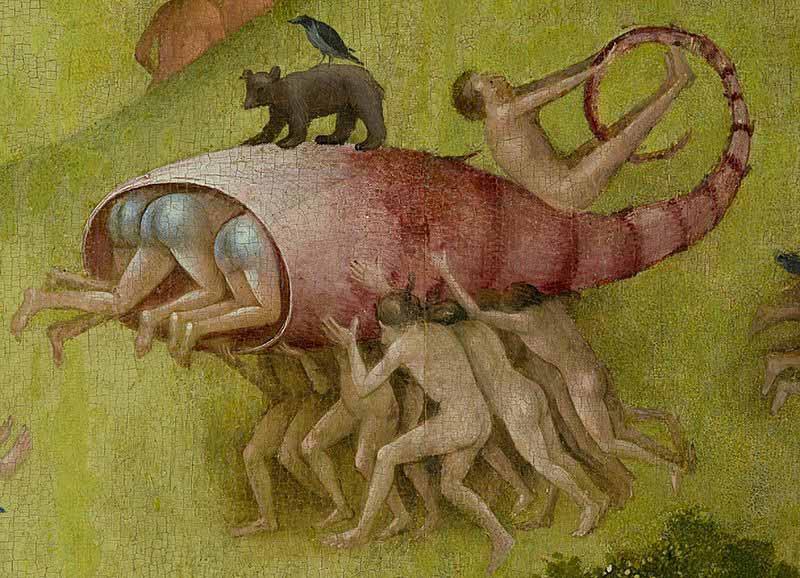
an ideal poetry reading
and, as always, glad I could help
FUCK YER BRAND, IMMA DO ME (/help me figure out my brand?)
[u shd probably read the NOTE(S) as they come up for cohesion, but do as u wish, obvi]
so there s a lot of things that have been going on here, on our dearly beloved htmlg. there seems to be an even bigger emphasis than ever before on attn. and i won t lie, it is nice to feel that w/e it is i might have written here might have been read or provoked a thought to someone—ANYONE—outside of me. but the reason i am writing this, right now is to set up a personal statement of sorts for how i want to use this site, as someone who regularly (?) tries to put stuff up…
MISSION STATEMENT(S)
I will refuse to care about being “cool.” I reject the notion of a grotesquely narcissistic coolness in an alt lit universe, where we are all nerds, when viewed through the larger lens of people who are not only unaware of this lit stuff, but also actively ignore its existence.
Perhaps I am just the biggest loser in the universe, but I like to care. If I did not, maybe I would not want to write. The reason I started writing was to figure out things I was genuinely curious about, not always in a healthy fashion. It was not to one-up anyone, not to be smarter in a gimmicky sort of way that will fade and might feel cheap in a couple of years.
HTMLG was one of the places online I constantly returned to when I was in a cubicle day after day doing shit I hated, trying to find a way out. To me, it used to be a liberating space, a meaningful forum that introduced me to writing I care for, and still value. Now, it is confusing. I have the hardest time figuring out the intentions behind what is being written. Sometimes I wonder if pressing “publish” was the entire goal of some contributor; I do not think it should be. [1]
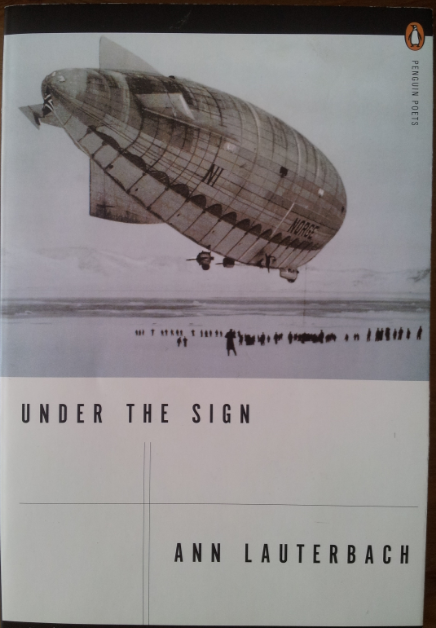
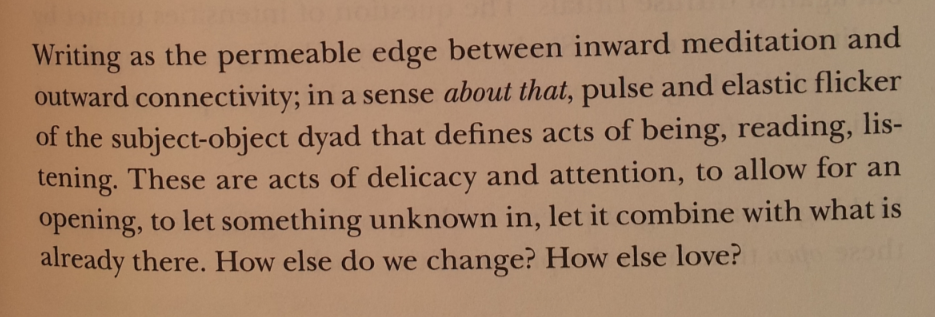
An amazing book of poetry was loaned to me, to remind me of my incentives and goals. Ann Lauterbach is brilliant, even though she cares. Or maybe because of it. I do not write poems, but her intentions—as presented in the middle section of “Under The Sign” are ones I would like to have as ideals.

So perhaps caring is not so bad. I will not actively try to not care about writing; writing by those who don’t care does not interest me.
But to care, one needs to put something at risk. One must “open,” perhaps even lose a part of their “security”—usually stemming from exercising a controlled performance of confidence—by showing insecurity. Being clevererererer just shouldn’t cut it if one wants to be true to oneself. [2]
I like the way Lauterbach understands writing. I wish we all agreed on that a little more, but I won’t force it upon you, because that would go against my principles.
NOTE(S)
[1] It is entirely possible that the reason I feel this way about putting words together in a creative way is because I did not study it. Maybe the excessive studying of something leads some of my fellow HTMLG contributors to an insipid cynicism that is often reduced to “being smarter.” Maybe it has to do with the frustrations of a young writer—or new, actually— as an immaterial existence in a material universe: the rewards of writing are rarely fiscal.

So yes, there is a relationship to be noted here that births frustration. But I do not think it should be our driving force. I will not let it be mine. In the Greek language there is no word that accurately translates to “writer.” The options for the translator are either “journalist” or “novelist.” Language depicts “realities,” to a degree. In the English language it might still be possible to be a writer at large. Someone who tackles fiction and/ or nonfiction. But rather than appreciate it, we are all beating this possibility; rejecting it, killing it.
The fixation on rapid success that is intrinsic in late-capitalism has infected our immaterial universe, stigmatizing creative intentions. And I am aware money is—and probably will be—an issue for a lot of us/ you/ whatever you want me to say. But to let it dictate creative intentions would be embracing defeat.
The rewards I value, thus far, are the kind and generous exchanges of ideas I have with individuals I admire and respect. I don’t know if they count as material or immaterial, but I do know that money cannot buy them. An email from Blake casually saying “hey man, i liked that thing you wrote” means more to me than a paycheck. Perhaps I am just the biggest loser in the universe.
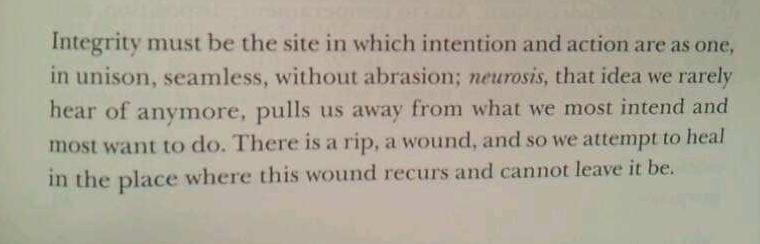
Or perhaps I just prefer losing with integrity over winning without it.
[2] Or if it does, I don’t understand why such a person would turn to writing. Is writing not a resort away from “the real world?” The material world is the one I am willing to fail in with less hesitation; the immaterial one I have “chosen” out of no other choice: because I care.
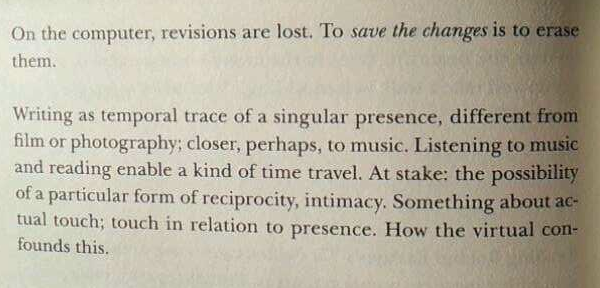
Am I living in the past? Is anyone even reading this. Is “reciprocity” the recognition of who the smartererererer one is?
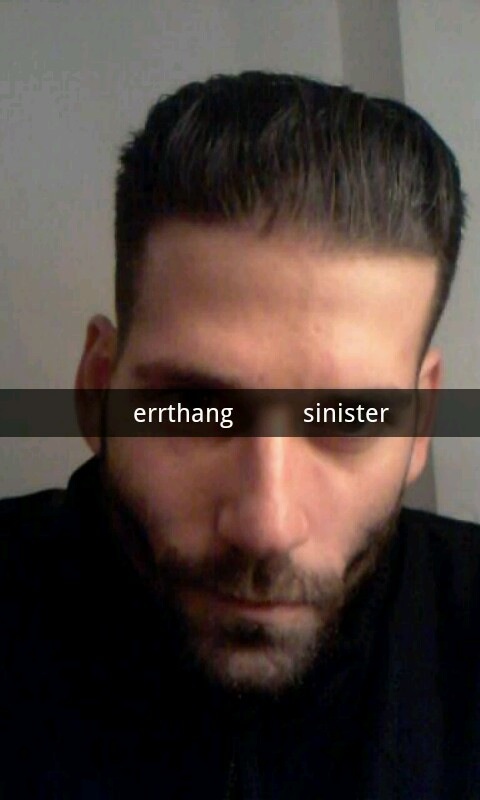
then fuck “you,” imma do it 4 me
Let’s overanalyze to death … Bonnie Tyler’s “Total Eclipse of the Heart”
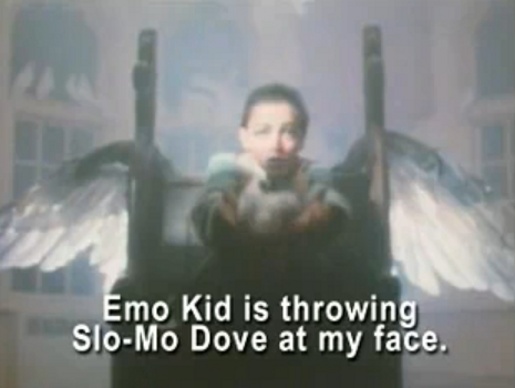
So far in this very irregular series, we’ve scrutinized Gotye’s “Somebody That I Used to Know” and Macaulay Culkin eating a slice of pizza—preparation for tackling one of the greatest and most beguiling music videos ever made.
“Total Eclipse of the Heart” was a single from Bonnie Tyler’s fifth album, Faster Than the Speed of Night (1983), and her biggest hit. It was written by Jim Steinman, Meat Loaf’s once and future collaborator. Steinman also planned out the video, which was then directed by Russell Mulcahy, a man responsible for numerous ’70s and ’80s music videos, as well as the films Highlander, Highlander II: The Quickening, and Blue Ice. So that’s the aesthetic world we’re dwelling in. (In a single word: overblown.)
The video itself is pretty broad, and rather easy to read—broadly. Simply put, Tyler plays an instructor (or an administrator) at an all-boys boarding school. (I will refer to her character as “Tyler” throughout, for convenience’ sake.) Extremely sexually repressed, Tyler endures a long night of the soul fantasizing about her young charges; this constitutes the bulk of the video. Come morning, she (and we) are returned to restrained, repressive reality. But we’re left with the hint that A.) at least one of her students has magically become aware of her fantasy, or B.) her fantasia has caused Tyler to become mentally unhinged. (I lean toward B and will defend that reading below.)
That’s the basic outline. The devil, however, sits in a straight-backed chair, clutching a dove. He’s also in the details, so let’s delve deeper …
NOT SO #DTF, OH NO!!

Do you ever think that universally all we have in common is our interest in food and sex?
Well in Japan they are over the sex, so check your hypothesis: http://i-d.vice.com/en_gb/read/think-pieces/863/i-sex-its-better-than-sex
What I actually mean though is: can you think about materiality today? But in a good way: like touch, not like technology. I will!