
“The 20th Century’s Greatest Hits: 100 English-Language Books of Fiction” by Larry McCaffery
Titles are below; you can read the list, complete with McCaffery’s brief thoughts on each, at LitLine (excerpting from American Book Review, Volume 20, Issue 6, September/October 1999).
1. Pale Fire, Vladimir Nabokov, 1962.
2. Ulysses, James Joyce, 1922.
3. Gravity’s Rainbow, Thomas Pynchon, 1973.
4. The Public Burning, Robert Coover, 1977.
5. The Sound and the Fury, William Faulkner, 1929.
6. Trilogy (Molloy [1953], Malone Dies [1956], The Unnamable [1957]), Samuel Beckett.
7. The Making of Americans, Gertrude Stein, 1925.
8. Nova Trilogy (The Soft Machine [1962], Nova Express [1964], The Ticket that Exploded, [1967]), William S. Burroughs.
9. Lolita, Vladimir Nabokov, 1955.
10. Finnegans Wake, James Joyce, 1941.
11. Take It or Leave It, Raymond Federman, 1975.
12. Beloved, Toni Morrison, 1986.
13. Going Native, Stephen Wright, 1994. READ MORE >
The First and Favorite Kill
Sometimes in my dreams I am blessed with the true-length arms of a man, and I am proud of my arms, and sun shines upon them. I’m also usually younger. My face is taut, my teeth well lined, my hair is black as ever it was, and there is fidget in my step, because I am youth with potential. There is no ache in my hips. No murders replay in imagination.
When I’m awake I catch a smell, and there’s a throat slit in mental vision. A gut split. My blade through a spine. The first kill was in self-defense. A young friend of Welder’s taunted me toward duel. He gaped at my arms. Hollered guttural things. Kicked dirt in my face. Drew his sword.
“You’re hideous,” he said “And now I’ll disappear you.”
I might have had my sword two years then. I had taken it into a thicket of mesquite in the park near the river, and I had practiced chipping at branches, slashing low limbs free from the trees, but I had never had anything come at me in turn. My father used to work with Welder on how a sword should be held, on how an enemy should be approached. They had names for the moves they made. One thing was called an appel. It wasn’t a move with a sword. They’d mash a foot on the ground to distract their opponents. In theory the opponents would hear the noise and their attention would draw away from the next move, and then they might lunge, holding their swords out and level with their shoulders, just shy of arm fully extended, and take a wide stride at their opponent, essentially stepping into a stab.
So much of how they fought was with their legs, but I didn’t care for their style. You have to stay loose on your feet, in my opinion. Less postured. Ready to move in all directions. There was so much rigidity in their methods. Or, maybe I’m lazy. I didn’t want to take the time to learn. I think, for a while, I just assumed that only the proud cared to get good at it. I was so angry at my arms and the world, my father, brother, and mother, that I sort of hoped to be bad. Perhaps someone would take offense at me and make me nothing—a sack of skin with bones and blood in it, less blood than needed, and no air in its lungs. But, somehow, I thrived. And when Welder’s friend drew his sword and stood stern postured with his blade at me and his face smart with rage, I heard his foot mash the floor, drew my short sword, stepped back, brushed his blade aside as he lunged, and drove my sword twice into his face. It split open in both spots, and blood covered his white skin in gushes, blood near black, and his eyes widened as he dropped to his knees, grabbed his face and began flailing. I hadn’t thought of them while it happened, but he had friends with him. I can’t remember how many, but they looked scared of me when they saw I’d bested their friend, and they didn’t know if they could go to him, to hold him as he bled out, but when I sheathed my sword, he fell face down, and one of them picked him up, turned him over, and laid him on his lap, telling him lies as he died. I think the boy was seventeen. He’s probably my favorite kill.
But in my dreams those moments often cease to be. There is music gently somewhere. Perhaps there is a party. It’s for me, and there is cake. Light, soft as lullabies, bleeds in from a window. Balloons hover. Candles are lit. People sing my name. I hold my arms above me. There is a ceiling, but my hands are far from it. There’s my mother, but her breath is just plain sweet, not Sweet- Jane sweet, and she holds me to her. Maybe she says, “You make your mother and father proud,” and maybe my father says, “You’re my favorite son,” and Welder says, “I wish I looked as much like Dad as you do,” and then perhaps Edie, the young Edie, the Edie of the first time ever I saw her, dances toward me shyly with her hands held behind her. “I brought you a present,” she tells me, “I picked it out special.” And she produces a small box, wrapped in paper with a bow, “I’ll open it later,” I tell her, “Right now we should dance.” And then the rest of them will disappear, the way dreamt things often do, and we’d be in a small space all our own, nobody in sight of us, and we’d hold each other and move with a music that would speak to our souls, and in unison, and with grace. We’d be together.
Brian Allen Carr lives near the Texas/Mexico border. This is an excerpt from his forthcoming novella, Edie & the Low-Hung Hands.
“to overlook / when I am at an overlook and at no other time”

Dear stunning axe, the sad Alexander, the scores
of life, the life that will probably be, the life
of the biggest thoughts, to have found the pizza
faultless, to have noted, in the mountains, the fitting
thing about being in the mountains, that you feel
upheld, the 99th part of 100, only lonely in the house,
on the street, through the turnstiles, in the stadium,
the held beer and the beer that is in the cup holder,
the I am thinking about the suits of the travelers,
prodigious coffee, enraptured pop, the guitars
that sound like bubbles and the ones that sound
like lasers, the I have met trees, two or three
times, that made me cry, sad about injustice, sad
about environment, by all means, gravely, with great
concern, without being flip, the I am trying to be
honorable, to be all right again, to overlook
when I am at an overlook and at no other time,
the I have accepted it, I of the friendlier memories,
I of the best love to your mother, I met her, she
liked me, the young man, the polite, the I am writing
that there may be a pencil rubbing, some borders
to the epoch, the foghorn I heard, the breakfast,
the here I am, hours early, as always, mid-winter,
pelagic, the tyrannosaurus of popularity, the burgeoning
truth arrived at upon further consideration, a diamond
cutting the blank, blank, blank, much as we might
choose to skip over it, the part of life that is bracketed
off, sorry how sudden, sorry and sorrier, quiet
to greet you, quiet as an airport when life is over.
“A Botanist considers the coconut one-seeded drupe (aka: dry drupe)”
 One thing I can recommend without even needing a kickback is coconut milk ice cream. It’s pretty easy to make on your own, it’s good if you don’t eat dairy for whyever, some companies that make it have hilarious videos of their hippie-ass founders on their websites, and one time on the phone with Comcast I actually bonded with the person from Comcast over it, over coconut milk ice cream. Another thing I can recommend is Coconut #15, the newest issue of an online poetry magazine, which is back after a hiatus. Way back in 2005, I used to get Coconut mixed up with Shampoo, so now you know whether you would ever want to take a shower with me.
I don’t get Coconut #15 mixed up with anything, which is because the old old old universe is shaped like a saddle. And also because my love for you is not a coin operated washer/drier or that type of orgasm (Spectateur, -trice, n) that watches you, as if from above. Instead I am a vibration as hard as a living creature, and I am always on the lookout for officers of light. Instead I keep finding “history” in mornings and quotation marks. The prisoners keep hitchhiking and waving soap box guns. You keep puking in your mother’s mouth, which doesn’t help Dorothea any, because she already expects all the witches. Galaxy-sheep can count every time they’ve cried in a hole in the wall piano bar. They know they don’t need to count anything to know that everyone’s a hero or fooled you. Imagine sleeping in a canoe or as a toy whale in a gutter. Now imagine everybody as a  feather on a child with a bird’s head. If that feels annoying, let your eyes wander to water. Try to understand those kids who hide in abandoned refrigerators and want shoulder blades to replace knives. If you are lucky you’ll be able to see the turnip fields from here, glowing and torpedoed from the rain. You’ll see yourself downing your fourth energy drink and hating how not tired you are. People who play video games don’t sleep. People who don’t sleep watch commercials. Don’t comfort it out in the middle there. We will absorb these rules like a saltbath. We check out the list of demands and it’s filled with things we like but never used to like. In what you once famously referred to as my earlier, bullshit life, the clock on the bed and the white horse sad as the island both failed to tell me what time it is because time is a mirror made wrong. How many times have you wandered beneath the dark only to emerge into darker? I don’t know about you, but I don’t want my cloud to understand anything. You tell yourself your bones are too fat to fly and a tree tells you otherwise. The tree tells you it was beautiful to hold boys who wanted to make girlfriends out of paper or stones, and the fiddlehead fern—with gunshots of light in the leaves?—it high-fives you in your face.
“I was thinking – to keep your left hand going – after I die – why not then – just pretend I’m still around…” — Excerpts from Dear Dawn: Wuornos in Her Own Words
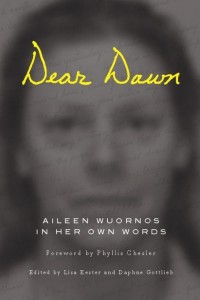 On Thursday, we talked about Dear Dawn: Wuornos in Her Own Words, a collection of letters that Aileen Wuornos wrote from prison to her childhood friend Dawn Botskins. As a follow up to that post, which includes a conversation between editors Lisa Kester and Daphne Gottlieb, we’d like to show you some of the letters in the book. Our selection spans from the early 90s to the early 00s. Enjoy.
7-5-92
Dear Dawn,
Dear Dawn,
“Can you remember time!” Do you remember the fight me an greasy haired Penny Dole and I had at the front steps of troy Union Grade School . . . Do you remember when Lori, + Ducky got in that car accident . . . Do you remember a guy with real long jet black hair. Named “Black sheep” at the high school.? Well one day. Him and I went under neath a stair well near the new section they built that had swinging doors that head outside. Once you hit the bottom of the steps. Well he had a 4 finger lid of “Acapolco Gold” . . . we went under there to roll a big one and smoke it there. We heard footsteps coming down. But we figured that was just another kid on his way out to somewheres. So we finished rolling it. And started to lite it. And Low and Behold. It was the Principle. He looked at us both and said “Report to my office now” . . . . . Black sheep. Gave me the lid. And he started up the stairs. I said to the Principle. Bullshit! I aint reportin now where. Matter of fact. I quit school. Right now. He said. Then you get off of these school grounds right now wuornos. And if I ever see you on them again Ill call the police. You understand. ha ha ha! I walked out the double doors with the pot. And that was the day I quit school. What was really strange was that the principle knew I wasn’t living at home. But in the woods. I guess he admired me, for having the guts to still go to school, as a runaway, and living in the woods near your house. A trip huh!
Well last page. Gotta close er up. Take Care Dawn . . . I’m still surviven. A little crazy but still comin through. 4-now Love Lee
4 Comments
November 18th, 2012 / 2:46 pm
November 18th, 2012 / 2:46 pm
www.shopgoodwill.com

Gleaming with the inconsequential, my constant interest in the literature of the obscure grows. Meanwhile, we all shrink and decay into our modern selves, over-popularing each other’s realities with endless nonsense records of our existence. People seem to disappear into websites. The litany of modern life. The digital record: always forgotten but never gone. The Internet is a hyper-intensification of my impulse to explore the absurdly irrelevant, the abjectly marginal. Everything on the internet just sticks around like a bar friend, drunk at a house party. A funny costume from the 90s and there hyperlinks you won’t touch. Sweaty skin under the light in the living room in a bad photo from the time before good digital cameras. 2.1 megapixels. The web content is profoundly un-useful. It fades into this extreme distance from relevance, but yet never totally decays. This is the asymptote of doom literature, the heating-up of total irralvence, in a context of viral-seeking buzzworthiness. The 0 views, 0 comments culture that I seek, very nearly condences on one particular commerce site.
My Secret Life – An Erotic Diary of Victorian London (1902) – Selected Subheadings
 My aunt’s backside. – Haymaking frolics. – Romance and sentiment. – My father dies. – A wet dream. – My letch for a little one. – Funking consequences. – Nelly consents. – Fred looks on. – A saucy valet. – Low-class fucksters. READ MORE >
Comments Off on My Secret Life – An Erotic Diary of Victorian London (1902) – Selected Subheadings
November 12th, 2012 / 5:20 am
November 12th, 2012 / 5:20 am
I still work, motherfucker–New Sam Pink!
Electric Literature’s Recommended Reading this week is an excerpt from Sam Pink‘s forthcoming novel, Rontel, which is coming Valentine’s Day 2013 in print form from Lazy Fascist Press (kudos to Cameron Pierce!), as well as in a digital edition via Electric Literature. EL has also posted an animation of one of the sentences:
I found the excerpt hilarious and enjoyable and good. Sam is one of my favorite authors. I assume a lot of people who come to this site already love Sam Pink or suck, but if you don’t know him, he is a very clever author, darkly comic with some other thing going on.
Some excerpts from the excerpt:
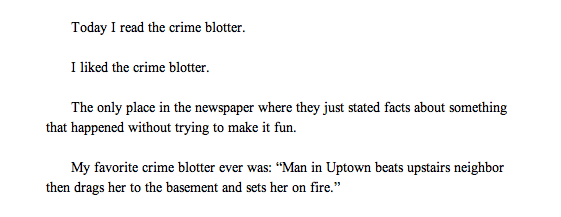
And also:
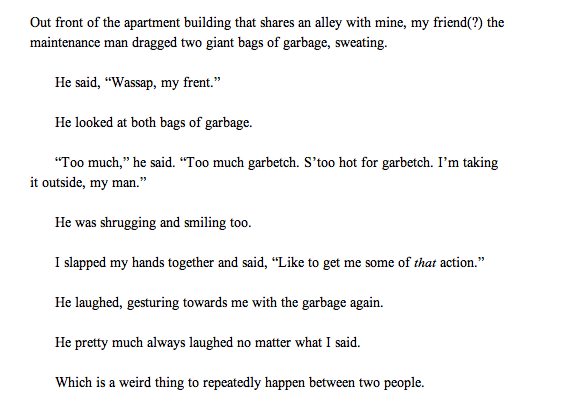
Viva Sam Pink!
select comments on “Zen Garden” and other youtube meditation videos
As the title of the post suggests, here are some comments I found on Zen Garden, Simple Meditation and other youtube videos I enjoy:
i’m a wolf, my criminal background says it all, fuck sheep. i eat them.
When I went to the warm hole there was no left up down right.
no need for ‘great longing’ when we are already the ocean we just need to remember.
what the fuck are you talking about srsly
thinking of turning my back porch into an “asian bath house” now…paper lanters bamboo curtains…candles lit…whos with me? lol :)
So he’s saying eat my body and live forever.
that buddha looks like my wife…
The Pleiadian star system is in fact our core essence, our ancestral home.
Is it wierd if I wack off to this ?
God is _________fill in the blank!!!!!
2012 marks the beginning of a global Golden Age of Peace and Oneness. Please check my channel for more.
so like crouching tiger hidden dragon sword fight to the death or some memoirs of a geisha type shit…
my true self is stillllll innocent…i think i am not and telll others I am anything but innocent but i realise now that i am in fact a child…
Satan is very happy with you
The company writes a novel per year

The ancient art of the annual report. A book written to ensure investors that their money is safe, that work is being done, profits cleared, America marches forward to the beating of motion of the Invisible Hand of capital. Whether you’re a non-profit, a .EDU, a religious organization, or a major bank, everything is smooth and calm between these pages baby. It’a all less relevant now of course – investors need daily information, not yearly. But there is still something very nice about the idea of an annual report. The plot is always the same, the characters are mild, their decreasing quality of life is the small repetitive tragedy. These are the stories that organizations want to believe about themselves. I believe them.
Craft Notes & Excerpts / Comments Off on The company writes a novel per year
June 28th, 2012 / 11:43 am
June 28th, 2012 / 11:43 am