
Editor Interview: Scott Bugher, Split Lip Magazine
1. In a world of many, many literary magazines, what made you want to create another one?
I was a reader for Bull: Men’s Fiction for a short while and it was during that short while I discovered I enjoyed the hunt for fresh stories that hadn’t been told yet. It got to the point I began saying to myself, “If I were Bull, I’d publish this one,” so I figured why not gather some friends in the literary world and launch our own project. You’re right, the world has plenty of literary magazine, but Split Lip likes to think we bring something new to the table.
2. Follow up: How do you see Split Lip defining its own literary space?
Our hope is to help incorporate the literary and fine arts into pop culture, a culture that seems to give its attention exclusively to music and film anymore. So, we pay attention to both the mainstream (music and film) and the underground (literature and fine art). Split Lip isn’t only a good place to find great writing, but also serves as a venue for independent music, fine art, and film. We want to take what Paste Magazine did for independent songwriters and apply that to independent storytellers and poets by presenting the full scope of pop culture.
3. What causes you despair?
Fox’s cancellation of Arrested Development.

4. Do you require a cover letter with submissions? Why or why not?
We’re pretty laid back about stuff like that, but do ask for one. Why? I suppose there are two reasons. First, it simply shows if the guidelines were read. Second, it keeps things professional. We get subs as stripped down as the attachment of the work alone. No “hello’ or anything.” That’s just inconsiderate.
5. Have you had any conflicts with writers? Any spicy stories?
Ben & Amy Read Chapbooks (Miscellaneous Stuff Edition)
Amy Lawless and I like to read chapbooks and review them on the internet. We used to write these together, while drinking wine and watching TV. We live in different cities now, so we do them over gchat. Here are our recent reviews:
Review 1: The Wikipedia Page for Tears

“boy with mullet, crying”
Amy: HEY
Sent at 1:23 PM on Sunday
me: yo
Amy: we did it
me: ya good job
Amy: ha
OK
me: lets get into it. what’s the first item
Amy: The Wikipedia Page for Tears:
ttp://en.wikipedia.org/wiki/Tears
Let’s both look at the page and go for it.
Public Collection
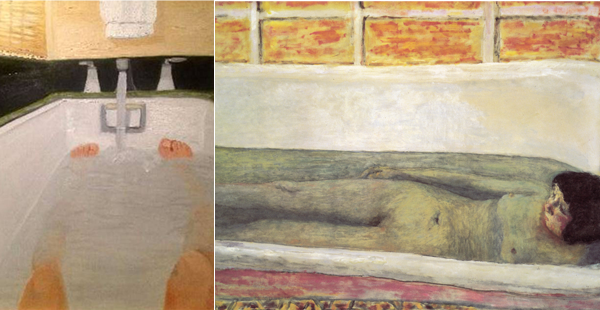
Of a kind of modesty far disproportionate to the attention it’s getting — for it would take a hacker to get into our former president’s sister’s email — amateur yet keenly perceptive paintings by George W. Bush have surfaced. They are remarkable: not so much their rendering or skill, but in their quiet internal repose, evocative of the peculiarities of the Nabis post-impressionist school. An immediate, and easy association — if one considers their respective and mindless havoc onto their perceived enemies — is Adolf Hitler, who also produced unexpected touching watercolors of churches. The imperial hubris with which Bush demonized Afghanistan at large, and later Iraq, is a sad example of turning the enemy into an abstraction. The same can be said for liberal media in their inclines against Bush; and so now, it seems, we are perplexed, and very taken aback at being allowed to see this man in a different light. It is simply hard to imagine such a heartless war monger painting such gentle paintings. Yet, the disparity lies not with Bush’s character, but the assumption that artists are somehow — by the very auspices of their art, as if introverted pastime were a moral act — essentially good people. Enter Pierre Bonnard, whose codependent relationship with his wife Marthe has kind of hilariously been documented by the many paintings of the her in the bathtub. She is said to have suffered from OCD and compulsively bathed half-a-dozen times a day, as if trying to wash away the dabs of paint for which she might have been mistaken by her husband. The pairing here is at best merely coincidental, until we look at their perspectives: George W. Bush gives us his own POV, as autoerotic muse, his phallac member just off the bottom of the canvas, perhaps the rod-like stream of water a surrogate hard on. This is the same view Marthe was having back around 1935, and toggling between the two collapses us into a kind of he-said-she-said scenario, of different versions of the same history.
Dating Siri
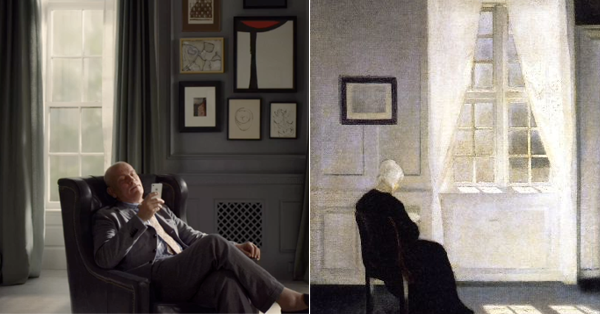
With the release of Siri, an “intelligent personal assistant” app introduced in iOS6, Apple took a unique marketing approach, that of entitled idleness. We see John Malkovich, a cloud of constant irony around him, seated at home skeptically saying “life” into his phone. Siri then offers this advice: try and be nice to people; avoiding eating fat; read a good book every now and then, get some walking in, etc. (c.f. “Fitter Happier,” OK Computer). It’s as if the ad were making fun of the app, bowing to the absurdity of first world problems gone amuck, which is a peculiar move for Apple, whose ads are usually literal and almost condescendingly simplistic (e.g. dancing silhouettes, sincere FaceTime). The camera takes long pans of his house, giving into a kind of bourgeois, somewhat sad reverie: the tempting light of a good day yawning through the panes, the modern art hung salon style on the walls, a suit jacket flayed open to let the smallest gut out. There is even a faint air of derision. Vilhelm Hammershøi, a Danish late 19th century minor painter, made banal paintings in the then climate of fierce modernism; they were sentimental and weak-handed, simply not a match for the explosiveness of his more devastated peers. There’s a clear homage to Vermeer, and one may see him as a precursor Edward Hopper, but overall it’s rather forgettable. He painted his house from a dozen angles, repainting the same scene a year or so apart, his averted subjects slightly older, and having wandered elsewhere. The movement of light across the floor was more of an event, sans notifications and likes. People were walking sundials, the radius of their slow shadows boring as fuck. They knitted, read, and died early.
CONFESSIONS OF A SLEEPREADER
The time I set aside for pleasure reading has become, in a word, unpleasant. Like you, I have obligations that irritate the ulcers. Bills to pay, a job to attend, a body to take care of, domestic insects to kill or exterminate. The other day I had to rest a glass of apple vinegar atop my bedroom dresser to trap gnats (they love the stuff—who knew?). My girlfriend was “seriously convinced”it was a glass of pee.
Among the detritus of everyday life, like contributing to the genocide of bugs, it’s often nice to turn to the literary big hitters for a respite from the banal. We let Nicholson Baker make us feel dirty; allow Mark Twain to make us laugh; invite Poe to exercise our imaginations and neuroses. If only we didn’t stab them in the back.
While I do happen to harbor my fair share of neuroses, my particular irrational fixations fortunately do not pervade my End of the Day Time to Go To Bed times. I like sleeping and I like walking, but I’ve never sleepwalked. I’m no psychiatrist, but it seems to me a condition afflicting those whose adventures in waking life have taken a turn for the disenchanted. Having the fortune of sound sleep, it’s hard to relate to the woes of the sleepwalker, or, as a matter of fact, any rigors of debilitating nocturnal activity (sleep eating, sleep apnea, sleep talking, sleep onanism, the grinding of the jaw, or that kind of bodily sprawl that ends with a dull, but loud THUD as a loved one graces the floor). But I can speculate that the body does these things to reconcile anxieties. Among which lies boredom.
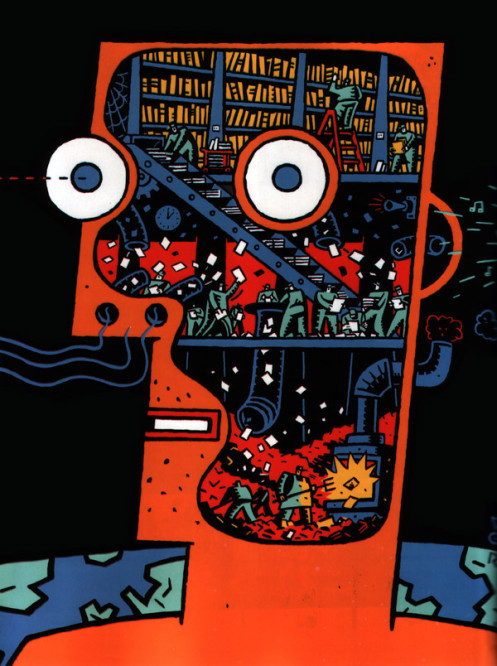
“Warum machen Menschen Fehler?” – Hendrik Dorgathen, 1991.
From my past as a musician with a practice-until-your-fingers-bleed type dedication, I know that an in and out, day after day routine can bludgeon one’s piece of mind. In the 1960’s Guy Debord, a French Situationalist, imagined a serum for this kind of anxiety. Debord conceptualized Dérive, an experimental behavior that encourages one to make new what has become plebian, everyday, boring. Normally, this is done by making urban landscapes exciting again by drifting (literally, walking) through the city, taking directional cues not through street signs, but through the contours of the town’s architecture. Just kind of feeling your way out through new, unexplored terrain to invigorate the drifter from routine. There is no destination; only, perhaps, in the mind: to find something out about yourself and your city. Debord encourages getting hammered beforehand.
Lines from Shakespeare Mistaken for 1990s Hip Hop Lyrics
“I’ll teach you how to flow.” (The Tempest)
“He speaks plain cannon fire, and smoke and bounce.” (King John)
“I have within my mind / A thousand raw tricks of these bragging Jacks, / Which I will practise.” (The Merchant of Venice)
“That’s an ill phrase.” (Hamlet)
“Holla, holla!” (King Lear)
READ MORE >
On Impermanence and Guarantees
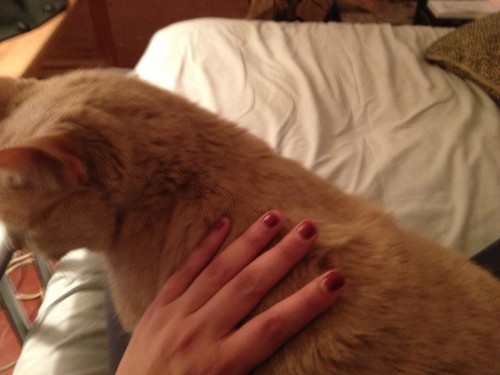
1. This nail polish is supposed to last fourteen days without chipping or fading. I am on the tenth day.
2. The fire I built at 10pm last night is just starting to go out. I have added so many pieces of wood to it.
3. Life insurance plans expire arbitrarily. My father’s will be void if he lives past 76. My sister’s was void because she stopped paying.
4. The rechargeable batteries I bought in 2003 only hold charge for thirty minutes now.

DIED: The Verbessem Brothers

Marc and Eddy were deaf and learned that soon they would both go blind. They were 45 and twins. Because they were Belgian, the option of assisted suicide was available to them. Believing they would no longer be able to live self-sufficiently, and to communicate with each other and family (they had developed their own sign language), they chose death by lethal injection. Before they died, they had coffee. READ MORE >