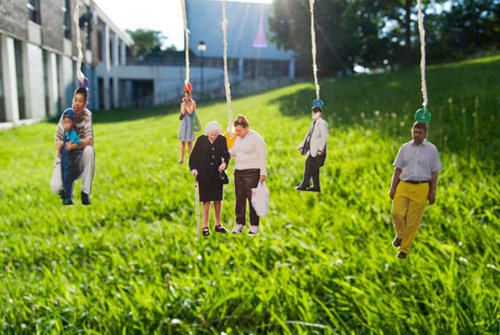
Glowing tutorial

Faster Times contributors banner

I’m always struck by how all the contributors at The Faster Times are glowing. Sometimes I feel people think we at HTMLGIANT also want our contributors to glow, but that we don’t have the photoshop skillz. I say NO! — we do have the photoshop skillz, we just never got around to doing a “mass glow” for our contributors.

Glowing is pictorial lubrication, and augments the experience of looking at a bio pic. For writers who want to glow, what follows is a photoshop tutorial on how to make that happen.

READ MORE >

Craft Notes / 26 Comments
February 9th, 2010 / 4:38 pm

Back Flash: Mikhail Zoshchenko

(cake by Lukka Sigurdardottir)

Words by Mikhail Zoshchenko.

He liked to yap out, “This is not theatre!”

He had a bird he named Dog.

His writing often deadpan. We know why people write deadpan (E.L Doctorow to Dashiell Hammet to, oh hell, Tao Lin)–they are saying what they are saying and are not. A deadpan is an iron skillet. The flavor is “cured” in the core. Like a bowl of bacon or a jelly intruder. [But now I am getting hungry.]

He saw that flash fiction (“snapshots” his term) was disreputable to the bourgeoisie. (At the time, they felt the genre unfit for critical analysis, so unfit, period.) This glowed Zoshchenko to the form. The bourgeoisie lived as if life was theatre. Worms under teacups, something.

So fuck them.

READ MORE >

Author Spotlight / 6 Comments
February 9th, 2010 / 3:49 pm

Women of the Avant-Garde: Mina Loy

Mina Loy was a kick ass modern writer/thinker whose historical significance has unfortunately been overshadowed by her male contemporaries — as is the case for many important women avant-garde writers. We hear about Andre Breton and Filippo Marinetti, but rarely do we hear about Beatrice Wood, Baroness Elsa von Freytag-Loringhoven, or Mina Loy.

Anyway, the other day I came across this thoughtful examination of one of Loy’s poems (“Mina Loy: “Lunar Baedeker”: The poet navigates the unknown world” by Jessica Burstein) so I thought I’d share that with you and use the opportunity to boost Loy’s name back into the cultural consciousness.

Here’s the opening of the poem Burstein discusses in her essay:

A silver Lucifer
serves
cocaine in cornucopia

To some somnambulists
of adolescent thighs
draped
in satirical draperies

–from the opening of “Lunar Baedeker

And here is a quote from Loy’s book called The Lost Lunar Baedeker:

Imagine a tennis champion who became inspired to write poetry, would not his verse be likely to embody the rhythmic transit of skimming balls? Would not his meter depend on his way of life, would it not form itself, without having recourse to traditional, remembered, or excepted forms? This, then, is the secret of the new poetry. It is the direct response of the poet’s mind to the modern world of varieties in which he finds himself. In each one we can discover his particular inheritance of that world’s beauty.

If you’re interested to learn more about her, you can begin here, here, and here.

Uncategorized / 50 Comments
February 9th, 2010 / 1:29 pm

Fence is looking for a new poetry editor to join its current three editors (Katy Lederer, Charles Valle, Max Winter), who all report to editor Rebecca Wolff. Responsibilities include: Vetting approximately 500 submissions per year through an electronic submissions manager; participating in group editorial meetings (online and/or in person); sporadic soliciting; correspondence with accepted poets and with Fencemanagement. This position is unpaid. A two-year commitment is required. Interested parties should send a six-page writing sample, resume, and letter of interest to associate editor Colie Collen at: iwannabeyourpoetryeditor@gmail.com. Women and persons of color are strongly encouraged to apply.

Massumi and Malbec 2: Guest Post by Corey Wakeling

Since Brian Massumi’s Parables for the Virtual is in effect a piece of Deleuzian theory and by nature indulges in micro-theses embedded in paragraphs, I feel it’s worth making a veritable castle gate out of the primary thesis put forward by ‘The Bleed’ to help us all start on the right foot with this week’s chapter. So here it is:

Rethink body, subjectivity, and social change in terms of movement, affect, force, and violence – before code, text, and signification.

As we know from Chapter One, this book’s primary task is to re-introduce theories of affect into the cultural theory landscape. By nature, as definitionally a term used to describe non-cerebral, non-rational, and emotional influence and intensity – intensity being Massumi’s privileged noun – affect was the victim of disregard under postmodern theory due to its seemingly impossible assimilability within methodologies of cultural analysis and deconstruction. As lit theory students, we know well one of our first-year edicts: the affective fallacy. Affect qualified is emotion, but Massumi nips this in the bud early on in Chapter One when he says that, “Intensity is qualifiable as an emotional state and that state is static…” This leads us to ‘The Bleed’, and an important distinction: affect, also known as intensity, bleeds over our receptivity to it. What would otherwise be approached as the language of subjectivity, or the language of human feeling, here is recovered as a site that must be investigated as a “resonating chamber”. Receiving affective energy, the body then responds to the stimulus by making sense of it, first bodily (and this has vicissitudes that I will later explain) and then in language. What we have in this chapter is the concerted attempt to construct an incorporeal materialism – a Massumian appellation for Deleuze’s transcendental materialism – that accounts for the real, material influence of virtuality on the actual, and the actual’s communication through virtuality. So, the task is to include sensation that is either too small or too amorphous or opaque as a part of our critical programmes, and in the process perhaps succeed in following Nietszche’s admonishment of being human-all-too-human and move towards ontological analysis that accounts for becomings via means that are not necessarily entirely explicable as purely sociological or psychological phenomena. Massumi explains that cultural theory as it stands is not all wrong, it’s just that we need to be articulating a language and a philosophy that better deals affect and intensity. READ MORE >


Author Spotlight / 13 Comments
February 9th, 2010 / 11:18 am

Our own Justin Taylor appears on 52 Stories this week with “Tennessee,” one of my favorite stories from Everything Here Is The Best Thing Ever, which drops tomorrow. It’s something special. Get pumped. You’ll notice some truly spectacular blurbs from a forthcoming New York Times Book Review on the left side of the 52 Stories page. In celebration, here’s a timeless Pavement video that I think pays adequate homage to Justin and, as Harold Bloom might say, whipper-snappers everywhere–and that I think embodies just how happy and excited I am that we have JT as a new voice in American fiction:

httpv://www.youtube.com/watch?v=AnrM4UjaQmY

Yippy Dogs

So much soy lining. A parrot strains, laughing

at the

gas masks or wolves. I

laughed (just a

little). A feather across

an intersection.

Mimicking a parent,

socializing

demented love

songs. She spoke

through a gap in her

fingers.

Amish Trivedi

Author Spotlight / Comments Off on Yippy Dogs
February 8th, 2010 / 5:04 pm

Lonely Glasses

READ MORE >

I Like __ A Lot / 8 Comments
February 8th, 2010 / 4:29 pm

Let’s Get Baffled!

http://www.affordablehousinginstitute.org/blogs/us/Bush_baffled_small.jpgMoe Tkacik’s “Journals of the Crisis Year” is now live at The Baffler‘s website. Tkacik considers a baker’s dozen books about (and/or by players in) the Recent Financial Crisis.

“From time immemorial,” Tett explains, “the worlds of business and finance have been beset with the problem of default risk, the danger that a borrower will not repay a loan or bond.” This is frustrating to read if you think of this lingering “problem” as a bank’s fundamental reason for being.

This is a long piece that demands and deserves your full attention. It will make you aware of things that you ought to be aware of. Also, while we’re at it–Holy Shit! The Baffler! I always thought of them as that small, weird journal whose publication schedule never made sense to me, but thanks to Moe’s piece I’m now looking at their front page and am thoroughly thrilled. Matt Taibbi, Christine Smallwood, Walter Benn Michaels. And I guess if/when the actual issue comes out (is out?) there’s also Naomi Klein and Lydia Millet in the paper version.

Author Spotlight & Web Hype / 4 Comments
February 8th, 2010 / 4:01 pm

Yves Tanguy

I believe there is little to gain by exchanging opinions with other artists concerning either the ideology of art or technical methods. Very much alone in my work, I am almost jealous of it. Geography has no bearing on it, nor have the interests of the community in which I work.

-Yves Tanguy, 1954 (via this John Ashbery article)

Power Quote / 10 Comments
February 8th, 2010 / 1:48 pm