The Spoiler

the-sixth-senseRecently, Alice Hoffman had a bit of a blow-up over a bad review that gave away too many plot points. (Also, the review was not altogether positive.) So, she argues something like this:

“Critics, don’t spoil my plots. I control the release of information, and am careful about how things unfold.”

After I read Never Let Me Go by Kazuo Ishiguro, I read some of the critical reviews and author spotlights that came out with the book and they almost all gave away a significant piece of information about it—a piece of information that Ishiguro does not himself mention (though it is hinted at, of course) until page 80. At an author event, I asked Ishiguro about it, and his shrugged it off. He didn’t care. He argued something like this:

“The ‘mystery’ in the plot is not important, but instead the mystery of the characters is. The book is not about the idea that drives the plot, but the way the characters live in the world I have created for them.”

Is someone right here? I really don’t know. Is Hoffman suggesting that the pleasure of reading her book is primarily in following the plot? And that if we know what happens, we’ll be disinclined to read it? If Ishiguro doesn’t care about what the critics revealed about his book, why did he wait for 80 pages to reveal it himself? The revelation was, in my reading experience, a very powerful one. Is he wrong to be fine with a critic depriving a reader of that powerful experience?

Are these two unrelated situations that I am throwing together?

Craft Notes / 28 Comments
July 16th, 2009 / 2:29 pm

World Takes: Stories by Timmy Waldron

Word Riot Press recently published World Takes, a collection of stories by Timmy Waldron. Many of these stories appeared online in journals, including “Worry for the Well Rested” on pindeldyboz and “Things You Would Know About Paul if You Were His Friend” on eyeshot. And yet, buy the book for the ones that you can’t find online,  and to have this wonderfully shaped collection in its entirety. My philosophy about story collections is that  they are like albums more than novels. What story is chosen to go first, second, last and so forth, greatly shape the book. Often, there are a few “hits”.  Sometimes, there is filler. Many a poor collection revolve around only one or two good stories. This is not the case with Waldron’s World Takes.  Here is a collection perfectly shaped, with a strong punch of a first story, “Amanda”, that sets the dark, funny tone for the book.  READ MORE >

Author Spotlight / 37 Comments
July 16th, 2009 / 11:36 am

Interview with John O’Brien of Dalkey Archive Press over at Jacket Copy.

(via Josh Maday)

Comments Off on John O’Brien Interview

James Hamilton-Paterson: Green opinions you can trust

Saltier than thou

Saltier than thou

“The oceans have long been, and will long be, subjected to ruthless exploitation and even, in places, to ruin. It is not really the sea which is in recession, though, but wildness itself. Wildness is everywhere but it can no longer be seen; and its apparent vanishing is a direct consequence of the new conservationism. ‘The Wild’ is nowadays a concept ringing with the overtones of patronage, of collections by schoolchildren on its behalf. The present generation is as much contaminated by its own reverential and placatory attitude as the older was by domination. There is something ignoble about it, compounded as it is of urban sentimentalism, virtuous concern and sheer panic at having irrevocably fouled the nest while so comfortably lining it…Virtue and the wild share no common universe.”—Seven-Tenths: The Sea and its Thresholds.

Power Quote / 2 Comments
July 16th, 2009 / 10:08 am

My Inaugural Post

a schematic

a schematic

Hello Everybody!

To kick off my tenure here at the Giant, I thought I’d point y’all to a new issue of the web journal Flash Point, which is dedicated to James Joyce’s Finnegans Wake. Much to explore and devour, from poems to essays to illustrations to audio of Joyce reading excerpts. Whether you’ve soaked in the Wake for years or been afraid to dip your toes, I recommend checking it out.

Uncategorized / 19 Comments
July 16th, 2009 / 9:16 am

The Codex, the Hurders, and me: a new book, an old book, and two years of intermittent emailing

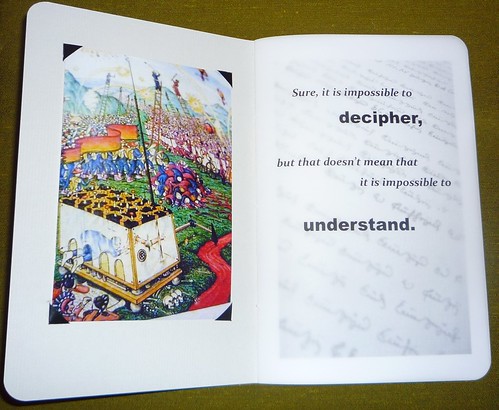
If I had to pick the single piece of my own writing that has generated the most reader responses, I would without hesitation name “The Codex Seraphinianus: A Fragment of the Complete History of an Unknown Planet,” an essay about Luigi Serafini’s hallucinatory faux-encyclopedia which The Believer published in May, 2007. (Aside: I’m hoping to meet or beat this record with “A Figure in the Distance Even to My Own Eye,” my new essay in the current issue of The Believer.) Two years out, the Codex essay continues to bring me new and interesting correspondence, to the tune of at least a letter or two per month. People write to say they enjoyed the piece, to thank me for turning them onto the Codex, or to share their own stories about when they first discovered it, or what they think it all means. Sometimes they want to know if the text has been “deciphered” yet, or if I personally think it can be deciphered at all. Often, they just want to know if I can send them the full text of Calvino’s introduction (it isn’t available in English, so I commissioned a translation from the French version, but it was only briefly quoted in the essay). Anyway, today I’m thrilled to share with you all news of a new Codex-related publication: Confronting and Collecting the Works of Luigi Serafini, available as a severely-limited edition (100 copies!) chapbook by Jordan and Justine Hurder.

READ MORE >

Presses / 23 Comments
July 16th, 2009 / 7:54 am

Plotting with 419Eater.com

Pix1I somehow spent an hour or so this weekend reading various ‘baits’ in the PublishYourWork forum over at 419Eater.com, a site devoted to the art of scambaiting (if you’re not familiar with scambaiting, read this post by Tom Whitwell at The Times Online).

As I read through the threads, I was surprised at how scambaiters talk about their work. Scambaiters use specific terms to describe what they do: a ‘lad’ is a targeted scammer, a ‘trophy’ is something the scambaiter receives from the lad, a ‘mark’ is a victim of a scammer (known as a ‘mugu’ in scammer circles apparently), and so on.

I was also impressed with how involved some of these ‘baits’ are. A few of the better scambaiters put a lot of effort into working the scammers: they play multiple characters, from clergymen to hackers to other scammers; they do their best to send the exchange into odd twists; and they often wait until the right moment, just when the scammer has done all he thought he needed to do in order to get the money, before revealing the hopelessness of the situation/play their trick/etc.

READ MORE >

Technology / Comments Off on Plotting with 419Eater.com
July 15th, 2009 / 11:38 pm

I am home from The Dollar Store Show Tour, thanks to all who came out and hung out and were rad people, I had a blast. Back to living on a netbox. Upon my return, I’d like to welcome the advent of the newest HTMLGiant contributor Chris Higgs, who I couldn’t be much more excited about having on board. Welcome, Chris.

Displaced Press

punkparty

From the minds of Daniel Borzutzky, Brian Whitener, and Steven Hendricks, the ultra new and sexfed Displaced Press, who have come out of the gates hard and strong with two titles of powertext, one a translation by Johannes Göransson of Johan Jönson, Collobert Orbital, and Yedda Morrison’s girl scout nation. Both titles have just been released, and are available through the press’s site, as well as via SPD.

Check the specs:

READ MORE >

Presses / Comments Off on Displaced Press
July 15th, 2009 / 10:09 pm

Haut or Not: Your Tattoo

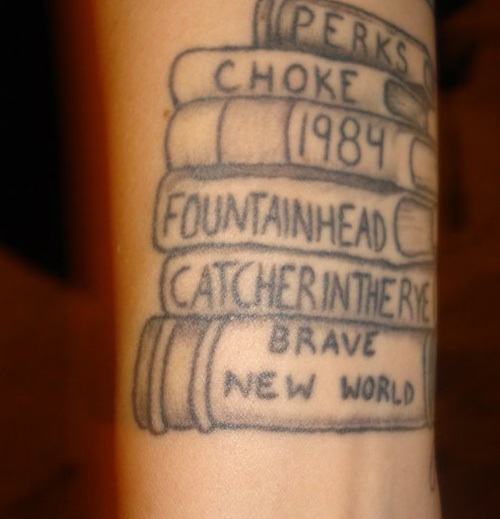
BookieTattooOne light hug from this “arm of wrath” and suddenly your vision of the future looks rather grim. Imagine this guy on a date: “Hey babe, let me get some more pasta for you, and yah, people are phony and socialist or something, and like the world is gonna end.” The Fountainhead and 1984 were both written as arguments against Socialism, though their meanings have been diluted to vague political restlessness in contemporary culture. I just typed “contemporary culture,” someone shoot me. My prob with books like this (‘cept Catcher – and what the hell is Perks?) is that their didactic agenda overshadows their artistic one. As for Choke and its author Chuck, dunno, that hyped up Red Bull-ish man/boy fascination with violent transgression just doesn’t do it for me.

Rating: Not

READ MORE >

Haut or not / 114 Comments
July 15th, 2009 / 3:33 pm