
Grammar Challenge: Answers and Winner
Thanks to all who participated in the Second Grammar Challenge. “essysea” is the winner; if you are “essysea,” contact me in some way that allows me to contact you back, and I’ll do you a prize. There were 47 comments on the post, which is fitting.
Here are my answers and, in cases where I missed something, Wallace’s edits to my answers:
(1) It was the yuletide season like I had never seen it before.
It was the yuletide season as I had never seen it before.
(2) We were in Innsbruck, Austria and we could not find a place to stay the night.
We were in Innsbruck, Austria, and we could not find a place to stay the night. [Comma after Austria]
(3) We passed by the inn.
We passed the inn. [By is redundant]
(4) It has made its way into the mainstream of verbal discourse.
It has made its way into mainstream discourse. [Discourse is already verbal]
Blake Butler—
At the Awl, a comprehensive post re: David Foster Wallace’s private self help library.
6
Criticism and The Pale King
Elegant but problematic write-up on The Pale King in GQ by John Jeremiah Sullivan. Read it for the elegance, but I’d like to unfairly isolate the review’s conclusion, which alarmed me for the reasons articulated below. Quote:
Wallace’s work will be seen as a huge failure, not in the pejorative sense, but in the special sense Faulkner used when he said about American novelists, “I rate us on the basis of our splendid failure to do the impossible.” Wallace failed beautifully. There is no mystery whatsoever about why he found this novel so hard to finish. The glimpse we get of what he wanted it to be—a vast model of something bland and crushing, inside of which a constellation of individual souls would shine in their luminosity, and the connections holding all of us together in this world would light up, too, like filaments—this was to be a novel on the highest order of accomplishment, and we see that the writer at his strongest would have been strong enough. He wasn’t always that strong.
Insightful, or regurgitation of the “humanist” DFW diet? At what point will critics realize that there is not one single sense to DFW’s work–that is, Wallace as what Kyle Beachy, ironically or not, called the “empathy machine,” the brain with a heartbeat? There is no question that this caricature of Wallace suits our time, but it nevertheless should be considered as just that: a pitiful reduction of what Wallace demands, and the ensnaring of criticism in the dangerous matrix of “human values”–as if he awoke from his postmodern slumber merely to mourn the “souls who would shine”–which is, incidentally, my answer to Blake’s recent post. Answer: a critic should be critical, a problem which will be the challenge and measure of reviewing The Pale King.
Second Somewhat Bi- oh wait Semi- no it’s Biennial Grammar Challenge!
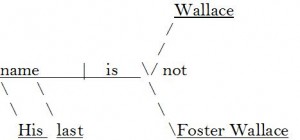
This is for fun.
This is a contest. It is taken from a homework assignment in David Foster Wallace’s Extremely Advanced Composition class at Pomona College. It was a creative nonfiction workshop.
The contest is, correct these sentences for what Wallace, at least, perceived as errors in mechanics, grammar, punctuation, syntax, idiom, and/or usage. You get a point every time you are the first person to correct an error in comments (by rewriting the sentence correctly), but I’m going to wait to get lots of answers in to reveal the answers, so don’t hesitate to tackle a sentence that someone else has already tried. You may make multiple guesses on the same sentence, and you can guess out of order. Some sentences may have more than one error. One point per error. Prize TBA.
Some of these are pretty basic. Some are very obscure and speak to Wallace’s particular peeves, some of which I don’t share. The point is to figure out what he thought was wrong with these. No use arguing with a dead man.
And I quote:
English 183D 10 March 2004
” . . . every such phrase anesthetizes a portion of one’s brain.”–G. Orwell
(1) It was the yuletide season like I had never seen it before.
(2) We were in Innsbruck, Austria and we could not find a place to stay the night.
(3) We passed by the inn.
(4) It has made its way into the mainstream of verbal discourse.
(5) Cross burning began in medieval times on the green hills of Scotland, where clans used them to rally their kin and kith against enemies.
(6) “Get used to it.” I said to myself.
(7) As the president is a Christian, he prays every morning.
(8) I can support this claim with quotes from several published sources.
(9) It consisted of only two brief 50-minute workshops which one speaker enticingly described as “therapy session sized.”
The Pale King Changes
Today at Conversational Reading, Scott Esposito linked to a Google document that showed differences between the recent David Foster Wallace excerpt in The New Yorker titled “Backbone” and a transcription of Wallace reading the same piece in 2000, what Wallace then called ‘a fragment of a longer thing.’
Esposito writes:
It’s common knowledge now that Wallace did not get close to finishing The Pale King, and that the book that will be published on April 15 represents a heavily edited and stitched together version of what Wallace left behind. Clearly, this book has been made to serve the many readers out there who would like to see a completed, standardized version of The Pale King.
For more, go to the full post.
In Defense of the Democratic, Therapeutic Workshop

This is in response to Kyle’s comment on Sean’s post. Or, maybe in reaction. In the comment thread, I responded to part of what Kyle said, but the rest of my response veers pretty far from what Sean was asking, so I’m going to develop it here instead.
I want to take up the ideas of workshop as democracy and workshop as therapy session. What does it mean, really, to say you don’t like those ideas? I should just let Kyle answer that first, but I’m going to say what I make of those terms first.
Workshop as democracy: If I was the one saying that, I would mean that a workshop is a chance to hear from a group of the kind of people who would be your readers. With nobody’s reading being privileged, including the professor’s, who is just one reader. The professor certainly is there to teach how to respond to peer work, how to read and respond sensitively, but hers shouldn’t be the final word. Bruce Covey was telling me last night that he never speaks during the workshops he teaches. Each workshop, a student facilitates. I think this is a wonderful idea. Sure, workshops can work beautifully in other ways, too, but I think this is one good way. This can come down to tiny details. It’s great to know whether 10% or 80% of readers don’t catch a certain reference. To be in control of that, of how obscure the references are. I prefer the perhaps squishy sounding term “focus group” to “democracy” for this function (not the only function, but one function) of a workshop.
Workshop as therapy session: This is thrown around a lot, always negatively. Workshop shouldn’t be therapy. I think there are two problems with this. One, what kind of therapy are we talking about. Substitute “person” in what Kyle says at the end. “…from there, to help a [person] do the thing the [person] really wants to do as powerfully and truly as the [person] can.” That can be (should be?) the goal of therapy, no? When I went to therapy, that’s what I was looking for, and I found it. This happened in many ways and on multiple levels, but I’ll use an example that has to do with writing. Toward the end of my course of therapy, my main problem was that I was behind on my thesis. (After I finished, my therapist said it was time I set new goals or quit therapy. I quit, and we kept in touch.) My therapist said, how about writing five pages a day (I think she said three at first, but I explained I wouldn’t make the deadline that way). I started writing five pages a day. I finished the thesis. I sent the critical component of the thesis–which was never workshopped–to someone I interviewed for it. He wanted me to adapt it for the magazine he edits. Made $1500 for the article. Didn’t pay for my whole course of therapy, but it more than covered the session where she said to just write 5 pages a day. Why shouldn’t a workshop do this?
Can We Not Talk About What We’re Working On Again, Please?
 The pendulum has swung, as pendulums are so woefully apt to do. When I was small, and first starting reading about what writers said about writing, they all seemed to say that it was better not to discuss a work in progress. At the time, this seemed a kind of magic trick, a superstition of some kind. But I’d be damned if I didn’t take their word for gospel, even though I didn’t understand it any better than I understood the actual Gospels (I heard “Jesus is everywhere” and imagined a thousand teeny tiny invisible Bethlehem babies lounging around even as I bathed).
Apparently, I was damned. By the time I started writing in earnest, the whole mechanism had to do with not only discussing but sharing your work in progress. In college, this was great, because I wasn’t in any way ready to complete anything to the point that it could be published. So participating in workshops was like army boot camp. I learned lots.
In MFA school, I still learned, especially in literature seminars, but I certainly didn’t complete anything publishable. But this time, I was probably ready to, but was hampered by the workshop process. There were three reasons for this, I think. 1, in no workshop that I took did anyone say that a piece should just be abandoned. All criticism was constructive, which was the point, but in reality some work needs to be torn down so that something better can be built in its place. I’m very impressionable, so after hearing my work discussed for 20 or so minutes, I became convinced it was worth my continued attention even if it really wasn’t. But I ran into trouble with the continued attention because 2, my classmates’ and professor’s opinions about any one piece, even a 3-pager, were so conflicted, and the problems they unearthed so convoluted, that I was totally lost when faced with revision. To make matters worse, 3, my professors and classmates (not to mention lots of other people in my life–they all agreed) also told me what book they thought I should write, and how I should go about it. Almost five years later, I have only just really decided that they were wrong, and that the book they had in mind is not the one I should write, at least not right now. Like I said, I’m very impressionable. I have confidence in my own work, sure, but there is something powerful about everyone you know saying they want to read the same as-yet-unwritten book by you. Powerful and dangerous.
Ken Baumann—
Insightful read of Wallace’s philosophical concerns, passions. James Ryerson: Thank you.
5 awareness that the essential values through which one…lock cat
2. Washington Post with “Three Books on Hipsters.”
Their affinity for tight jeans, shaggy hair and Pabst Blue Ribbon beer is easily mocked, but the principal criticism is that they’re frauds.
11. Rose Metal Press is having a fund drive! For 5 years RMP has been putting heart-imploding hybrid/slash/flash into your taped coins/eyes/tattoo tails/synapses. You get stuff, too. Give.
14. Cult Pulp Fiction at Sabotage Times. Or:
Pretty soon, my feverish teenage brain was boiling over with descriptions of high-class orgies, anal penetration and amyl-nitrate-fuelled orgasms.
236. Did someone on this fucking site already link to this long un-cut interview of DFW from 1998? I don’t know. I don’t. If so, some HTML god will most likely remove it and you won’t even see these words. Fuck.
9. Did you hear Steve Martin was so blar they had to offer a refund? Why was he boring? He talked about art. Martin says:
“So the 92nd St. Y has determined that the course of its interviews should be dictated in real time by its audience’s emails. Artists beware.”
Get off my lawn! Yeh but Steve, you’re trying to sell a book. You are Steve Martin. You manipulated, man. But I like it. This goes under one of my favorite genres of public readings: You expected this, I’m going to give you that. Recently, I went to see a semi-famous memoir writer and she ignored all that and read a dry history of religion. you could hear the air crackle as expectations tumbled into walls. Hissing. Andy Kaufman reading Great Gatsby. Ever been to one of those readings? Like WTF? They glow.
The Myth of the Human w/r/t David Foster Wallace’s “Mister Squishy”
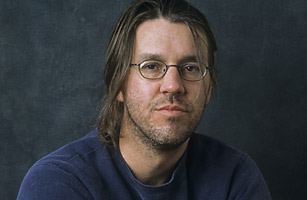
Some of the most singular moments in understanding come on as if being shook: a presence entering the body unto some new consideration of how that entrance might occur. One kind of a map of a version of one’s self might be determined by considering among the terrain of the body a series of approached organs; objects imbibed, in what order, how one’s own output is affected; what is out there; what is. Seeing does this. Language, more indirectly, does this, too: entering as symbols and networks of orchestrations. Some strings of language, as well, leave in their wake a total reinvention of creation as an act, iconing on the map of self, and many selves; updating or widening or recalcifying what any kind of words can, could, or should do.
I can remember with unusual clarity the feeling in me the first time I read David Foster Wallace’s “Mister Squishy.” It was published under the name Elizabeth Klemm in the 5th issue of McSweeney’s in 2000, but by the time the magazine reached my hands I’d already heard on the Wallace listserv that this rather lengthy piece of fiction could only ever be written by him; there could have been nobody else. I was already a rabid Wallace freak; I’d pretty much begun writing fiction as a direct byproduct of reading Infinite Jest, and since then become obsessed. I read this story, long as perhaps 3 normal stories, on a futon in a house in one sitting under a skylight with legs crossed, already ready to be lit. And yet, the particular instance of “Mister Squishy,” even having then been well versed in a way that somehow placed the author’s presence in my daily thoughts (which has not since then stopped), rendered in me that the first time something different even than what I’d been ready to expect: some odd confabulation of provocation, confusion, inundated awe; a feeling rare not only for any kind of language, but particularly for a shorter work. This was something singular beyond even the already neon body of Wallace’s work in constellation, and in particular, beyond the confines of what a story as a “story,” or a novel even, or text as text, traditionally operationally assists to construe.
Since then I’ve read the 63 pages of “Mister Squishy” at least a dozen times. I’m not sure even still I can begin to wholly how to parse the innumerable levels of its moves, using tactics and employments that continue shifting with each reconsideration and further study in the way a Magic Eye painting might if it could get up and walk around: a kind of high water mark of contained language and ambition, since then, now ten years later, still uncontested in the ways of invoking the uninvocable, the void. It is a station, I believe, should be reexamined; it is, in many ways, a kind of key to a beyond, both in the content of the story, and the method of its opening a new kind of affect in languageground, one that still has yet to be, these years later, fully inculcated, or because of time’s way, even unpacked.
71 Comments
November 22nd, 2010 / 11:32 am
November 22nd, 2010 / 11:32 am