
A List of Especially Memorable Fiction and Nonfiction from 2016
For the past few years I’ve been keeping a list of all the books I’ve read. This simple trick has resulted in a marked increase in the amount of reading I do. I group the book titles by month; when the date is getting to be in the mid- to late 20s and I check my list to find that I’ve only listed one or two books so far, which is often the case, the next several days will include harried bouts of late-night reading intended to prevent myself from later feeling ashamed when I would hope to be proudly perusing my list.
Highlights from this year’s list follow the jump. READ MORE >
Great First Lines: “Rose Alley” by Jeremy M. Davies
They shot her screen test in Paris, where I’ve never been, in the private room of the café Tout Va Bien, in the Latin Quarter, newly paved in tar, and still lewd that winter with debris from the blockades of stacked cobblestones—centuries old, pried right off the streets—and the stink of some secret catastrophe.
A disclaimer: Jeremy’s a dear friend and former roommate of mine—but c’mon! That opening line is obviously great. & the whole book is simply fabulous. I was motivated to post this because I just recommended, for the dozenth time, no joke, that a fellow writing classmate read the book …
So what’s going on in this opening line?
The Evolutionary Revolution
Lily Hoang’s new book, The Evolutionary Revolution, is now available from Les Figues Press via SPD. Super excited for this one…
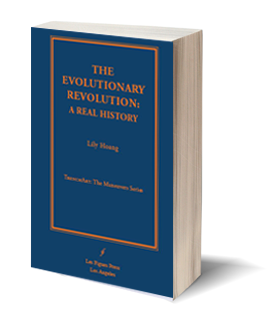
What if evolution was decided by committee and revolution by mere chance? What if man was a subspecies? What if man, as a subspecies, was woman, with tiny red wings on her thighs and pasted shut eyes? What if she flew in the sky or slept on the moon, and what if the earth was a saltless water world filled with forgetful, vengeful two-headed mermen? Welcome to THE EVOLUTIONARY REVOLUTION, a fabulist story of sense-making for the 21st century. In this twinning tale of freak shows and prophets, tract homes and impending doom, award-winning author Lily Hoang collapses time and narrative into a brilliant novel of beginnings and ends, where sentences undo each other and opposites don’t cancel each other out. As Anna Joy Springer notes in the book’s introduction, “In literature, as sometimes in life, it’s a scary kind of fun to be manipulated by a pretty girl, who changes the game on a whim.”
excerpt at The Collagist * audio reading at Apostrophe Cast * excerpt at Harp & Altar
Blake Butler—
Everyone, please help us welcome our last 3 new lovely contributors: Sean Lovelace (author of How Some People Like Their Eggs), Matt Bell (editor of The Collagist and author of, among many things, the forthcoming How They Were Found), and Lily Hoang (author of Changing, Parabola, and about 50 others). We’re busting up!
24
Blake Butler—
Lily Hoang wins the 2009 PEN / Beyond Margins Award for her book Changing, because she is a badass. There are excerpts from the novel on the site. You can buy it here, and should. Congrats Lily!
Word Spaces (11): Lily Hoang
Lily Hoang is the author of Parabola (Chiasmus Press) and Changing (Fairy Tale Review Press) and has an ebook at Lamination Colony titled The Woman Down the Hall. She is an associate editor at Starcherone Books.
Lily Hoang once visited Houston. She was impressed with Houston’s public transportation, which is basically a light rail train that travels up and down a few blocks, but costs lots of money to maintain. She gave a reading at UH-Downtown and then shared a cigarette with Gene Morgan at Poison Girl.
After the jump: Lily’s Word Space.
Lily Hoang’s CHANGING
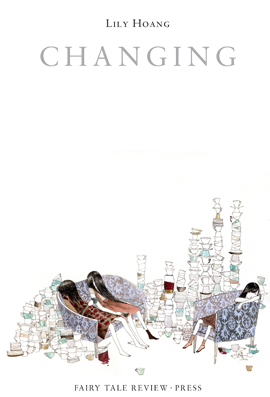
In the third fantastic release from the already massive-powered Fairy Tale Review Press (whose first two releases, PILOT by Johannes Goransson and THE CHANGELING by Joy Williams are both brain eating monsters of true glee), the brand new and clean white book object CHANGING by Lily Hoang has now hit and awaits your head.
At once a fairy tale, a fortune, and a translation told through the I Ching, Vietnamese-American author Lily Hoang’s CHANGING is a ghostly and miniature novel. Both mysterious and lucid at once, the book follows Little Girl down a century-old path into her family’s story. Changing is Little Girl’s fate, and in CHANGING she finds an unsettling, beautiful home. Like a topsy-turvy horoscope writer, Hoang weaves a modern novella into the classical form of the I Ching. In glassine sentences, fragmented and new, Jack and Jill fall down the hill over and over again in intricate and ancient patterns. Here is a wonder story for 21st century America. Here is a calligraphic patchwork of sadness.
“This is an impossible thing, a dream object”–Joyelle McSweeney, author of FLET.
That the book is based on the I-Ching plays no small part in the making of the book’s power: consisting of a series of form-shaped prose sections that mimic the structure of the holy book, CHANGING begins to take on this weird, recursive power. Lily Hoang has a way of roping the big mythic energy of tableau and mysticism down out of the nowhere and branding it with her own peculiarities of everyday upbringing. The result is kind of a maze of hypnotic language and cultural mishmash, which truly operates in resonance unlike any other book I can remember.
Giant Talks: Joshua Cohen interviewed by Lily Hoang
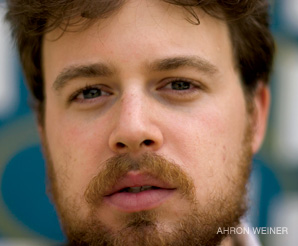 I first came across Joshua Cohen’s work a couple years ago at AWP. I walked by the Starcherone Books table and asked editor Ted Pelton which book he would recommend. He handed me a bunch, and luckily, among those was Cohen’s A Heaven of Others. What struck me then (and continues to strike me every time I read his work) is what an incredible badass he is. For one, he’s an amazing writer. His words are quite literally delicious. But beyond that, he’s the most prolific writer I know (and I know some crazy prolific writers!). Still shy of thirty, he’s got four books in print, one on the way from Dalkey Archive, and tons more sitting either on a physical or virtual shelf. Cohen is a powerhouse, but don’t take my word for it. Go buy one of his books. You won’t regret it.
— Lily Hoang
LH: Something that really strikes in about your writing is the very distinctive voice your characters have. In A Heaven of Others (from here on out known as Heaven), the narrator has an extremely urgent voice, one that compelled me to read faster & faster, until I was practically skimming. (Then of course, I had go back and read the whole thing over again to really savor the language!) Cadenza for the Schneidermann Violin Concerto (known as Cadenza), however, has a much more patient narrative voice. Can you tell me more about the development of these narrators in particular? Please feel free to talk about your other works as well.
JC: The voices of both my novels are fictions within fictions, and, as that, they’re opposites: The voice of A Heaven of Others is that of 10-year-old Jonathan Schwarzstein of Tchernichovsky Street, Jerusalem. The voice of Cadenza for the Schneidermann Violin Concerto is that of Laster, an octogenarian, perhaps nonagenarian, concert violinist from eastern Austro-Hungary. Again, both are fictions, meaning both are ultimately Me. I think what I’ve done in all my books so far comes, primarily, from speech rhythm. The rhythm of how I want to speak. How I speak to myself. As for echoes, A Heaven of Others derives from poetry, especially 20th century Hebrew poetry (Dan Pagis), and German-Jewish poetry (Paul Celan), while Cadenza comes from comedy, and despite its typographical trickery owes more to the history of the novel, and much, specifically, to Saul Bellow.
Interview w/ Lily Hoang & Stacey Levine
 Lisp Service has just posted an interview with Lily Hoang and Stacey Levine, in which they discuss the writing process, creation of fable worlds, Oulipo, speculative fiction, and various other interesting topics in the form of craft of strange lit.
Levine on small presses:
My work was rejected by the big guns New York publishers. I’m with a semi-larger house for my next book, but it’s still an independent (MacAdam/Cage). Still, I’ve been happy with smaller presses. They suit me and my slow way of writing. Of course, they have their well-known downsides…. Yet with smaller houses, there’s less nonsense like the imperative to sell, sell no matter what, the crazy competitiveness and drive to promote that is discombobulating and not very real, in a way. I mean, we’re all going to die anyway, whether we have loudly and lavishly-published books or not. The most important is to have people around the book who love it.
I like the idea of pairing two writers of a similar ilk and having them interweave in the discussion… read the rest!