httpv://www.youtube.com/watch?v=Ch6Jtk6oJRo
Sometimes writing can knock a whole lot of angry into you. Ever really, really freak out? What happened?

httpv://www.youtube.com/watch?v=Ch6Jtk6oJRo
Sometimes writing can knock a whole lot of angry into you. Ever really, really freak out? What happened?
It has even been suggested that I spent six years writing my last novel in order to create a demand that cannot be filled. Basic Black With Pearls has had rave reviews and has been bought by William Morrow Company in New York. Success and 60 cents will get me a ride on the subway. No one can find a copy of my novel in the bookstores.
First published age 45.
Did, but did not enjoy, raising rabbits for food.
94 is way bonus years.
All the literary forms were men’s, all the philosophies were men’s philosophies. … I had to translate these forms into the female
Achieved?
Pointed out that gardens might be an answer to God Money (or that fleas do tricks for food).
RIP Helen. To be avant and overshadowed by a spouse. Push back? Harder? But it happens. But let’s pause.
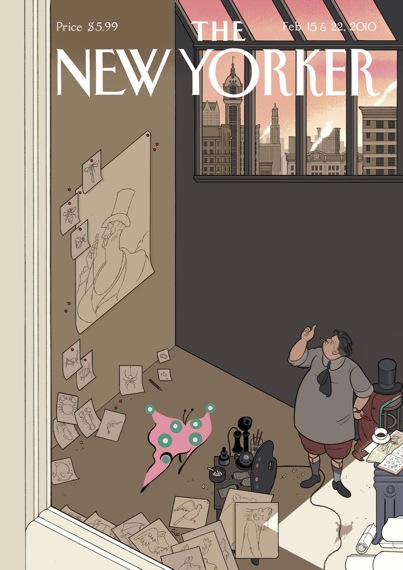
"Natural Selection" by Chris Ware, New Yorker, February 2010
Of the four covers for New Yorker‘s 85th Anniversary Issue, my favorite (while I appreciate all of them) is Chris Ware’s. He has a way of condensing large amounts of narrative into small hints or incidents; this is what I enjoy most about Ware: the visual riddles in his work. Eustace Tilley, as implicated by his top hat and green shirt — just a sliver, see it? — resting on his stool, is seen in a sort of aesthetic Darwinian tussle, unknowing of the prophetic butterfly outside his window, a lateral view which places us at the shared “fly’s butterfly’s eye” view. Check out the arc of evolution starting from from the wall: insects to arthropods to aves to primates, to eventually, Eustace himself. Ware’s sense of visual space is simply genius, his empathy abound. We see a pudgy Eustace in sock garters, cutting off his self-portrait just above the belly. And there on the floor rests the butterfly’s shadow, evoking a distance between our orientation as invited voyeurs outside the window and the space inside the artist’s studio. What looks like a self-assured “thumbs up” is, if we are to assume common draftsmen techniques, really just Eustace blocking out the affixed subjects with his thumb, still tentative, despite the cultivated naturalism of this wonderful scene, about what he will select.
[The Tyrant sends his thoughts on the unpspeakable. Please enjoy. – BB]
“Most stuff that is genuine is better left unsaid.” This is from a letter written in 1993 by J.D. Salinger to his friend E. Michael Miller (for this story, go here). Sounds like old boy’s last plea, doesn’t it? That last line of the red one, you know: “Don’t tell anybody anything. If you do, you start missing everybody.” This thought occupies my mind past the point of it being healthy. There are so many things for me that I cannot write down, or will not write down. I have tried to write them down, and I have written them down, and hated myself afterwards for doing it.
This is someone I won't, can't, write about.
It’s the same with speech. There are so many things I can’t speak about, won’t speak about. I have tried to speak about them, and I have spoken about them, and hated myself afterwards for doing it. I don’t know how to categorize these untouchables for there is no common denominator that I can pin down. I am not talking about gossip or secrets. Forget all that shit. I’m talking about the times or thoughts or experiences that cannot be regaled, or feel like they shouldn’t be regaled (even though they could be regaled but you would just feel like shit afterwards because no matter how good it felt to tell it, once you’re done it always feels like you have just let go of a kite string). That bit of advice from Dorothy Parker (about how if you have an idea for a story, not to speak about it or it will lose its steam) has something to do with it, but not exactly. Or it’s like that feeling you feel in that span of time between the moment you hear some good news (Writers, insert “acceptance-letter joy” here) and the moment that you start blabbing your head off about it. As soon as you start communicating it, telling others about it, something disappears, doesn’t it? And there was something good about that something that disappeared, wasn’t there? It’s not exactly like, but is kind of like, how you and your good friend would never talk about how good of friends you are because the mere mention of you even being friends would cause your friendship to wither somehow.
Born Magazine’s “hyper” e-books [Example 1 | Example 2 | Example 3 | Example 4], self described as “cinematic and interactive interpretations,” are very impressive yet a little distracting. The traditional HTML versions — not because of content, but comparison — seem frigid, naked, unsure of their capacity. If the medium is the message, is the message that we’ve lost our faith in words? Or that we have some new killer software?
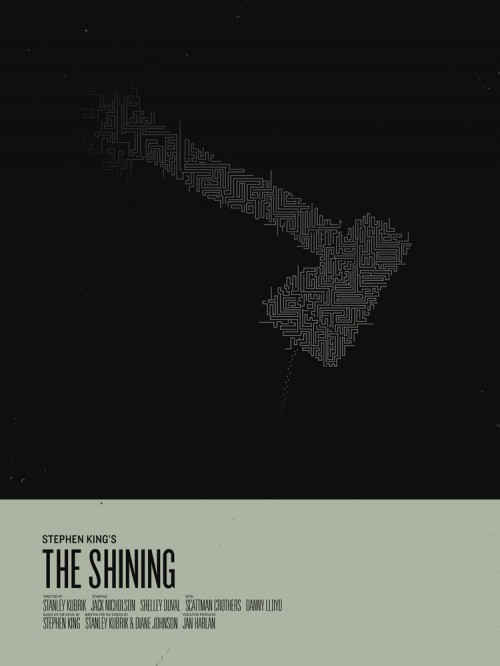
Designer Nick Tassone (alias bee combs) makes posters for films based off Stephen King novels, all of which I really like. They are conceptually gratifying and an unfortunate anomaly in the movie poster business; that these are from a school project make it that much more impressive.
From Walter Benjamin’s essay “Critique of Violence”:
If the rule of myth is broken occasionally in the present age, the coming age is not so unimaginably remote that an attack on law is altogether futile. But if the existence of violence outside the law, as pure immediate violence, is assured, this furnishes proof that revolutionary violence, the highest manifestation of unalloyed violence by man, is possible, and shows by what means. Less possible and also less urgent for human kind, however, is to decide when unalloyed violence has been realized in particular cases. For only mythic violence, not divine, will be recognizable as such with certainty, unless it be in incomparable effects, because the expiatory power of violence is invisible to men. … Divine violence, which is the sign and seal but never the means of sacred dispatch, may be called “sovereign” violence.
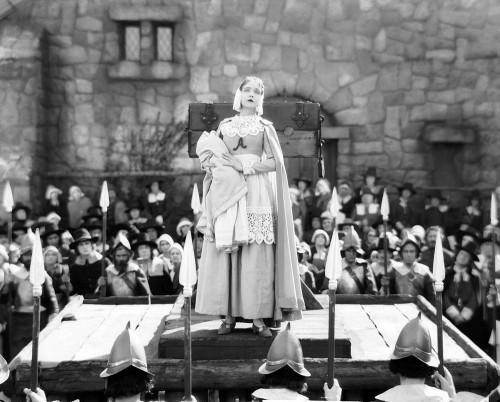
The fiction section of the new issue (ETA: the set of stories that indicate they’ve been guest edited by Claire Messud) of Guernica is guest-edited by Claire Messud and she offers a brief essay, Writers, Plain and Simple, to introduce her selections, all written by women. In her essay, Messud writes of how Elizabeth Bishop did not wish to be known as a woman writer and she states:
As an American writer of the early twenty-first century, I agree with her wholeheartedly. An artist’s work is in no way limited or defined by her gender. To allot space, then—such as this fiction section of Guernica—to women writers specifically is, surely, to limit and define them—us!—by an irrelevant fact of birth.