
What do you think about book trailers?
Over at Salon.com, Laura Miller has a piece called “Never coming to a screen near you: Why promoting books with movie-style trailers is a silly idea.” Here’s a snippet of her argument:
Alas, Web videos are even more numerous than books, and as with books, the vast majority of them go unwatched and uncelebrated. A few manage to command that most mysterious of all magical powers, word of mouth, and become sensations, but that kind of success is as impossible to force as an “Oprah” booking. In the meantime, an author’s energies have been funneled into a project that’s unlikely to yield many results.
Here is an example:
httpv://www.youtube.com/watch?v=1chqggKw_Ds&feature=player_embedded
Justin Taylor—
 NYC Area Alert: The launch party for LIT #17 (the journal of the New School graduate writing program) is tonight at Housing Works bookstore & cafe. Sasha Fletcher, Phillip Gardner, Anne Ray, and the inimitable Jennifer L. Knox will be rendering their readerly services. The facebook page claims that space is limited and so you need to RSVP if you’re going, but my bet is that if you show up, they’ll figure out a way to get you in. I am very excited about this and planning to attend, so think about your desire to hear these readers, weigh it against your desire to potentially interact with me, and plan your evening accordingly.
4
You, whore.
Baudelaire says: All art is prostitution.
Discuss.
Rounding Up, Rounding Down
 Stephen Burt reviews Mark Bibbins’s The Dance of No Hard Feelings at Coldfront. He gives the book 8.5 out of 10 stars, and declares the poet “inescapably sexy”–this pretty much sums it up, but probably you should read the whole review.
Found this blog recently, via can’t remember what. It showcases what purport to be genuine letters from notable cultural persons. They offer a copy of each letter as well as a typed transcription. Letters of Note.
Ever since Jeremy Schmall turned me on to John Gallaher’s blog, my feelings about poetryland have been just a little bit brighter.
Last week I went to see Jonathan Lethem read from Chronic City at NYU. The reading was enjoyable, but the real standout for me was the Q&A, which I found especially powerful. JL talks with Darin Strauss about influence, composition, struggling to get that first book done, and the responsibility you feel to re-issued books that you write the introductions for. (Lethem recently prefaced Nathaniel West’s Miss Lonelyhearts / Day of the Locust for New Directions; first time that book’s ever had an introduction.) Anyway, while you’re over at the NYU page, you might want to check out some of their other recent podcasts- Lydia Davis, Forrest Gander, Colum McCann with Padgett Powell, which in fact I’m going to enjoy with my breakfast right now. The main page for the series is here.
Last but hardly least, I’m going to make a semi-concerted effort from now on to illustrate these posts with the work of visual artists I admire, instead of just random shit I Googled for. So pleased for you to meet J.L. Schnabel, an old friend of mine and a fantastic artist and writer and jewelrymaker. She blogs here, and writes for the more-SFW-than-it-sounds art website Fecal Face. Her most recent piece is a studio visit with John John Jesse.
The Complex of All These
While a resident at the Women’s Studio Workshop last year, Abigail Uhteg created The Complex of All These, a neat handmade book in limited edition. She took over 3,000 photos of the entire process and put them together into this video.
httpv://www.youtube.com/watch?v=l9a5hH5idQc
Like a Dog
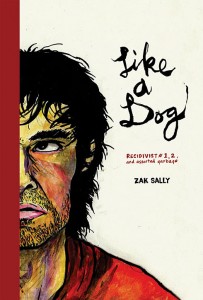 You are supposed to listen to Low while reading Ander Monson’s book from back when, O.E.
Interview with Zak Sally at Bookmunch.
I mean, I really do think that’s an important thing for…everyone, for all human beings on some level – just asking “what am I doing here? why am I doing it? am I being an asshole, am I holding myself accountable for the things I’m doing in this life?”
It is better to be good than smart. That is the idea.
Like a Dog Review at Bookmunch.
I like saying the word munch.
Words begat images, images begat words. That is the idea.
Snow of syllables. Eat etchings. Cold. Thaw. Words.
Cultural Masturbation
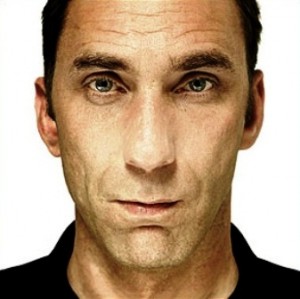 If you want to go to a very lonely place, find the Cultural Criticism section of your local bookstore. No one is ever there, it seems, except for the occasional confused student staring at the placard– Cultural Criticism?— wondering what it could mean and forgetting that he is actually looking for Joan Didion’s The White Album. But if you find yourself in this dusty corner, you could do worse than pick up Will Self‘s Junk Mail. It’s a collection of nonfiction and journalism he published over the 90’s and 00’s. There’s an essay about London crack houses, another about Woody Allen and Jewish comedy, and many others including one about artist Damien Hirst in which you will find this question:
“Is it better to masturbate over the image of the Emperor if he has no clothes on, or is it preferable to stimulate yourself discreetly knowing that he is tightly sheathed?”
Alec Niedenthal—
On his mother: “Photography thereby compelled me to perform a painful labor; straining toward the essence of her identity, I was struggling among images partially true, and therefore totally false. To say, confronted with a certain photograph, ‘That’s almost the way she was!’ was more distressing than to say, confronted with another, ‘That’s not the way she was at all.’ The almost: love’s dreadful regime, but also the dream’s disappointing status–which is why I hate dreams. For I often dream about her (I dream only about her), but it is never quite my mother: sometimes, in the dream, there is something misplaced, something excessive: for example, something playful or casual–which she never was; or again I know it is she, but I do not see her features (but do we see, in dreams, or do we know?): I dream about her, I do not dream her. And confronted with the photograph, as in the dream, it is the same effort, the same Sisyphean labor: to reascend, straining toward the essence to climb back down without having seen it, and to begin all over again.”
–Roland Barthes, Camera Lucida, p. 66
Ryan Call—
Coudal Partners asked people to read poetry into their answering machine. The result is Verse by Voice.