David Foster Wallace and Imagining Moral Fiction

David Foster Wallace was never doing anything wrong. Even Wallace’s first published story, “The Planet Trillaphon as It Stands in Relation to the Bad Thing”–published in 1984 by the Amherst Review, written presumably at the age of 22–bears most of his stylistic earmarks circa Infinite Jest, and grapples with themes that would echo throughout much of his work to follow: infinity, fear, the risk of autobiography, fiction as an event, the struggle to empathize–the struggle to simply be in one’s own skin. All of this with a keen and self-aware sense of humor which dares you not to let Wallace’s cheeky, vigorous and, behind all that, ultimately hurt voice crawl into your head and stay there. But toward the end of his life, Wallace wasn’t sure, any longer, if his stylistic approach to the themes he felt to be most urgent–the themes that ran, almost doctrinairally, obsessively, through both his fiction and nonfiction–was truly effective in the big, big way he wanted it to be. He wanted to pare down the ecstasy of his prose, empty his sentences of self in a move toward mindfulness, toward sacrifice. Partly, I think Wallace’s stylistic shift (which we will see in full force soon when his final, unfinished novel, The Pale King, hits) was simply him doing good work; no artist as intelligent and unremittingly inventive as Wallace could stay working in the same mode for long. But and also (just kidding; I won’t do that here), I think Wallace, the whole time, imagined his work as a call-to-arms to the writer inside of every reader, the reader inside of every writer. In his essay “E Unibus Pluram,” Wallace points toward exactly the kind of shift in literary consciousness–and moral consciousness–away from what he saw as the destructive impulses of postmodernism, the shift which he could never, for whatever reason, fully effect in his own work:

The next real literary ‘rebels’ in this country might well emerge as some weird bunch of ‘anti-rebels,’ born oglers who dare to step back from ironic watching, who have the childish gall to actually endorse single-entendre values. Who treat old untrendy human troubles and emotions in U.S. life with reverence and conviction. Who eschew self-consciousness and fatigue. These anti-rebels would be outdated, of course, before they even started. Too sincere. Clearly repressed. Backward, quaint, naive, anachronistic. Maybe that’ll be the point, why they’ll be the next real rebels. Real rebels, as far as I can see, risk things. Risk disapproval. […] Who knows. Today’s most engaged young fiction does seem like some kind of line’s end’s end.

I want to concentrate on Wallace’s understanding of the fictionist as, essentially and necessarily, an artist concerned with ethics, with how and why we do the things we do, with aesthetics as absolute freedom, with evil and with personal truth–truth concealed by a lie. And I want to ask why we are not more concerned with his vision. Why we do not, by and large, see aesthetics as ethics, as an ethical act, a metapolitics, for which we, as writers with the power and duty to transform, are deeply and inescapably responsible. And how we get from ethics to moral literature: literature with deep conviction and passion toward the event of truth.

READ MORE >

Author Spotlight / 95 Comments
January 25th, 2010 / 5:39 pm

What do we think, team–is this shit for real? And if it is, can we solve the riddle of this person’s identity? And if anyone happens to know for sure, feel free to say so in the comments, or for improved anonymity, email me via the address on my website. Actually come to think of it that would result in me knowing who you are, but I promise I won’t tell anyone. Okay, go!

An Interview with Mark Gluth

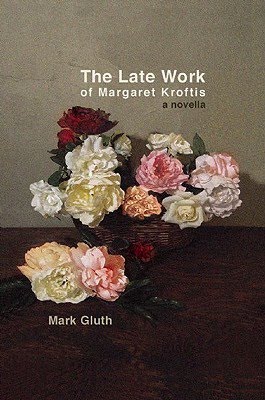
Brand new from Dennis Cooper’s Little House on the Bowery imprint of Akashic Books is a fantastic short novella by Mark Gluth, titled The Late Work of Margaret Kroftis. As with all the books on Little House, there is a certain air of magic, maze-making, language-play, and reinvention to be expected in those titles, and Gluth’s amazing webcomb of image and memory-tricks is certainly no exception. Reading this book it felt aurally pleasant in a way of great refreshment, with mirror time worming and layers of photography and weaving of levels of consciousness and continuity, all in very brief, clean sentences; a beautiful package with one of the most memorable endings I’ve read in a while. Feels of classical short French writing but in modern American scenery, which I can’t remember having happened in other books. A lot of people I will know will really like this.

Immediately after reading, I contacted Mark and talked to him some about the book, his process, language making, and so on. Our interaction follows, and I believe will make you, if you don’t already, want to get a hold of his beautiful text glyph.

READ MORE >

Uncategorized / 11 Comments
January 25th, 2010 / 3:04 pm

Contest winner/Annalemma call for submissions

by Chris Killen is the winner of HTMLGIANT & Annalemma’s “When Writers Get Off” contest. Congratulations Chris. Some notes from judge Chris Heavener of Annalemma:

First of all, yall should be ashamed of yourselves and your filthy, disgusting, brilliant minds.

Outstanding In the out-of-control category:
– Jesus’ Cum
– 1984 = Nineteen-tranny-whores
– The Diarrhea of Anne Frank

Outstanding in the fucking hilarious category:
– Twats Heating Gilbert’s Grapes
– Leak, Mammory
– Dong of Solomon

Runner up: The Magic Mountin’

Winner: Finnegan’s Wank

Gives a new definition to masturbatory writing. Submit 250 words of this nasty novel and we’ll post on annalemma.net soon.

CALL FOR SUBMISSIONS: Annalemma will be publishing a collaborative effort entitled “Finnegan’s Wank,” a work of fiction containing multiple accepted pieces. Each writer is to submit ~250 words; one submission per writer, and, as succinctly offered by Chris, “No furries.” This is a private venture, independent of HTMLGIANT’s influence, and will be moderated autonomously henceforth. Thanks for playing along.

Contests / 18 Comments
January 25th, 2010 / 2:06 pm

Author Spotlight & Reviews

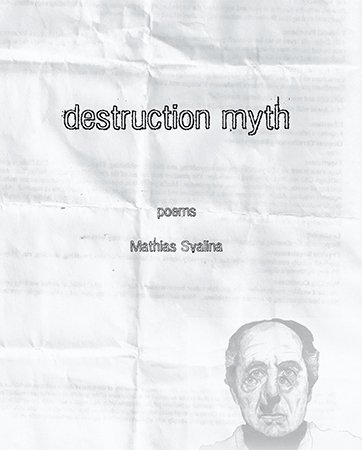
GIANT Review: Mathias Svalina’s Destruction Myth

http://2.bp.blogspot.com/_Dn9PVeD8ezA/Sw1HDfl5V1I/AAAAAAAAEgc/nXcej3O22ko/s1600/15138_188453413831_689168831_3842308_195102_n.jpg

Published by Cleveland State University. $15.95, 83 pages.

[NOTE: The author of this review discloses a high personal regard for the author of the book under consideration.]

The first forty-four of the poems in Mathias Svalina’s Destruction Myth are called “Creation Myth”—that’s all of them except the very last one, which happens to be the title poem. It would be easy enough, and also probably correct, to read deeply into the title, locate there the thematic and/or philosophical and/or theoretical matrix that centers and informs the work. One could go off on the whole thing about how all creation is in some sense a destructive act (even ex nihilo creation requires a rending of the nothingness that exists prior to thingness), or, better still, how even as creation is ongoing and ever-renewing, we can never escape the essential fact of destruction: the limitless variety of creation, for all its glory, can never not be overshadowed by the singular fact of destruction, the final and re-unifying change that awaits us all. But to be perfectly honest, I’d rather not get into it, because there are few things duller than diligent, well-intentioned exegesis, and a book as big-hearted and bonkers as this one deserves better.

READ MORE >

5 Comments
January 25th, 2010 / 12:31 pm

Collectors Of

Writer: What do you think about when placing stories or flashes or essays or poems or whatnot in a collection?

Order? Disorder? Intent?

Reader: How do you ingest a collection? Start to finish, left to right, top to bottom—blar!

Reader: A while back I was reading Drift and Swerve by Samuel Ligon and found myself intrigued by Nikki, a reappearing character. So I read all the Nikki stories first, then read the others.

Writer: Is a collection an album? Greatest hits, do you hear a single, does anyone remember the term concept?

Reader: This Richard Russo collection, it had a spectacular story, one, and the others…well.

Seems like you can crag in more tone shifts, more gnashes, poet. Can the prose writer do the same, or do these texts need to have some similarity?

You say hybrid, I say what?

Let’s bale these tendrillic texts, bathtub them, and call everything a novel! So clean!

OK.

Was just wondering. Etc.

Behind the Scenes & Craft Notes / 25 Comments
January 25th, 2010 / 11:25 am

This reminded me of Keyhole‘s handwritten issue: Stephen Lloyd Webber is looking for images of writers’ journal pages to launch his new literary magazine, Di Mezzo Il Mare. Send some snapshots if you’re interested.

Don’t forget this Thursday at 9 PM Eastern time marks the kickoff of our monthly online live reading series, Live Giants!, featuring Heather Christle, author of The Difficult Farm, live from her home in Atlanta. More info at RSVP at Facebook.

Burch Chapbook Winners

We were really blown away by the number of entries for the chapbook giveaway as well as the very interesting ways in which you take yourselves apart. Jereme, we would be inclined to answer your question with a question.  We thank everyone who entered.

Without further delay, Matt has carefully considered the entries, meditated, read some tea leaves and chosen his five favorites. If you’re one of these folks, e-mail me your address (roxane at pankmagazine dot com) and we’ll get the book in the mail to you early this week.

How the winners take themselves apart:

1. Teresa turns it up loud, takes an acidbath and gets sweaty.

2. Marco tears in with tongs and staple guns.

3. Bob follows the Way and does it ’til it’s done.

4. Cameron accomplishes it with panache, mustachioed.

5. Vaughan first undoes the leather.

Congratulations to you all and a big thanks to the anonymous donor who made this giveaway possible.

Contests / 4 Comments
January 24th, 2010 / 7:37 pm

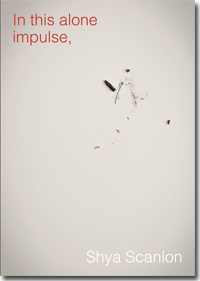
Shya Scanlon’s much anticipated In This Alone Impulse is now available for preorder from Noemi Press. “If Gertrude Stein ran track for Mineola Prep, she’d text these alert, convival poems from the team bus.” — Joyelle McSweeney

Comments Off on