
Lydia Davis Can and Will
 Can’t and Won’t
by Lydia Davis
Farrar, Straus and Giroux, April 2014
304 pages / $26 Buy from Amazon
Lydia Davis’ Can’t and Won’t is the latest offering from an author who, over the past few decades, has consistently confused notions of genre within literary fiction. A writer mostly of short fiction and a translator, notably, of Proust and Flaubert (whose letters supply the language for one series of pieces in the book), Davis is as at home with the authors of the late-twentieth century French avant-garde as she is with those of the nineteenth-century high-realist novel. As they do in all of her books, her stories work with minutiae of language and experience that are broadly accessible in ways that cannot be called simply conventional or experimental.
1 Comment
April 21st, 2014 / 10:00 am
April 21st, 2014 / 10:00 am
Interview With Luis Panini
 Luis Panini is one of the most talented writers you’ve never heard of. With writing that recalls the best of Franz Kafka, Lydia Davis, David Foster Wallace, and Julio Cortázar, it is a regret that his writing can not be read in English (until now! see below). I recently sat in on a class at CalArts where he was a special guest in my friend Laura Vena’s class on Latin American literature, and it was a huge pleasure to hear him talk about his writing and thought processes. Laura Vena translated a few of his short stories (or fragments) into English, the results of which can be found below, and so I’m hugely happy and excited to share this interview here and debut these new translations of his work into English.
Janice Lee: In your other life, you’re an architect and furniture designer. I’m interested in how this work and mode of thinking influences your stories. For example, the preciseness of your language, the constructedness of your stories as rigid and stable structures, your attention to spatial details and spatial relationships, and the existence of people and objects in physical environments rather than in relation to each other.
Luis Panini: My academic background has not only influenced the way in which I think about stories before I actually write them but also it has made me think about overall structures when I am constructing (not writing) a book, whether is a collection of short fiction, a novel, a book of poems or some piece of writing that does not necessarily falls into these ankylosing categories. Spatial awareness is very important for me since it is ultimately where the “game is played” and this is why I frequently try to inject some sort of symbolic meaning to both, the spaces my characters inhabit and the objects they come in contact with. In a way, what I am trying to accomplish is to integrate these “architectural objects” into the narrative in such a way that these become as important as the characters or the story itself. It is about translating the mere functionality of a space or an object into an emotional component in the writing process or how this space or object is acknowledged and assimilated by the reader. Duchamp’s “Fountain” comes to mind. He managed to transform a simple urinal into an object charged with many layers of meaning by placing it within the confines of a “sacred space.” Outside the museum, Duchamp’s piece is nothing but a urinal. Inside the museum is everything but a urinal because the reading conditions of this object have been transgressed. This is the sort of relationships I like to establish between my characters and the space they move about.
JL: You’ve described your stories as vignettes or fragments, and I think they operate in this way, but too, at the same time, they seem like such self-contained and intentionally built structures that do have set boundaries. Can you talk a bit more about the general shape of your individual stories?
LP: I did refer to those texts (the ones collected in my second book) as vignettes or fragments because that is truly what these are. They are absolutely self-contained pieces of writing. I like to think that the most interesting building block in writing is not the sentence, the paragraph, the chapter, etc. but the fragment, because a fragment does not require a beginning or an end, it does not need to tell a whole story to work, it does not have to acknowledge the fragment that precedes it or follows it and I find this to be truly liberating, a sense that I do not get when I take a different approach. About a year or two ago I finished writing a book that deals with memory and it is comprised of more than one hundred fragments. There are two versions of that book. In one version the fragments follow a chronological order of events and in the other version the fragments appear in the order in which they were written, the order in which I remembered a loved one who died recently. I chose to write about that story through fragments because in a way I wanted to emulate the mechanisms of memory and a fragmentary approach made perfect sense since I could experiment with the elasticity of the overall structure (or lack of one) by allowing a virtually infinite number of permutations. This also allowed me to set very strict boundaries on a fragment bases that I had to respect as I was writing each line. Every time I deviated in any way from those boundaries, the fragment did not work. It felt like an ill-conceived part of a whole. Through this method of writing I learned about the shape of not just individual stories but also how these can be connected in a book and how they interact among themselves by borrowing, cannibalizing from each other, etc. A book composed of fragments can be dozens of different books, only limited by the sequence you end up choosing.
JL: I know you are a Béla Tarr fan too, and I find that there are some resonances in your work with Tarr’s fans. For example, the focus in your stories is often on a person’s existence in a space or situation, and the story settles in on the details of the environment, constructing a scene that becomes a sort of story, rather than a story that is based on action and resolution. This reminds me of the indifference of the camera in Tarr’s films too, where often the setting is there before a character enters, and remains there after the character is gone. What are your thoughts on this observation?
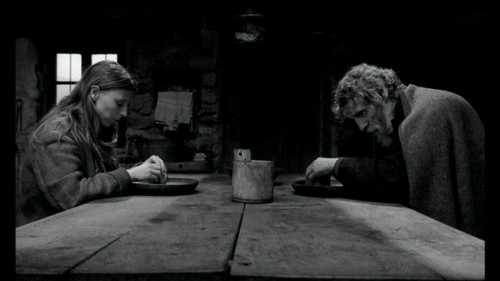
LP: Sometimes I think that filmmakers are the ones who truly influence my creative process and writing methods, much more than literature in general or specific writers and books, and this has nothing to do with the fact that I live in Los Angeles, a city in which if you mention that you are a writer most people immediately ask you what screenplays have you written. Béla Tarr is one of these auteurs (I can’t tell you how much I enjoyed seeing that old man peeling potatoes in “The Turin Horse”), but also I am fascinated with the way other directors choose to tell stories, like Michael Haneke, Yorgos Lanthimos, and my personal favorite Ruben Östlund. I am not trying to say that my literary work has a cinematic quality or that it could easily be translated onto the screen, but this element becomes quite obvious since I tend to favor heterodiegetic narrators in most of my texts. I like to take it to the extreme, turning them into machine-like narrators which can be perceived as actual cameras panning through multiple rooms in a residence to create some sort of long shot composed by zoom-ins, abrupt cuts, blurs, etc. My vignette titled “The Event” is an example of this. After the character has “disappeared” in a very tragic way the camera goes back into the apartment where it all began and stays in recording mode to capture the solitude of the space, which to me is far more important than the demise of the actual character. In another vignette the narrator also acts as a camera that moves inside of a mansion to capture many of the possessions of a lonely man dying of complications related to an immunological disease. I was not interested in that man’s story specifically, but in how I could construct one by describing the pieces of furniture and ornaments he owns, the art hanging on his walls, and the materials and finishes of his home. I guess by doing this I am trying to illustrate some sort of terror that sometimes keeps me awake at night, the fact that after one dies everything else remains in its place, unaltered, because we are that insignificant. And it is this sense of pervasive malaise what informs most of my writing.
JL: I’m affected deeply by level of compassion and human dignity present in Tarr’s fans. On this subject, Andras Balint Kovacs writes:
“The man, whose philosophy despises ‘humanist’ feelings like compassion and pity, suddenly and certainly unwillingly, manifests the deepest compassion for a helpless living being, a beaten horse. This event, says Krasznahorkai, is ‘the flashing recognition of a tragic error: after such a long and painful combat, this time it was Nietzsche’s persona who said no to Nietzsche’s thoughts that are particularly infernal in their consequences.’ This is the example which leads to a conclusion about the universality of this feeling: ‘if not today, then tomorrow… or ten, or thirty years from now. At the latest, in Turin.’ … an attitude or an approach to human conditions, which Tarr fundamentally shares with Krasznahorkai… Both authors have a fundamentally compassionate attitude toward human helplessness and suffering in whatever situation it may manifest itself, and of whatever antecedent it may be the result.”
In Tarr films, compassion can exist without moral judgment, or, in other words, “In the Tarr films human dignity is not based on morality. It is based on the fact that in spite of their absolutely hopeless and desperate situations the characters remain what they are, however low what they are brings them.”
This simultaneous closeness and distancing, this empathy is ever-present in your stories for me too. For example, in “Mathematical Certainty,” there is a deep care in the description of the hat, but also in the generous curiosity afforded to the man with the brain tumor. I also recently heard Lydia Davis talk about description, and said something like, “In order to describe something, you have to love it. Even if it’s ugly, like an old shoe, you have to love it in a way to really describe it.” The preciseness of your language and the kind of curiosity afforded by such a detail as the length between the interior wall of the hat and the tumor, seems like a generous gesture in a way. What are your thoughts?
LP: I believe empathy and compassion is what drove me to write the vignettes included in my second book, as strange as that may sound given the dark nature of the overall subject matter of those texts, which is ill will. In fact, I can pinpoint the exact moment that acted as the catalyst. Back in 2006 there was a terrible brush fire, which consumed an enormous area near Los Angeles. For some reason that I yet have to comprehend a news show chose to broadcast a recording with no “viewer discretion advised” warning beforehand. I saw the body of a fallen hare partly carbonized. It was still moving, shaking the rear legs, convulsing, agonizing. And it affected me so much because animal suffering is something I simply cannot deal with. So this visceral reaction prompted me to explore this feeling in different ways, in fact so many that soon became a book about ill will. Ill will towards animals, patients with terminal diseases, sexual partners, art, even towards the reader. The main character in “Mathematical Certainty” is a man who soon will die of a brain tumor he has chosen not to have surgically removed. Instead, he decides to buy a white hat to conceal, maybe in an unconscious way, this organic tissue developing inside of him. Growing up in a predominantly catholic environment I heard many people say that the real reason why a man or a woman got cancer was the result of divine punishment, as if sinful behavior (whatever that means) could trigger it. So, in a way, that particular vignette is about religious ill will, the supposed shame caused by the disease, thus the comparison between the hat and a crown of thorns. Again, I was not too interested in the life of this character, but in presenting a juxtaposition of elements, such as a man fully dressed in white with something truly dark growing inside of his skull, and more so in determining the distance between the interior wall of the hat and the tumor, because those particularities or insignificances are what fuel my desire to write. I don’t want to write about the victims of a serial killer or the reasoning behind his actions, instead I want to write about the way in which this terrible person peels potatoes.
6 Comments
January 15th, 2014 / 10:00 am
January 15th, 2014 / 10:00 am
Leaving Proust
Part 1
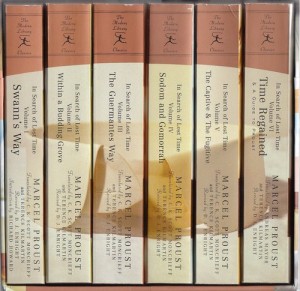
I recently finished Marcel Proust’s seven-volume novel In Search of Lost Time. As I read the last sentence, which appropriately ends with the word “Time,” (clever Proust, very clever) I felt a range of unexpected thoughts and emotions. I knew that I deserved the biggest cookie in the world. I also wanted a sign from the universe to acknowledge this labor of love, because I could be sure as shit that no one else in the world would really care about this personal accomplishment. I just wanted to brag and walk around the city, challenging people by saying, “Hey, I just finished the longest novel ever, what, do somethin!” though I realized that most people would laugh at my pretentiousness. So, instead, embracing the dorkiness of the endeavor, I write about my experience and will wait for the countless plaudits and emails to race my way. Here we go! (Disclaimer: If I sound a bit oh-look-at-me pretentious, please forgive me, I deserve something for this effort. LET ME HAVE THIS.)
Some context/backdrop: Proust and his posthumous publishers split up his over 3,000 page novel into seven volumes. That comes out to over 1 million words, and if you’ve ever tried to read any of his volumes, you know the most prohibitive parts are the never ending sentences and paragraphs. You need to forget about that frequent reinforcement you get in reading that comes from the end of a sentence, paragraph or chapter. This in no way exists in Proust, and you need to give up any expectation of those consistent reinforcements that allow us to finish long literature. This takes time to get over, and I don’t know anyone who can say that the beginning of Proust was smooth or easy sailing. It takes time to learn how to read the book, though Proust will teach you the best way to read his writing, which is very nice of him.
I read this novel over a period of five months, from June to October, but I must mention that I attempted to read the first volume, Swann’s Way, at least twice before to little success. The first two times I made this endeavor, I actually grew to hate Proust. In my arrogance I thought that if I could not even get through one page, then the problem must lie in the author, not in me, the great reader. I soon realized that, attempting to read Proust, even at the age of 21, and then 23, I was neither mentally nor intellectually prepared. It requires some real high level discipline, patience, and even more patience. (If Proust gave me anything, and I would contend that he gave me a lot, he at least gave me a widened attention span. Now, I’ve moved on to reading all of Tolstoy and I find his large books breezy compared to Proust.)
17 Comments
December 28th, 2012 / 12:00 pm
December 28th, 2012 / 12:00 pm
wallop
And the trouble people took to attach a modern-sounding label to these texts and to create a special genre-haven’t there been short texts since way back when? So people were, perhaps they still are, fidgeting with blaster, sudden fiction, flash fiction, prose poem and attempting to segregate these texts. The quality of the thing ought to be foregrounded. -Diane Williams
I believe a reader must work harder in interpreting flash, filling in those gaps with his or her own experiences. -Kim Chinquee
I love the immediacy of the medium–of reading a story that is not only compressed, but memorable in the images that are presented. -Meg Tuite
I had long admired the very short stories of Kafka, Borges, Hempel, others, before I gave the idea of length any real thought. -Pamela Painter.
I’ve been very interested to see what different writers have done with the very short form. It can go in so many directions, and whether one chooses a sort of mini-essay or mini-narrative or prose poem, meditation, etc., each will be quite different because the mind of each different writer comes through so clearly–the writer’s way of thinking, viewing the world, and then of course his or her way of handling language. In such a short form, each word has to be right. -Lydia Davis
I think my stories start fairly short, somewhere in the neighborhood of 200-300 words, and often stay there. -Chella Courington
I’ve always read the shortest stories I could get my hands on. It’s always appealed, the power to receive the full scope of a piece, to tour all the feelings the writer wants you to feel in one uninterrupted moment. It’s so easy to be brutal without consequence to characters in the shortest form. -Amelia Gray
I also think it’s the least egotistical form of writing. Not a lot of show-offs go into writing flash. None that I know anyway. -Mary Hamilton
“Disagreement” by Lydia Davis
Three months ago I sent in the final version of my manuscript to Amanda and Joseph at Caketrain. To celebrate this accomplishment I bought a PS3 and a copy of Call of Duty: Black Ops, which I played for nearly every day until about a week ago when hackers completely shut down the Playstation Network, suddenly dumping me back into reality.
In the resultant silence, I returned to books, reading in two days the entertaining Aurorarama by Jean-Christophe Valtat, which I recommend. I read In Watermelon Sugar by Richard Brautigan during two consecutive lunch breaks at work. And then I reread a favorite, Stories in the Worst Way by Gary Lutz, to finally recharge myself.
A Metaphysics of Emma: Madame Bovary Today (NB: spoilers near the end)
Frederic Jameson, reviewing Sartre’s The Family Idiot for the NYT in 1981:
Sartre had always seen literary works as responses to concrete situations, responses that become intelligible only when grasped within those situations. He now draws the unexpected consequences: Like tools, literary works outlive the situations for which they were intended, and they are passed down with a new material inertia. ‘The tradition of all the dead generations,’ Marx said, ‘weighs like a nightmare on the brain of the living.’ The artists of Flaubert’s generation had no way of understanding the practical purposes for which the older generation had invented their now inert themes: critical negativity, misanthropy, the ideal of classlessness, the defense of the autonomy of the intellectual (which will now be ‘mistranslated’ as art for art’s sake), and a quasi-religious conviction of the nothingness of the world and the emptiness of life. Crippled by the themes of their predecessors, the following generation became artists without inspiration. This was not a subjective matter, a lack of talent or vocation. Rather, Sartre’s idea of the practico-inert -the weight of so many dead artistic ideologies from an incomprehensible past – suggests a situation in which it was objectively impossible for them to have something to say.
This nothing-to-say–the trajectory of an incomprehensible past–will be our focus in the beginning. First there is the fact of time.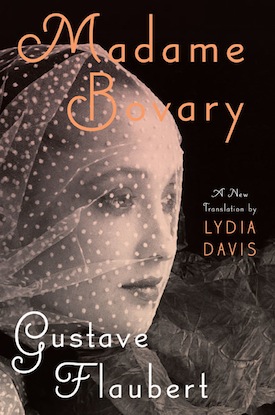 There is its sense. Space becomes subordinated to time in Madame Bovary; space is now the reflection of time’s passage, its here-and-there deposit, its surplus. But there is another mistake of time: the time of Madame Bovary, in contrast with time in Madame Bovary.
Madame Bovary is first serialized in 1857. Lydia Davis’s translation–if not a watershed moment then an event, or a watershed of an event of some sort–appears in 2010. Davis wants to reproduce Flaubert’s style, which is his novel’s vocation and substance, in English: his quirks of tense, the intensities of his adverbs, the subtleties of his free indirect style. I wouldn’t go so far as to say that Davis’s task is to mirror the French, but faithfulness is indeed a primary concern of hers. How does Madame Bovary change through time? Moreover: how, and with what appurtenances, with what way of reading, do we understand Emma’s caresses, her infidelities and her ennui, in October 2010?
8 Comments
October 18th, 2010 / 11:02 am
October 18th, 2010 / 11:02 am
Paris Review Blog 404
This is why I like the internet somewhat: Joyce typos caused by quick updates even from the glossies.
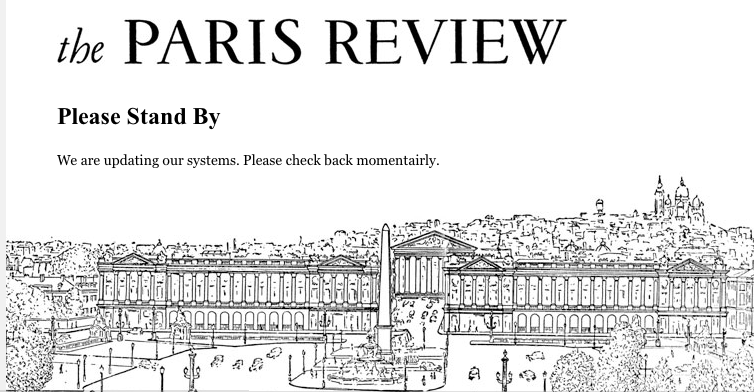
Or maybe it’s no typo? Maybe “momentairly” is a more beautiful way to remind you that on the internet part of the fun is the making of whoompers, and sometimes whoompers are the charm.
Anyway, in however long it takes a momentairly to pass (perhaps it is over by the time you are reading this, realtime, shooing this icon to the PR web fodder bin), the Paris Review blog will return with a two week series of guest posts featuring Lydai Davis considering the act of translation, which we could surely use some help with anytime.
4 Lick-n-Catch
1.) New Diagram 10.1. It be sick like light socket soup. Go stain yourself.
2.) Russia glow will dig Moscow & St. Petersburg 1900 to 1920: Art, Life and Culture in Russia’s Silver Age and this Bookslut interview.
3.) What book speckles/sighs the floorboard of your car right now? I have a copy of Hayden’s Ferry, a Gary Lutz, and a 2009 Best Magazine Writing. The Lutz has a snow/melt coffee stain on its cover and I haven’t even spatulaed the book yet. Oh well. Won’t hurt the sentence none.
4.) The Cows
httpv://www.youtube.com/watch?v=q8SsY3AFdBU
NEW Electric Literature Single-Sentence Animation: Lydia Davis
httpv://www.youtube.com/watch?v=q8SsY3AFdBU
Uncategorized / Comments Off on NEW Electric Literature Single-Sentence Animation: Lydia Davis
December 17th, 2009 / 1:03 pm
December 17th, 2009 / 1:03 pm
Unhumorous Punchlines
The MotherThe girl wrote a story. “But how much better it would be if you wrote a novel,” said her mother. The girl built a doll-house. “But how much better if it were a real house,” her mother said. The made a small pillow for her father. “But wouldn’t a quilt be more practical,” said her mother. The girl dug a small hole in the garden. “But how much better if you dug a large hole,” said her mother. The girl dug a large hole and went to sleep in it. “But how much better if you slept forever,” said her mother.
“The Mother,” a short piece from Lydia Davis’s Break it Down, perfectly demonstrates, for me, the unhumorous punchline where the last line and components leading up to it operate as a joke, but aren’t funny. Punchlines at their best are oblique and unexpected; it’s the minor epiphany of “getting it” that makes them so visceral — keyword here, because what begins in the brain ends in the gut.