
25 Points: Michael Kimball Writes Your Life Story (on a postcard)
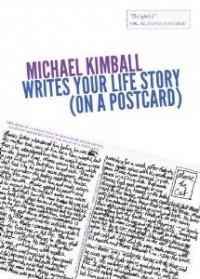 Michael Kimball Writes Your Life Story (on a postcard)
by Michael Kimball
Mud Luscious Press, 2013
162 pages / $15.00 buy from SPD or Amazon
2 Comments
March 21st, 2013 / 12:09 pm
March 21st, 2013 / 12:09 pm
ON CARDBOARD: Michael Kimball
Michael Kimball still feels like a bit of a sleeper hit. It’s not as if people aren’t reading him, or discussing him, or heeding his presence in general on earth; but when you yourself pick him up and feel the various array of facial slaps he harbors in his repertoire, you can’t help but think his work’s been waiting around for you to discover and devour it.
@MichaelKimball
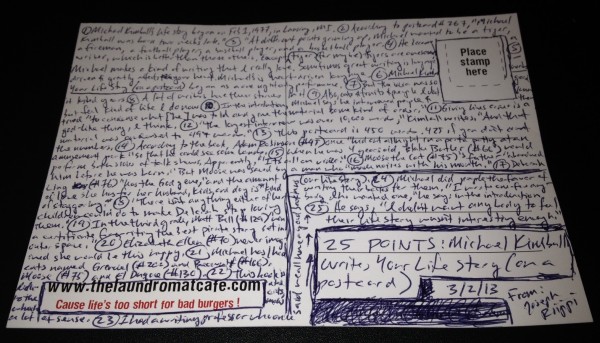
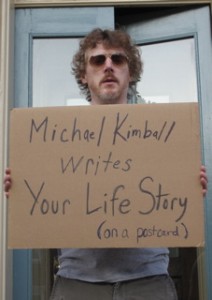
Kimball’s already been discussed, reviewed, and interviewed in and around the online literature sphere, so that’s not what this will be. No. This is the result of one day having opened in congruence Kimball’s Twitter page, and a page of blurbs re: Big Ray. His Twitter avatar is a picture of him holding a cardboard sign that reads MICHAEL KIMBALL WRITES YOUR LIFE STORY (ON A POSTCARD) in promotion of a series of posts on Kimball’s blog where he writes the stories of various writer’s/friend’s in the space allotted by a postcard. The juxtaposition of this and the reviews of Big Ray made me realize: I want to review books on slabs of cardboard exactly like that, but weirder, maybe.
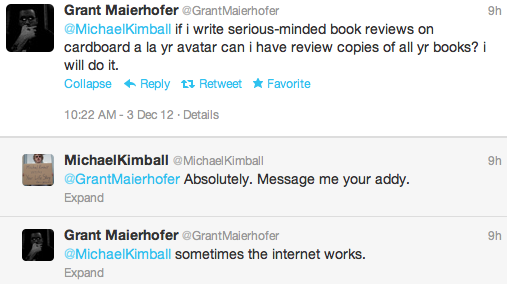
I tweeted to Kimball about the possibility (see below) and, solid dude that he is, he obliged. What follows are those reviews.
There will be two reviews, essentially; the first being a photograph of a large readable-from-a-distance review of the book without any corresponding text below. The second will be a smaller-but-still-fairly-large review of the book on the back of said cardboard with the text transcribed below.
Why the hell am I doing this? I guess from the get go I was never going to write normal reviews of anything. I’m terrible with journalism and essays have always eluded me. At best I can write a decent rant about shit I love, and this seemed an original way to describe art that I’m fond of while not getting too far outside the realm of reason.
5 Comments
March 4th, 2013 / 12:00 pm
March 4th, 2013 / 12:00 pm
25 Points: Big Ray
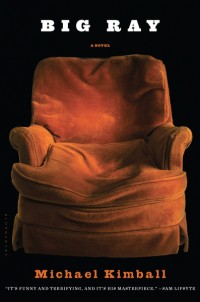 Big Ray
by Michael Kimball
Bloomsbury USA, 2012
192 pages / $23.00 buy from Amazon
1. Big Ray blends genre between flash fiction and novel.
2. Each chapter within the work is told in first person confessional episodic moments, which read as a short flash fiction piece which could be read on its own as a complete story.
3. Each of the flash sections rarely surpass 200 words, though the sizes ebb and flow throughout.
4. Kimball heightens intensity by elongating the more anxiety-ridden sections of the book and in parallel compresses the sections which give appropriate if not beautifully told anecdotal backstory. In doing so, Kimball is showing his expertise as the mark of his incredible ability to craft story.
5. Michael Kimball is one of the nicest guys as a person in “the business.” Also, he can write. Dude can write.
6. Kimball is opening the reader to a complicated familial past quickly.
7. We are witness to Big Ray’s past and the way in which his ether has an everlasting effect on our narrator. As our narrator walks between Big Ray’s passing and their intertwined past as father and son Kimball provides us with generously rendered unfolding history, and in doing so, illuminates a thick, vastly layered novel which reads painfully, slowly, like ice melting in the most profound way possible.
8. “It makes him look as if he’s about to do some damage.”
9. Heartbreakingly, there is a kindness at work, a tongue in cheek commentary about the ways in which people, motivated by their own intentions, are terrible to one another, observe:
“Here’s what happened: After high school, my father went into the Marines and my mother went to college. My father lived in the barracks with dozens of other men and my mother moved into an apartment with a roommate who she didn’t know particularly well. To fill in the space between them, my mother and my father wrote letters to each other for months.
Then, without any explanation, my mother stopped receiving my father’s letters. Not long after that, my mother stopped writing letters to my father. Neither one of them knew what had happened. They both waited for months, thinking the other one had stopped writing.
What my mother didn’t know was that my father was still writing her letters. What my father didn’t know was that my mother wasn’t receiving the letters. This was because my mother’s roommate would come home to the apartment at lunch and steal my father’s letters.”
10. A part of the pain our narrator endures is a sense of trying to explain this narrative to himself. Which, is brilliant in that Kimball writes a guy who walks the line between reliable narrator and human being. He wants love, attention, appreciation, but imposed a sense of failure on himself, which leads to resentment and anguish again. What Kimball can do is paint, for any person, the pain felt in never really connecting with a parent, yet simultaneously connecting with a parent by default.
“My father’s life was an ordinary one in so many ways. I wonder if I am making him into something more than he was because he was my father.” READ MORE >
5 Comments
January 10th, 2013 / 12:04 pm
January 10th, 2013 / 12:04 pm
Eating Donuts with Michael Kimball
I showed up at Michael Kimball’s sweet new condo with a dozen donuts.
His father was a fat man, like the title character in Big Ray, Kimball’s latest novel that you’ve heard so much about. We poured out glasses of orange juice, and in memory of his father, dug into those gross ass donuts.
For the first twenty minutes of what would be a two hour conversation, Michael recounted the events of the previous Saturday night, a rowdy, drunken time we had that I beered out of memory. Listening to the stories was like hearing about myself as if I was my own close friend who missed a party I threw.
Reading Big Ray is like hearing about an equally close friend processing some serious loss. Michael Kimball does emotional immediacy better than any writer alive, I shit you not. READ MORE >
I Wish I Sat Under Trees More: An Interview with Sheila Heti
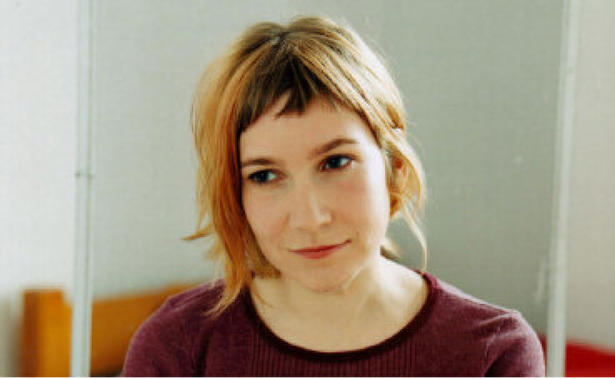
Sheila Heti is the author of five books: the story collection, The Middle Stories (McSweeney’s Books); the novella, Ticknor (Farrar, Straus and Giroux); How Should a Person Be? (Henry Holt); and an illustrated book for children, We Need a Horse (McSweeney’s McMullins) featuring art by Clare Rojas. With Misha Glouberman, she wrote a book of “conversational philosophy” called The Chairs Are Where the People Go (Faber), which The New Yorker chose as one of its Best Books of 2011. She works as Interviews Editor at The Believer, and has contributed long interviews with writers and artists to the magazine.
Michael Kimball: I feel as if I should know why the collection is called The Middle Stories, but I don’t. Tell me?
Sheila Heti: I had been writing these short stories for a few years, in my early twenties, not thinking they would end up as a book, so the stories came first. Then the manuscript. Then I had to think of a title. I spent a lot of time on this, consulting a thesaurus and drawing little book covers in my notebooks. One day between classes (I was university at the time) the title just came to me: The Middle Stories. Pretty instantly I felt a kind of relief and pleasure. I liked the way it sounded. It made sense to me. It was one of those situations where you make your brain work really really hard on a puzzle, then the solution comes from some other-brained place. I recall trying it out in phrases, “Have you read The Middle Stories?” — imagining writers I knew saying it.
A Kind of Weird Beauty: Michael Bible’s Simple Machines
 Michael Bible is the author of Cowboy Maloney’s Electric City, as well as the chapbooks Gorilla Math and My Second Best Bear Rug. He was winner of the ESPN: the Magazine/Stymie fiction prize. He lives in Oxford, Mississippi where he edits Kitty Snacks.
Michael Kimball: I’m curious: How did you get the title? That feels like it must have been a key to writing the piece.
Michael Bible: As far as Simple Machines goes, the title actually came to me after I wrote it, but you’re right, it sort of crystallized it for me. I started the manuscript after I read The Policeman’s Beard is Half Constructed and I was playing around with random sentence generators and ESL textbooks. I love sentences that are used as examples for school. (Has someone written a book of word problems? Also, that would be a good title. Probably somebody’s written it.) There is an oddness to those example sentences that I love, “bad” writing as “good” writing. They have a kind of weird beauty and they seemly have no context but somehow make stories anyway. Simple Machines is also something I learned about in school so it made sense that that would be a good title. READ MORE >
Big Ray by Michael Kimball
Congratulations to Michael Kimball, author of Us, Dear Everybody and The Way The Family Got Away, because this: “I’m having a pretty great year so far and I feel really grateful for it. I don’t even know how to explain how grateful I feel. I’m so happy to announce that I just sold the world rights to a new novel, BIG RAY. It’s the story of a son coming to terms with the sudden death of his obese father. It’s told through 500 brief entries, moving back and forth between past and present, the father’s death and his life, between an abusive childhood and adult understanding. BIG RAY went to Kathy Belden at Bloomsbury USA, which will publish in Fall 2012, and Michael Fishwick at Bloomsbury UK, which will publish in Winter 2013.”
A letter to Michael Kimball
Dear Michael Kimball,
In perhaps a not entirely sober state, I started your book Us on Saturday night. It was midnight, plus or minus some time. I had many other books to read, but I started your book, and after I read the first paragraph, I wanted to read the whole thing, that night, but I fell asleep on page fifty, plus or minus some pages, and all night while I slept, I was angry at myself for falling asleep.
Michael Kimball, I started your book from the very beginning yesterday because I was perhaps not fully sober when I started the night before. I woke up unnecessarily early yesterday morning, despite having had a raucous night previously, not to mention the disturbed slumber, at 6:30. I propelled myself out of bed and picked up your book immediately. I read your book while I prepared my coffee.
Rather than check my email, I read your book.
I read your book while I walked to the café.
Elliot Feels His Feelings: an interview with Michael Kimball
Michael Kimball is now the author of three of my favorite books. Before I read his latest, US, I had read and loved THE WAY THE FAMILY GOT AWAY. Before I read US, I read and really, really loved DEAR EVERYBODY. And before I read US, I had purchased but had not yet gotten to HOW MUCH OF US THERE WAS.
Now there’s US: disarmingly simple, gorgeously structured, and as achingly sad a book as I have ever read. I had to stop a couple of times. I really did. The book’s elderly couple—so painfully aware of the fact that one of them is living the last parts of her life—are drawn so concisely, and the situation is so precisely rendered, it was hard not to spend all my time living in it even when I wasn’t reading the book.
Michael and I talked about DEAR EVERYBODY when it came out. When US appeared, we thought it might be nice to talk again.
***
Started your book last night. You are going to break my heart again, aren’t you?
Yes, but in a different way.
Why do our hearts have to break in so many different ways?
It’s one of the surprising things about life, right? When we learn that that can happen.
Or,
I think that it’s partly a structural issue, the heart’s strange shape. READ MORE >
Michael Kimball’s US [Tyrant Books, 2011]
At last in its U.S. edition, Tyrant Books makes their third release in the form of Michael Kimball’s gorgeous US (formerly released in a different version overseas as How Much of Us There Was).
This is one of like three books ever that made me cry. I read it in a bathtub, all in one go. It is essentially the story of a old man losing his wife to sickness, but rendered in a way that only Michael Kimball knows. You should find out.
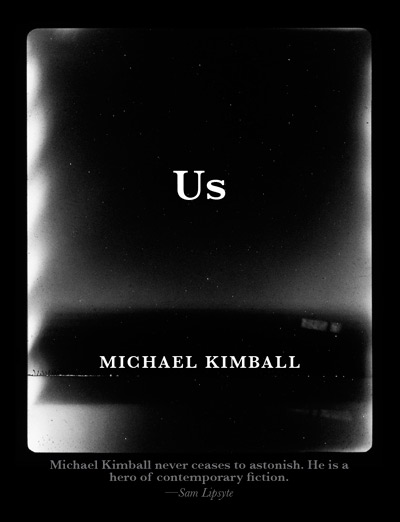
Shipping now from Tyrant Books.