
Magic: The Gathering, a review

Sometimes when we’re sitting at the dinner table, my partner looks at me and says, “Hon. Stop.”
I know what she means. She means that the table is shaking. The chairs are shaking. The room is shaking.
And it’s my fault. Because, unconsciously, I am bouncing my right leg up and down, and in doing so, I am shaking the table, the chairs, and the room.
She says, “Hon. Stop.” And I stop.
I stop for a while, anyway. Eventually, unconsciously, I start up again. And after a few minutes, she says “Hon. Stop.”
§
Magic: The Gathering is a collectable card game first introduced in 1993. It was created by a mathematician named Richard Garfield at the behest of Peter Adkinson, who was looking for a game people could play in between TTRPG convention role-playing sessions, or at home games while players waited for other players to arrive.
It’s like a combination of poker and chess, I guess? That’s how I’ve heard it described. Briefly: You have a deck full of cards (a library), you deal a hand of seven to yourself from that library, and you play them in a game that is about wizards doing battle with each other, where the cards are either a resource or a spell. You play the resource (mana) cards, and then you spend (tap) the resource in order to cast a spell that you use to try to whittle down your opponents other resource (life total). Cards interact with each other in interesting ways, and you can build your library in order to leverage all the possible synergies to win.
Poker has variants: stud, draw, Texas Hold ‘Em, etc. Chess has variants: different board sizes, random or alternate starting positions, fairy pieces, etc. Magic: The Gathering also has variants: Standard, Vintage, Pauper, Commander, etc.
Today, it is a billion dollar brand, with both its own deep and evolving lore, and relationships with existing and popular IPs in its Universes Beyond sets.
And like all things that people love, it is controversial within its fanbase, the source of strife and second-guessing, frustrating, beloved, fawned over, discussed at all different intellectual levels, copied, satired, the source of compensation-seeking content, conventioned, declared dead, declared revived, pirated…you name it.
§
“Hon. Stop.”
I’m lying on the bed, on my side, scrolling through something on my phone, and my leg is shaking.
“Sorry.”
I got it from my dad. I remember him forever bouncing his leg, sitting at the table, sitting in his easy chair watching TV. Even toward the end of his life, when he was on medication for his pain and anxiety, still bouncing.
But I don’t recall cards, whittling, knitting, juggling. He just bounced. He must’ve had something. If I could, I’d ask him.
Ah, well.
§
Lately, I’m obsessed with Magic. I play it online on both Magic: The Gathering Arena and on Magic: The Gathering Online. I play with my young son, and make decks for the two of us, I think about it, spend time online researching ways to get better at it (I’m terrible), watch strangers play it, annoy my wife with it, let it take up an ever-expanding section of my bookshelf. All that.
But mostly—and I swear I think this is really the reason—I spend my time shuffling sleeved up decks of Magic cards.
I like holding a pile of cards on the length and width, my right hand going middle finger and ring finger on top width, thumb on the bottom width, and then left hand on the bottom, thumb on one side of the length, middle and ring finger on the other. I like to split the deck in half, and then do an overhand mash shuffle sliding the pile in my right hand down into the pile on my left hand. And then I return my fingers to the previous hold and slowly, methodically tamp down the cards into a neat exact, pile.
Sometimes when I’m feeling anxious, when I’m sitting at the dinner table and the noise begins to get overwhelming, when dishes banging into glasses, or silverwear hits dishes, when the earplugs that dampen the loudest noises but still allow me to engage with others aren’t working, when I’ve moved my phone as far away from me as I can on the table so I’m not looking at it while I’m trying to eat, when all that is happening, sometimes I can feel my hands wishing for cards.
§
Repetitive movement is a well-known technique for self-regulation, and the act of shuffling cards is a successful technique because it provides predictable tactile feedback, and the cognitive demand, especially after years of engaging in the activity, is low.
There is the fingertip friction, the mirrored sensory experience of the card surface to both hands.
Shuffling offers a predictable, rhythmic sound, a quick, quiet patter of card against card, and there is a satisfaction to a competent, steady shuffle where every card in each of the two piles interweaves exactly and the rhythm is perfectly timed.
It offers: certainty instead of uncertainty. It offers: hands mirrored in space, exactly where one wants them to be. It offers: mild dopamine release. It offers: disappearance into task.
No interruptions or changes to the pattern. No goal except another shuffle.
§
My mother taught me to play solitaire in grade school, and I would play here and there. In my first semester of college (Go Fighting Phoenix!), though, I lived alone in an apartment in a city where I knew no one. I had a roommate, but he was always traveling for work—he was the son of a friend of my father—so it was just me. It was 1991, I wasn’t on the internet, and I had an electric typewriter for my assignments. I spent hours in the school library. And when I went home, I played solitaire.
Games and games of solitaire.
Which meant I shuffled my deck of red Bicycle cards over and over.
I’d listen to music and shuffle the cards, lay out the cards. Phwip, phwip, phwip. Play the black seven on the red eight. Phwip. Ace to the top row. Phwip. Sun goes down outside. Fail to complete the stacks, reshuffle. Start again. Dark outside. Desk lamp on. Sitting on my bed, laying out the cards, shuffling. Falling asleep past 2am with the stereo looping whatever is on.
Eventually, my roommate, on one of the rare days he was at home, asked if it was okay for a friend of his to move into his room, and I said yes. I didn’t really talk to this new person, but one evening, he walked by my door—shirtless…he was always shirtless at home, for some reason—and said, “Hey, how many games of solitaire do you play a day?”
I didn’t know how to answer him. I wasn’t sure. Dozens, I supposed?
“You know, you can play solitaire at casinos.”
I didn’t know that. I thanked him for telling me.
§
My phone has a number of notifications on it and I don’t really know how to turn all of them off. Or if I should keep some and get rid of others. What if I turn off notifications and something important happens?
So, I’m listening to something, and there is a notification about movement at the front door, and it’s a truck that drove by.
And then there is a notification for the rear outdoor camera, and it’s just a bunny running through the yard.
And then there is a notification for an email, and it’s just a Word-of-the-Day message that I don’t remember signing up for.
And then there is a ping about a text message, and it’s just a message from the place where we rented my kid’s trombone last year, and did I tell them I wanted to receive messages about trombones? I don’t remember doing that, either.
And then I am reminded to take my vitamins and SSRI.
I put my phone to the side, and I turn on the Focus setting to quiet the notifications, but I worry that if I don’t look at my phone every few minutes, I’ll miss a text from my partner, so I check, and I check, and I work, and I type, and I type, and then I realize I haven’t checked in a while, and I check, and there are four texts, three from my partner and the last one is “Hon?” because I missed a question that needed an answer urgently.
And then the same notifications are showing up on my laptop screen, but my eyes on the second screen I’m using to type this out. The laptop screen is in my peripheral, and a box just popped up on it. It startles me, that unexpected box popping up. I’m just here, a gentle gazelle, typing out a blog post, when out of the corner of my eye I see a carnivorous pop-up notification, warning me about an email from Wirecutter, who would like to tell me what the best rice cooker is for 2026. That email is going to eat me, my brain says. I should be on guard. I should be vigilant.
I put my earplugs in. I reach for cards and shuffle. I deal myself seven cards, as one does in Magic. I look at them. I play a land, and I pass. I draw a card, I play a land, I play a creature. I think through the lines, the proper sequencing of cards in hand to maximize efficiency.
§
In Magic’s resource management system, the resources are broken down into five colors. WUBRG–White, blUe, Black, Red, and Green. You can build a deck with cards that are all one color, or with multiple colors, and as a shorthand for combinations of colors, the designers have created two-color Guilds. Red and blUe is Izzet, named for Niv-Mizzet, the ancient dragon who founded the guild. It is blUe’s perfection-seeking study and logic with Red’s aggression and explosiveness. Green and Black is Golgari–the colors of growth (Green) and rot (Black) combined. It’s the nurse log, life growing from death, the endless cycle. It’s Herzog’s jungle, “overwhelming and collective murder,” but a murder that grows orchids from the bloody aftermath.
I like Orzhov. It’s the combination of white and black. And it feels like bureaucracy. White’s order, it’s community. Black’s sacrifice. The Orzhov Syndicate is Magic’s “Church of Deals.” Contracts are black ink on white paper. Contracts entice us. Contracts connect us. Contracts trap us.
Magic has a plane with a magical school called Strixhaven, and in Strixhaven, white and black is Silverquill, the magical rhetoricians. The writers. I used to be a writer, so I like Silverquill.
I enjoy the inevitability of death and taxes, so I like Orzhov. I love the bizarre, endless lawsuit in Bleak House. I like The Trial by Kafka. I like getting lost in a maze of words and walls. Old, empty, ruined buildings. Borges. The Marbled Swarm. Piranesi. House of Leaves. Ashbery. BLAME! de Chirico. Burial. NaissanceE. Control.
“Columnated ruins domino.”
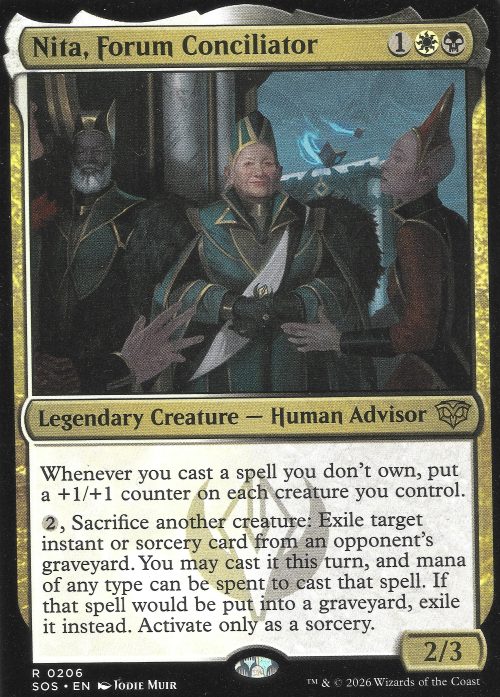
I made a Nita, Forum Conciliator deck recently, and it’s all about death and taxes. I sacrifice creatures from my board in order to take things out of my opponents’s graveyards. (Cards are permanent or impermanent. You play a permanent, like a creature, it goes to the battlefield and it stays there until it is killed and goes to the graveyard. You play a Sorcery, a spell with a limited effect, it does its thing and goes to the graveyard.). Nita digs into your history, audits your graveyard, digs up your bones and your secrets, your misplayed cards and your topdecked temporary triumphs. I make an army of weak little bureaucrats, and I sacrifice them to take the best things you’ve used away from you.
It’s my favorite. In the art on the card, Nita is an older woman, a formally dressed apparatchik. She has what appear to be the members of her forum with her, all in shadow while single light shines on her, a pleasant and passive look on her face. She appears to be ready to conciliate, to mend a conflict, to strike a bargain, to suggest a resolution, to help manage change.
And in the attire and the look in her eye, you can also see that she has a knife she will gently plunge into your back. She appears to you as a neutral party. She is from the Silverquill set, and thus, a member of school staff, one assumes. Good with words and adept at making others find compromise.
But look at that face. There’s an agenda there.
I’ve been making altered cards—versions of existing cards with art that I think also fits—and my Nita uses an Odd Nerdrum painting of a behatted woman holding what is, if the painting’s name is to be believed (and why wouldn’t I believe the painting’s name?) a door knob. But whereas Nita’s clothes are formal and crisp, this Nita’s clothes are ill-fitting and frumpy. She has a lazy eye, a dour face. She looks younger than the woman in Nita’s original art. In fact, she looks like a young person very incompetently cosplaying Nita.
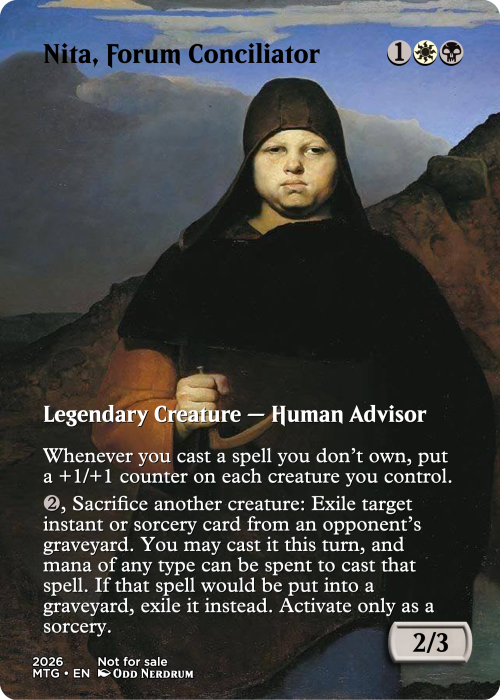
I’m a pretty terrible Magic player. It occurs to me that maybe making altered versions of cards that appear to be incompetent cosplays of the original cards is a reasonable way of illustrating that.
§
That’s the thing that makes me bad at it—I keep thinking of my deck libraries as a pile of sentences in a story instead of a set of interacting mechanics that can be mastered in order to follow lines of play that lead to game wins. I like to win but am usually surprised when it happens.
I don’t play to win. I’m sorry.
§
I volunteer in hospices these days. Not working with the clients, but making calls to the recently bereaved. I know it’s strange to say, but even though I could work from home, I prefer going in when I can. It’s quiet there. It’s all sad-eyed smiles and coping and almost no raised voices.
I like the moments when I walk from the temp office to the kitchenette to make tea or coffee. The halls are empty, the doors closed. Behind the doors, someone is quiet. People are masked. Families sit in the lounge next to the kitchenette putting together a puzzle. A counselor sits at a table with two people, talking through a pamphlet.
There’s a respect in the building. Everyone there respects everyone else’s need to exist in their thoughts. Everyone
§
Right now, my favorite deck to shuffle is a fully-proxied, 80-card Dandân deck, which I have sleeved in a set of Midnight Blue Dragon Shields.
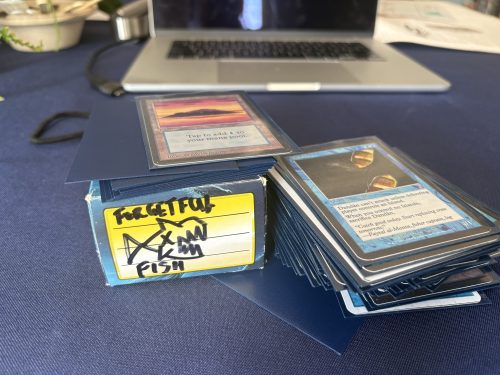
The sleeves are a little tackier on the transparent side, and slicker on the opaque side. The tackiness makes them easier to shuffle through in hand. The slicker side has a pebbled surface, given them friction.
And the proxy cards were printed not on a heavy card stock, but on a thinner photo paper, so they don’t feel like a deck of stiff Magic cards. They are more pliable. They shuffle together more easily. And even though there are 80 of them, they riffle shuffle on a tabletop easily. I like to cut the deck in two, and use the bottom corners to gather and intermingle them.
Sometimes I’ll grab a quarter of the deck, and hold the cards by the short ends with my thumbs and pointer fingers, and do a gentle, rhythmic bend. I had a Nabokov paperback that had a soft, giving cover and page quality that I would sometimes hold onto and bend back and forth, convex, concave, convex, concave, convex, concave.
Convex, concave.
I used to rub my thumb and pointed finger in small circles, feeling the smooth interaction between the pads, the whorls of the fingerprints, but then a few years ago, I cut my thumb washing a newly-sharpened kitchen knife so deeply I needed stitches, and now there is a scar across it. It doesn’t feel the same, doesn’t soothe and quiet my thoughts like it used to.
I leave the box for the Forgetful Fish deck on my desk and pull them out when I start to get too many notifications while I’m trying to type.
I wrote a lot of this in the backseat of my car while I waited for my kid to get done with their Sunday gymnastics class, typed it right into the browser, no wi-fi, no personal hotspot access. I was wearing earbuds with no music playing. No sound. No noise except for the occasional car honk from someone locking up their car with a key fob button, honking to affirm to themselves that they have locked their door. Sometimes even when I don’t have anything playing in my earbuds, I have them on. I don’t even realize that they are there.
§
        One gives pause to the other,
	Or there will be a symmetry about their movements
	Through which each is also an individual.

        It is their collective blankness, however,
	That betrays the notion of a thing not to be
        destroyed.

—From Flowering Death, John Ashbery (1979)
§
Magic: The Gathering—it’s fun. Nine out of ten. (A point deducted because it can be so darn expensive.)