

Sunday Service: Molly Brodak Poem
Hex
Gorges ago
in gymnasium-Church
under puff
of sleeve
in acid orange/
lavender/brown
& weak yellow
I felt punched
& sensed a new hollow
where a verse wormed:
He will spit you out
& the candy-bunny hollow
now punched
with He will spit you out
held hollows upon
hollows, cellless organs
& blank synapse billows
of He is not coming here
I am spit out after gorges of
gorges of minutes having
soft-snapped my tooth off
& held it all service
all heartless singing
all heartless repeating
held it under my tongue
finally spit from His mouth
the glassy hollow charm
& now feeling handless
& calm in gymnasium-Church
that one time only.
Molly Brodak is the author of A Little Middle of the Night (U of Iowa Press, 2010) and is the 2011-2013 Poetry Fellow at Emory University.
6
Gene Morgan—
The site was slow, so I messed with some stuff and made it faster.
Also, I felt like giving Htmlgiant an animated glitter star background, so I gave Htmlgiant an animated glitter star background.
Enjoy this special enhancement!
UPDATE: Removed the animation. :(
Favorite Passages from Deleuze & Guattari’s What Is Philosophy? (In Chronological Order)
To criticize is only to establish that a concept vanishes when it is thrust into a new milieu, losing some of its components, or acquiring others that transform it. But those who criticize without creating, those who are content to defend the vanished concept without being able to give it the forces it needs to return to life, are the plague of philosophy.
There is such force in those unhinged works of Hölderlin, Kleist, Rimbaud, Mallarmé, Kafka, Michaux, Pessoa, Artaud, and many English and American novelists, from Melville to Lawrence or Miller, in which the reader discovers admiringly that they have written the novel of Spinozism. To be sure, they do not produce a syntheses of art and philosophy. They branch out and do not stop branching out. They are hybrid geniuses who neither erase nor cover over differences in kind, but, on the contrary, use all the resources of their “athleticism” to install themselves within this very difference, like acrobats torn apart in a perpetual show of strength.
If philosophy is paradoxical by nature, this is not because it sides with the least plausible opinion or because it maintains contradictory opinions but rather because it uses sentences of a standard language to express something that does not belong to the order of opinion or even of the proposition.
Philosophy thus lives in a permanent crisis. The plane takes effect through shocks, concepts proceed in bursts, and personae by spasms.
We do not lack communcation. On the contrary, we have too much of it. We lack creation. We lack resistance to the present. READ MORE >
An Excerpt from Jarett Kobek’s ATTA
New from Semiotext(e) is Jarett Kobek’s ATTA, “a fictionalized psychedelic biography of Mohamed Atta that circles around a simple question: what if 9/11 was as much a matter of architectural criticism as religious terrorism?”
He prepares himself, watches television, hopes the box displays violence. But television is coy, intimates killings as abstractions. Beatings, certainly, beatings and brutality. But minimal death. Always the moment after. Police crash into a room, find a body, hunt the killer. But the actual kill? Off-screen. Or with guns. And what can he learn from guns?
Atta opens a video rental account, chooses movies that help with knowledge of death. He rejects Hollywood fantasies, imperialist propaganda efforts, prefers outlandish tales of monstrous abuse. The Horror section. Blood explodes in these films, bright red replica splashes on skin. READ MORE >
Nate Pritts’s Big Bright Sun
 Big Bright Sun
by Nate Pritts
BlazeVOX, 2010
100 pages / $16 Buy from Amazon
Nate Pritts’s Big Bright Sun celebrates witness, of one’s self and the self’s relationship to the world.
All of this is, frankly, // too much. When the bright red fire truck / zips (brightly) by I want to yell, “Here / is your emergency!” The red stop sign / sways gently in the bright wind not working // as usual. Today is still today. Time, / though brighter, passes normally. The difference // is that I can see exactly what I’m doing.
1 Comment
September 16th, 2011 / 11:00 am
September 16th, 2011 / 11:00 am
The One MFA Program to Rule Them All
Scott Kenemore is very angry that his beloved Columbia University has fallen to #47 in the Poets & Writers MFA rankings and he’s going to tell you exactly why Columbia has the awesomest MFA program in all the world.
1. Columbia is expensive and that makes it awesome.
2. Fancy writers teach at Columbia and that makes it awesome.
3. Writers who go to cheaper schools end up selling chapbooks in quantities of 500 (?) and teaching at those terrible regional universities in fly-over states so Columbia is awesome.
4. He has written six novels! All his Columbia friends are equally successful. Even though you may not be able to name one of his six books, Columbia is awesome.
5. Only writers who attend Columbia (or the one school he considers superior, Iowa) have genitals. The rest of you have the smooth plastic of Barbie and Ken so Columbia is awesome.
6. Unlike the thousands of writers at other MFA programs, or heaven forbid those writers who dare to write without the degree, students at Columbia want to be successful so Columbia is awesome.
7. The MFA rankings should include a category for manuscript placement and FOUR FIGURE advances so Columbia is awesome. (That last idea, minus the suggested prestige of a four figure advance is a good one.)
To summarize, Columbia is the awesomest and only MFA program worth attending if you are a serious, important writer. Other than Iowa.
Here is a rational, smart response to all this MFA ranking business (via Hobart’s Tumblr).
Wire to Wire
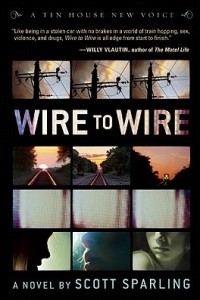 Wire to Wire
by Scott Sparling
Tin House Books, 2011
392 pages / $15.95 Buy from Tin House Books
Rating: 9.5
America is too diverse and American culture too fast evolving to produce A Great American Novel. I do believe, though, in an Essential American Shelf, as long as it needs to be to hold all the voices that speak artfully, truthfully and with compassion about their chosen hunk of psycho-social real estate. Scott Sparling’s Wire to Wire claims a place on my personal instance of that shelf, snugged up somewhere between William Kennedy and Charles Bukowski, between Theodore Dreiser and Flannery O’Connor, rubbing elbows with the best of the noir detectives and assorted snotty 1980s boy nihilists.
6 Comments
September 15th, 2011 / 3:07 pm
September 15th, 2011 / 3:07 pm
Unteaching in the Creative Writing Classroom

We do a lot of teaching in writing classrooms, but we also do a lot of unteaching. This is particularly true in introductory creative writing classes, where a large percentage of our work is undoing what teachers before us (in elementary and high school) have done.
I want to be clear that I’m not picking on English teachers here. Both of my parents and many of my friends are English teachers and I have the utmost respect for them. They do great work exploring the history and meaning of literature in their classrooms. Typically, though, they are not themselves devoted to the craft of imaginative writing. They’re literature scholars who are asked (sometimes against their will) to do a unit or two on creative writing as part of their curricula. Wisely, teachers in such situations often use the “Creative Writing Unit” as an opportunity to hone students’ skills in spelling, grammar, punctuation, vocabulary, and other fine points of the language. While they may be better off in terms of vocabulary and punctuation skills, there are often negative consequences for their creative compositions.
Below are some examples of these unintended consequences. These are bad habits I’ve seen young writers bring into my classroom and how I’ve tried to help them break free.
READ MORE >