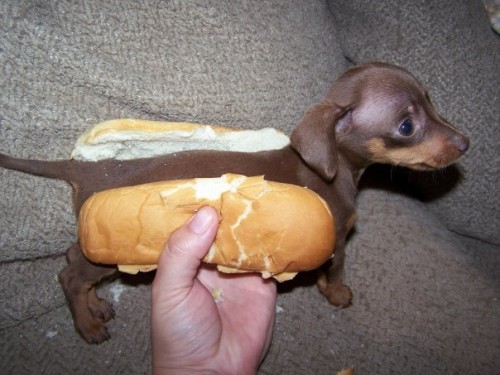
Hot Dog

How much my life has changed, and yet how unchanged it has remained at bottom! When I think back and recall the time when I was still a member of the canine community, sharing in all its preoccupations, a dog among dogs, I find on closer examination that from the very beginning I sensed some discrepancy, some little maladjustment, causing a slight feeling of discomfort which not even the most decorous public functions could eliminate; more, that sometimes, no, not sometimes, but very often, the mere look of some fellow dog of my own circle that I was fond of, the mere look of him, as if I had just caught it for the first time, would fill me with helpless embarrassment and fear, even with despair.

first few lines of “Investigations of a Dog” by Franz Kafka (translated by Willa and Edwin Muir)

Excerpts / 14 Comments
January 13th, 2010 / 10:15 am

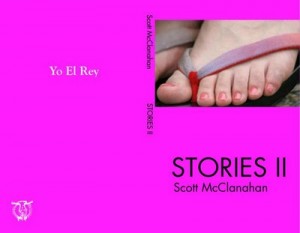
STORIES II: A REVIEW, AN ESSAY BY THE AUTHOR AND A STORY FROM THE BOOK

Scott McClanahan is from West Virginia, which, as he has to explain to another person in STORIES II, is not just a part of Virginia, but an entire state of its own.  

READ MORE >

Author Spotlight / 11 Comments
January 13th, 2010 / 10:15 am

Fiction Writers Review does a Michael Czyzniejewski feature. We get an interview, all kinds of links you should touch with the tip of your tongue. (You move your mouse with your tongue, right? I mean you are at this site…) We get love for Michael. It is deserved.

Harold Bloom Viceland Interview

VICE: It’s disappointing because the internet could have been such a good thing. It could have been like an indestructible Library of Alexandria, but with porn.

BLOOM: This goes back to what I said about the saving remnant. You’re part of that saving remnant. As I’ve been saying for years: If, in fact, you have an impulse to become and maintain yourself as a deep reader, then the internet is very good for you. It gives you an endless resource. But if, in fact, you don’t have standards and you don’t know how to read, then the internet is a disaster for you because it’s a great gray ocean of text in which you simply drown.

Read a report today in the Yale Daily News that Harold Bloom has had to cancel his classes this semester due to illness. He’s had a brutal last several years, but had seemed to be doing well lately–up until today’s announcement, anyhow. Here’s hoping that this is just a blip on the screen for him. Anyway, the above is from a great, and weirdly sweet, interview that I just uncovered that he gave to Vice Magazine last year. It’s worth reading in full.

Lastly, since HB tends to be a lightning-rod for controversy and/or ignorant invective, you are hereby reminded that a man is ill, perhaps gravely so, and you are forewarned to say something kind/useful, or else keep your bullshit to yourself for once.

Author Spotlight & Web Hype / 49 Comments
January 12th, 2010 / 11:11 pm

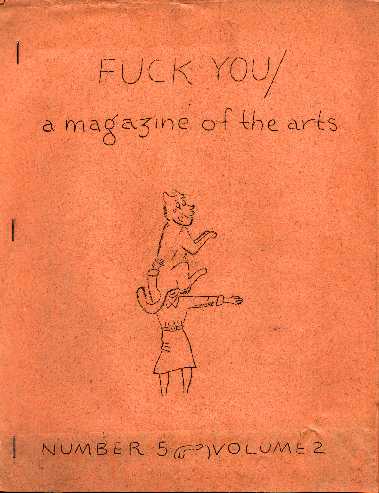
Fuck You

glow interview with Ed Sanders over at Poetry Daily. If you have seen it, Fuck You. If not, Fuck You.

It’s pretty good to write here, because people leave us alone.

Author Spotlight & Behind the Scenes / 3 Comments
January 12th, 2010 / 6:56 pm

Moves in Contemporary Poetry

Way back in the comments on Danika Stegeman’s poem “Panacea,” a discussion started about “moves” in contemporary poetry, and I mentioned that I’d seen the poet Elisa Gabbert start pretty awesome discussions about “moves” on her own blog and on the Ploughshares blog. Then she posted the following comment: “Hi Mike, I have definitely talked about moves before, moves I like and moves I don’t like and my own signature moves, but haven’t made a real list, certainly not a comprehensive list, certainly not the DEFINITIVE list. Let me know if you want to collaborate on a list of moves for HTMLGiant.”

Well, I thought that sounded like a terrific idea. So here it is, our stab at cataloging 41 popular moves in “contemporary poetry,” an exercise that’s fraught with peril, what with the competing definitions, camps, roles, and processes of “contemporary poetry,” the nebulousness of calling something a “move,” the inevitable non-definitiveness of such a list, and so on, but hey: dancing is fraught with peril too, and no one’s managed to stop me from doing that. So here we go. 41 moves. With mildly related pictures! In no particular order! Please argue and add in the comments. Many thanks to Elisa Gabbert for the bulk of the work on this list.

READ MORE >

Craft Notes / 229 Comments
January 12th, 2010 / 6:39 pm

Thinking about Intervals and Nature

As the new year and decade begin, I’m thinking about intervals. Most instantly, a year seems to be a more natural interval than a decade. Roughly the same things happen each year. There will be a shortest and a longest day and the air will grow warm and then cool again. The arbitrary part of a year is in its stopping/starting point. Nothing is magical so far as I can see about where we choose to end one year and begin the next. If anything, I’d prefer to wait until mid-February or so to conclude all of last year’s business and begin anew.

A decade in the natural world seems to mean not much. But what about in a lifetime? Age 0-10, age 10-20, age 20-30, and so–these seem a bit more adequate as era-markers. Even in the 1800s decades were given sobriquets. There were the Hungry Forties (think potato famine) and the Gay Nineties (aka the Naughty Nineties; aka the Mauve Decade). But not before that; what about modernity made the decade seem like a definable, describable, identifiable interval?

Day is perhaps the truest time-interval. The sun will rise and set. While a year is a real thing, a felt thing, it is usually too drawn out and diffuse to pinpoint or summarize in a word.  If you say that 2003 was a good year, I will know that it took the space of time for you to make that judgment.  Mid-year, there is no telling.  But a day has a character and a shape detectable even as it passes.  It is defined by its largest moment. It can be remade no more than once, and the next day may be something else entirely. “Weeping may endure for a night, but joy cometh in the morning” (Ps. 30:5).

These are time intervals. Modern space intervals mean very little (inch, mile, pint) and exist only for the purpose of standardization, ratio.

Then there are language intervals.

READ MORE >

Craft Notes / 42 Comments
January 12th, 2010 / 5:29 pm

An Indie Publishing Wiki

A while ago I talked about how I wished there were some kind of resource for independent publishers great and small and then Dave Housley and I started talking about how it would be great to start a wiki and then well, we did. The Indie Publishing Wiki is still in its infancy but I thought I would share the project’s existence so people can start adding their knowledge and participating in what we hope becomes a valuable resource for editors.

Presses / 23 Comments
January 12th, 2010 / 3:48 pm

“An Australian study found that every hour per day spent sitting in front of a TV or monitor raises your risk of early death from heart disease by 18%, even if you exercise and aren’t overweight.”    What??? (via Jezebel)

Mississippi Review flash fiction issue, guest edited by Kim Chinquee, includes some wonderful writers.