
so Roithamer.

I’d Probably Get More Replies if This Was About College Rankings

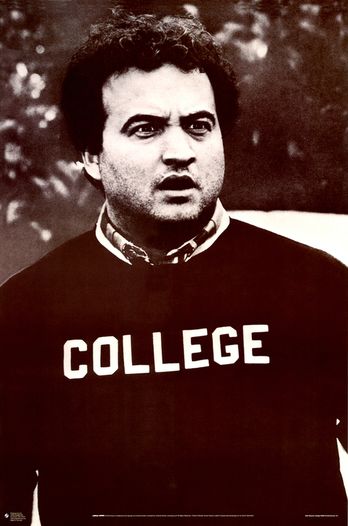
collegeThis may be  weak for mean week, but of late, after catching up with an old friend, I’ve been thinking about college majors and their relationship to what we write. Most people I meet now assume I was an English major, but I was history. Here’s the mildly mean part–I sometimes feel slightly, unjustifiably superior to writers who were English majors–it’s as if I mastered (or, I guess, bachelored) a whole nuther thing first, and they didn’t.

I know that college majors rarely relate directly to future career choice. But four years is a long time to think about something in a serious way. My history coursework was far more rigorous than my MFA work, and my history thesis was much more grueling as well. Somehow, knowing a lot about torture during the Algerian War must inform my writing. All of it does even more for my reading, probably. Context!

So, what did y’all major in? What relationship do you think it has to your writing, if any? If you were in English major, do you think that helps or hurts you, or neither?
Behind the Scenes & Mean / 91 Comments
October 30th, 2009 / 10:57 am

Breaking the Cycle of Consent: e-chapbooks

There is no such thing as an e-chapbook. And honestly, why would you want there to be? The very term shrieks “diminished expectations” and “compromised dignity.” This is no referendum on the quality of your poetry, which I do not doubt is lovely, smart, and in the words of Daphne Dunham writing about Dan Brown’s The Lost Symbol, “brain candy of the best sort.”

Nonetheless, “e-chapbook” is a non-form that somebody made up, presumably as a joke, but which, like everything else in the poetry world, seems doomed to invert the classic Marxist formula–ahem, flarf–by appearing first as farce, and then as tragedy, which is the late-stage of e-chapbookism in which we now find ourselves copiously sighing. Can you think of anything more ludicrous than the idea that the publication of a pdf file to a blogger page is somehow cause for a new entry on one’s bibliography? I can, but all the examples are about other things, like healthcare.

In poetry world, this seems about as absurd as it gets, and the logical extension of the poetry “pub-credit arms race” which, unsurprisingly, tends to do double duty as an all-purpose “race to the bottom.” The only thing that I wonder is whether the impetus is the result of cynicism, laziness, or a sheer lack of imagination on the part of so-called “innovative” publishers. Though, now that I’m thinking about it, I suppose there’s really no reason why I shouldn’t be generous in my thinking and assume it’s all three at once. It’s the same lamentable urge that causes poets to casually mis-identify “chapbooks” as “books,” as in, “I had five books last year, and three more are coming out in the next six months.”

Listen, I’m sure your poems are great and I’m really glad you have eight friends with access to a copy machine and/or letter press. Seriously. That’s awesome. (I have one friend who has these things–and I love him.) And I’ve no doubt–none whatsoever–that the work is deserving of–or perhaps better than–Allen Ginsberg’s description of Naked Lunch as “the endless [poetry chapbook] which will drive everybody mad.” Still, it must be said that you have not in fact published “a book” of any kind–not even of the chapbook kind, since the one thing one of the many and best things the chapbook has going for it is its built-in value as a limited-edition, a status necessarily contingent on the physicality of the thing itself. And if you’re wondering why “must it” be said– the reason is very simple: because you are standing there trying to convince me that you have. If you weren’t trying to lie to me, I wouldn’t be forced to tell you the truth about yourself. But by all means, do go ahead and fwd me that pdf file. I’m genuinely excited to see it.

Mean / 134 Comments
October 30th, 2009 / 10:28 am

Diameter of a Circle Jerk

Clio-CircleJerk-751056.jpgThe recent “Bubble Boy” hoax may be read as an example of how people are, or wish to be, famous for being famous. Think of “New York” (person) from Flavor of Love who got her own show for being an awesome ho, or  Octomom, or those bitches from The Hills or The Kardashians. People work on being famous instead of just working. These examples are “lowbrow,” but we are not exempt.
I have a hard time commenting on someone’s blog, or even this website, telling so and so I really liked their post or their story or whatever. If my feelings are very strong, I email them. If I can’t find their email, I say to myself: “This person will do fine in life without getting an email from me,” or “it should not matter to this person if I like their story — they should be writing on behalf of the story, not its reception.” And it all fits perfect in my head: 1) writers write, 2) readers read, and 3) everybody lives a nice modest life, 4) in relative obscurity, and 5) maybe one day, if applicable, a writer may be recognized, however mildly, for their contribution to literature.

READ MORE >

Mean / 102 Comments
October 29th, 2009 / 8:17 pm

Seen this Movie Before: All Publicists Go to Heaven….Don’t They?

And it isn’t even MEAN WEEK at the Rumpus! Click through anywhere to read the whole sick amazing thing.

The Rumpus received a press release for a new book today, along with a kind personal note. Unfortunately, we can’t cover every book that gets released. But since a lot of people who read this site have blogs of their own we thought we would share this press release with you. Feel free to contact the publicist directly.

***

Hi Stephen,

I came across your website and have a story idea that is appropriate for your readers. We have several options of how we can provide content for your site, too (see below).

TOPIC: Pets bring us joy and companionship. However, as with all living things, there comes a time when we have to say goodbye to our furry friends. Have you ever wondered where your pet goes after it passes from this place? Animal lover and rescuer Susi Pittman, who is often referred to as “Susi of Assisi,” explores this question in her new book, Animals in Heaven? Catholics Want to Know!

Mean & Web Hype / 6 Comments
October 29th, 2009 / 6:50 pm

Elitism: An Encomium

creamIf you are the among the best at something, who can blame you for wanting to associate with other people who are among the best at things, too? Like, if you’ve got the best tits, why shouldn’t you want to date whoever has the best hoodies, or become best friends with whoever’s got the best pepperoni? Why, at HTMLGiant, is elitism such a dirty word–and not the good kind that gets you cred in the comments section?

“Elite” means the choice part. The cream. The fruit. It seems as if among certain cohorts of writers and thinking people, this one included, some kind of stigma is attached to being, doing, or having the best, even if that superiority is hard-won and merit-based. And it’s even worse to demonstrate an affinity for others who you deem to be the best. Editors are called elitist if they publish the same writers over and over again or send form rejections. But an editor by definition must be selective, and choosy. Maybe we would choose differently than they would, but that’s why we all must figure out which publications we trust.

When someone cries elitist, to me it just sounds like envy at not feeling like a part of the elite. The envy is understandable! It’s nice here in the creamy, fruity elite. Wish I could extend an invitation.

Mean / 123 Comments
October 29th, 2009 / 4:26 pm

A (a dude, in midst of an actual conversation): Wait, Deb Olin Unferth isn’t famous.
C (another dude): She’s not? Of course she is. She’s famous.
A: Famous why? Because she had a book out with McSweeney’s and was in Harper’s?
C: People know who she is.
A: Writers know who she is. That’s not famous.
C: Famous, fine. She’s a buzzball. People talk about her. She’s famous enough.
B (a jew dude): Nobody is famous unless my grandmother knows who it is.
C: So are there any famous writers?
B: Philip Roth.

Remember Alone?

Writers:

Remember what it is to be alone?

Fifteen interviews after XXXX gets his book published by XXXXX XXXX Press. Constant promo. Constant talk. Talk about the work. ‘What brought this book out?’  ‘What were you thinking here?’

Use of words: Great, Beautiful, Amazing, Stunning, Remarkable.

After an hour of thought, I’d say that I’ve read two books that I would consider great in my proportion. Two books. I know it’s nice to be nice. That’s okay. But, please, as an excuse, do not use the ‘it’s tough to be a writer.’ No. It may feel tough, but it is not. Look around you.

To sum: I think that within the internet, writers can easily grab hold of a lot of pages and capitalize and gather attention.

Remind yourself: This is a psychic burden, this page. Is it worth it? Is it worth it for me and for the audience?

It is okay to be alone.

Have you ever said no to an interview? You can! You can, actually. It can be worth the gamble of pissing off the proposer. You don’t even need to tell them that it is because of you, because of your want to sit quietly and think, and work. Talk can be poison.

It’s a mistake for a sculptor or a painter to write or speak very often about his job. It releases tension needed for his work.  –Henry Moore

It’s easy to feel the frenetic prompts that the internet–and within it the communities–create. Resist them. Action for action is not action at all. It is movement. (Marketing is often the endgame for this movement; you create burden. Burden. Think about what you want to play, what you want to ask. What you want to give. Think long term. Ten moves in chess deep long term. Anything less than that is lazy.)

Resist the movement. Revolution, now, is a withdrawal.

Remeber what it is to write. Remember the seed?

The seed is you. Alone.

This is, as it must be, as much for me as it is for XXXX. For you. For me. One in the same here.

Random / 42 Comments
October 29th, 2009 / 3:19 pm

Lit Mags as an Empty Mob Scene & yes I know this is an oink

National Blood GRP B 0209

If there’s anything the majority of the community of literary magazines suffers from, it is a lack of imagination: a whole-on blanket of blanking in the way of actual attention demanding, which is very likely a large part of the reason why many of these magazines, and the book industry as a whole, often, doesn’t spread. Blank. Noise for noise’s sake. Tribunals and routine.

READ MORE >

Mean / 193 Comments
October 29th, 2009 / 2:23 pm

Youtube teaches me something about writing.

Let’s talk about flat affect in a writer’s tone. But first, let’s watch Beyonce:

httpv://www.youtube.com/watch?v=8mVEGfH4s5g
READ MORE >

Craft Notes / 26 Comments
October 29th, 2009 / 1:56 pm