Three mini-chapbooks from Mud Luscious Press arrived today (link here to JA Tyler’s ml press), consisting of “Isn’t This What You Were Looking For?” by Ken Sparling, “Molting” by Aaron Burch and “Those Bones” by David Ohle. Excerpts after the jump:

Three mini-chapbooks from Mud Luscious Press arrived today (link here to JA Tyler’s ml press), consisting of “Isn’t This What You Were Looking For?” by Ken Sparling, “Molting” by Aaron Burch and “Those Bones” by David Ohle. Excerpts after the jump:
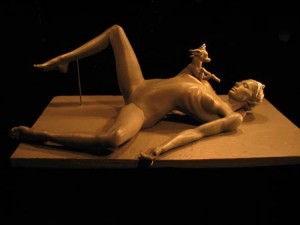 Hippolytos, the insufferable son of Theseus, was a celebutard of antiquity. In Euripides’ play, the dandy loves only two things: himself and the goddess Artemis. He’s even got an entourage to follow him around and tell him how great and pure he is. Yes, pure. He is untouched by woman, devoting himself exclusively to his chosen deity. The problem is, his chastity and vomit-inducing self-regard has pissed off Aphrodite, who takes his piss-poor attitude as an affront. Theseus is out of town, and Aphro believes the time of her revenge is at hand. Did I mention that Hippolytos’ stepmother is in forbidden love with her stepson? READ MORE >

The hands are holding the planet in space.
From BetterWorldBooks.com:
We’re breaking new ground in online bookselling. We believe that education and access to books are basic human rights. That’s why books sold on BetterWorldBooks.com help fund high-impact literacy projects in the United States and around the world.
All books are available with free shipping to any location within the United States (or $3.97 worldwide). And in case you’re concerned about your eco-footprint, every order is shipped carbon neutral with offsets from Carbonfund.org.
Here’s the best part: In addition to selling new titles, Better World Books supports book drives and collects used books and textbooks through a network of over 1,600 college campuses and partnerships with nearly 1,000 libraries nationwide. So far, the company has converted more than 11 million donated books into $4.5 million in funding for literacy and education. In the process, we’ve also diverted more than 6,000 tons of books from landfills.
That’s right. Free US shipping, cheap international shipping, new & used books, ecologically-conscious shipping, $$$ to charity, and they work with schools/libraries. Oh, and from a quick search of five books in my ToRead list, they have multiple copies of each.
Alright. What’s to like about Amazon anymore?

WO: I guess I don’t know where any information other than what I choose to provide on the records is really anybody’s business. That’s kinda it. I understand that doing interviews… Look, the record labels like that to happen, and I understand on some level why they like that to happen, because it provides some sort of eye-catching thing. It’s like some kind of advertising, for a minimum expenditure of energy and money. But to me, the best purpose of an interview would be to illuminate some things about how somebody works for the benefit of somebody else who wants to do those things. And that’s not where most interviews go at all, so to me, they seem like strange exercises in small talk and wasted air.
And printing credits… I think for those of us who make records, it’s our business how we put it together. Same with a book. You know, the publishing industry has somehow avoided having a light shone on their process. In a book, you basically have the name of the publisher and the name of the writer, and you’re led to believe that those are the two things that created this book. And you and I both know that’s not the case. There’s an army of people involved with the production of each book, most essentially the editor or editors who work closely with the writer on shaping and forming and developing a piece of work, plus the writer’s agent, blah blah blah. And yet somehow it doesn’t matter to us that all of that information is never publicly, readily available. Yet we want that on our records.
Here’s a nice, radical shift in the perspective of a story. There’s a guy trying to save a princess. The princess was kidnapped by a tyrant as part of his scheme to control a kingdom. The tyrant has minions. The minions stand between the guy and the princess. The guy is the natural focus of the narrative.
But in this video, a relatively minor character in what we might call the ur-narrative is instead the focus.
Is it as exciting as the traditional, Mario-focused way of telling the story? No, probably not. But it still has a kind of driving tension. You can HEAR Mario’s approach. You know the two goomba’s are done for, which adds a tension to the subtext of their mundane March Back and Forth, Bounce Off the Pipes and Each Other existence. Something sort of interesting is going on here.
So, for homework, write a story from the perspective of someone relatively minor to the story’s ur-narrative.
TANGENT:
According to Urban Dictionary, “goomba” is a slang term for Italian Americans. Cher used to call Sonny Bono a goombah. Being that Mario is a self-identifying Italian American, and Mario spends most of his time stomping on goombas, can we read Super Mario Bros. et al as an allegory for assimilating into a mass culture? Mario must stomp on his personal “goombas” to fit in and get the girl?
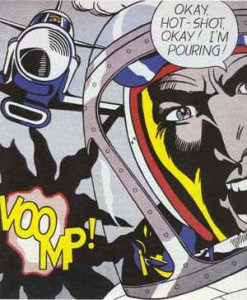
This is the second follow up to my “Let’s make a list,” art influences post. I asked Gabriel Blackwell to respond to these two prompts:
1) Pick one of the pieces you chose and describe the thing about it that seems particularly innovative about it.
2) Tell me what changed about your writing because of that innovation.
Here are his answers:
1) Roy Lichtenstein’s appropriation of Jack Kirby and Kirby-esque comic panels very nearly manages to carry us into the hip-hop age single-handedly. Yes, there are of course Duchamp, Warhol, and Lichtenstein’s other Pop Art contemporaries, but, for me at least, no one is quite so honest and unapologetic about the act of choice being the most important (so important that it can stand on its own) technique in the creation of art—and the subsequent ethic of recycling—as is Lichtenstein.
2) My mother and one of my older brothers are visual artists, and I was dragged—literally, by the arm—into a lot of museums and galleries as a kid. I probably hadn’t started writing yet, so I don’t think it would be fair to say that anything “changed” as a result. But I think that seeing Lichtenstein, in that context and at that age, permanently affected the way that I think of art—all art, including writing. The first story I can remember writing, when I was in 4th grade (so around the same time that my family and I went to MoMA and I first saw Lichtenstein’s appropriations), won first prize in my elementary school’s writing contest. A week later, the prize was stripped from me when it was discovered that I had lifted part of the premise of my story from Daniel Manus Pinkwater’s “Fat Men From Space.” I didn’t see anything wrong with it then, and I still don’t now.
ALSO:
Follow this link to Gabe’s blog and you’ll find a bit from a Paris Review interview with William Burroughs on cut-ups.

Super Flat Times, pg. 156, from ‘Instructions’
Before I lost my wife I had only ever hit one other person, and that was in junior high. His face is like a cotton swab in my memory now–he floats there in slow motion, holding a black book bag over his groin outside the locker room. It’s the Sesquicentennial and we’re getting out early to see the tall robots. I remember the scent of a person, the way it changes the air in a room. Louis Burney smelled like hair and lighter fluid–he came from the developments, where kids pissed out their territory and traveled in herds. I hit him in the gut–the reason isn’t so important anymore. The sound, though, is the thing. Like two sounds at once–and one of them is like the whole world just lifting up and folding over.

Is Adbusters the single most obnoxious magazine on the face of the earth? If their articles matched their headlines, and their execution matched their ethics, they’d be a valuable cultural resource, as well as a kickass read. I would be willing to bet that on a checklist of political positions and beliefs, Adbusters and I would agree about 98% of the time. It’s not their politics I object to. It’s their holier-than-everything-all-the-time posturing, combined with the fact that their articles read like the diary entries of intelligent but under-achieving 8th graders. Also, their high-gloss “I went to design school but I’m still punkasfuck aren’t I please tell me I am oh tell me please” aesthetics. It’s Disneypunk, and I just can’t figure out how the people who produce it live with themselves, or why they don’t use all their energy to do something useful for the causes they champion, instead of striving to be the vapid polyanna incitement-jockeys of the blinders-on knees-jerking nobody-likes-you-and-there’s-a-good-reason-for-that Left.
When Tao lived here he had a free subscription, I think because he was in it once, and the issues still show up. I usually just let them pass me by, but I flipped through the most recent one because there was a cover story about the ubiquity of what we’ll call porno-culture, and I thought that might be worth reading (it’s also online). Boy was I ever wrong. See if you can get through the whole thing. I’ll wait here…
 As you may already know, this summer I’ll be traveling to Russia for a week. Because of that trip, I decided to read as much Russian literature as I could. I even blogged about my plans over at Conversational Reading. But so far, I haven’t read much; it’s taken me longer than I expected just to get through Dostoyevsky’s Notes from the Underground, The Idiot, and The Brothers Karamazov. What follows are some brief thoughts (perhaps too personal?) about Notes; look out for more posts on the next few books. Read on if you’re interested.