Reviews

WAKEFIELD PRESS REVIEW: THE YOUNG GIRL’S HANDBOOK OF GOOD MANNERS

wakefieldhorizon

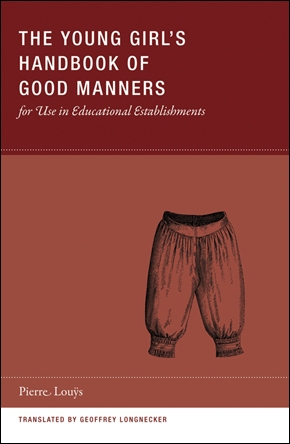
louyscover4aThe Young Girl’s Handbook of Good Manners for Use in Educational Establishments
by Pierre Louÿs, translated by Geoffrey Longnecker
Wakefield Press, March 2010
80 pp. / $12.95 Buy from Wakefield Press

The first time I ever heard of Pierre Louÿs was when I read Susan Sontag’s essay, “The Pornographic Imagination.” In it, among other things, she posits five works of literature that bridge the gap between pornography & erotic, expanding into very Literary territory. Louÿs’s book was the only I hadn’t read. I tracked it down–it’s title The She-Devils–and was sorely disappointed in the translation. Despite this, I had still enjoyed the narrative, and filed the name in the back of my head to keep at bay in my never-ending path through erotic literature.

Years later, Louÿs’s name came up again–but this time as a correspondent of Mallarmé. It might strike some as strange that Mallarmé–who has probably garnered as many stuffy academic essays as God himself (though I prefer the former far more than the latter, let it be said)–chafed elbows, so to speak, with a man whose primary literary concerns were pedophilia, scatology, and whores. Louÿs was a part of the vaguely shaped Symbolist movement in France as the 19th century slipped into the 20th, immediately following the Fin de Siecle ‘movement’ that had shown artists and writers that certain ideas were now available subjects. Baudelaire was a major influence on the symbolists, as was Edgar Allen Poe.

Louÿs is most often considered a novelist, but the brilliant Young Girl’s Handbook of Good Manners instead takes the form of a satirical handbook–lampooning school guides to “good manners” and instead positing sixty pages of sexual advice, tongue planted firmly in cheek. It could perhaps be considered that this could become, shall we say, boring, or perhaps overdone, but Louÿs is a master parodist, in addition to being a damn good writer, so the laughs just keep coming.

I’m not one for humor unless it’s delivered via a sort of combination of hyperbole, absurdity, and base-ness, which the Handbook delivers in spades. The aphoristic fragments are all structured under headings, such as “Games and Recreations” (“Never masturbate a young man by the window. You never know on whom it might fall.”), “At the Ball” (“If you cum while waltzing, say so softly; don’t shout it out.”), and even a special column, “On Losing Your Virginity.”

There is no narrative thread, only a bawdy romp to be followed, with aphorism after aphorism delving into a perversely juvenile mind. There’s a total jouissance present in many of the acts which Louÿs implores ones not to do, and this set-up provides the idea that young girls are performing these acts with regularity (and who knows–perhaps they are; I was never a young girl).

– – – – – – – – – – – – –

Former WAKEFIELD PRESS reviews:
TREATISE ON ELEGANT LIVING by Honoré de Balzac
3 Comments
August 15th, 2013 / 11:06 pm

“Besides: to learn to use her mind’s energy against itself, she would have to add new content. Even if it was content that might eventually ease the burden of having content, at this point, she is so overwhelmed with the content she already has, she thinks she cannot take on any new content even if it’s promised that the new content will help her.” — from Evelyn Hampton’s “The End of Content” over at The Collagist; no one does clever and sad at the same time like Evelyn Hampton

An Interview with Roy Kesey

Roy Kesey, whose most recent book is the collection of short stories Any Deadly Thing, recently spent some time talking with me about his writing. Kesey is also the author of Pacazo, one of my favorite novels of 2011, All Over, another collection, and Nothing in the World, a beautiful novella.

I suggest listening to/watching this thing up to the 40:30 point, at which point I would rather you closed the tab and forgot all about it. Our connection died at this point, but what it looked like from my perspective was Roy staring at me in utter bewilderment for several minutes straight, which was kind of awkward. I would edit it out and put a proper ending on it if i could! But I can’t.

Regardless, Roy says some very smart, useful stuff, and I had a great time talking to him. You should buy all his books.

I Like __ A Lot & Massive People / 7 Comments
August 15th, 2013 / 2:29 pm

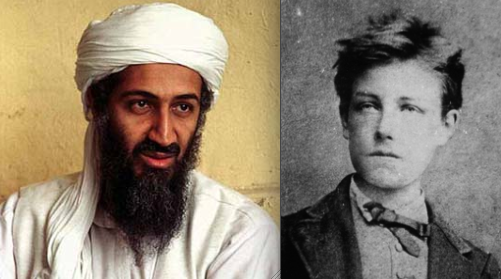
Some Similarities Between Osama bin Laden and Arthur Rimbaud

Picture 1

There is a boy who has captured a considerable amount of my heed lately, and that boy is called Osama bin Laden (or, if you’re in the CIA, UBL). Obviously, I, along with the rest of the world, was aware of this boy for quite a while. But it wasn’t until one of the most disgusting days in recent history (that is, the day when the Supreme Court repealed formidable features of DOMA) that I began to discern the details of his origins; for, on that disgusting day, girl-boy Judith Butler told me that Osama, by residing in the Middle East, was surrounded by ungreivable lives — lives that could be erased and encroached upon without any kind of fuss because they already “inhabit a lost and destroyed zone.”

The devil-may-care attitude affixed to Osama’s homeland and peoples made him murderously upset. After some further investigation, I found that Osama’s consternation correlated to that of Arthur Rimbaud’s. In the late 19th century, Arthur declared war on the Western world with his poem “What Do We Care, My Heart.” He wanted America to “vanish!” He screamed: “Power, Justice, History, fall!” A century later, Osama, too, declared war against the advance, civilized nations, telling them (though, really, just America): “You are not unaware of the injustice, repression, and aggression that have befallen Muslims through the alliance of Jews, Christians, and their agents, so much so that Muslims blood has become the cheapest blood and their money and wealth are plundered by enemies.”

Uh-huh, both of these boys have bellicose bones to pick with, what Judith Butler describes as, secular modern states. The traits these countries confer upon their subjects — ones that make their lives grievable — violently appall Arthur and Osama, as Arthur and Osama exhibit an affinity for behaviors that don’t comply with those of normative Western humans. What follows are a few of the ways in which both Arthur and Osama contrast with humans from democratic, Capitalistic societies.
READ MORE >

Author Spotlight / 3 Comments
August 15th, 2013 / 1:55 pm

Reviews

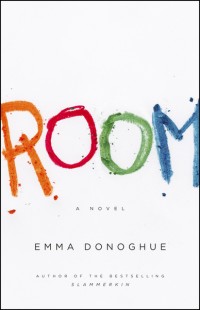
25 Points: Room

room-by-emma-donoghueRoom
by Emma Donoghue
Little, Brown, 2012
384 pages / $7.99 buy from Amazon


1. Not many authors could write believably from a child’s point of view and still provide such credibility and license to the narrator. That’s what you need to know most readily to begin this book.

2. Concepts like “TV People” and rain being nothing more than a blurry veil over Skylight–a saddening slap in the face realization for readers that this is really happening.

3. It is striking, the “savant” nature of the little boy – how he can be so well-educated with so few resources, and yet so ill-informed on social protocol and other “real world” mechanisms. It could be argued, though, that he is in many ways better off than a “normal” child.

4. This reviewer recommends reading this book aloud or obtaining an audio copy. Hearing the dialogue between the mother, the child, and Old Nick is especially gripping.

5. It is an incredible struggle not to be angry with Grandma. Grandma’s love for Ma exists but does not inspire.

6. The poem excerpt at the beginning. Yes.

7. The way the child refers to inanimate nouns as personified, proper-nouned entities provides reality to the voice of the child narrator, but also speaks to the attachment any human would have to inanimate things in a situation such as “Room” describes. It’s a very subtle way to calcify the experience for readers.

8. Page 67, “Princess Diana” “Should have worn her seat belt” — one of the funniest sidesteps in conversation throughout the novel, albeit cryptic.

9. The experience of the Indian family and their dog finding Jack in the park elicits severe, literal nausea. For the first time, picturing Jack outside of Room and experiencing what he must look like up next to other humans, other children – pure nausea.

10. There is a distinct failure to understand that radiates through the hospital. As such, the reader will experience a certain kind of rage and a certain kind of advocacy for Ma and Jack. On Donoghue’s merit, this is a great mechanism for roping readers in more tightly, On the other hand, the injustice provokes readers to consider how often and to what degree these situations are marred by “professionals” in our nonfiction world. READ MORE >

2 Comments
August 15th, 2013 / 12:06 pm

SEVEN BOOKS I HAVE ACQUIRED THROUGH CASUAL SEX

Recently, [1] I grabbed dinner with a friend of mine from when I worked in the financial services industry. To me, that seems like a lifetime ago but it is actually equivalent to only a couple of–amazing!–years. His name is Kevin and we mostly talked about books we like and why we like them as we shared dinner at an overhyped restaurant in the LES, called “Mission Chinese.”  [2]

In this friend-session we also talked about the act of underlining in books, an act in which I engage in fiendishly and sometimes manically, as well as how the things we underline are topically representative of ourselves. The things that speak to us at a set moment in time usually encapsulate how we view the world at that point in our lives. [3]

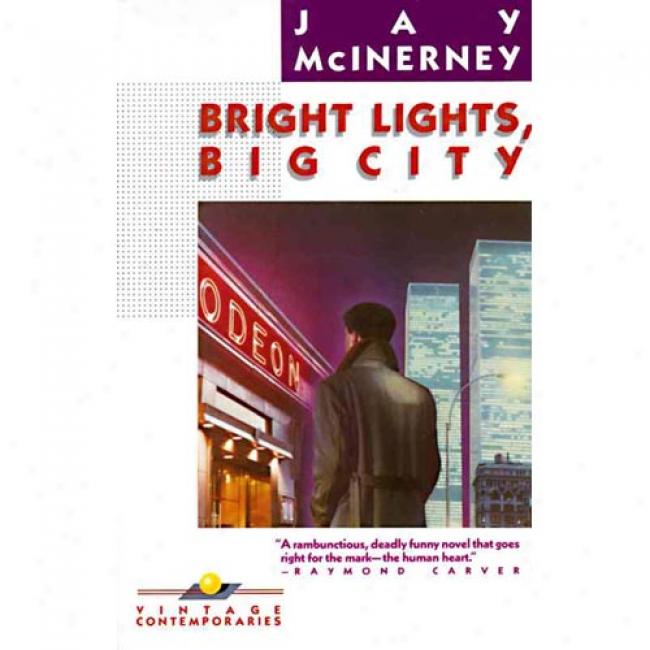
Following dinner we walked around and it was pleasant. The weather was at the precise intersection of where one is warm enough to be horny and cold enough to crave cuddling. The last person I have been horny and cuddly with recently received an email including my question: ‘Do you happen to have my copy of Bright Lights, Big City?’ The inquiry remains unanswered, but it is highly likely I might have previously clarified I never want any answers–and certainly no questions–from that recipient. I am glad I gave this book, because whatever, there are always 50 copies of it at all the used bookstores I go to and it is almost as easily replaceable as the good Bret Easton Ellis ones. However, I don’t actually plan on replacing it anytime soon; I did enjoy reading it when I did but I am not feeling a void since realizing it has been gone.

url

The person I was when Kevin first got to know me is still a part of me, but when he knew me I was underlined very differently. For example, I used to go to a funny place that is no longer in existence, which we can call “Not The Beatrice.” I used to go there with a friend of mine I no longer remember,  [4]  and we used to spend a ridiculous amount of time (and money) in the bathrooms, because it was that era of our lives. During a winter night there was a beautiful girl that pointed at me and complimented my coat. Claire had an expensive eye–because my coat was Dior Homme and it was tailored to fit me expensively–but she also spoke British and asked to do coke. I had none, but others did and when “Not The Beatrice” closed much after the hour all other places closed we ended up in a Soho apartment that was way too nice and full of everything Claire could ever want. My nightlife friend kept falling asleep, but I was awake and so was Claire so then we let everyone sleep and did things mostly with our hands. [5]

44526_1392739945774_4166312_n

READ MORE >

Random / 5 Comments
August 15th, 2013 / 12:37 am

Sidebrow is reading! Send in your manuscripts of prose, poetry, cross-genre, and collaborative work from now until Sept 15. Details here.

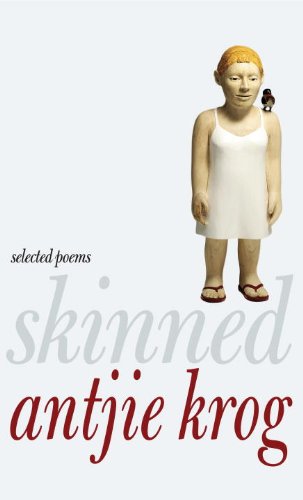
Skinned: An Interview With Antjie Krog

antjie krog skinnedjpg

Skinned

*****

One of South Africa’s foremost contemporary poets, Antjie Krog has been described as the “Pablo Neruda of Afrikaans.” I stumbled on Antjie Krog’s work several years ago and was rewarded with the strange, passionate, tough and well-organized verses of Body Bereft (which contains, among other work, her strange and fiery Menopausal Sonnets). So, I was excited when, earlier this year, a Selected poems of Antjie Krog, Skinned, released from Seven Stories Press.

*****

And here, then, is the transcript of an email interview I did with South African poet Antjie Krog that touches on those Menopausal Sonnets, South African Politics, Afrikaans, Indigenous Literature Translations, etc, etc:

Antjie Krog (29)

Antjie Krog

*****

Rauan: Many of the readers of this blog will be drawn to “Menopausal Sonnets” and other examples of frank, fiery and often crude writings about the changing (and failing) female body. In your Author’s Note you mention that “Skinned” contains “traces” of certain foreign writers, including Sharon Olds and Carolyn Forché. And it seems to me, besides, that you are naturally a fiery, direct and spicy personality. (How right and/or wrong am I?)

And can you elaborate on what, inside and outside, brought you to write such direct and sometimes graphic poems containing bits like

…you grab this death like a runt and plough its nose
right through your fleeced and drybaked cunt.

and

……the waist thickens and
the vagina wall thins and the colon crashes
through its own arse. how dare her toe
nails grow so riotous then…

Antjie: Poetry has taught me how to live. Everything of value I have found there. For me it therefore ought to be able to encompass one’s whole life. I am very aware what male poets have decided the Main Themes of Literature should be: Love, Death, God, Nature and War. This is fine, but it should also say menstruation, menopause and grandmother, READ MORE >

Author Spotlight & Random / 6 Comments
August 13th, 2013 / 8:04 pm

Reading what’s extraneous

Drive-Only-God-Fogives

Last week at Big Other, Paul Kincaid put up a brief but intriguing post in which he asks to what extent various factors surrounding a text influence the way we think about it or its author. He gives the following example:

The program I use for databasing my library pulls down information from a wide variety of sources ranging from the British Library and the Library of Congress to Amazon. More often than not, this can produce some very strange results. I have, for instance, seen novels by Iain Banks categorized as ‘Food and Health’, and novels by Ursula K. Le Guin categorized as ‘Business’. In all probability, these are just slips by somebody bored, though you do wonder what it was about the books per se that led to such curious mistakes.

Paul’s musings raise many interesting questions. For one thing, we might wonder whether the factors he’s describing are indeed extraneous or external to texts. Because I can imagine a good post-structuralist immediately objecting that texts more porous than that, and that it’s all just a sea of endless texts slipping fluidly into one another.

Me, I don’t have a problem with treating texts as discrete and coherent entities, but I admit the situation is complicated.

READ MORE >

Behind the Scenes & Presses / 15 Comments
August 13th, 2013 / 4:10 pm

Every day that I don’t give up writing completely feels amazing

I’m not one of those people who feels the need to write all the time, as you may have guessed, from reading my other shit on this website.

I frequently turn over the possibility of permanently ceasing all writing outside of my job. It’s not unusual. I think other contributors have mentioned this impulse. I’ve considered announcing this in some kind of horrifically boring final post. It’s obviously not a palatable idea, because who gives a shit? Certainly not someone similar myself, the self-audience, who is probably too lazy to every submit a single piece of writing to micro-press, let alone establish a relationship with an agent or editor. It doesn’t fit with the frozen vibe. I don’t fear rejection at all. I fear wasting people’s time. I fear over-sharing. I fear talking to an empty room.

Th end of publishing is kind of like a party thrown by a really unpopular kid.

READ MORE >

Craft Notes / 5 Comments
August 13th, 2013 / 1:35 pm