We had one semester to make a game.
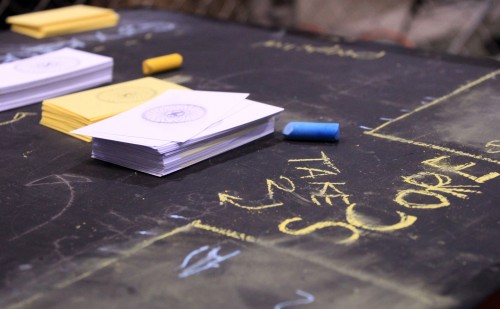
The class was through the California Institute of the Arts’ Integrated Media department, which styles itself a meeting ground for complimentary métiers. It met each Monday morning in the school’s chilly bowels for a scant two hours – just enough time to write something on a chalk board, high-five or disagree, and then not see each other for a week. It’s a wonder we made anything at all, let alone debuted a prototype at a crowded convention called the Maker Faire three hundred miles north. What we brought is not what we intended – a partially miscarried hybrid of real and vestigial features – but game development, like any collaborative undertaking, isn’t a straight shot.
Our group was nigh-ideal: five graduate students and one talented BFA, no one from the same background. There was a programmer, a theater set designer, two breeds of visual artist, an ambient musician, and myself – the writer. Previous groups had gone the techy route, rigging RC cars with baby monitors, but we wanted to straddle multiple media – to build a game that played in physical spaces, drew from digital content, and answered to verbal interaction. By the end of our first class we had a draft.
“I’ve never seen a game come together so quickly!” the class’ instructor announced. “It’ll be great at the Maker Faire.”
That’s the thing, though – you can chart a voyage to the moon, but landing on the surface is another thing entirely. High-concept ambitions are irrelevant until you see them through.
Our design on paper was a monster, something you would murder if you found it in a lab. The hulking Franken-game included real-world installations, app-based digital avatars, RPG-esque progression, and heavy narrative content.
Sounds rad, right? Proposals often do.
 Monika Fagerholm’s novel Diva: It’s a novel about this girl Diva who does some crazy stuff, but it’s also about a whole cast of characters, such as TruthMary and her sister Kari. Kari loses the ability to speak so she tries to re-learn it by listening to recordings of herself saying basic sentences, which Diva hears through the wall (they’re neighbors). And her hair grows really long so she lets it out and the neighborhood boys climb up on it. Years later Kari lights herself on fire in a telephone booth. The book is written in this incredibly cyclical style, where the same story gets told over and over, slowly revealing more and more details. I don’t think this book has been translated, but some of her more comprehensible books have been translated:




 Boxing the Compass