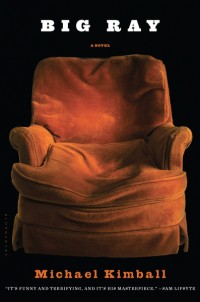
 Big Ray
by Michael Kimball
Bloomsbury USA, 2012
192 pages / $23.00 buy from Amazon
1. Big Ray blends genre between flash fiction and novel.
2. Each chapter within the work is told in first person confessional episodic moments, which read as a short flash fiction piece which could be read on its own as a complete story.
3. Each of the flash sections rarely surpass 200 words, though the sizes ebb and flow throughout.
4. Kimball heightens intensity by elongating the more anxiety-ridden sections of the book and in parallel compresses the sections which give appropriate if not beautifully told anecdotal backstory. In doing so, Kimball is showing his expertise as the mark of his incredible ability to craft story.
5. Michael Kimball is one of the nicest guys as a person in “the business.” Also, he can write. Dude can write.
6. Kimball is opening the reader to a complicated familial past quickly.
7. We are witness to Big Ray’s past and the way in which his ether has an everlasting effect on our narrator. As our narrator walks between Big Ray’s passing and their intertwined past as father and son Kimball provides us with generously rendered unfolding history, and in doing so, illuminates a thick, vastly layered novel which reads painfully, slowly, like ice melting in the most profound way possible.
8. “It makes him look as if he’s about to do some damage.”
9. Heartbreakingly, there is a kindness at work, a tongue in cheek commentary about the ways in which people, motivated by their own intentions, are terrible to one another, observe:
“Here’s what happened: After high school, my father went into the Marines and my mother went to college. My father lived in the barracks with dozens of other men and my mother moved into an apartment with a roommate who she didn’t know particularly well. To fill in the space between them, my mother and my father wrote letters to each other for months.
Then, without any explanation, my mother stopped receiving my father’s letters. Not long after that, my mother stopped writing letters to my father. Neither one of them knew what had happened. They both waited for months, thinking the other one had stopped writing.
What my mother didn’t know was that my father was still writing her letters. What my father didn’t know was that my mother wasn’t receiving the letters. This was because my mother’s roommate would come home to the apartment at lunch and steal my father’s letters.”
10. A part of the pain our narrator endures is a sense of trying to explain this narrative to himself. Which, is brilliant in that Kimball writes a guy who walks the line between reliable narrator and human being. He wants love, attention, appreciation, but imposed a sense of failure on himself, which leads to resentment and anguish again. What Kimball can do is paint, for any person, the pain felt in never really connecting with a parent, yet simultaneously connecting with a parent by default.
“My father’s life was an ordinary one in so many ways. I wonder if I am making him into something more than he was because he was my father.” READ MORE >

 Boston Noir 2: The Classics


 famously told viewers, “Don’t ask what the work is. Rather, see what the work does.”