Like many of us, I’ve read “On Writing” by Raymond Carver numerous times. It holds many useful ideas. There is a stage of our own creative writing. (I believe this phase usually arrives in the mid-20s, but possibly I am in error—perhaps it arrives after so many years of practicing the craft, not so much a writer’s age.) Either way, this stage involves reading copious interviews, craft books, and essays on writing, by writers. Apparently, as writers, were are seeking some golden ticket, some integral advice, etc. I believe most writers leave this period, and then, you know, write.
What is the most famous (or infamous) line from the Carver essay? No tricks.
“No tricks.” He says. “Period. I hate tricks.”
First, I like tricks. So what? Others have written the same. Second, Carver is wrong. He doesn’t hate tricks, he uses them. He especially employs tricks in the shorter form. Why? Because “tricks” are not tricks. Tricks are technique. Technique is important to the short story, very important to the sudden fiction, and absolutely essential to the flash fiction form. We flash writers have fewer words. We need artistry.
Let me show you Raymond Carver using some tricks. Read “Little Things” here.
OK, onward.
READ MORE >

My wife and I flew into Atlanta.
We were told we had a driver waiting for us by Mackie Wallace who, no shit, signed out on the bottom of our travel itinerary email with Executive Chief of Staff, and so we entered the baggage claim expecting a dude in a white and black suit, holding a paper sign. Instead, we saw pink.
At first, it scared the shit out of me—is this the same guy from the premiere? I stared at him, saw his sign (Mr and Mrss Baumann, misspellings as is), and really tried to figure out if it was the same guy. No. They both had a rough air, kind of dirty. But this gentleman had recently shaven, was a bit shorter. And he looked four thousand times more nervous. He stuttered out a hello, and escorted us outside to the temporary parking. I noticed the guy was wearing leather loafers with a hole near his right big toe when Aviva said, “Whoa.” A white on white on white Bentley—white paint, white leather interior, white rims. I like cars, but I felt totally inadequate for this sort of coach, especially considering that I am not Prince. READ MORE >
Random / 7 Comments
October 2nd, 2012 / 9:42 am
 Chris Toll, author of several books including The Pilgrim’s Process, Love Everyone, Be Light, The Disinformation Phase and the soon-to-be released Life On Earth, died on Thursday of natural causes. It was unexpected and unbelievable and too soon.
Chris was a poet and collage-maker. He lived in Baltimore, where he was an integral part of the literature scene. I invited people to send me their memories, which I’ve compiled here. Hopefully people will feel free to add more in the comments. READ MORE >
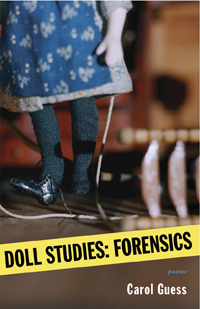 Doll Studies: Forensics
by Carol Guess
Black Lawrence Press, 2012.
84 pages / $14 Buy from Black Lawrence Press or SPD
At the National Gallery in London, there is a ‘peepshow’ that allows one to peer into a miniature 17th century Dutch household. Made by Samuel van Hoogstraten in the 17th century, and appropriately titled A Peepshow with Views of the Interior of a Dutch House, it is a small box that looks rather plain on the outside, but has been intricately painted inside to reveal a private domestic scene. There are two holes in opposite sides of the box, through which viewers are invited to take a peek. Though nothing out of the ordinary seems to be happening inside, the peepholes create a sense of the illicit; the viewer becomes a voyeur, examining the intimate space of strangers.
The surreal and smart prose poems in Carol Guess’s newest collection function in part as sensational Dutch peepshows, and in part as feminist meditations on the aesthetics of violence. Doll Studies: Forensics takes for its subject eighteen dioramas built by forensic pathologist Frances Glessner Lee. Based on real crime scenes, Lee’s dioramas were used as tools in the study of crime scene investigation during the 1940s and 50s. The majority of Lee’s dioramas depict scenes in which women are victims of domestic violence, so the dioramas are ripe with opportunity for feminist discourse.
READ MORE >
Comments Off on The Feminist Peep Show
October 1st, 2012 / 12:00 pm
Williamsburg Creatives Roundtable Showcase RAW AND UNCUT from Erik Stinson on Vimeo.
A rooftop near a new condo development was the perfect place to showcase some young creatives just settling into the perfect artistic mood of New York City in 2012. There were some questions. The deepness of creativity was tested. The problem of wealth and power was close to the surface. Love was in the air.
Vicarious MFA / Comments Off on Supportive Creative Environments and The Pop Art of Exclusion
October 1st, 2012 / 11:04 am
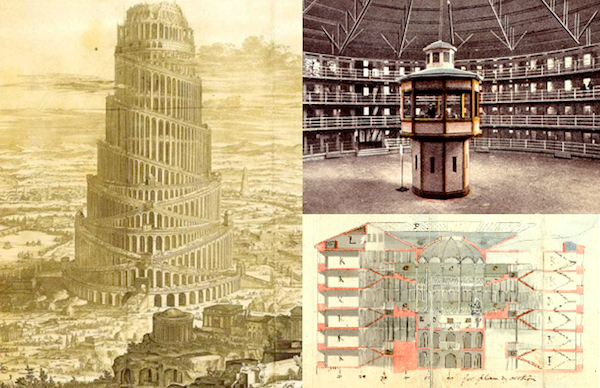
“Go to, let us go down, and there confound their language, that they may not understand one another’s speech,” says the ticked off voice from above in the Book of Genesis (11:7) — though modern versions prefer confuse to confound, retroactively auspicious, since Babel sounds like the revised “confuse” (bālal) in Hebrew — thereby scattering our tongues into various, um, babbles, from the harshest Cantonese, bluntest Ebonics, to the always DTF-French. Regarding the etymology of babble, “no direct connection with Babel can be traced; though association with that may have affected the senses,” attests the Oxford English Dictionary. Near bizarrely, the original English word for babble was babeln (c. mid-13th century), that helpful -n a kiss away from Babylon, just for funnies, where this all supposedly took place, meaning “gateway to God.” Early 19th century philosopher Jeremy Bentham conceives the Panopticon, an institutional building (usually prison, though also applicable to hospitals, daycare, etc.) in which authorities at an omniscient center have a 360° view of the entire perimeter. Mr. metaphor Foucault (in Discipline and Punishment, 1975) is moved by the idea of “permanent visibility,” a form of power whose construct was more imperative than its actually being possible: the prison guards, while having access to the sweeping perimeter could only look at one area at a time, their backs turned to everything else. The habitual possibility of being watched was just as effective as actually being watched. Hence, religion as security cam.
READ MORE >
Random / 4 Comments
September 30th, 2012 / 1:10 am
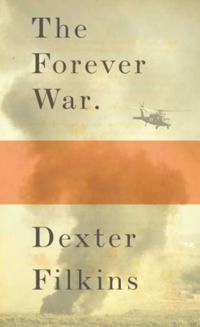 The Forever War
by Dexter Filkin
Knopf, 2008 / Vintage reprint 2009
384 pages / Buy 1st edition from Amazon ($25); Buy Reprint edition from Amazon ($15.95)
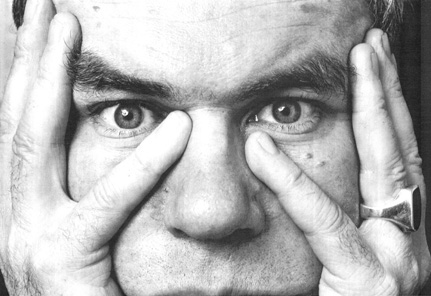
The Forever War, by Dexter Filkins. Nonfiction—investigative journalism. A journalist’s stories from Afghanistan and Iraq. Highly violent and disturbing, filled with bizarre wartime details, reminiscent of Apocalypse Now, conveying at times the hallucinogenic weirdness of wartime events (for example, the story “Blonde,” in which an American army platoon displays one of their female soldiers and announces that she is “for sale,” as a distraction to the Iraqi males in a village, thereby allowing the unit to search the Iraqis’ homes without encountering resistance). Obviously not a cheerful book. Just look at the author photo.
The book opens with a prologue entitled “Hells Bells,” describing the 2004 assault on Fallujah from the footsoldier’s perspective in terms that are not mournful but grimly exuberant—just like the heavy metal rock song “Hells Bells” (by AC/DC), which is playing from loudspeakers during the attack. We witness combat as a lethal game of tackle football, in which the marines and the journalist sprint downfield, dive for cover, bullets whip past, and a “jihadi’s head bursts like a tomato.”
READ MORE >
8 Comments
September 28th, 2012 / 12:00 pm