 Always late to the game, I didn’t learn about the term flâneur until I was in grad school, which is probably a good thing. See: I grew up in Texas. Texas is not a place for strolling, or at least San Antonio is not a place for strolling. It’s hot and everything is spread too far to make walking comfortable. Texas is a place for sitting, not walking, not moving.
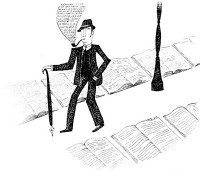
Baudelaire conceptualized a flâneur as someone who walks or strolls in order to experience his surroundings.
So for most of my life, I’ve been a sitter. Never the athletic type, I’d rather sit than sweat. But when I learned about the flâneur, I’ve wanted to modify myself to fit that romantic notion—Baudelaire: the romantic—of a person who absorbs and experiences through the act of walking. I wanted to want that (because I didn’t actually want it: I’d rather sit than move, still), but through time, I’ve trained myself out of my Texan laze. Now, I bike and walk, I strive to understand the world at a slower pace.
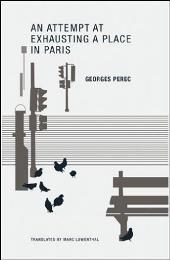 But then, but then, I learned about Georges Perec’s newest translation, At Attempt at Exhausting a Place in Paris. After years of training myself to want to walk, Perec gives me a reason to sit. In An Attempt, Perec provides a “sociological survey” of the infraordinary, which roughly translates as what happens when nothing happens. Over a period of three days, Perec watches a square in Paris, Place Saint-Sulpice, shifting locations periodically from café window to café window to park bench. By sitting (as opposed to walking or moving), he notes the birds, the weather, the passing of cars and buses, people walking and people sitting, people eating and how they eat, which hand they use or do not use, Georges Perec is charming, the most charming man I will never meet, and An Attempt is yet another charming example of his charm.
To read Perec is, in many ways, to be magicked away. His focus on detail, lists and lists, whether the items on his desk or the way of categorizing books (examples of his non-fiction from Species of Space), rather than exhaust the reader, excites. It seems illogical, that the minutia of the banal could be magical or charming, but such is Perec’s special charm.
READ MORE >