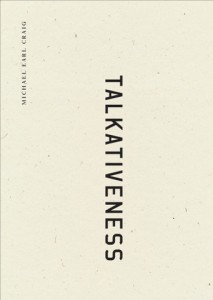
 Talkativeness
by Michael Earl Craig
Wave Books, April 2014
104 pages / Buy from Wave Books or Amazon
Without relying on the word “reticence” to describe the work, I would have to say that the poems throughout the collection feel withdrawn, taciturn, almost. Lurking in each one, though, is a sense of something boiling, some untapped resource, and these poems, these are the spill-over that the speaker couldn’t keep from bubbling out, like pasta water before you put the wooden spoon on the pot to keep everything calm.
The poems have in them and around them the sense of a Williamsonian take on “no idea but in things,” but they sound and read like early Williams, not Patterson Williams. The problem, if we can call this a problem, which I do not necessarily think it is, comes from how the music of the poems appear. Because the poet chooses to state the thing and not the idea, not the flourish or the afterthought, the thing itself yields only what it can yield:
I wear a light brown suit.
When I come upon you I grope you
for what seems like ten minutes.
As you have noticed.
— from “Sleepwalking through the Mekong”
and
struggling with his bags puts
his ass against my head for what
(corduroys) feels like a full
minute.
— from “What Will I Call This Poem”
Two things to note, here: first thing is that, because of his reliance on the pedestrian language, on the language of the thing and the action itself, it requires a certain precision, a boldness, even, to not inflate the action or the thing, but let the thing and the action remain what they are. This isn’t a poet hiding behind his pen. This is a poet incredibly stark and revealed to us, which allows the second realization to occur: He’s funny. That small twist of, “As you have noticed,” sounds remarkably like the joke in “This Is Just To Say,” that, yes, she probably noticed the ten minute night-groping session. Same goes for the parenthetical “(corduroys),” because it’s placed exactly where it should occur to make the joke work.
When you’re working with the onliness (to invent a word) of the thing and the action, it requires great skill to know how to place it where it should belong, to actually get more out of it than what it seems to present.


 Forest of Fortune